Commercial epoxy flooring cost runs $7.00 to $17.50 per sq ft installed in the City of Tulsa’s October 2024 bid: $7.00 to $8.50 for a 30 mil roll coat and $14.50 to $17.50 for moisture-tolerant urethane cement hybrids.
Key takeaways
- The City of Tulsa bid summary for IFB 25-809, opened October 3, 2024, priced a 30 mil three-coat epoxy and urethane floor at $7.00 per sq ft on footprints over 2,000 sq ft and $8.50 per sq ft on 250 to 2,000 sq ft.
- Thickness moved price first: the same bid priced a 3/16 inch anti-skid epoxy mortar at $9.80 per sq ft on large footprints, 40 percent above the 30 mil system.
- A damp slab is the costliest surprise. Federal guide specification UFGS 09 67 23.13 lets a standard resinous floor go down only at 3 lb of moisture per 1,000 sq ft per 24 hours (ASTM F1869) or 75 percent relative humidity (ASTM F2170); Tulsa’s moisture-tolerant build cost $7.50 per sq ft more than its 30 mil build.
- Removing an old coating added $1.50 per sq ft for 30 mils or less, $3.50 for 1/8 inch and $6.00 for 1/4 inch or more in the 2024 Tulsa bid.
- Five federal awards with stated areas ran $6.23 to $41.47 per sq ft; the highest was a 633 sq ft Smithsonian flake floor in 2020, the lowest an 8,000 sq ft Army storage floor in 2021.
- Same spec, same bidder: between the October 2021 Tulsa bid and 2024, the 30 mil price held at $7.00 while the urethane cement hybrid rose 27.8 percent, from $11.35 to $14.50 per sq ft.
How much does commercial epoxy flooring cost per square foot?
Commercial epoxy flooring cost $7.00 to $17.50 per sq ft installed in the City of Tulsa’s 2024 annual bid, which priced four named systems with mobilization, labor and materials included. The 30 mil roll coat was the cheapest line, a 3/16 inch epoxy mortar sat in the middle, and two urethane cement hybrids built for damp slabs cost the most.
The Tulsa Water and Sewer Department issued IFB 25-809 on September 9, 2024. Section II spells out every coat in mils (1 mil is 0.001 inch) and names one resin maker’s products for each layer, so the unit prices compare like for like. The city asked for prices on an estimated 2,000 sq ft of small jobs and 4,000 sq ft of large jobs per year, with a 12 month warranty on finished work. One firm bid.
| Tulsa line (IFB 25-809) | Build as specified | Total thickness | 250 to 2,000 sq ft | Over 2,000 sq ft | Same line, Oct 2021 (same bidder, large) | Source |
|---|---|---|---|---|---|---|
| Option 1, roll coat | 10 mil epoxy primer, 16 mil epoxy base, 4 mil urethane finish | 30 mils | $8.50 | $7.00 | $7.00 | Tulsa 2024 tab |
| Option 2, anti-skid mortar | 3/16 in epoxy base, 20 mil epoxy finish | About 208 mils | $11.00 | $9.80 | $9.53 | IFB pp. 3 to 4 |
| Option 3, moisture tolerant, textured | 1/8 in urethane cement with sand broadcast, 16 mil and 20 mil epoxy grout coats, 4 mil urethane finish | 3/16 in nominal | $16.00 | $14.50 | $11.35 | IFB p. 4 |
| Option 4, moisture tolerant, decorative | Same build with chip or quartz broadcast | 3/16 in nominal | $17.50 | $16.00 | $13.30 | IFB p. 4 |
| Remove existing flooring | Per sq ft removed | n/a | $1.50 | $1.50 | $1.00 | Tulsa 2024 tab |
| Remove coating, 30 mils or less | Per sq ft removed | n/a | $1.50 | $1.50 | $1.00 | Tulsa 2024 tab |
| Remove coating, 1/8 in | Per sq ft removed | n/a | $3.50 | $3.50 | $2.50 | Tulsa 2024 tab |
| Remove coating, 1/4 in or more | Per sq ft removed | n/a | $6.00 | $6.00 | $4.50 | Tulsa 2024 tab |
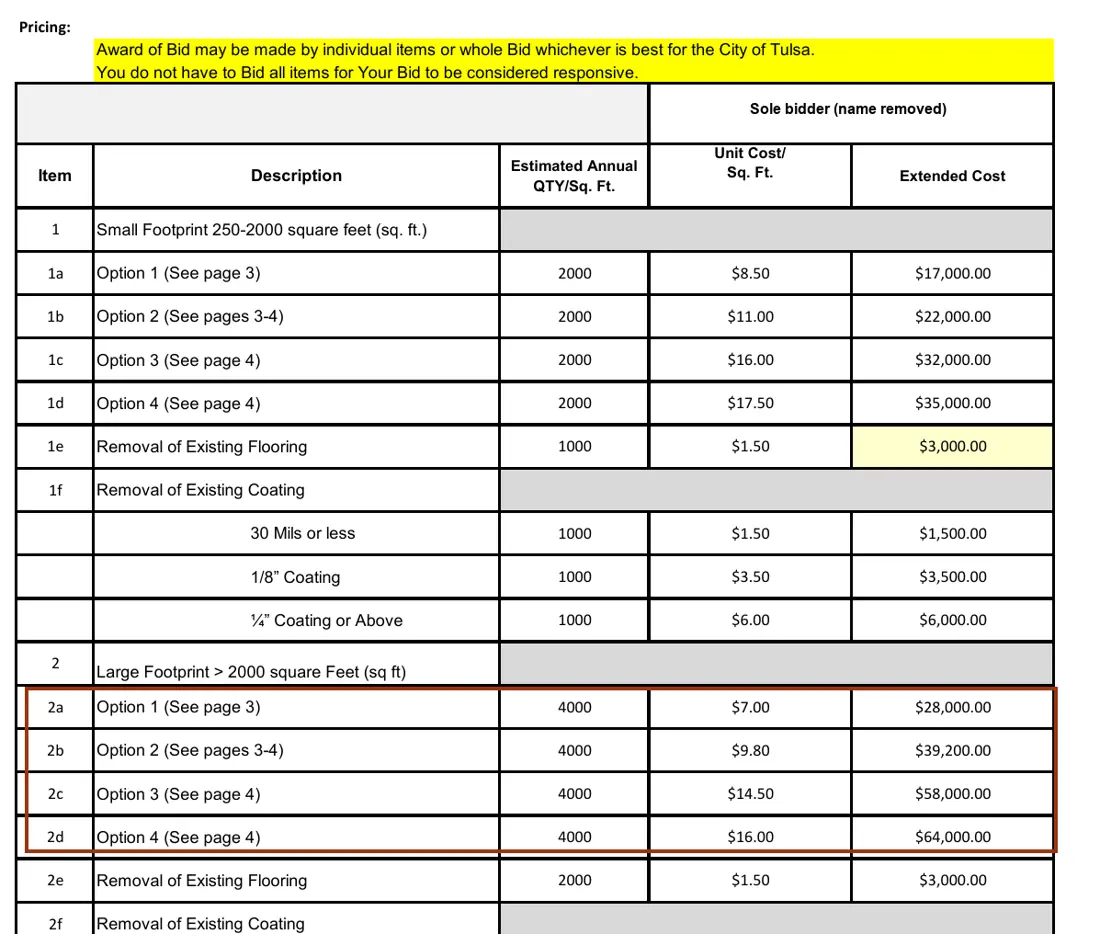
The October 2021 version, IFB 22-908, used the same four option texts. A second 2021 bidder quoted $4.50 to $9.50 per sq ft with no size break, and priced the 3/16 inch mortar ($4.50) below the 30 mil roll coat ($5.50). That inversion is a reason to read each bidder’s data sheets before awarding on the lowest number.
What do federal awards with stated areas show?
Five federal epoxy floor awards from 2020 to 2024 that state the floor area work out to $6.23 to $41.47 per sq ft, with scope driving most of the spread. Prep-only work on 8,000 sq ft cost the least, removal plus concrete repair cost about $22, and a 633 sq ft decorative room cost the most per foot (USAspending.gov, accessed November 2026).
| Agency and place | Scope as written in the award | Area | Award | Per sq ft | Signed | Source |
|---|---|---|---|---|---|---|
| Army, Fort Campbell, KY | Prepare concrete in storage areas 1061, 1062 and 1066 to receive epoxy flooring | About 8,000 sq ft | $49,852.00 | $6.23 | Mar 2021 | W9124821F0070 |
| Coast Guard, Base Galveston, TX | Remove old flooring adhesive, install textured epoxy in engineering offices | About 3,100 sq ft | $33,463.20 | $10.79 | Sep 2024 | 70Z02924PNEWO0196 |
| Air Force, Beale AFB, CA | Scrape, clean and prep; two coats of epoxy; one coat of polyurethane | About 20,000 sq ft | $233,946.96 | $11.70 | Sep 2022 | FA468622F0057 |
| Air Force, Shaw AFB, SC | Remove existing epoxy, repair concrete, anti-slip epoxy per UFC 4-730-10, repaint parking lines | About 8,646 sq ft | $189,583.13 | $21.93 | Sep 2023 | FA480323F0083 |
| Smithsonian, Edgewater, MD | Antimicrobial epoxy flooring with added top flake | 633 sq ft | $26,253.00 | $41.47 | Jul 2020 | 33330220FF0010292 |
Divide each award by its stated area only as a sanity check. Award values can include items the description leaves out, such as bonds or after-hours work, and none of the five states a thickness in mils. The Shaw AFB award, for one, also repainted parking lines. Use them to test whether a quote sits inside the public range, then compare thickness against the Tulsa lines.
What moves the price of an epoxy floor?
Four inputs moved price most in the Tulsa 2024 bid: thickness (+$2.80 per sq ft from 30 mils to 3/16 inch), a moisture-tolerant base (+$7.50), removal of an existing coating ($1.50 to $6.00) and job size (+$1.20 to $1.50 on jobs of 2,000 sq ft or less). Cove base is a fifth line that Tulsa did not price.
| Price driver | Threshold or condition | Effect in the public record | Source |
|---|---|---|---|
| Thickness | 30 mils to 3/16 in (about 208 mils) | +$2.80 per sq ft, large footprint ($7.00 to $9.80) | Tulsa 2024 tab |
| Damp slab | Above 3 lb per 1,000 sq ft per 24 h (F1869) or 75% RH (F2170) | +$7.50 per sq ft to move from Option 1 to the urethane cement base of Option 3 | Tulsa 2024; UFGS 09 67 23.13 |
| Existing coating | 30 mils or less; 1/8 in; 1/4 in or more | $1.50; $3.50; $6.00 per sq ft removed | Tulsa 2024 tab |
| Job size | 250 to 2,000 sq ft against over 2,000 sq ft | +$1.20 to +$1.50 per sq ft | Tulsa 2024 tab |
| Decorative broadcast | Chip or quartz instead of silica sand | +$1.50 per sq ft ($14.50 to $16.00) | Tulsa 2024 tab |
| Very small rooms | 633 sq ft federal job | $41.47 per sq ft, against $6.23 to $21.93 on 3,100 to 20,000 sq ft | USAspending.gov |
| Integral cove base | UFGS default: 4 in high, 1/2 in radius | Not priced in the Tulsa bid; ask for a per linear foot line | UFGS 09 67 23.13, 3.2.4 |
Which moisture tests should come before an epoxy floor?
Two ASTM tests decide whether a slab can take a standard epoxy. ASTM F1869 measures moisture vapor emission with a calcium chloride dome, in pounds per 1,000 sq ft per 24 hours. ASTM F2170 measures relative humidity with probes set into the slab. UFGS 09 67 23.13 (November 2019) sets bracketed limits of 3 or 4.5 lb, or 75 percent RH.
The thin-film guide, UFGS 09 67 23.15 (February 2021), says a slab above 3.5 lb per 1,000 sq ft per 24 hours needs a layered moisture reducing system first, and asks for 10 mil polyethylene under new slabs. Moisture-tolerant urethane cement such as Sika Ucrete HS24 NA accepts slabs under 100 percent RH per ASTM F2170, which is why Tulsa’s damp-slab options start with a urethane cement base. Vapor retarder pricing for new pours is in our guide to concrete slab cost per square foot.
Surface prep sets the bond. Each Sika system sheet cited here asks for a profile of ICRI CSP 3 to 6 (a shot blasted or ground texture on the International Concrete Repair Institute’s 1 to 10 scale) and concrete of at least 3,625 psi at 28 days with 218 psi of surface tensile strength.
How does thickness in mils change the system?
A 30 mil roll coat is three thin films, while a 3/16 inch mortar is about seven times thicker at 208 mils. Thickness buys impact resistance and the ability to level a rough slab; it does not by itself add moisture tolerance. In the Tulsa bid, a 3/16 inch build cost $9.80 to $17.50 per sq ft depending on the resin in its base layer.
What do maker data sheets say about each system type?
Maker data sheets give the thickness, strength and limits behind each price tier. Sika’s 2024 and 2026 sheets list epoxy systems from 24 mils to 3/8 inch and urethane cement from 80 mils to 1/2 inch, with heat ratings only on the urethane cement. Use one sheet per bidder so the comparison stays on the same test methods.
| Generic system type | Example product | Nominal thickness | Compressive strength (ASTM C579) | Limit or rating on the sheet | Source |
|---|---|---|---|---|---|
| Thin-film epoxy roll coat | Sikafloor MultiDur EC | 24 to 30 mils | 7,426 psi | Abrasion 90 mg loss (ASTM D4060); friction 0.6 | Sika, May 2024 |
| Broadcast epoxy | Sikafloor MultiDur ECB | 55 to 70 mils | 7,426 psi | Minimum 55 mils; friction 0.6 | Sika, May 2024 |
| Self-leveling broadcast slurry | Sikafloor MultiDur SLB | 125 to 156 mils | 7,426 psi | Minimum 125 mils; listed for food service areas | Sika, May 2024 |
| Troweled epoxy mortar | Sikafloor MultiDur MS | 3/16 to 3/8 in | 11,300 psi | Impact over 160 in-lb (ASTM D2794); friction 0.5 | Sika, May 2024 |
| Urethane cement slurry | Sika Ucrete HS24 NA | 80 to 160 mils | 6,961 psi | -40 °F to 248 °F; slabs under 100% RH; foot traffic about 24 h at 50 °F | Sika, June 2026 |
| Troweled urethane cement | Sika Ucrete UD 200 | 1/4 to 1/2 in | 7,541 psi | 176 °F at 1/4 in; 248 °F at 3/8 in; traffic in 16 to 24 h at 46 °F | Sika, June 2026 |
The epoxy sheets above publish no service temperature, while Sika Ucrete UD 200 rates 176 °F at 1/4 inch and 248 °F at 3/8 inch. If hot water or steam reaches the floor, ask each bidder for the heat rating at the thickness they quoted.
How long does a commercial epoxy floor last?
Federal guide specifications give the only sourced service-life figures we found: a urethane topcoat with non-skid grit lasts three or more years before recoating, and a 1/4 inch epoxy mortar base may serve more than 10 years (UFGS 09 67 23.15 and 23.16, February 2021). Warranties run one to two years.
| Item | Figure | Condition | Source |
|---|---|---|---|
| Urethane topcoat with non-skid grit | 3 or more years | Thin-film fuel-resistive system, nominal 15 mils | UFGS 09 67 23.15 |
| Epoxy mortar base | May serve more than 10 years as a topcoat base | Five-coat system, nominal 1/4 in | UFGS 09 67 23.16 |
| Life-cycle baseline for alternates | 50 years | Designers justify alternate systems on life-cycle cost | UFGS 09 67 23.15 and 23.16 |
| Warranty, standard resinous flooring | 2 years (bracketed default) | Materials and workmanship | UFGS 09 67 23.13, 1.6 |
| Warranty, thin-film system | 1 year minimum | Adhesion tests decide warranty claims | UFGS 09 67 23.15, 1.8 |
| Warranty, Tulsa annual contract | 12 months | Defects repaired at no cost to the city | IFB 25-809 |
Read those numbers as a recoat schedule, not a replacement date. Both federal guides say the system can be renewed by replacing only the urethane topcoats and non-skid, so budget a recoat at about year 3 on a forklift aisle and a full removal only when the base layer fails adhesion testing.
What would a 6,000 sq ft shop floor cost?
A 6,000 sq ft maintenance shop with a worn 1/8 inch coating and forklift traffic comes to about $79,870, or $13.31 per sq ft, at Tulsa’s 2024 unit prices for the 3/16 inch anti-skid mortar. If an ASTM F2170 test reads above 75 percent RH, the moisture-tolerant build raises it to $108,070.
| Line | Quantity | Unit price | Amount | Source |
|---|---|---|---|---|
| Remove existing 1/8 in coating | 6,000 sq ft | $3.50 | $21,000 | Tulsa 2024, line 2f |
| Option 2, 3/16 in anti-skid epoxy mortar | 6,000 sq ft | $9.80 | $58,800 | Tulsa 2024, line 2b |
| Three-phase generator rental | 2 days | $35 | $70 | Tulsa 2024, line 3 |
| Subtotal, dry slab | $13.31 per sq ft | $79,870 | CB&C arithmetic | |
| Swap to Option 3 if RH tests above 75% | 6,000 sq ft | $14.50 | $87,000 instead of $58,800 | Tulsa 2024, line 2c |
| Subtotal, damp slab | $18.01 per sq ft | $108,070 | CB&C arithmetic | |
| Integral cove base | About 320 linear ft (80 by 75 ft room) | Ask per linear foot | Not in public bid | UFGS 09 67 23.13, 3.2.4 |
The example assumes the shop’s floor counts as one large footprint over 2,000 sq ft and that unit prices from an Oklahoma annual contract carry to your market, which they may not. Put each of these lines in the bid form so the moisture swap is priced before testing, as our guide to comparing construction bids line by line explains.
Should you choose epoxy, urethane cement, polished concrete or tile?
Pick the system from the floor’s worst condition. Hot water above 176 °F points to urethane cement at 3/8 inch or tile, a damp slab to a moisture-tolerant urethane cement base, forklifts to a 3/16 inch mortar, and a dry, sound slab with light traffic to a 30 mil roll coat at $7.00 to $8.50 per sq ft in Tulsa’s 2024 bid.
| If the floor has | Then price | Public price basis | Source |
|---|---|---|---|
| Water above 176 °F or thermal shock (dish machine rinse can reach 194 °F) | Urethane cement 3/8 in or thicker (248 °F), or quarry tile with epoxy grout | No public unit price found; nearest is the Tulsa hybrid at $14.50 to $17.50 | UD 200 sheet |
| Slab above 75% RH (F2170) or 3 lb MVER (F1869) | Moisture-tolerant urethane cement base, or a moisture reducing layer under epoxy | $14.50 to $17.50 per sq ft | Tulsa 2024; UFGS 09 67 23.13 |
| Forklifts, carts or a rough slab to level | 3/16 in epoxy mortar or slurry | $9.80 to $11.00 per sq ft | Tulsa 2024 |
| Dry slab, foot traffic, offices or storage | 30 mil roll coat | $7.00 to $8.50 per sq ft | Tulsa 2024 |
| Food prep floors cleaned by hosing | Floor and wall juncture coved and sealed, with floor drains | Cove priced per linear foot | FDA Food Code 2026, 6-201.13 |
| A sound slab and no wish for a coating film | Polished concrete as an alternate | Ask bidders to price it as an alternate; public award prices are in our polished concrete cost guide | CB&C polished concrete cost guide |
Health departments write their own floor lists. Sonoma County, California, for example, accepts troweled epoxy at least 1/4 inch thick and quarry tile in full-service kitchens, so a 30 mil roll coat would not pass there. Kitchen rules by section are in our commercial kitchen flooring guide.
Where do cost guides go wrong on epoxy flooring?
Most ranking guides quote one installed range, often $3 to $12 per sq ft, with no source, size, thickness or date. Public bids show the low end applies only to thin films on large, dry floors, and that removal and moisture lines can add $1.50 to $7.50 per sq ft each (City of Tulsa, October 2024).
| What several guides say | What the primary record says | What to do |
|---|---|---|
| Commercial epoxy runs $3 to $12 per sq ft installed (vendor guides, 2025 to 2026, no source) | Tulsa 2024: $7.00 to $17.50 per sq ft for named builds; 30 mils is the floor of that range | Ask every bidder to state total mils and each coat |
| Prep adds 15 to 40 percent (vendor guide, no source) | Coating removal alone was $1.50 to $6.00 per sq ft, or 21 to 86 percent of the $7.00 roll coat | Price removal by thickness as its own line |
| $2.00 to $4.50 per sq ft for a 15 mil thin film (UFGS 09 67 23.15 editor’s note, February 2021 edition) | Tulsa bids for a 30 mil system: $5.50 to $9.00 in 2021 and $7.00 to $8.50 in 2024 | Treat the UFGS note as a dated planning figure |
| Moisture is mentioned as a risk with no limit | UFGS 09 67 23.13: 3 lb (F1869) or 75% RH (F2170) | Require test results in the submittal before the floor is ordered |
When the floor is part of a larger fit-out, carry it as its own line in the schedule of values so removal, moisture work and cove are billed and retained separately. Warehouse owners weighing a coating against a sealed slab can compare it with the slab specs in our warehouse construction guide. In the Tulsa bid, removal ran $1.50 to $6.00 per sq ft on its own line.
Coating prices for walls, decks and roofs from the same USAspending.gov records, including the $11.70 per sq ft Beale AFB floor, are in our commercial painting cost guide. For a restaurant or food hall, our restaurant build-out contractors page covers who carries the floor scope. To get matched with builders who bid resinous floors, use our quote request form.
The slab must be cured and dry before a resinous floor goes down, timed in our concrete curing time guide.
Public awards for the polished alternate, $6.92 to $16.06 per sq ft from 2021 to 2026, are compiled in our guide to polished concrete cost.
How we compiled this
We read two City of Tulsa bid packages and their bid summaries (2021 and 2024), five USAspending.gov awards that state a floor area, three Unified Facilities Guide Specifications and six Sika data sheets, 16 primary documents in all, in November 2026. We excluded Gwinnett County and Lake Land College tabs because they list lump sums without areas, and two federal orders that were material purchases or showed no obligated amount. Prices are as bid, not escalated.
Frequently asked questions
How much does epoxy flooring cost per square foot for a commercial building?
In the City of Tulsa’s October 2024 bid, installed commercial epoxy cost $7.00 to $8.50 per sq ft for a 30 mil roll coat, $9.80 to $11.00 for a 3/16 inch anti-skid mortar, and $14.50 to $17.50 for moisture-tolerant urethane cement hybrids. Removing an old coating added $1.50 to $6.00 per sq ft.
Is epoxy flooring cheaper than polished concrete?
We found no 2021 to 2026 public bid tab with a polished concrete unit price that we could open, so there is no sourced head-to-head figure. Ask bidders to price polished concrete as an alternate next to a 30 mil epoxy, which bid at $7.00 to $8.50 per sq ft in Tulsa in 2024, and compare recoat cycles too.
How long does a commercial epoxy floor last?
Federal guide specifications say a urethane topcoat with non-skid grit lasts three or more years, and a 1/4 inch epoxy mortar base may serve more than 10 years (UFGS 09 67 23.15 and 23.16, February 2021). Plan recoats of the topcoat rather than full replacement while the base still passes adhesion tests.
Why does a slab need moisture testing before epoxy?
Moisture rising through concrete can debond a resin film. UFGS 09 67 23.13 lets a standard resinous floor go down only at 3 lb per 1,000 sq ft per 24 hours under ASTM F1869, or 75 percent RH under ASTM F2170. A moisture-tolerant build cost $7.50 per sq ft more in Tulsa’s 2024 bid.
What does it cost to remove an old epoxy floor?
Tulsa’s 2024 bid priced coating removal by thickness: $1.50 per sq ft for 30 mils or less, $3.50 for 1/8 inch and $6.00 for 1/4 inch or more, plus $1.50 to remove other existing flooring. A 2023 Shaw AFB award that removed epoxy and repaired concrete before recoating came to $21.93 per sq ft.
Is urethane cement worth the extra cost over epoxy?
Pay for it where heat, thermal shock or a damp slab would fail an epoxy. Sika rates its Ucrete UD 200 urethane cement to 248 °F at 3/8 inch, and its HS24 NA accepts slabs under 100 percent RH. In Tulsa’s 2024 bid the urethane cement hybrids cost $14.50 to $17.50 per sq ft.
Sources
- City of Tulsa Purchasing, IFB 25-809 Epoxy Floor Coating, accessed November 8, 2026.
- City of Tulsa Purchasing, Bid summary, IFB 25-809 Epoxy Floor Coating (opened October 3, 2024), accessed November 8, 2026.
- City of Tulsa Purchasing, IFB 22-908 Epoxy Floor Coating, accessed November 8, 2026.
- City of Tulsa Purchasing, Bid summary, IFB 22-908 Epoxy Floor Coating (bid date October 28, 2021), accessed November 8, 2026.
- USAspending.gov, Award W9124821F0070, Fort Campbell epoxy floor prep, accessed November 8, 2026.
- USAspending.gov, Award 70Z02924PNEWO0196, Base Galveston textured epoxy, accessed November 8, 2026.
- USAspending.gov, Award FA468622F0057, Beale AFB concrete floor epoxy, accessed November 8, 2026.
- USAspending.gov, Award FA480323F0083, Shaw AFB Building 708 epoxy, accessed November 8, 2026.
- USAspending.gov, Award 33330220FF0010292, SERC antimicrobial epoxy, accessed November 8, 2026.
- WBDG / USACE, UFGS 09 67 23.13 Standard Resinous Flooring (November 2019), accessed November 8, 2026.
- WBDG / NAVFAC, UFGS 09 67 23.15 Fuel Resistive Resinous Flooring, 3-Coat (February 2021), accessed November 8, 2026.
- WBDG / NAVFAC, UFGS 09 67 23.16 Fuel Resistive Resinous Flooring, 5-Coat (February 2021), accessed November 8, 2026.
- Sika USA, Sikafloor MultiDur EC system data sheet (May 2024), accessed November 8, 2026.
- Sika USA, Sikafloor MultiDur ECB system data sheet (May 2024), accessed November 8, 2026.
- Sika USA, Sikafloor MultiDur SLB system data sheet (May 2024), accessed November 8, 2026.
- Sika USA, Sikafloor MultiDur MS system data sheet (May 2024), accessed November 8, 2026.
- Sika USA, Sika Ucrete UD 200 product data sheet (June 2026), accessed November 8, 2026.
- Sika USA, Sika Ucrete HS24 NA product data sheet (June 2026), accessed November 8, 2026.
- ASTM International, ASTM F1869-23, moisture vapor emission rate (calcium chloride), accessed November 8, 2026.
- ASTM International, ASTM F2170-19a, relative humidity in concrete slabs (in situ probes), accessed November 8, 2026.
- U.S. Food and Drug Administration, FDA Food Code 2026, accessed November 8, 2026.
- Sonoma County Environmental Health, Flooring guidelines for food facilities, accessed November 8, 2026.