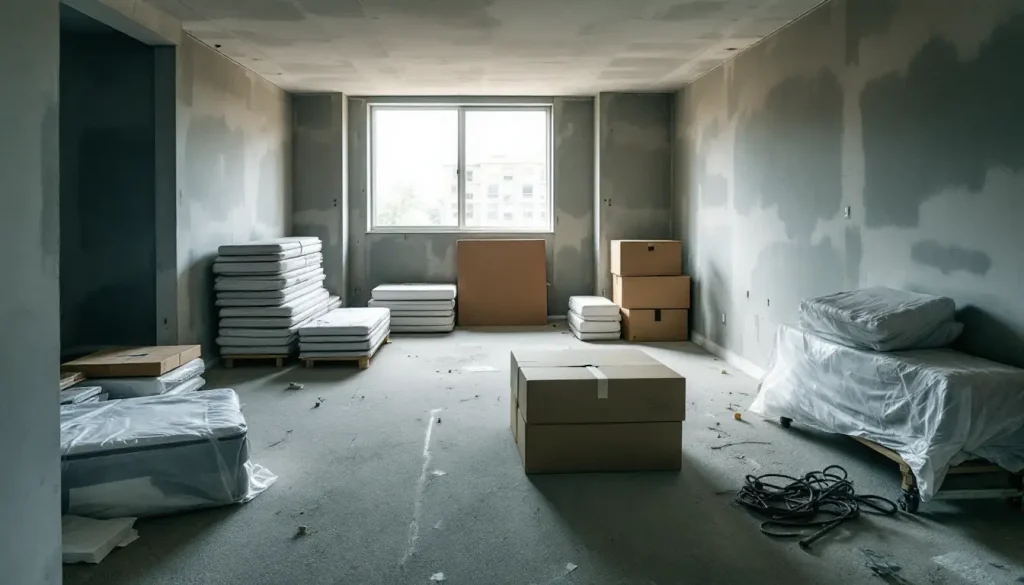
Hotel renovation cost per room runs about $10,200 to $14,500 per key for a midscale soft goods refresh and $26,700 to $36,300 for a full room and bathroom, in 2026 dollars before contractor markup.
Key takeaways
- The Hotel Cost Estimating Guide 2021 from Nehmer and HVS Design prices a midscale guestroom soft goods renovation, bathroom and corridor included, at $7,518 to $10,699 per key, and a full room with bathroom at $19,715 to $26,807 per key, in 2021 dollars.
- The BLS producer price index for inputs to commercial structures (series WPUIP231211) rose from 130.1 in May 2021 to 176.339 in October 2026, a factor of 1.3554 that CB&C applies to bring the 2021 guide figures forward.
- Fourteen hotel renovations registered with the Texas Department of Licensing and Regulation (TDLR) from 2024 to 2026 planned a median of $10,855 per key, from $2,857 for a 70-room Hampton Inn to $63,877 for 65 historic rooms at the Driskill Hotel.
- A 2023 Hilton property improvement plan cites brand standard 105.01: a soft goods renovation every 7 years and a complete renovation every 14 years, including casegoods, bathrooms and hard finishes (Hilton PIP, March 29, 2023).
- Under ADA 2010 Standards Section 224.1.1, altered guest rooms count toward Table 224.2 until the hotel meets new-construction numbers: 7 mobility rooms, 2 with roll-in showers, and 12 communication rooms when 101 to 150 rooms are altered.
How much does a hotel renovation cost per room?
Hotel renovation cost per room depends first on scope tier, then on hotel class. In the Nehmer and HVS Design 2021 guide, a soft goods refresh runs $3,385 per key at the low end for economy hotels, and a full room with bathroom reaches $88,918 per key at the high end for luxury hotels. Every figure covers construction plus furniture, fixtures and equipment (FF&E).
| Hotel class (guide model) | Tier 1: soft goods, room plus bath plus corridor | Tier 2: adds case goods | Tier 3: adds full bathroom | Source |
|---|---|---|---|---|
| Economy (90 rooms, 3 stories) | $3,385 to $5,054 | $5,572 to $7,873 | $9,391 to $13,205 | Nehmer and HVS Design 2021, summary pp. 10 to 11 |
| Extended stay (150 rooms, 4 stories) | $8,319 to $11,940 | $19,050 to $26,894 | $26,876 to $37,214 | Nehmer and HVS Design 2021, summary pp. 10 to 11 |
| Midscale (135 rooms, 5 stories) | $7,518 to $10,699 | $12,415 to $17,041 | $19,715 to $26,807 | Nehmer and HVS Design 2021, summary pp. 10 to 11 |
| Upscale (304 rooms, 9 stories) | $10,160 to $14,345 | $19,383 to $26,470 | $27,499 to $37,908 | Nehmer and HVS Design 2021, summary pp. 10 to 11 |
| Upper upscale (192 rooms, 25 suites) | $12,795 to $18,036 | $27,091 to $37,847 | $37,292 to $53,336 | Nehmer and HVS Design 2021, summary pp. 10 to 11 |
| Luxury (200 rooms, 20 suites) | $20,676 to $29,044 | $44,959 to $61,998 | $62,440 to $88,918 | Nehmer and HVS Design 2021, summary pp. 10 to 11 |
CB&C built each tier by adding the guide’s per-guestroom lines: Tier 1 is guestroom soft goods plus bathroom soft goods plus corridors, Tier 2 adds the guestroom full renovation line, and Tier 3 adds the bathroom full renovation line. The guide is dated May 2021, so multiply by 1.3554, the change in BLS PPI WPUIP231211 to October 2026: midscale Tier 1 becomes $10,190 to $14,501 and Tier 3 becomes $26,722 to $36,334 per key.
The index covers goods and services bought for commercial structures but excludes labor, so it is a floor for escalation, not a forecast. For how the index family behaves quarter to quarter, see our commercial construction price index.
What do recent hotel renovations cost per key in public records?
Texas owners register commercial renovations with TDLR for accessibility review, and each record lists an estimated cost, square footage and planned dates. Fourteen hotel renovations registered from 2024 to 2026 that state a room count planned a median of $10,855 per key, close to the escalated midscale Tier 1 band. Estimates are the owner’s, filed before bidding.
| Hotel (TABS facility) | Keys | Estimated cost | Per key | Registered scope | Start year | Source |
|---|---|---|---|---|---|---|
| Hampton Inn, Hopkins County | 70 | $200,000 | $2,857 | 4-story hotel, scope not itemized | 2026 | TABS2026024774 |
| Simply Sonesta, Dallas County | 122 | $583,275 | $4,781 | Furniture, finishes, accessories in rooms and baths; corridor finishes | 2024 | TABS2024014517 |
| Sonesta Select, Richardson | 123 | $633,360 | $5,149 | Same scope as above | 2024 | TABS2024017299 |
| Simply Sonesta, Tarrant County | 98 | $520,871 | $5,315 | Same scope as above | 2024 | TABS2024014512 |
| TownePlace Suites, Grapevine | 120 | $800,000 | $6,667 | 120 guest rooms, scope not itemized | 2026 | TABS2027003284 |
| La Quinta Inn and Suites, Odessa | 120 | $875,000 | $7,292 | Renovation of a 120-room hotel | 2024 | TABS2024012270 |
| Hyatt Regency Austin | 449 | $4,500,000 | $10,022 | Soft goods and casegoods; accessible baths reconfigured | 2025 | TABS2025007504 |
| Comfort Suites, Collin County | 77 | $900,000 | $11,688 | 77 rooms plus lobby and corridors | 2026 | TABS2027005784 |
| Courtyard Amarillo Downtown | 107 | $1,379,340 | $12,891 | Brand PIP in an occupied hotel, no layout change | 2026 | TABS2027006332 |
| The Highland Dallas | 198 | $2,600,000 | $13,131 | Furniture, finishes and accessories | 2024 | TABS2024014835 |
| W Hotel, Austin | 251 | $9,000,000 | $35,857 | New finishes in 251 rooms | 2024 | TABS2024018380 |
| JW Marriott San Antonio Hill Country | 1,002 | $45,000,000 | $44,910 | New finishes and toilet room upgrades | 2026 | TABS2025008397 |
| Gunter Hotel, San Antonio | 300 | $14,000,000 | $46,667 | 300 rooms, all public spaces, bar, restaurant, exterior | 2024 | TABS2024018982 |
| Driskill Hotel Phase 2, Austin | 65 | $4,152,000 | $63,877 | 65 historic rooms and corridors | 2025 | TABS2025024806 |
Two patterns hold across the 14 records. Of the 6 records at $7,292 per key or less, 3 describe furniture and finish replacement with no plumbing work, which is Tier 1 and Tier 2 scope, and 3 do not itemize scope. The 4 records above $35,000 per key are upper upscale or historic properties, and 3 of them name bathrooms, public spaces or historic fabric. Some owners leave FF&E bought directly out of the TABS figure, so treat low records as construction only.
What is included in each renovation tier?
The four tiers differ by what leaves the room. A soft goods renovation replaces fabric and finish items; a case goods renovation adds the furniture; a full renovation rebuilds the bathroom; a full PIP adds public areas and building systems. The 2025 Fairfield by Marriott Franchise Disclosure Document defines both terms used in brand contracts.
That FDD defines soft goods as “wall and floor coverings, window treatments, carpeting, bedspreads, lamps, artwork, decorative items” and upholstery. It defines case goods as “cabinets, shelves, chests, armoires, chairs, beds, headboards, desks, tables, mirrors, lighting fixtures and similar items” (2025 FDD, Exhibit definitions). Brand PIPs use the same 2 words, so these definitions settle most scope arguments.
| Tier | What the guide includes (midscale) | Midscale per key, 2021 | Typical code level | Source |
|---|---|---|---|---|
| 1: Soft goods | Carpet and pad, vinyl wallcovering, window treatments, lamps, art, soft seating, paint; bath vanity light, wallcovering, mirror, paint; corridor carpet, wallcovering, sconces | $7,518 to $10,699 | IEBC Level 1 | Nehmer and HVS Design 2021, footnotes 1 and 3 |
| 2: Case goods | Adds casegoods and install, bedsets, entry hard flooring, TV and mount | $12,415 to $17,041 | IEBC Level 1 | Nehmer and HVS Design 2021, guestroom full renovation lines |
| 3: Full room with bath | Adds vanity base and top, faucet, stone or tile tub surround, shower valve, tub refinish, porcelain tile floor and base | $19,715 to $26,807 | IEBC Level 1 or 2 | Nehmer and HVS Design 2021, footnote 2 |
| 4: Full PIP | Adds lobby, breakfast, meeting rooms, public restrooms, PTACs, elevator cabs, signage, parking | Tier 3 plus per-square-foot and per-item lines | IEBC Level 2 or 3 | Nehmer and HVS Design 2021, summary p. 10 |
A brand PIP mixes tiers. The 2023 Hilton PIP for a DoubleTree relicensing in Atlanta required a soft goods renovation of the lobby, bar, fitness center, meeting rooms, guestrooms, suites and corridors by June 30, 2026, plus 55-inch minimum LED TVs in every room and replacement of fitness equipment over 6 years old (Hilton PIP, items A-3, G-1, I-1). Before buying a hotel with an open PIP, a property condition assessment prices the building items the PIP does not list.
What costs sit outside the per-key figure?
The 2021 guide states that its numbers exclude professional fees, contingency, operating supplies and equipment, attic stock, freight, sales tax, the contractor’s general conditions, overhead and profit, performance bonds and building permits. Those lines often decide whether a bid lands inside the budget, so price them separately.
| Cost outside the per-key figure | Published number | Source |
|---|---|---|
| Freight on guestroom FF&E, midscale | 8.00% plus 4.00% warehousing | Nehmer and HVS Design 2021, p. 98 (Audit Logistics) |
| Freight on guestroom FF&E, upscale | 6.25% plus 3.50% warehousing | Nehmer and HVS Design 2021, p. 98 |
| Freight on guestroom FF&E, economy | 10.50% plus 6.50% warehousing | Nehmer and HVS Design 2021, p. 98 |
| Brand PIP issue fee | $12,000 | Fairfield by Marriott FDD 2025, Item 6 |
| Brand PIP revision | $5,000 per revision | Fairfield FDD 2025, Item 6 |
| Brand design review of PIP or periodic renovation | $3,000 | Fairfield FDD 2025, Item 6 |
| Contractor general conditions, overhead, profit, bonds, permits | Not published in the guide | Nehmer and HVS Design 2021, general notes 3 and 4 |
Systems and access items are listed separately in the guide because they are not part of a standard tier. A midscale hotel’s packaged terminal air conditioner (PTAC) direct replacement costs $1,070 to $1,372 each, and an RFID key system $345 to $483 per key. Converting a room to a mobility-accessible room costs $17,371 to $24,000 with a bathtub and $19,602 to $28,000 with a roll-in shower, all in 2021 dollars.
| Midscale add-on (2021 dollars) | Unit cost | Unit | Source |
|---|---|---|---|
| PTAC direct replacement, no finish work | $1,070 to $1,372 | Each | Nehmer and HVS Design 2021, common additives |
| RFID key system (nested Wi-Fi) | $345 to $483 | Per key | Nehmer and HVS Design 2021, common additives |
| Guestroom entry door and hardware | $676 to $1,208 | Each | Nehmer and HVS Design 2021, common additives |
| ADA room conversion, bathtub | $17,371 to $24,000 | Per key | Nehmer and HVS Design 2021, common additives |
| ADA room conversion, roll-in shower | $19,602 to $28,000 | Per key | Nehmer and HVS Design 2021, common additives |
| Elevator cab finishes | $3,416 to $12,426 | Per cab | Nehmer and HVS Design 2021, common additives |
| Hydraulic elevator modernization, 5 stops | $84,043 to $112,529 | Per cab | Nehmer and HVS Design 2021, common additives |
| Lobby full renovation (2,500 sq ft model) | $64 to $88 plus $13 to $18 soft goods | Per sq ft | Nehmer and HVS Design 2021, summary p. 10 |
Hold a contingency for concealed conditions behind tub surrounds and PTAC sleeves; our guide to construction contingency shows how owners size it. When bids arrive, line them up against the guide’s line items with our method for comparing construction bids.
How often do hotels renovate, and how long does it take?
Brand standards, not building codes, set the renovation cycle. The 2023 Hilton PIP quotes brand standard 105.01: soft goods every 7 years and a complete renovation every 14 years. Fairfield’s 2025 franchise agreement, Section 4.3, requires “periodic renovation” of all guestrooms and public facilities, with soft goods and case goods replaced “periodically as required by the Standards” (Fairfield FDD 2025).
Federal franchise law makes the brand disclose this obligation before you sign: 16 CFR 436.5(i) requires FDD Item 9 to list the franchisee’s “maintenance, appearance, and remodeling requirements”. The Fairfield FDD recommends a reserve account funded on a regular basis, without fixing a percentage, so read Item 9 and the agreement’s renovation section for your brand’s cycle.
| Stage | Duration | Source |
|---|---|---|
| Design documents to a brand prototype | 2.5 months | Nehmer and HVS Design 2021, sample renovation schedule, p. 96 |
| Design documents, custom design | 5 months | Nehmer and HVS Design 2021, p. 96 |
| FF&E ordering and lead time | 16 weeks | Nehmer and HVS Design 2021, p. 96 |
| Permitting and bidding | 2 months | Nehmer and HVS Design 2021, p. 96 |
| Construction, select-service hotel | 3.5 months | Nehmer and HVS Design 2021, p. 96 |
| Brand confirms PIP compliance | 2 weeks | Nehmer and HVS Design 2021, p. 96 |
| Planned construction, 14 Texas hotel renovations | Median 5.4 months; range 2.9 to 11.4 | TDLR TABS, CB&C count |
The Texas records run longer than the guide’s 3.5-month construction stage because several cover 300 to 1,002 rooms. The 70-room Hampton Inn planned 2.9 months, from July 6 to October 1, 2026; the 1,002-room JW Marriott San Antonio Hill Country planned 11.4 months, from April 6, 2026 to March 19, 2027.
How do you keep the hotel open during a renovation?
Most hotels renovate while open by taking one floor or one block of rooms out of order at a time. The 2026 Courtyard Amarillo Downtown registration describes an “existing, occupied 107-room hotel” renovated under a Marriott PIP, and a Marriott on Houston’s West Loop registered 12 guestroom floors separately at $175,000 each, most at 10,636 sq ft per floor (TABS2025005030 and companion filings).
| Phasing input | Value | Basis |
|---|---|---|
| Keys | 120 | Worked example below |
| Rooms per floor | 30 (4 floors) | Assumption; the guide’s midscale model has 27 rooms per floor |
| Construction window | 106 days (3.5 months) | Nehmer and HVS Design 2021, sample schedule |
| Days each floor is out of order | 26.5 | 106 / 4 |
| Rooms out of order at any time | 30 (25% of inventory) | 1 floor of 4 |
| Total out-of-order room-nights | 3,180 | 120 x 26.5 |
| Revenue at risk | 3,180 x your ADR x your occupancy | Use your own STR or PMS data |
Schedule phases so the hotel’s accessible rooms (7 mobility rooms at 101 to 150 keys under ADA Table 224.2) are not all out of order at once, and keep the exit path open on the working floor. Night and weekend limits, dust control and life safety plans for occupied buildings are covered in our guide to commercial renovation contractors.
Which code upgrades does a hotel renovation trigger?
The trigger is the scope, not the budget. Replacing finishes with like items is Level 1 work under the International Existing Building Code (IEBC); moving walls, doors or systems is Level 2; a work area over 50% of the building is Level 3 (IEBC Sections 503 to 505, as adopted in Seattle 2015). Accessibility, sprinkler and HVAC rules attach to those levels.
| If your renovation | Then | Threshold | Source |
|---|---|---|---|
| Only paints, wallpapers or swaps like-for-like finishes | Usually maintenance, not an ADA alteration | Unless it affects usability | 28 CFR 36.402(b)(1) |
| Alters guest rooms (bathrooms rebuilt, walls or doors moved) | Altered rooms count toward Table 224.2 until the hotel meets new-construction numbers | 101 to 150 rooms altered: 7 mobility, 2 with roll-in showers; 12 communication | ADA 2010 Stds 224.1.1, 224.2, 224.4 |
| Alters any guest room door | Door gives a 32 in clear opening, even in non-accessible rooms | 32 in minimum at 90 degrees | ADA 2010 Stds 224.1.2, 404.2.3 |
| Alters the lobby, restaurant or meeting rooms | Make the path of travel accessible | Up to 20% of the cost of that alteration | 28 CFR 36.403(f) |
| Level 2 work area serves exits or corridors for more than 30 occupants | Sprinkler the work area | Over 50% of the floor and sprinklers required for new construction; smoke detection if water supply needs a new fire pump | IEBC 804.2.2, Seattle 2015 text |
| Is a Florida lodging of 3 or more stories, contract let before October 1, 1983 | Full NFPA 13 sprinklers, or corridors and public areas with 1-hour room separation | 3 stories | Fla. Stat. 509.215(2) |
| Replaces PTACs in existing sleeves under 16 in high or 42 in wide | A non-standard size PTAC may be used | Cross section under 670 sq in | 10 CFR 431.92 |
The sprinkler threshold is what turns a guestroom renovation into a fire protection project. Under IEBC 804.2.2, a work area larger than 50% of a floor must be sprinklered where new construction would require it, and IBC 2024 Section 903.2.8 requires sprinklers throughout new Group R-1 hotels. Retrofit pricing per square foot is set out in our guide to fire sprinkler system cost. Local amendments change these sections, so ask the building official which IEBC edition applies.
How do ADA room counts work when you renovate in phases?
Section 224.1.1 bases the count on rooms “altered or added”, and the ADA advisory says compliance with 224.5 dispersion is more likely if accessible rooms are not all in the same area. A mobility room must also meet the bathroom and door rules in our guides to ADA bathroom requirements and ADA door width. This is not legal advice; confirm counts with your accessibility consultant.
PTAC, fan coil or something else?
Like-for-like PTAC replacement is the cheapest HVAC path: $1,070 to $1,372 each at midscale in 2021. A 12,000 Btu/h standard size PTAC must reach an EER of 10.4 (14.0 minus 0.3 x 12), while a non-standard unit for an old sleeve must reach 8.3 (10.9 minus 0.213 x 12) under 10 CFR 431.97 Tables 7 and 8. Upscale fan coil replacement costs $2,366 to $5,496 each.
Moving from PTACs to vertical fan coils or ducted systems reconfigures a system, which makes it Level 2 work and opens energy code review of the new equipment. Compare system types in our commercial HVAC system guide before the PIP fixes the choice.
Worked example: what does a 120-key midscale renovation cost?
A 120-key midscale hotel doing a Tier 3 renovation of every room, with new PTACs and 3 added accessible rooms, budgets about $4.07 million, or $33,954 per key, in October 2026 dollars before markup and brand fees. Every input below comes from the guide or the BLS index, and the shortfall of 3 accessible rooms is an assumption.
| Line | Input | Arithmetic | Result |
|---|---|---|---|
| Tier 3 room, bath and corridor | Midscale midpoint $23,261 per key (2021) | 120 x $23,261 | $2,791,320 |
| PTAC replacement | Midpoint $1,221 each | 120 x $1,221 | $146,520 |
| Roll-in shower rooms added | Midpoint $23,801; assumed shortfall of 2 | 2 x $23,801 | $47,602 |
| Bathtub mobility room added | Midpoint $20,686; assumed shortfall of 1 | 1 x $20,686 | $20,686 |
| Subtotal, 2021 dollars | Sum of lines | $3,006,128 | |
| Escalated to October 2026 | BLS PPI WPUIP231211: 176.339 / 130.1 | $3,006,128 x 1.3554 | $4,074,506 |
| Per key | $4,074,506 / 120 | $33,954 | |
| Brand fees | PIP fee plus design review (Fairfield FDD 2025) | $12,000 + $3,000 | $15,000 |
| Not included | General conditions, overhead and profit, design fees, contingency, freight (8% plus 4% of FF&E), tax, permits | Add from bids | Owner input |
The ADA lines follow Table 224.2: altering all 120 rooms requires 7 mobility rooms, 2 of them with roll-in showers, and 12 rooms with communication features. Phasing the same job floor by floor costs 3,180 out-of-order room-nights. New-build cost per room, for owners weighing a rebuild against a Tier 4 renovation, is covered in our guide to hotel construction cost per room.
Which renovation tier does your hotel need?
Match the tier to the brand clock and the building’s condition. If soft goods are 7 years old and casegoods are under 14, the Hilton standard calls for Tier 1; at 14 years, Tier 3. If the PIP names tub-to-shower conversions, PTACs or public areas, price Tier 3 or Tier 4 and check the code triggers first.
| If | Then plan | Budget per key, midscale, 2026 dollars | Source |
|---|---|---|---|
| Soft goods 7 or more years old, casegoods sound | Tier 1 soft goods | $10,190 to $14,501 | Hilton PIP std 105.01; guide x 1.3554 |
| Casegoods damaged or brand requires new furniture package | Tier 2 case goods | $16,827 to $23,097 | Guide x 1.3554 |
| Last complete renovation 14 or more years ago, or tub-to-shower conversions in the PIP | Tier 3 full room | $26,722 to $36,334 | Hilton PIP std 105.01; guide x 1.3554 |
| PIP includes lobby, F&B, meeting rooms or systems | Tier 4: Tier 3 plus per-sq-ft public area lines | Texas full renovation record: $46,667 (Gunter Hotel, 2024) | Guide; TDLR TABS |
| Accessible rooms fewer than Table 224.2 for the rooms altered | Add conversions | $23,545 to $37,951 per converted room | Guide ADA lines x 1.3554 |
| Work area over 50% of a floor in an unsprinklered building | Price a sprinkler retrofit before committing | Per sq ft, separate budget | IEBC 804.2.2 |
Hotel kitchens and restaurants follow their own budgets, covered in commercial kitchen cost and restaurant construction cost.
How we compiled this
We combined 3 kinds of primary documents accessed in November 2026: the Nehmer and HVS Design 2021 cost guide, 14 TDLR TABS hotel renovation registrations from 2024 to 2026 that state a room count (pulled from 779 search results on November 21, 2026), and brand documents (a 2023 Hilton PIP and the 2025 Fairfield FDD). Code rules come from the ADA 2010 Standards, 28 CFR 36, 10 CFR 431, Florida Statutes and the IEBC as adopted in Seattle. The newer 2025 and 2026 guide editions are gated behind a form, so we escalated the 2021 edition with BLS PPI WPUIP231211 and excluded figures quoted only in news articles.
Frequently asked questions
How much does it cost to renovate a hotel room?
For a midscale hotel, the 2021 Nehmer and HVS Design guide gives $7,518 to $10,699 per key for soft goods and $19,715 to $26,807 for a full room with bathroom. Escalated by the BLS commercial inputs index to October 2026, that is about $10,200 to $14,500 and $26,700 to $36,300, before contractor markup, fees and freight.
What is the difference between soft goods and case goods in a hotel?
Soft goods are wall and floor coverings, window treatments, carpet, bedspreads, lamps, art and upholstery. Case goods are cabinets, chests, chairs, beds, headboards, desks, tables, mirrors and lighting fixtures. Both definitions come from the 2025 Fairfield by Marriott Franchise Disclosure Document, and brand PIPs use the same split to set scope.
How often do hotels renovate guest rooms?
The brand sets the cycle. A 2023 Hilton property improvement plan cites brand standard 105.01: a soft goods renovation every 7 years and a complete renovation, including casegoods, bathrooms and hard finishes, every 14 years. Other brands state periodic renovation in the franchise agreement, disclosed in FDD Item 9 under 16 CFR 436.5(i).
Can a hotel stay open during a renovation?
Yes. Most renovations take one floor or block of rooms out of order at a time. A 120-key hotel renovating 30 rooms at a time over the 3.5-month construction stage in the Nehmer and HVS sample schedule loses about 3,180 room-nights, while 90 rooms keep selling. Texas registrations show the Courtyard Amarillo Downtown PIP planned in an occupied hotel.
Does renovating hotel rooms require adding accessible rooms?
If the work is an alteration, yes for the rooms altered. ADA 2010 Standards Section 224.1.1 applies Table 224.2 to rooms altered or added until the hotel meets new-construction numbers. Altering 101 to 150 rooms requires 7 mobility rooms, 2 with roll-in showers, plus 12 communication rooms. Painting and wallpapering alone are not alterations under 28 CFR 36.402.
How long does a hotel renovation take?
The Nehmer and HVS Design 2021 sample schedule for a select-service hotel runs 2.5 months of design to a brand prototype, 16 weeks of FF&E lead time, 2 months of permitting and bidding, and 3.5 months of construction. Fourteen Texas hotel renovations registered from 2024 to 2026 planned a median of 5.4 months of construction.
Sources
- Hotel Cost Estimating Guide 2021, Nehmer and HVS Design, accessed November 21, 2026.
- TABS project search and project registrations, Texas Department of Licensing and Regulation, accessed November 21, 2026.
- PPI Inputs to commercial structures, excl. capital investment, labor and imports (WPUIP231211), U.S. Bureau of Labor Statistics, accessed November 21, 2026.
- 2010 ADA Standards for Accessible Design (Sections 202.4, 224, 404.2.3), U.S. Department of Justice, accessed November 21, 2026.
- 28 CFR 36.402 Alterations, eCFR, accessed November 21, 2026.
- 28 CFR 36.403 Alterations: path of travel, eCFR, accessed November 21, 2026.
- 10 CFR 431.92 Definitions (standard and non-standard size PTAC), eCFR, accessed November 21, 2026.
- 10 CFR 431.97 Energy efficiency standards, Tables 7 and 8, eCFR, accessed November 21, 2026.
- 2015 Seattle Existing Building Code, Chapter 5 (IEBC Sections 503 to 505), City of Seattle, accessed November 21, 2026.
- 2015 Seattle Existing Building Code, Chapter 8 (IEBC Section 804), City of Seattle, accessed November 21, 2026.
- Florida Statutes 509.215, Firesafety, Florida Legislature, accessed November 21, 2026.
- Property Improvement Plan, Atlanta Perimeter Dunwoody, relicensing as DoubleTree (March 29, 2023), Hilton, accessed November 21, 2026.
- Fairfield by Marriott Franchise Disclosure Document (March 31, 2025), Marriott International, accessed November 21, 2026.
- 16 CFR 436.5 Disclosure items (Item 9), eCFR, accessed November 21, 2026.