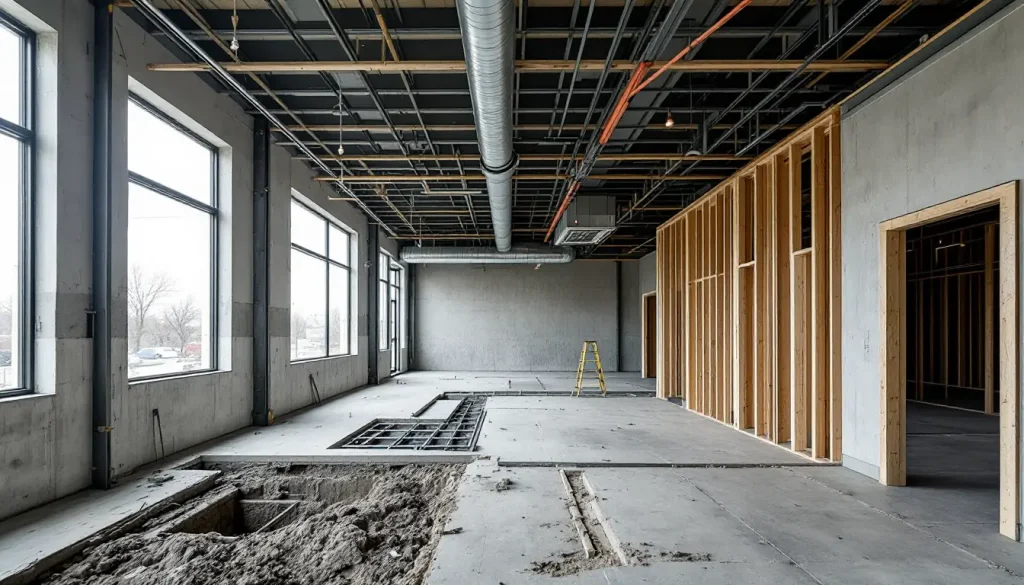
Restaurant construction cost in 1,788 Texas project registrations from 2024 to 2026 ran a median $371 per sq ft for ground-up buildings, $146 to finish a shell and $125 to re-fit an existing restaurant, before land and equipment.
Key takeaways
- Across 396 ground-up restaurant buildings registered in Texas from January 2024 to November 2026, the median estimated construction cost was $1,100,000, or $371 per sq ft, for a median 2,994 sq ft building (TDLR TABS).
- Finishing a first-generation shell or converting a non-restaurant space ran a median $146 per sq ft in 547 records, and re-fitting a space that was already a restaurant ran $125 per sq ft in 577 records (TDLR TABS).
- Small buildings cost the most per foot: ground-up restaurants under 2,500 sq ft had a median of $423 per sq ft, against $221 for buildings of 6,000 to 15,000 sq ft (TDLR TABS).
- One kitchen hood with its grease duct cost $27,279.76 installed on a 2025 federal award in Texas, and one kitchen fire suppression system cost $9,249 to $62,834 on federal awards from 2022 to 2026 (USAspending FA302025C0002).
- Texas requires a TABS registration for building projects with an estimated cost of $50,000 or more, which is why this dataset exists and why it starts at $50,000 (TDLR Architectural Barriers FAQ).
How much does restaurant construction cost per square foot?
The starting space sets the price more than the menu does. In Texas registrations filed January 2024 to November 2026, a new freestanding restaurant had a median estimated cost of $371 per sq ft, a shell finish-out $146, and work inside a space that was already a restaurant $125. The middle half of ground-up projects ran $207 to $580 per sq ft (TDLR TABS, pulled November 21, 2026).
| Starting point | Records | Median $ per sq ft | Middle half, $ per sq ft | Median size | Median estimated cost | Median planned months | Source |
|---|---|---|---|---|---|---|---|
| Ground-up building (new construction) | 396 | $371 | $207 to $580 | 2,994 sq ft | $1,100,000 | 6.0 | TDLR TABS |
| Addition to an existing restaurant | 49 | $175 | $107 to $299 | 2,283 sq ft | $325,000 | n/a | TDLR TABS |
| First-generation shell finish-out or conversion | 547 | $146 | $87 to $216 | 2,390 sq ft | $300,000 | 3.8 | TDLR TABS |
| Re-fit of an existing (second-generation) restaurant | 577 | $125 | $66 to $200 | 2,495 sq ft | $300,000 | 3.0 | TDLR TABS |
| Renovation, starting point not stated | 219 | $147 | $90 to $247 | 2,278 sq ft | $275,000 | n/a | TDLR TABS |
Each figure is the estimated construction cost the owner or design professional entered when registering the project with the Texas Department of Licensing and Regulation (TDLR) under the Texas Architectural Barriers Act. It excludes land. Whether it includes cooking equipment, furniture and site work depends on the filer; 80 of the 396 ground-up scopes mention site work, parking or paving.
Planned schedules follow the same order. The median ground-up registration planned 6.0 months from start to completion (middle half 4.0 to 8.1), a shell finish-out 3.8 months and a re-fit 3.0 months, measured from the start and completion dates in each record (TDLR TABS).
What does a quick service, fast casual or full service restaurant cost?
Brand records show the format gap clearly. Ground-up quick service restaurants (QSR, the drive-thru burger, chicken and taco chains) had a median of $423 per sq ft and $1,200,000 per building, while 12 ground-up full service restaurants ran $229 per sq ft on larger 5,138 sq ft buildings (TDLR TABS). Format was assigned only where the record names a chain whose format is public; 945 independent or unnamed records sit in their own rows.
| Format (assigned by chain name) | Starting point | Records | Median $ per sq ft | Middle half | Median size | Median estimated cost |
|---|---|---|---|---|---|---|
| Quick service (QSR) | Ground-up | 191 | $423 | $287 to $601 | 2,739 sq ft | $1,200,000 |
| Quick service (QSR) | Shell finish-out | 66 | $186 | $142 to $305 | 1,766 sq ft | $300,000 |
| Quick service (QSR) | Existing restaurant re-fit | 210 | $148 | $94 to $213 | 2,626 sq ft | $337,500 |
| Drive-thru coffee | Ground-up | 22 | $561 | $352 to $694 | 1,050 sq ft | $732,123 |
| Coffee | Shell finish-out | 27 | $214 | $178 to $351 | 2,226 sq ft | $400,000 |
| Fast casual | Ground-up | 30 | $414 | $265 to $597 | 2,385 sq ft | $1,000,000 |
| Fast casual | Shell finish-out | 55 | $235 | $168 to $291 | 2,406 sq ft | $650,000 |
| Fast casual | Existing restaurant re-fit | 15 | $192 | $91 to $255 | 2,600 sq ft | $350,000 |
| Full service | Ground-up | 12 | $229 | $162 to $325 | 5,138 sq ft | $1,150,000 |
| Full service | Shell finish-out | 16 | $126 | $68 to $172 | 3,960 sq ft | $475,000 |
| Full service | Existing restaurant re-fit | 13 | $86 | $42 to $125 | 3,052 sq ft | $200,000 |
| Independent or unnamed | Ground-up | 141 | $241 | $129 to $440 | 4,233 sq ft | $1,017,200 |
| Independent or unnamed | Shell finish-out | 383 | $118 | $76 to $190 | 2,400 sq ft | $289,500 |
| Independent or unnamed | Existing restaurant re-fit | 294 | $97 | $58 to $179 | 2,685 sq ft | $250,000 |
Source for every row: TDLR TABS registrations, January 2024 to November 2026, medians computed by CB&C. Full service and fast casual re-fit rows rest on 12 to 16 records, so treat them as indicative.
Does a drive-thru change the cost?
Ground-up records that mention a drive-thru had a median of $421 per sq ft on a 2,728 sq ft building, against $336 per sq ft and 3,034 sq ft for the 274 that do not mention one (TDLR TABS). Part of the gap is size: the drive-thru lane, menu boards and canopy add cost without adding floor area, so the same site work is spread over fewer square feet.
Why do small restaurants cost more per square foot?
The kitchen, restrooms, utility services and site work cost nearly the same whether the dining room seats 40 or 140. In the ground-up records, buildings under 2,500 sq ft had a median of $423 per sq ft and a median total of $850,000; buildings of 6,000 to 15,000 sq ft had a median of $221 per sq ft but a median total of $2,156,825 (TDLR TABS).
| Ground-up building size | Records | Median $ per sq ft | Middle half | Median size | Median estimated cost |
|---|---|---|---|---|---|
| Under 2,500 sq ft | 147 | $423 | $287 to $613 | 2,106 sq ft | $850,000 |
| 2,500 to 3,999 sq ft | 121 | $401 | $250 to $597 | 3,000 sq ft | $1,225,000 |
| 4,000 to 5,999 sq ft | 78 | $243 | $174 to $448 | 4,923 sq ft | $1,200,000 |
| 6,000 to 15,000 sq ft | 50 | $221 | $133 to $424 | 8,756 sq ft | $2,156,825 |
Is a second-generation restaurant space cheaper than a first-generation shell?
Yes, but by less than most guides claim. The median re-fit of an existing restaurant was $125 per sq ft against $146 for a shell finish-out, a gap of $21 per sq ft, or about $50,000 on a 2,400 sq ft space (TDLR TABS). The saving is real only when the hood, suppression, grease interceptor and walk-in pass inspection for your menu; if they must be replaced, most of the gap disappears.
Have the builder and a licensed suppression contractor check each item below before signing the lease. The broader build-out process, health plan review and permit sequence are set out in our guide to restaurant build-out contractors.
| Existing item | What to verify | Rule behind the check | Public price if it must be replaced | Source |
|---|---|---|---|---|
| Type I hood and grease duct | Hood overhangs every grease-producing appliance on all open sides; duct is intact to the roof | IMC Chapter 5, Section 507; NFPA 96 | $27,279.76, one hood plus grease duct, installed (2025) | USAspending FA302025C0002 |
| Kitchen fire suppression | System is listed to UL 300 and covers the new appliance layout | UL 300, Edition 4 | $9,249 to $62,834, one system (2022 to 2026) | USAspending 47PE5526F0450, N4008022F4924 |
| Grease interceptor | Size meets the sewer utility’s sizing table for your fixtures | Local pretreatment ordinance | $4,000 to $8,500, new 750 to 1,500 gallon unit, installed | City of Tampa FAQ |
| Walk-in cooler or freezer | Box size fits your storage plan; refrigeration runs to temperature | FDA Food Code 2026, 3-501.16: cold holding at 41°F or less | $26,373.20 (8 x 10 ft box) to $85,250 (14 x 18 ft, installed) | W50S6Q24FA011, 12639523P0450 |
| Electrical service | Amps and phase carry the equipment schedule | Utility service rules | $6,400 utility connection for three-phase up to 800 A vs $3,000 single-phase (one utility, 2026) | Pend Oreille PUD fee schedule |
| Restrooms | Count and layout meet accessibility rules for the seat count | 2010 ADA Standards, 213 and 604 | $35,000 per single-user toilet room (2024 estimate) | Minnesota DLI memo |
Which line items swing a restaurant budget the most?
Kitchen exhaust, cold storage and utility capacity move the number most, because a shell has none of them and a second-generation space may or may not have usable ones. Public records price one installed hood and duct at $27,279.76, a walk-in cooler and freezer pair at $68,572.45 and a 750 to 1,500 gallon grease interceptor at $4,000 to $8,500 (USAspending W50S9224PA023).
| Line item | Scope stated in the record | Public price | Date and place | Source |
|---|---|---|---|---|
| Kitchen exhaust hood | Equipment purchase only | $16,185.37 | June 2025, Langley AFB, Va. | USAspending FA480025P0106 |
| Hood plus grease duct | Replace one hood and duct, installed, no makeup air | $27,279.76 | Feb 2025, Sheppard AFB, Tex. | USAspending FA302025C0002 |
| Kitchen fire suppression | Replace or install one system | $9,249 to $62,834 | 2022 to 2026, Ga. and Md. | 47PE5526F0450, N4008022F4924 |
| Grease trap, 0 to 100 gal | Installed, average range | $250 to $1,500 | 2026, Tampa, Fla. | City of Tampa |
| Grease interceptor, 750 to 1,500 gal | New, installed, average range | $4,000 to $8,500 | 2026, Tampa, Fla. | City of Tampa |
| Walk-in cooler, 8 x 10 ft | Outdoor box, purchase | $26,373.20 | Sept 2024, Ark. | USAspending W50S6Q24FA011 |
| Walk-in cooler 8 x 12 ft plus freezer 8 x 10 ft | Pair of boxes | $68,572.45 | Sept 2024, Pa. | USAspending W50S9224PA023 |
| Walk-in cooler, 14 x 18 ft | Installed with evaporator and condenser | $85,250 | Sept 2023, Gastonia, N.C. | USAspending 12639523P0450 |
| Three-phase electric service | Utility connection up to 800 A (single-phase 200 or 400 A: $3,000) | $6,400 | April 2026, Pend Oreille PUD, Wash. | PUD fee schedule |
| Accessible single-user toilet room | New construction cost estimate | $35,000 | April 2024, Minnesota | Minnesota DLI |
| Health department plan review | New or remodel, 2,000 to 3,999 sq ft | $1,865 ($1,044 to $2,723 by size) | Rev. 11/2025, Los Angeles County | LA County form |
Hood sizing, exhaust rates and more award prices are in our guide to the commercial kitchen hood. Service intervals and the 2022 to 2026 award list for suppression are in our guide to the commercial kitchen fire suppression system.
Interceptor sizing by drainage fixture units and pumping prices are in our guide to the grease trap and grease interceptor. Restroom dimensions and the 20% cap on path-of-travel accessibility spending in alterations (28 CFR 36.403(f)) are in our guide to ADA bathroom requirements.
A cooking line that adds a second fryer bank or a conveyor oven can push a 200 A single-phase service past its limit; the voltage, amperage and utility charges for an upgrade are laid out in our guide to three-phase power. Cooking and refrigeration equipment itself sits outside most construction estimates and is priced in our guide to commercial kitchen equipment.
What did public airport, pier and park concession build-outs cost?
Public concession spaces cost more per foot than street restaurants because of small footprints, secure-side logistics and public bidding. Five Texas records registered 2024 to 2026 ran $161 to $822 per sq ft; the McAllen International Airport secure-side build-out was $1,800,000 for 2,190 sq ft. The 28 publicly funded restaurant records in the main dataset had a median of $322 per sq ft (TDLR TABS).
| Project (TABS number) | Funding | Scope as registered | Size | Estimated cost | $ per sq ft |
|---|---|---|---|---|---|
| McAllen airport concessions, phase 3 (TABS2024017035) | Public | Secure-side concessions build-out | 2,190 sq ft | $1,800,000 | $822 |
| Bob Hall Pier, Nueces County (TABS2026005844) | Public | Concession stand addition and restaurant kitchen addition | 5,000 sq ft | $3,800,000 | $760 |
| McKinney commercial terminal (TABS2026028736) | Public | Concessions space with cafeteria, bar and back of house | 1,660 sq ft | $750,000 | $452 |
| Harris County terminal addition (TABS2026018883) | Private | Four food tenant fit-outs plus shared seating | 9,647 sq ft | $3,500,000 | $363 |
| Cameron County terminal (TABS2025012641) | Public | New tenant build-out in existing terminal | 1,040 sq ft | $167,000 | $161 |
At the top of the institutional scale, the Defense Department’s June 2026 pricing guide puts a new enlisted dining facility, kitchen equipment and installation included, at $841.18 per sq ft for a 50,434 sq ft reference building at October 2025 prices (UFS 3-701-01, Table 2). That is a contrast figure for large public kitchens, not a restaurant budget.
Worked example: what would a 2,400 sq ft fast casual restaurant cost?
Take a 2,400 sq ft fast casual restaurant, the median size of fast casual shell finish-outs in the Texas records. At the fast casual medians it costs about $564,000 to finish a first-generation shell and $460,800 to re-fit a second-generation space, or $622,265 and $508,745 after a plan review fee and a 10% owner contingency (TDLR TABS).
| Step | First-generation shell | Second-generation re-fit | Input and source |
|---|---|---|---|
| 1. Construction estimate | 2,400 x $235 = $564,000 | 2,400 x $192 = $460,800 | Fast casual medians, TDLR TABS |
| 2. Of which: kitchen systems a shell lacks | $27,279.76 + $9,249 + $8,500 + $68,572.45 = $113,601 | $0 if the existing items pass inspection | Hood and duct, one suppression system, interceptor (top of Tampa range), cooler and freezer pair; table above |
| 3. Health plan review fee | $1,865 | $1,865 | LA County, 2,000 to 3,999 sq ft |
| 4. Owner contingency, 10% of step 1 | $56,400 | $46,080 | CB&C assumption, not a sourced rate |
| 5. Total before land and equipment | $622,265 | $508,745 | Steps 1 + 3 + 4 |
| Range at the middle half of step 1 | $403,200 to $698,400 | $218,400 to $612,000 | $168 to $291 and $91 to $255 per sq ft |
The $113,601 of kitchen systems in step 2 is close to the $103,200 gap between the two construction estimates. That is the case for a second-generation space in one line: the savings come almost entirely from reusable kitchen systems, so a space whose hood is too short or whose interceptor is undersized saves little.
Landlords often pay part of this. A tenant improvement allowance is negotiated per square foot in the lease, and how it is paid out and accounted for is set out in our guide to the tenant improvement allowance. For a fixed-scope buffer, see our page on construction contingency.
How do common restaurant cost figures compare with filed records?
The figures repeated on most cost pages are older survey averages or unsourced ranges. Filed Texas records put ground-up quick service restaurants at a median $423 per sq ft, several times the $63 per sq ft fast food average still quoted from an undated industry survey, and they put re-fits of existing restaurants at $125, not $85 (TDLR TABS).
| What several guides say | What the records show | Source of the record figure |
|---|---|---|
| Fast food averages $63 per sq ft; full service $198 (undated survey, widely re-quoted) | QSR ground-up median $423; QSR re-fit $148; full service ground-up $229 (12 records) | TDLR TABS |
| New restaurant $242 per sq ft; renovation of an existing restaurant $85 (same survey) | Ground-up median $371; existing-restaurant re-fit $125 | TDLR TABS |
| 2019 national model, 5,000 sq ft restaurant: $199 to $220 per sq ft including fees | Ground-up 4,000 to 5,999 sq ft: median $243, middle half $174 to $448 (2024 to 2026) | TDLR TABS |
| Restaurant renovation $150 to $600 per sq ft (2026 guide, no source) | Existing-restaurant re-fit middle half $66 to $200 per sq ft | TDLR TABS |
| Hood installation $20,000 to $60,000 or more (2026 guide, no source) | One hood plus grease duct installed: $27,279.76 (2025) | USAspending FA302025C0002 |
Prices in the records are also rising for new buildings: ground-up registrations had a median of $345 per sq ft in 2024, $358 in 2025 and $504 in the 74 records filed so far in 2026, while shell finish-outs moved only from $139 to $152 (TDLR TABS). The 2026 jump partly reflects a smaller, more drive-thru-heavy mix, so read it as direction, not a rate. For all building types, our commercial construction cost per square foot page tracks national cost data.
Which starting space should you choose for your restaurant?
Choose by what the concept needs that a lease space cannot give. A drive-thru or brand prototype needs a pad and a ground-up budget near $421 per sq ft; a sit-down or counter concept that fits an existing restaurant with a usable hood and interceptor can budget near $125; anything else starts from a shell near $146 (TDLR TABS). The table and chart below hold the same logic.
| If your project | Then | Budget anchor (median, Texas records 2024 to 2026) |
|---|---|---|
| Needs a drive-thru lane, pad site or chain prototype | Build ground-up | $421 per sq ft with drive-thru; 6.0 planned months |
| Fits a former restaurant whose hood covers your line, suppression is UL 300 listed and interceptor meets the utility table | Take the second-generation space | $125 per sq ft; 3.0 planned months |
| Fits a former restaurant but the hood is short or suppression is not UL 300 listed | Second-generation space plus replacements | $125 per sq ft plus $27,279.76 hood and duct and $9,249 to $62,834 suppression |
| Is a vanilla shell, or an office or retail space being converted | Plan a first-generation finish-out | $146 per sq ft; 3.8 planned months |
| Adds dining or kitchen area to a restaurant you already run | Plan an addition | $175 per sq ft |
| Needs more cooking load than a 200 A single-phase service carries | Ask the utility for a three-phase quote before signing | $6,400 connection up to 800 A at one utility (2026) |
The kitchen is the costliest part, so see commercial kitchen cost and the inspections needed before opening.
How we compiled this
On November 21, 2026 we searched the TDLR TABS public registry for 35 restaurant terms and chain names registered from January 1, 2024, opened 2,623 project records, and kept 1,788 restaurant projects after dropping non-restaurant scopes, records under 300 sq ft or outside $15 to $2,000 per sq ft, 29 records whose stated size conflicted with the scope text, and 238 repeats of an identical cost and size. One national burger chain filed 100 new-store registrations at an identical $750,000 estimate; 23 survive the repeat filter, and without them the ground-up median is $389 per sq ft. Line-item prices come from 7 federal award records, 4 municipal or utility documents and the Defense Department pricing guide. We did not survey contractors or price any project ourselves.
Frequently asked questions
How much does it cost to build a restaurant per square foot?
Texas registrations from 2024 to 2026 put a new freestanding restaurant at a median $371 per sq ft, with the middle half between $207 and $580. Quick service chains ran higher, at a median $423, and small buildings under 2,500 sq ft ran $423. These are construction estimates without land; equipment may or may not be included, depending on the filer (TDLR TABS).
How much does a restaurant build-out or fit-out cost?
Finishing a first-generation shell or converting a non-restaurant space ran a median $146 per sq ft, or $300,000 for a median 2,390 sq ft, across 547 Texas records registered 2024 to 2026. Fast casual chains ran higher, at a median $235 per sq ft, and independent restaurants lower, at $118 (TDLR TABS).
Is it cheaper to take over an existing restaurant space?
Usually, by a modest margin. Re-fits of existing restaurants had a median of $125 per sq ft against $146 for shell finish-outs in Texas records. The saving depends on reusing the hood, suppression, grease interceptor and walk-in; replacing one hood and duct alone cost $27,279.76 on a 2025 federal award (USAspending).
How much does a fast food restaurant cost to build?
Ground-up quick service restaurants registered in Texas from 2024 to 2026 had a median estimated cost of $1,200,000, or $423 per sq ft, for a median 2,739 sq ft building across 191 records. Records that mention a drive-thru ran a median $421 per sq ft. Land and the equipment package are usually outside that figure (TDLR TABS).
How long does restaurant construction take?
Planned schedules in Texas registrations ran a median 6.0 months for a ground-up restaurant, 3.8 months for a shell finish-out and 3.0 months for a re-fit of an existing restaurant, measured from the start and completion dates in each record. Permits, health plan review and utility upgrades come before that clock starts (TDLR TABS).
What costs are not included in restaurant construction estimates?
Land, the cooking and refrigeration equipment package, furniture, design fees and opening costs usually sit outside a construction estimate, along with fees such as health plan review, which Los Angeles County prices at $1,044 to $2,723 by size. Ask your builder to list each exclusion in writing before comparing bids (LA County form).
Sources
- Texas Department of Licensing and Regulation, TABS project search and project records (1,788 restaurant registrations, Jan 2024 to Nov 2026), accessed 2026-11-21.
- Texas Department of Licensing and Regulation, Architectural Barriers frequently asked questions ($50,000 registration threshold), accessed 2026-11-21.
- USAspending.gov, Award FA302025C0002: replace kitchen hood and grease duct, Building 2320, accessed 2026-11-21.
- USAspending.gov, Award FA480025P0106: kitchen exhaust hood, accessed 2026-11-21.
- USAspending.gov, Award 47PE5526F0450: replace child care center kitchen suppression system, accessed 2026-11-21.
- USAspending.gov, Award N4008022F4924: replace kitchen hood suppression system, accessed 2026-11-21.
- City of Tampa Wastewater Department, Grease Ordinance FAQ, accessed 2026-11-21.
- USAspending.gov, Award W50S6Q24FA011: 8 x 10 outdoor walk-in cooler, accessed 2026-11-21.
- USAspending.gov, Award W50S9224PA023: walk-in cooler and walk-in freezer, accessed 2026-11-21.
- USAspending.gov, Award 12639523P0450: installation of a 14 x 18 walk-in cooler, accessed 2026-11-21.
- Pend Oreille Public Utility District, Utility Extension Fees, effective April 1, 2026, accessed 2026-11-21.
- Minnesota Department of Labor and Industry, Proposed expedited permanent rules regulating adult changing stations, memorandum, April 23, 2024, accessed 2026-11-21.
- Los Angeles County Department of Public Health, Retail Food Facility Plan Review Service Request, Rev 11/2025, accessed 2026-11-21.
- Whole Building Design Guide / U.S. Department of Defense, UFS 3-701-01, DoD Facilities Pricing Guide, June 6, 2026, accessed 2026-11-21.
- International Code Council, 2024 International Mechanical Code, Chapter 5 Exhaust Systems, accessed 2026-11-21.
- National Fire Protection Association, NFPA 96, Standard for Ventilation Control and Fire Protection of Commercial Cooking Operations, accessed 2026-11-21.
- UL Standards and Engagement, UL 300, Fire Testing of Fire Extinguishing Systems for Protection of Commercial Cooking Equipment, Edition 4, accessed 2026-11-21.
- U.S. Department of Justice, 2010 ADA Standards for Accessible Design, accessed 2026-11-21.
- U.S. Food and Drug Administration, FDA Food Code 2026, accessed 2026-11-21.
- eCFR, National Archives, 28 CFR 36.403, Alterations: Path of travel, accessed 2026-11-21.