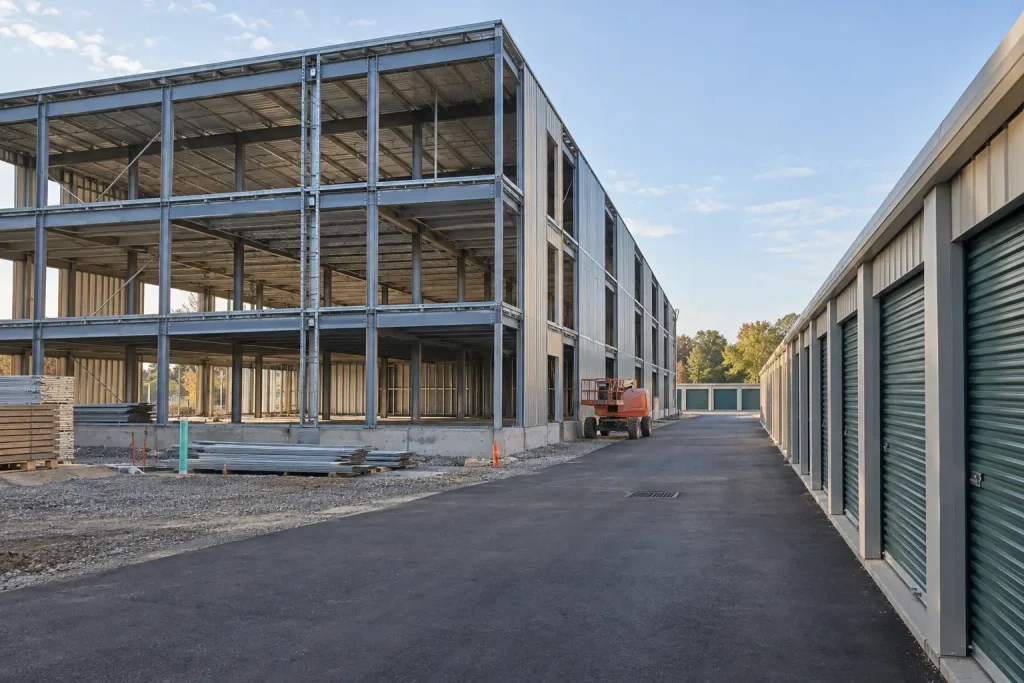
Self storage construction in Texas ran a median $61 per sq ft for the building in 122 projects registered in 2025 and 2026; Public Storage’s filed development cost, land not split out, was about $195 per net rentable sq ft.
Key takeaways
- In 122 Texas self-storage projects registered from January 2025 to October 2026, the median estimated construction cost was $61 per sq ft (middle half $40 to $78); multi-story buildings had a median of $70 and single-story sites $58 (TDLR TABS project search, CB&C count).
- Those projects planned a median of 11.4 months from construction start to completion, 12.0 months for multi-story buildings; Public Storage says physical occupancy can come 2 to 3 years after completion and revenue stabilization takes at least 3 to 4 years.
- Public Storage reported $408.9 million of completed development and redevelopment adding 2.1 million net rentable sq ft in 2025 (Form 10-K, filed February 12, 2026), about $195 per net rentable sq ft, against about $155 per sq ft for the 87 facilities it bought.
- The 2024 International Building Code places a self-service storage facility (mini-storage) in Group S-1 (IBC Section 311.2), and IBC Section 903.2.9 requires sprinklers where an S-1 fire area exceeds 12,000 sq ft, sits more than three stories above grade plane, or all S-1 fire areas combined exceed 24,000 sq ft.
- 2010 ADA Standards Table 225.3 requires 5% of units to be accessible in facilities with up to 200 units, and 10 plus 2% of the units over 200 in larger ones: 18 accessible units in a 600-unit facility.
- The SBA approved 62 504 loans to self-storage operators (NAICS 531130) in fiscal 2025 with $101.5 million in debentures (SBA FOIA data); 43 were startups, which must inject at least 15% of project cost under SOP 50 10 8.1.
How much does self storage construction cost?
The most current public price records are Texas project registrations. Owners register commercial projects with the Texas Department of Licensing and Regulation for accessibility review, and each public record lists estimated construction cost, square footage and planned start and finish dates. In 122 self-storage projects registered from January 2025 to October 2026, the building ran a median $61 per sq ft and 11.4 months.
| Project type (Texas, registered Jan 2025 to Oct 2026) | Projects | Estimated cost per sq ft: 25th / median / 75th percentile | Median estimated cost | Median size | Median planned construction time | Source |
|---|---|---|---|---|---|---|
| Multi-story building (2 to 4 stories) | 29 | $61 / $70 / $75 | $7,182,000 | 107,982 sq ft | 12.0 months (middle half 11.0 to 13.0) | TDLR TABS project search, CB&C count |
| Single-story drive-up or mixed site | 93 | $36 / $58 / $81 | $1,900,000 | 40,544 sq ft | 9.0 months (5.0 to 12.0) | TDLR TABS, CB&C count |
| All self-storage projects | 122 | $40 / $61 / $78 | $3,550,000 | 61,995 sq ft | 11.4 months (6.0 to 12.7) | TDLR TABS, CB&C count |
These are estimates filed at registration (pulled October 26, 2026), Texas prices and gross building area, not bids or closeout costs. They cover the building contract, not land, financing or lease-up. One record shows the gap: Public Storage registered a 3-story, 134,186 sq ft climate-controlled building in Collin County at $9,415,000, about $70 per sq ft (TABS2025020371), while its own filings show completed development at about $195 per net rentable sq ft.
For the all-in number, the firmest public figures are filed ones. Public Storage’s 2025 Form 10-K reports $408.9 million of completed development and redevelopment that added 2.1 million net rentable sq ft.
| Period | Activity (Public Storage) | Cost reported | Net rentable sq ft | Cost per net rentable sq ft (CB&C arithmetic) | Filing |
|---|---|---|---|---|---|
| 2023 | Completed development and redevelopment | $362.9 million | 1.7 million | $213 | Form 10-K FY2025 |
| 2024 | Completed development and redevelopment | $343.4 million | 1.5 million | $229 | Form 10-K FY2025 |
| 2025 | Completed development and redevelopment | $408.9 million | 2.1 million | $195 | Form 10-K FY2025 |
| Jan to Jun 2026 | Completed development and redevelopment | $57.3 million | 0.4 million | $143 | Form 10-Q Q2 2026 |
| 2024 | Acquired 22 facilities | $267.5 million | 1.7 million | $157 | Form 10-K FY2025 |
| 2025 | Acquired 87 facilities | $945.6 million | 6.1 million | $155 | Form 10-K FY2025 |
| Jan to Jun 2026 | Acquired 23 facilities | $243.2 million | 1.7 million | $143 | Form 10-Q Q2 2026 |
Three limits apply to this arithmetic. Net rentable sq ft counts rentable unit area, which is smaller than gross building area once corridors, offices and stairs are added. The filings round square footage to 0.1 million, so the 0.4 million figure for 2026 could be off by about 12%. The development totals also mix new sites with expansions of existing facilities.
Prices for the shell keep rising. The BLS producer price index for new warehouse building construction (series PCU236221236221) rose 4.5% in the 12 months to September 2026 (preliminary) and 50.5% since January 2020. Our guide to commercial construction cost per square foot covers hard-cost benchmarks by building type, and the CB&C construction price index tracks the escalation indexes.
What do cost guides say, and what do primary sources say?
Several ranking guides quote self-storage cost and SBA loan figures without a primary source, and some of the loan figures predate SOP 50 10 8.1. The table sets four of those claims, described neutrally, against a public record or the SBA rule in force as of October 2026.
| Claim in ranking guides | What the primary source says | Source |
|---|---|---|
| A cost guide updated in January 2026 gives $25 to $75 per sq ft in one version and $55 to $175 per sq ft in another, with no named source | The ranges measure different things: Texas registrations put the building alone at a median $61 per sq ft (middle half $40 to $78), while Public Storage’s filed 2025 development cost, with land not split out, works out to about $195 per net rentable sq ft | Public Storage Form 10-K FY2025 |
| A financing guide lists 504 eligibility as tangible net worth under $15 million and net income under $5 million | The alternative size standard is tangible net worth up to $20 million and average net income after federal tax up to $6.5 million (13 CFR 121.301) | SBA SOP 50 10 8.1 |
| Several guides give the 504 maximum as $5.5 million for any project | The standard debenture limit is $5,000,000 per small business; $5,500,000 applies to energy public policy projects and small manufacturers | SBA SOP 50 10 8.1 |
| Several guides state a 10% down payment for 504 loans | A business operating 2 years or less injects at least 15%, and 20% if the property is also limited or special purpose; 43 of 62 FY2025 self-storage 504 loans were startups | SBA SOP 50 10 8.1; SBA FOIA |
How long does it take to build and fill a self-storage facility?
Construction takes about a year: 29 multi-story self-storage buildings registered in Texas in 2025 and 2026 planned a median of 12.0 months on site, and single-story sites 9.0 months. Filling the building takes longer. Public Storage’s Q2 2026 Form 10-Q gives the clearest filed markers: remaining spending on its $691.7 million development pipeline is expected over the next 18 to 24 months, physical occupancy can come 2 to 3 years after completion, and revenue stabilization takes at least 3 to 4 years.
| Phase | Marker | Source |
|---|---|---|
| Construction, Texas registrations | Median 12.0 months for multi-story and 9.0 months for single-story sites | TDLR TABS, CB&C count |
| Zoning | A June 2026 Atlanta mayoral order stopped new self-storage building permit, land disturbance and rezoning applications pending council action; Georgia zoning procedures may take up to 180 days | City of Atlanta Executive Order, June 2026 |
| Construction spending | Remaining $431.6 million of a $691.7 million pipeline incurred mostly in 18 to 24 months | Public Storage Form 10-Q Q2 2026 |
| Lease-up | Physical occupancy as early as 2 to 3 years after completion | Public Storage Form 10-Q Q2 2026 |
| Stabilization | At least 3 to 4 years for revenue; underwritten at about an 8% yield on cost | Public Storage Form 10-Q Q2 2026 |
The same 10-Q names “challenges in obtaining building permits for self-storage facilities in certain municipalities” as a constraint on new projects. The steps below follow the order most projects take, with the document each one produces.
- Zoning check. Confirm self-storage is a permitted or special use on the parcel and whether a moratorium is pending, as in Atlanta’s Ordinance 26-O-1396.
- Environmental review. SOP 50 10 8.1 requires an Environmental Investigation of all commercial property pledged for an SBA loan or debenture; our guide to the Phase 1 environmental site assessment covers the ASTM E1527-21 report.
- Code analysis. Record Group S-1, construction type, fire areas against 12,000 sq ft and 24,000 sq ft, and the ADA Table 225.3 unit count on the cover sheet.
- Permits. Submit building, sprinkler and fire alarm drawings; our commercial building permits guide lists the usual review stages.
- Financing close. For a 504 loan, the third-party lender’s letter of intent or commitment must be in the application, and projects of $5,000,000 or more also need its credit memo (SOP 50 10 8.1).
- Construction and inspections. Ask the fire code official when the sprinkler (NFPA 13) and fire alarm acceptance tests must happen relative to final inspection.
- Occupancy. The building department issues the certificate of occupancy, and lease-up starts.
How do you choose a self storage construction company?
Choose a builder that has delivered your building type under the same code path: unsprinklered drive-up rows held under the 12,000 sq ft fire area, or a sprinklered multi-story S-1 building with elevators and a corridor fire alarm. Ask for 2 or 3 finished storage projects with owner contacts and planned versus actual months; the Texas median was 12.0 months for multi-story buildings.
| Question to ask | Why it matters | Rule or figure behind it |
|---|---|---|
| Did you price the building sprinklered, or split into fire areas of 12,000 sq ft or less? | The two layouts carry different costs, and the code allows either | IBC 2024 903.2.9; Table 707.3.10 (3-hour separation) |
| Is the metal building package, erection and roll-up doors in your number? | Pre-engineered steel is often bought separately from the general contract | Scope check on the bid form |
| Where are the accessible units, and in which size classes? | A 600-unit site needs 18, spread across the sizes offered | 2010 ADA Standards Table 225.3, 225.3.1 |
| How many months did your last 3 storage projects take, planned and actual? | Texas registrations planned a median of 12.0 months for multi-story and 9.0 for single-story | TDLR TABS, CB&C count |
| Will you work to an SBA 504 lender’s draw and inspection schedule? | The third-party lender’s commitment is part of the 504 application | SBA SOP 50 10 8.1 |
CB&C is a matching service, not a contractor. Line up at least three bids on the same drawings using our guide on how to compare construction bids, and see metal building contractors for how steel packages are designed and erected.
What counts as self storage construction under the building code?
The 2024 International Building Code defines a self-service storage facility as real property used to rent individual storage spaces to customers who store and remove their own goods, and Section 311.2 places it in Group S-1, moderate-hazard storage. That one classification drives the sprinkler, fire-wall, height and area rules for every building type in the table below, from drive-up rows to multi-story conditioned buildings.
Four building types cover most projects. Each follows a different path through the 2024 IBC and the 2024 International Existing Building Code (IEBC), so the first design decision is which path the site and budget allow.
| Building type | Typical form | Code path that usually governs | Check first | Source |
|---|---|---|---|---|
| Single-story drive-up | Rows of units with roll-up doors facing drive aisles, often several separate buildings | Each S-1 fire area at or under 12,000 sq ft can stay unsprinklered; the 903.2.9.4 furniture trigger does not apply | Building footprint against 12,000 sq ft and the Table 506.2 area limit (17,500 sq ft, Type IIB, nonsprinklered) | IBC 2024 Sections 903.2.9, 903.2.9.4; Table 506.2 |
| Multi-story climate-controlled | Interior corridors, elevator, conditioned space | Sprinklers once a fire area passes 12,000 sq ft or all floors pass 24,000 sq ft; manual fire alarm in corridors at 3 or more stories | Construction type against stories and height (Type IIB sprinklered: 4 stories, 75 ft) | IBC 2024 Sections 903.2.9, 907.2.10.1; Tables 504.3, 504.4 |
| Conversion of an existing building | Vacant big-box store, office or warehouse fitted with unit partitions | IEBC Chapter 10 change of occupancy to Group S-1 | Existing sprinkler coverage, egress, exterior wall ratings | IEBC 2024 Section 1011 |
| Enclosed vehicle, boat or RV storage | Large-door bays inside a building | Sprinklers where commercial motor vehicle storage exceeds 5,000 sq ft or lithium-ion powered vehicle storage exceeds 500 sq ft | Which vehicles the leases allow | IBC 2024 Section 903.2.9, items 4 and 5 |
Distribution, cold storage and flex shells follow different clear-height, slab and dock rules, which are covered in our guide to warehouse construction.
When does a self-storage building need sprinklers?
Under IBC 2024 Section 903.2.9, a building with a Group S-1 self-storage occupancy needs an automatic sprinkler system throughout when any S-1 fire area exceeds 12,000 sq ft, any S-1 fire area sits more than three stories above grade plane, or the S-1 fire areas on all floors together exceed 24,000 sq ft. Vehicle storage and stored upholstered furniture add two lower triggers.
A fire area is the floor area bounded by fire walls, fire barriers, exterior walls or horizontal assemblies, and the IBC defines a horizontal assembly as a fire-resistance-rated floor or roof (IBC 2024 Chapter 2). Between S-1 fire areas, IBC Table 707.3.10 requires a 3-hour rating, and Table 706.4 also sets 3 hours for S-1 fire walls. An unrated floor in a two-story building therefore joins both floors into one fire area.
The worked check below runs four example buildings through the five questions in the flowchart. The examples are illustrations, not designs.
| Example building | Largest S-1 fire area | Stories | Combined S-1 fire areas | Result under IBC 2024 Section 903.2.9 |
|---|---|---|---|---|
| A. Four separate drive-up buildings of 10,000 sq ft each | 10,000 sq ft | 1 | 10,000 sq ft per building | No trigger; the 903.2.9.4 furniture trigger does not apply because every unit opens outside |
| B. One drive-up building of 30,000 sq ft, no interior fire walls | 30,000 sq ft | 1 | 30,000 sq ft | Sprinklers required (item 1), or split into fire areas of 12,000 sq ft or less with 3-hour fire walls or fire barriers |
| C. Two-story interior-corridor building, 11,000 sq ft per floor, unrated floor | 22,000 sq ft (floors join) | 2 | 22,000 sq ft | Sprinklers required (item 1); with a 3-hour floor, items 1 to 3 are not met, but the 2,500 sq ft furniture trigger still applies |
| D. Three-story climate-controlled building, 30,000 sq ft per floor | 30,000 sq ft | 3 | 90,000 sq ft | Sprinklers required (items 1 and 3); corridor manual fire alarm under 907.2.10.1 unless waterflow activates notification |
Section 907.2.10.1 requires a manual fire alarm system for interior corridors and common areas in public- and self-storage buildings of three or more stories, with no visible alarm appliances required inside units. Its exception drops the manual pull stations where the building is sprinklered under Section 903.3.1.1 and occupant notification activates on sprinkler waterflow.
The IBC is a model code. Ask the building department which edition it adopted and whether it amended Section 903.2.9, and ask the fire code official how the 2,500 sq ft furniture trigger in Section 903.2.9.4 is applied when tenant contents are unknown.
How tall and how large can a self-storage building be?
IBC 2024 Tables 504.3, 504.4 and 506.2 set the limits for Group S-1 by construction type. A Type IIB building, noncombustible and unprotected, may rise 2 stories and 17,500 sq ft per story without sprinklers, or 4 stories, 75 ft and 52,500 sq ft per story with an NFPA 13 system in a multistory building. Frontage increases under Section 506.3 can add area.
| Construction type | Height, ft (NS / S) | Stories (NS / S) | Area per story, NS (sq ft) | Area, one story, S1 (sq ft) | Area per story, multistory, SM (sq ft) |
|---|---|---|---|---|---|
| IB | 160 / 180 | 11 / 12 | 48,000 | 192,000 | 144,000 |
| IIA | 65 / 85 | 4 / 5 | 26,000 | 104,000 | 78,000 |
| IIB | 55 / 75 | 2 / 4 | 17,500 | 70,000 | 52,500 |
| VA | 50 / 70 | 3 / 4 | 14,000 | 56,000 | 42,000 |
| VB | 40 / 60 | 1 / 2 | 9,000 | 36,000 | 27,000 |
NS means nonsprinklered; S, S1 and SM mean sprinklered under Section 903.3.1.1. Values are the Group S-1 rows of IBC 2024 Tables 504.3, 504.4 and 506.2, accessed October 20, 2026; Type IA is unlimited.
For a sprinklered Group S building of one or two stories surrounded by public ways or yards at least 60 ft wide, IBC Sections 507.4 and 507.5 remove the area limit entirely. That rule is the code basis for a single large sprinklered footprint; the alternative is a set of smaller buildings or fire areas, each held at or under 12,000 sq ft.
What does converting a store or office into self storage trigger?
Converting a vacant store, office or warehouse into self storage is a change of occupancy to Group S-1 under IEBC 2024 Chapter 10. Section 1011.2.1 requires sprinklers in the converted area wherever IBC Chapter 9 requires them for S-1 or sets a different threshold, and Tables 1011.5 to 1011.7 decide whether egress, height and area, and exterior walls must meet new-building rules.
| Existing use | Egress hazard (Table 1011.5) | Height and area hazard (Table 1011.6) | Exterior wall hazard (Table 1011.7) | Sprinkler threshold change | What usually follows |
|---|---|---|---|---|---|
| Retail, Group M | Category 3 to 4: lower hazard | Category 3 to 3: equal | Category 2 to 2: equal | Both trigger at a 12,000 sq ft fire area; the furniture trigger drops from 5,000 sq ft (903.2.7.2) to 2,500 sq ft (903.2.9.4) | Existing egress elements meet the IEBC rules for the new use; confirm the existing sprinkler design suits S-1 |
| Office, Group B | Category 4 to 4: equal | Category 4 to 3: higher hazard | Category 3 to 2: higher hazard | Group B has no area-based trigger (903.2.2 covers ambulatory care); S-1 triggers at 12,000 sq ft | Heights and areas must meet IBC Chapter 5 (1011.6.1); exterior walls must meet IBC ratings, with a 2-hour exception up to 3 stories (1011.7.1) |
How many accessible units does a self-storage facility need?
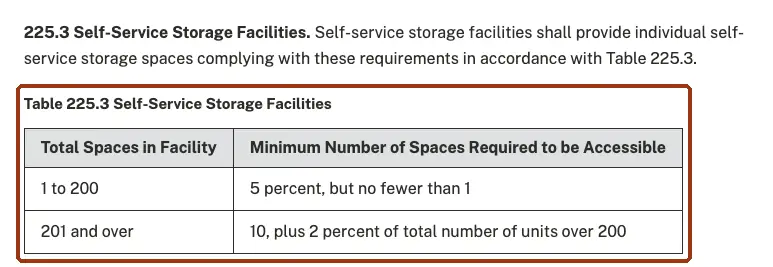
The 2010 ADA Standards for Accessible Design, Section 225.3, set how many self-storage units must be accessible: 5% of units, but at least 1, in facilities with 1 to 200 units, and 10 units plus 2% of the units over 200 in larger facilities. Section 104.2 rounds fractions up, and Section 225.3.1 spreads accessible units across the size classes offered.
| Total units in facility | Table 225.3 formula | Accessible units required |
|---|---|---|
| 80 | 5% of 80 = 4 | 4 |
| 150 | 5% of 150 = 7.5, rounded up under Section 104.2 | 8 |
| 200 | 5% of 200 = 10 | 10 |
| 600 | 10 + 2% of 400 = 18 | 18 |
| 1,000 | 10 + 2% of 800 = 26 | 26 |
Section 225.3.1 does not require accessible units to be spread among buildings in a multi-building facility, so a drive-up site may group them in one building served by accessible parking under Section 208. Under the Section 206.4.5 exception, storage spaces not required to comply with Section 225.3 need not sit on an accessible route.
Can an SBA 504 loan finance self storage construction?
Yes. The SBA loan-level FOIA file lists 62 SBA 504 approvals in fiscal 2025 for NAICS 531130, Lessors of Miniwarehouses and Self-Storage Units, carrying $101.5 million in debentures plus $158.2 million in third-party bank loans. Every one carried a 25-year (300-month) term, and 43 of the 62 borrowers were startups opening a new facility.
| SBA fiscal year | 504 approvals, NAICS 531130 | Debenture total ($ millions) | Average debenture ($) |
|---|---|---|---|
| FY2019 | 71 | 82.8 | 1,166,873 |
| FY2020 | 130 | 145.0 | 1,115,108 |
| FY2021 | 181 | 202.4 | 1,118,365 |
| FY2022 | 147 | 171.9 | 1,169,259 |
| FY2023 | 91 | 139.4 | 1,532,099 |
| FY2024 | 66 | 125.9 | 1,907,409 |
| FY2025 | 62 | 101.5 | 1,636,790 |
Counts are approvals by SBA fiscal year in the FOIA file dated June 30, 2026, including loans later cancelled; the 7(a) program added 119 self-storage approvals worth $163.4 million in FY2025.
SBA SOP 50 10 8.1, effective October 1, 2026, sets the capital stack. The worked example applies its three typical structures to a hypothetical $6,000,000 project covering land, building and eligible soft costs.
| Structure (SOP 50 10 8.1) | Third-party lender | CDC/SBA debenture | Borrower injection | Largest project under the $5,000,000 debenture cap |
|---|---|---|---|---|
| Standard: 50 / 40 / 10 | $3,000,000 | $2,400,000 | $600,000 | $12.5 million |
| New business (2 years or less) or limited or special purpose property: 50 / 35 / 15 | $3,000,000 | $2,100,000 | $900,000 | $14.3 million |
| New business and special purpose property: 50 / 30 / 20 | $3,000,000 | $1,800,000 | $1,200,000 | $16.7 million |
The SOP’s list of limited or special purpose properties names cold storage facilities where more than 50% of floor area is refrigerated, but not self-storage. The list is not all-inclusive, and the CDC must state its conclusion in the credit memorandum, so ask the CDC early which column it will use.
Three more rules matter for self-storage borrowers. Businesses primarily engaged in owning real estate and leasing it are ineligible under 13 CFR 120.110(c), so lenders document the operating business. The NAICS 531130 size standard is $34.0 million in annual receipts. From July 4, 2026, a borrower who takes a 7(a) loan first may combine up to $5 million of 7(a) with up to $5 million of 504 (SBA, May 18, 2026).
A project whose renewable energy sources generate more than 15% of the energy used at the facility can qualify as an energy public policy project with a $5,500,000 debenture limit. The SBA 504 loan data for builders themselves are in our report on SBA loans for construction companies. CB&C is not a lender, and this section is not financial advice.
Which path fits your project?
The decision table turns the code and financing thresholds above into next steps. Each row names the rule that sets the threshold, so a designer or lender can confirm it against the adopted code or the current SOP before money is spent.
| If | Then | Rule |
|---|---|---|
| You need a first construction budget | Start from the Texas registration medians ($70 per sq ft multi-story, $58 single-story, building only), then add land, site work, soft costs and lease-up | TDLR TABS, CB&C count; Public Storage Form 10-K |
| Each building can stay at or under a 12,000 sq ft fire area, one story, units opening outside | Plan unsprinklered drive-up rows; confirm local amendments | IBC 903.2.9, 903.2.9.4 |
| One building needs more than 12,000 sq ft in one fire area | Sprinkler it under NFPA 13, or split it with 3-hour fire walls or fire barriers; price both | IBC 903.2.9, Table 707.3.10 |
| Three or more stories | Sprinklered Type IIB or better (Type IIB: 4 stories, 75 ft, 52,500 sq ft per story); corridor alarm under 907.2.10.1 | IBC Tables 504.3, 504.4, 506.2 |
| Converting big-box retail (Group M) | Expect equal or lower IEBC hazard categories; confirm the existing sprinkler design for S-1 | IEBC 1011.2.1, Tables 1011.5 to 1011.7 |
| Converting an office (Group B) | Budget for height and area compliance, exterior wall ratings and sprinklers above 12,000 sq ft | IEBC 1011.6.1, 1011.7.1 |
| More than 200 units | Provide 10 plus 2% of units over 200 as accessible, spread across unit sizes | ADA 2010 Table 225.3, 225.3.1 |
| Business under 2 years old using a 504 loan | Plan at least 15% equity (20% if the CDC rules the property special purpose) | SBA SOP 50 10 8.1 |
| Project above $12.5 million (existing operator) or $14.3 million (startup) | The $5,000,000 debenture cap binds; add 7(a) under the $10 million combined limit or use a conventional loan | SOP 50 10 8.1; SBA, May 18, 2026 |
For single-contract delivery, our page on design-build contractors compares the options.
To price the sprinklered option, including the fire line and a possible fire pump, see our fire sprinkler system cost breakdown.
The 3-hour separation can be a fire wall or a fire barrier, and our fire rated wall guide compares the two, with UL designs and door ratings.
How we compiled this
We read 9 primary documents by section, including IBC 2024, IEBC 2024, the 2010 ADA Standards, SBA SOP 50 10 8.1, two Public Storage SEC filings and a City of Atlanta executive order. We computed from 2 federal datasets, the SBA 504 and 7(a) FOIA files and BLS producer price indexes, accessed October 2026. For cost and timing we pulled every self-storage registration in the Texas TDLR TABS public search from January 2025 to October 2026 on October 26, 2026 and kept 122 new buildings and additions with usable cost and size. Blog and contractor cost ranges were excluded because none named a primary source.
Frequently asked questions
How much does it cost to build a self storage facility?
For the building alone, 122 Texas self-storage projects registered in 2025 and 2026 had a median estimated cost of $61 per sq ft, $70 for multi-story buildings. All-in, Public Storage’s 2025 Form 10-K reports $408.9 million of completed development adding 2.1 million net rentable sq ft, about $195 per net rentable sq ft; the filing does not split out land.
Do self-storage buildings need fire sprinklers?
Under IBC 2024 Section 903.2.9, yes when any Group S-1 fire area exceeds 12,000 sq ft, sits more than three stories above grade plane, or all S-1 fire areas combined exceed 24,000 sq ft. A one-story facility with every unit opening outside is exempt from the 2,500 sq ft upholstered furniture trigger. Local amendments can be stricter.
Can I use an SBA 504 loan to build self storage?
Yes. SBA FOIA data show 62 504 approvals for NAICS 531130 self-storage operators in fiscal 2025, all on 25-year terms. Under SOP 50 10 8.1 a standard project is 50% bank, 40% debenture and 10% equity, and a business operating 2 years or less injects at least 15%. The standard debenture limit is $5,000,000.
How long does a new self-storage facility take to fill?
Public Storage’s Form 10-Q for the second quarter of 2026 says physical occupancy can be reached as early as 2 to 3 years after completion, and revenue stabilization takes at least 3 to 4 years. The company underwrites new developments to stabilize at about an 8% yield on cost.
How long does it take to build a self-storage facility?
Texas registrations from 2025 and 2026 planned a median of 12.0 months of construction for a multi-story self-storage building and 9.0 months for a single-story site. Zoning can add more: a June 2026 Atlanta order paused new self-storage permits, and Georgia zoning procedures may take up to 180 days. Lease-up then takes 2 to 3 years, per Public Storage.
How many ADA accessible units does a storage facility need?
Table 225.3 of the 2010 ADA Standards requires 5% of units, but no fewer than 1, in facilities with 1 to 200 units, and 10 plus 2% of the units over 200 in larger ones. A 600-unit facility needs 18. Section 225.3.1 spreads them across unit size classes but not across buildings.
What occupancy classification is self storage?
IBC 2024 Section 311.2 lists a self-service storage facility (mini-storage) under Group S-1, moderate-hazard storage. That classification sets the 12,000 sq ft sprinkler trigger in Section 903.2.9, the 3-hour rating between fire areas in Table 707.3.10, and the height and area limits in Tables 504.3, 504.4 and 506.2.
Sources
- International Code Council: International Building Code 2024, Chapter 2 Definitions (accessed October 20, 2026)
- International Code Council: International Building Code 2024, Chapter 3 Occupancy Classification and Use (Section 311.2) (accessed October 20, 2026)
- International Code Council: International Building Code 2024, Chapter 5 General Building Heights and Areas (Tables 504.3, 504.4, 506.2; Sections 507.4, 507.5) (accessed October 20, 2026)
- International Code Council: International Building Code 2024, Chapter 7 Fire and Smoke Protection Features (Tables 706.4, 707.3.10) (accessed October 20, 2026)
- International Code Council: International Building Code 2024, Chapter 9 Fire Protection and Life Safety Systems (Sections 903.2.2, 903.2.7, 903.2.9, 907.2.10.1) (accessed October 20, 2026)
- International Code Council: International Existing Building Code 2024, Chapter 10 Change of Occupancy (Section 1011) (accessed October 20, 2026)
- U.S. Department of Justice: 2010 ADA Standards for Accessible Design (Sections 104.2, 206.4.5, 225.3) (accessed October 20, 2026)
- U.S. Bureau of Labor Statistics: Producer Price Index industry data for construction, series PCU236221236221 (accessed October 3, 2026)
- U.S. Securities and Exchange Commission, EDGAR: Public Storage Form 10-K for fiscal 2025 (filed February 12, 2026) (accessed October 20, 2026)
- U.S. Securities and Exchange Commission, EDGAR: Public Storage Form 10-Q for the quarter ended June 30, 2026 (filed July 29, 2026) (accessed October 20, 2026)
- U.S. Small Business Administration: SOP 50 10 8.1, Lender and Development Company Loan Programs (effective October 1, 2026) (accessed October 20, 2026)
- U.S. Small Business Administration: 504 loans (program page) (accessed October 7, 2026)
- U.S. Small Business Administration: SBA doubles cumulative 7(a) and 504 loan limit to $10 million (May 18, 2026) (accessed October 7, 2026)
- U.S. Small Business Administration: 7(a) and 504 FOIA loan-level data (files as of June 30, 2026) (accessed October 7, 2026)
- Office of the Federal Register, eCFR: 13 CFR 121.201, size standards by NAICS code (accessed October 7, 2026)
- City of Atlanta, Office of the Mayor: Executive Order on self-storage, secure-storage and mixed-use storage facility applications (June 2026) (accessed October 20, 2026)
- Texas Department of Licensing and Regulation: TABS project search, self-storage registrations January 2025 to October 2026, accessed October 26, 2026.