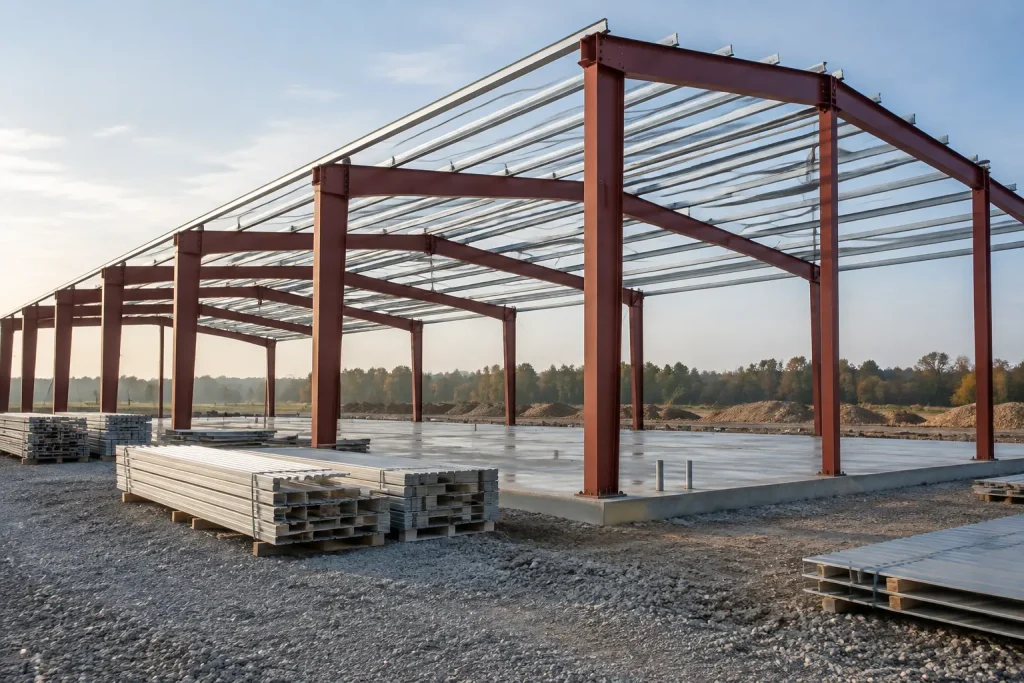
Steel building prices in federal purchase records run about $16 to $17 per sq ft for the steel package alone and $50 to $122 per sq ft erected; the BLS package index rose 4.7% in the year to September 2026.
Key takeaways
- Four federal kit purchases with a stated size on USAspending.gov cost $16.17 to $17.30 per sq ft for 1,200 to 8,000 sq ft packages (2021 to 2024), or $17.77 to $21.47 in September 2026 dollars; a 480 sq ft kit cost $46.23.
- Erected, the same records show $50.20 per sq ft for a 1,440 sq ft shell (California, 2023) and $122.10 for a 10,023 sq ft insulated building with its slab (Texas, 2025).
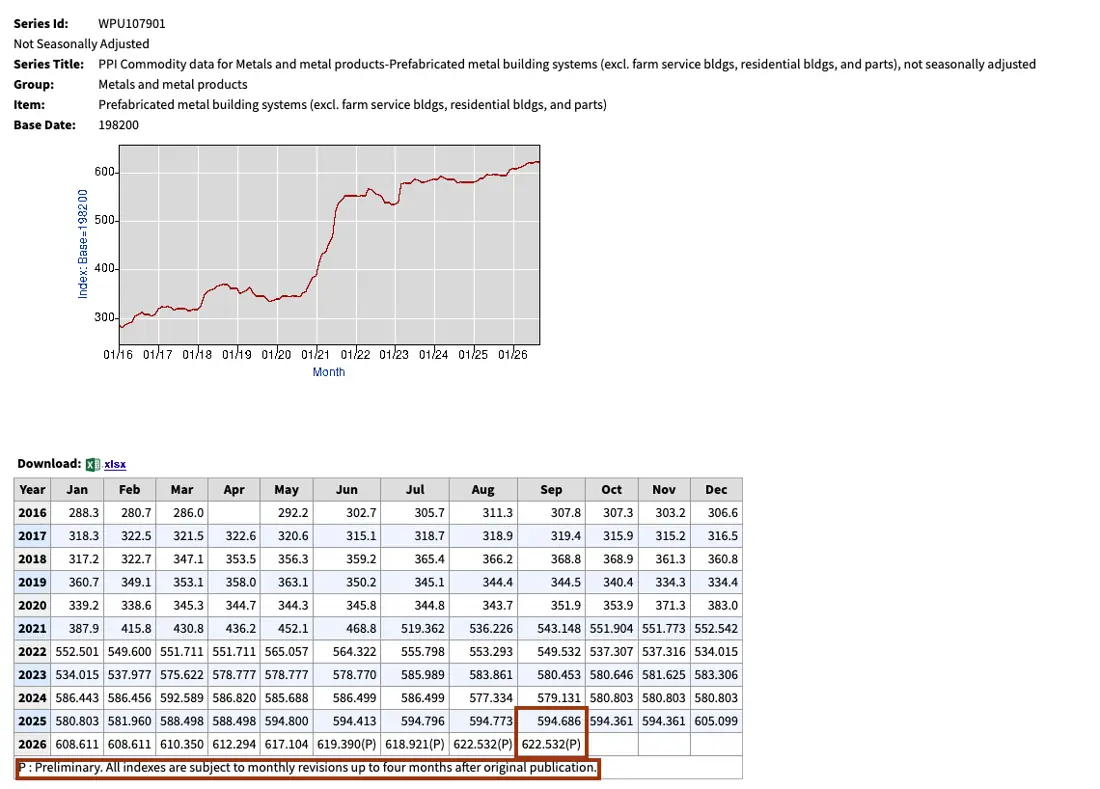
- The Bureau of Labor Statistics producer price index for prefabricated metal building systems (WPU107901) read 622.532 in September 2026 (preliminary), its highest level on record, up 4.7% in 12 months and 83.5% since January 2020.
- Raw steel moved much faster: steel mill products (WPU1017) rose 27.6% and cold rolled steel sheet and strip (WPU101707) rose 36.9% in the 12 months to September 2026.
- Since April 6, 2026, Proclamation 11021 charges the Section 232 duty of 50% on the full customs value of imported steel articles, regardless of metal content.
- Location moves a finished building more than steel does: the Rider Levett Bucknall Q3 2026 report puts warehouse hard costs at $75 to $155 per sq ft in Dallas and $290 to $370 in Portland.
How much does a steel building cost in 2026?
Federal purchase records give a dated answer. In awards that state the building size, the steel package alone cost $16.17 to $17.30 per sq ft for 1,200 to 8,000 sq ft buildings bought from 2021 to 2024, about $18 to $21 per sq ft in September 2026 dollars. Erected buildings ran $50.20 per sq ft for a small shell and $122.10 with slab and insulation.
| Scope in the record | Building and buyer | Award | Per sq ft as awarded | Per sq ft, Sep 2026 dollars | Date | Record |
|---|---|---|---|---|---|---|
| Package only | 80 x 100 x 20 ft metal building, 8,000 sq ft; Federal Law Enforcement Training Center, Georgia; 6 offers | $129,370 | $16.17 | $21.47 | Jun 2021 | USAspending |
| Package only | 30 x 50 x 12 ft building kit, 1,500 sq ft; Defense Logistics Agency order, New Jersey | $24,860 | $16.57 | $17.77 | Sep 2023 | USAspending |
| Package only | 30 x 40 ft building kit, 1,200 sq ft; Defense Logistics Agency order, Maryland | $20,761 | $17.30 | $18.37 | Jan 2024 | USAspending |
| Package only | 24 x 20 ft metal building kit, 480 sq ft; Defense Logistics Agency order, New Jersey | $22,190 | $46.23 | $49.45 | Feb 2025 | USAspending |
| Erection labor only | 60 x 100 ft prefabricated steel shed, 6,000 sq ft; USDA Agricultural Research Service, Arkansas; 3 offers | $24,680 | $4.11 | Not escalated | Mar 2020 | USAspending |
| Erection labor only | 40 x 60 ft prefabricated steel hay barn, 2,400 sq ft; USDA Agricultural Research Service, Arkansas; 6 offers | $35,748 | $14.89 | Not escalated | Jul 2022 | USAspending |
| Erected shell | 48 x 30 x 13 ft pre-engineered metal building for equipment storage, 1,440 sq ft; USDA Agricultural Research Service, California; 11 offers | $72,283 | $50.20 | Not escalated | Sep 2023 | USAspending |
| Erected on an existing slab | 18 x 20 ft tubular steel garage, 360 sq ft; USDA Agricultural Research Service, North Carolina; 17 offers | $30,842 | $85.67 | Not escalated | Aug 2024 | USAspending |
| Slab, delivery, erection, insulation | 10,023 sq ft insulated pre-engineered building with slab and plumbing rough-in; U.S. Fish and Wildlife Service, Texas | $1,223,784 | $122.10 | Not escalated | Sep 2025 | USAspending |
| Complete facility | 2,700 sq ft pre-engineered metal building for tools and equipment; U.S. Air Force, Florida; not competed | $739,515 | $273.89 | Not escalated | Sep 2022 | USAspending |
What these records cover, and what they do not:
- They are the 10 federal contract awards, out of about 3,400 metal building and prefabricated building awards screened on USAspending.gov on October 26, 2026, whose description names a steel or metal building and its size.
- Each per-sq-ft figure is the obligated amount divided by the floor area in the description; scope is only what the description says. CB&C escalated the package rows with BLS series WPU107901 to September 2026 (622.532, preliminary).
- Federal prices can run above private ones: the three Defense Logistics Agency kits were prime-vendor orders without competition, so they carry a vendor margin, and construction awards carry prevailing wages, which the Davis-Bacon Act requires on federal construction contracts over $2,000.
- Cooperative purchasing contracts we checked publish discount or not-to-exceed terms rather than per-sq-ft prices, and the municipal awards we found sat behind paid bid services, so neither is used.
- Ten records are a price anchor, not a market survey.
What does a 30 x 40, 40 x 60 or 60 x 100 steel building cost?
At the federal kit record rate of $18 to $21 per sq ft in September 2026 dollars, a 40 x 60 package comes to about $43,200 to $50,400 and a 60 x 100 package to $108,000 to $126,000. Add erection labor, which ran $4.11 and $14.89 per sq ft in two federal awards, then the slab. A finished warehouse costs far more.
| Size (ft) | Floor area | Package at $18 to $21 per sq ft | Erection labor at $4 to $15 per sq ft | Finished warehouse, RLB Dallas, $75 to $155 per sq ft |
|---|---|---|---|---|
| 30 x 40 | 1,200 sq ft | $21,600 to $25,200 | $4,800 to $18,000 | $90,000 to $186,000 |
| 40 x 60 | 2,400 sq ft | $43,200 to $50,400 | $9,600 to $36,000 | $180,000 to $372,000 |
| 50 x 100 | 5,000 sq ft | $90,000 to $105,000 | $20,000 to $75,000 | $375,000 to $775,000 |
| 60 x 100 | 6,000 sq ft | $108,000 to $126,000 | $24,000 to $90,000 | $450,000 to $930,000 |
| 80 x 100 | 8,000 sq ft | $144,000 to $168,000 | $32,000 to $120,000 | $600,000 to $1,240,000 |
All figures are CB&C arithmetic on the records above and the RLB Quarterly Construction Cost Report for Q3 2026, which puts warehouse hard costs at $75 to $370 per sq ft across 18 U.S. cities. The package and erection columns leave out the slab, doors beyond the base kit, insulation, freight beyond the record terms and permits. Buildings under about 500 sq ft cost more per sq ft, as the 480 sq ft kit at $49.45 shows.
Manufacturer and dealer guides publish their own per-square-foot ranges, but in our October 20, 2026 check none named a source or a data date. The two leading U.S. guides disagree by about 2 times on the same kit, which price movement cannot explain: the BLS building systems index rose only 5.8% from March 2025 to September 2026.
| Benchmark | What it measures | Latest figure | Period | Source |
|---|---|---|---|---|
| RLB Quarterly Cost Report, warehouse | Hard cost of a finished warehouse per sq ft of gross floor area, 18 U.S. cities | $75 to $370 per sq ft | Q3 2026 | Rider Levett Bucknall |
| PPI, prefabricated metal building systems (WPU107901) | Manufacturer prices for complete metal building systems, excluding farm and residential buildings | 622.532 (P), +4.7% in 12 months | Sep 2026 | BLS |
| PPI, new warehouse building construction (PCU236221236221) | Contractor prices for finished new warehouses | 244.738 (P), +4.5% in 12 months | Sep 2026 | BLS |
| PPI, steel mill products (WPU1017) | Mill prices for steel shapes, plate, sheet, bar and pipe | 388.580 (P), +27.6% in 12 months | Sep 2026 | BLS |
| DoD area cost factors | Relative construction cost by location, 96-Base-City average = 1.00 | 0.81 (Charlotte) to 2.03 (Honolulu) for cities listed here | Data as of Oct 1, 2025 | UFS 3-701-01 |
The table below sets what the two leading guides published as of October 20, 2026 against what the primary data confirms. We describe the guides rather than name them, because their figures carry no source we could check.
| What a top-ranking guide says | What the primary data shows | What to do with it |
|---|---|---|
| A manufacturer guide titled for 2026 (accessed Oct 20, 2026): kits $30 to $68 per sq ft, installed $55 to $114, with no source or data date | Federal kit records priced 1,200 to 8,000 sq ft packages at $16.17 to $17.30 per sq ft (2021 to 2024); escalated to Sep 2026 they reach $17.77 to $21.47, under this guide’s $30 low end, so its range likely covers more scope or smaller buildings | Ask any supplier what the per-sq-ft number includes: frame, panels, insulation, doors, freight, erection, slab |
| A dealer guide titled for 2025, still served in Oct 2026: kits $15 to $25 per sq ft, installed $24 to $43 | Escalated by WPU107901 from Mar 2025 (588.498) to Sep 2026 (622.532), $15 to $25 becomes $15.87 to $26.45, a band that holds the escalated federal kit records | Escalate any dated range with a named BLS series before budgeting |
| Guides say steel market prices drive steel building prices | Steel mill products fell 41.8% from Dec 2021 to Jan 2025 while WPU107901 rose 5.1% | Do not wait for a steel price drop to lower a package quote; track the building systems index |
| Guides mention tariffs only in general terms | Section 232 steel duty: 25% from Mar 12, 2025, 50% from Jun 4, 2025, 50% of full customs value from Apr 6, 2026 | Ask whether any component is imported and how the duty is passed through |
For budgets across all building types, our guide to commercial construction cost per square foot explains how to read published ranges.
What moves steel building prices, and by how much?
Seven inputs move a steel building price: hot rolled plate and shapes for the primary frames, cold rolled sheet for purlins, girts and panels, fasteners, insulation, concrete for the slab, freight and diesel. In the 12 months to September 2026, BLS prices for these inputs ranged from a 3.1% fall for bolts to a 115.2% rise for diesel fuel.
| BLS series | ID | Sep 2026 index (P) | 12 months | Since Jan 2020 | What it prices in a steel building |
|---|---|---|---|---|---|
| Prefabricated metal building systems | WPU107901 | 622.532 | +4.7% | +83.5% | Complete package from the manufacturer |
| Steel mill products | WPU1017 | 388.580 | +27.6% | +107.5% | All mill steel, the raw input |
| Hot rolled bars, plates and structural shapes | WPU101704 | 319.693 | +15.0% | +69.1% | Plate for built-up frames, columns, rafters |
| Cold rolled steel sheet and strip | WPU101707 | 492.454 | +36.9% | +125.3% | Coil for purlins, girts and panels |
| Fabricated structural metal | WPU107405 | 380.544 | +5.8% | +67.6% | Fabricated beams and columns (conventional frames) |
| Bolts, nuts, screws, rivets and washers | WPU1081 | 331.921 | -3.1% | +56.6% | Frame bolts and panel fasteners |
| Insulation materials | WPU1392 | 293.639 | +2.7% | +51.9% | Roof and wall insulation |
| Ready-mixed concrete | WPU1333 | 395.319 | +2.3% | +40.4% | Slab and foundations |
| Truckload long-distance freight | PCU484121484121 | 219.384 | +17.9% | +61.0% | Delivery of the package |
| No. 2 diesel fuel | WPU057303 | 675.626 | +115.2% | +215.0% | Freight surcharges, cranes and site equipment |
The pattern is clear in the numbers. Sheet steel and freight rose fastest in 2026, while bolts, concrete and insulation barely moved. A quote with a large freight share, long delivery distance or a heavy panel package will feel the 2026 increases more than a quote that is mostly frame. Our monthly report on the commercial construction price index tracks these series with labor and output prices.
Why don’t steel building prices track raw steel?
Steel building prices track a finished product, not a commodity. The BLS index for prefabricated metal building systems rose 62.9% from January 2020 to December 2021 with steel, then held near its peak while steel mill products fell 41.8% by January 2025. Engineering, fabrication, labor and overhead make up the rest of the package price, and those costs rarely fall.
| Month | Metal building systems (WPU107901) | Steel mill products (WPU1017) | Cold rolled sheet (WPU101707) |
|---|---|---|---|
| Jan 2020 | 100.0 | 100.0 | 100.0 |
| Dec 2021 | 162.9 | 240.1 | 323.7 |
| Jan 2023 | 157.4 | 164.5 | 146.2 |
| Jan 2025 | 171.2 | 139.6 | 143.9 |
| Apr 2026 | 180.5 | 182.4 | 191.7 |
| Sep 2026 (P) | 183.5 | 207.5 | 225.3 |
Index values are rebased by CB&C to January 2020 = 100 from the published BLS levels (339.2, 187.3 and 218.6 in January 2020). After 2021 the metal building systems index fell at most 5.4%, from June 2022 (564.322) to January 2023 (534.015), while steel mill products swung from 240.1 down to 139.6 and back to 207.5.
The practical point: when steel prices fall, a package quote may not follow, and when steel jumps, the package rises less. The BLS table for WPU107901 shows the September 2025 and September 2026 readings used throughout this page, and the note that preliminary values can change for 4 months.
How do Section 232 steel tariffs reach a steel building quote?
Section 232 duties raise the price of imported steel, and domestic mill prices have risen alongside them. Three proclamations set the 2025 to 2026 path: 25% for all countries from March 12, 2025, 50% from June 4, 2025, and 50% on full customs value from April 6, 2026. U.S. net import reliance for steel mill products was 13% in 2025, per the USGS Mineral Commodity Summaries 2026.
| Date | Action | Rate | Steel mill PPI (WPU1017) | PEMB systems PPI (WPU107901) | Source |
|---|---|---|---|---|---|
| Mar 12, 2025 | Proclamation 10896 | 25% on steel, all countries | 287.362 | 588.498 | 90 FR 9817 |
| Jun 4, 2025 | Proclamation 10947 | Raised to 50% | 309.231 | 594.413 | 90 FR 24199 |
| Apr 6, 2026 | Proclamation 11021 | 50% on full customs value; 25% for Annex I-B derivatives | 341.570 | 612.294 | 91 FR 18201 |
| Sep 2026 | Latest BLS reading | Preliminary (P) values | 388.580 | 622.532 | BLS |
From March 2025 to September 2026, steel mill products rose 35.2% and PEMB systems rose 5.8%. Construction took about 31% of U.S. net steel shipments in 2025, according to USGS, so builders feel mill prices directly on rebar, deck and structural shapes even when the building package moves less.
The American Institute of Steel Construction puts the pass-through in proportion on its tariffs page: material is less than one-third of framing system cost, and the frame is around 12% of project cost. On a $1,000,000 project that puts the steel material in the frame under $40,000, so the 27.6% mill price rise in the 12 months to September 2026 adds under $11,040, or under 1.1% of project cost (CB&C arithmetic).
A metal building carries more of its value in steel than the typical framed building AISC describes, because its walls and roof panels are steel too, and cold rolled sheet rose 36.9% in the same 12 months, so run the same arithmetic with the steel share from your own quote. The month-by-month tariff register is in our report on tariffs on construction materials.
How much does location change a steel building price?
Location changes the finished price by more than any 2026 steel move. RLB’s Q3 2026 warehouse hard costs run from $75 to $155 per sq ft in Austin and Dallas to $290 to $370 in Portland. For a 6,000 sq ft building, that is $450,000 to $930,000 in Dallas against $1,740,000 to $2,220,000 in Portland, before land and soft costs.
| City | RLB warehouse hard cost per sq ft, Q3 2026 | 6,000 sq ft at RLB range (CB&C arithmetic) |
|---|---|---|
| Austin | $75 to $155 | $450,000 to $930,000 |
| Dallas | $75 to $155 | $450,000 to $930,000 |
| Miami | $80 to $160 | $480,000 to $960,000 |
| Phoenix | $85 to $170 | $510,000 to $1,020,000 |
| Las Vegas | $80 to $180 | $480,000 to $1,080,000 |
| Charlotte | $135 to $215 | $810,000 to $1,290,000 |
| Nashville | $140 to $215 | $840,000 to $1,290,000 |
| Denver | $140 to $225 | $840,000 to $1,350,000 |
| Los Angeles | $150 to $230 | $900,000 to $1,380,000 |
| Chicago | $155 to $245 | $930,000 to $1,470,000 |
| Seattle | $195 to $265 | $1,170,000 to $1,590,000 |
| Honolulu | $160 to $305 | $960,000 to $1,830,000 |
| Portland | $290 to $370 | $1,740,000 to $2,220,000 |
For a city not listed, ask local builders for recent warehouse or shop prices in the same county, and compare them with the package and erection figures above to see what the slab, site work and finish add. Steel buildings in Broward and Miami-Dade counties also carry Florida’s stricter wind rules, covered in our guide to high-velocity hurricane zone construction.
How do you update an old steel building quote?
Multiply the old price by the ratio of the latest BLS index value to the value for the month of the quote. A $150,000 metal building package priced in September 2025 becomes $157,024 on the building systems index (WPU107901) but $191,369 on the steel mill index (WPU1017). The index named in your escalation clause decides which number you pay.
| Step | Building systems index (WPU107901) | Steel mill index (WPU1017) |
|---|---|---|
| Package quote, Sep 2025, 6,000 sq ft (60 x 100), illustrative | $150,000 ($25.00 per sq ft) | $150,000 ($25.00 per sq ft) |
| Index, Sep 2025 | 594.686 | 304.579 |
| Index, Sep 2026 (P) | 622.532 | 388.580 |
| Ratio (Sep 2026 / Sep 2025) | 1.0468 | 1.2758 |
| Escalated package | $157,024 ($26.17 per sq ft) | $191,369 ($31.89 per sq ft) |
| Increase | $7,024 | $41,369 |
The $34,345 gap between the two columns comes only from the choice of index. Follow these steps for any dated quote or published range:
- Find the month the price was set, not the month you received the paperwork. A quote valid for 30 days from June 15 is a June price.
- Pick the series that matches the scope: WPU107901 for a complete metal building package, WPU101704 for hot rolled plate and shapes, PCU236221236221 for a finished warehouse contract.
- Read the base-month and latest values at data.bls.gov/timeseries followed by the series ID. Values marked (P) are preliminary and can change for 4 months after release.
- Divide the latest value by the base value and multiply the quote. Round only at the end.
- In a contract clause, name the series ID, the base month, whether final values replace preliminary ones, and any cap. Have your attorney review the wording; this page is not legal advice.
When bids arrive on different dates, escalate each to the same month before you rank them: at the 2026 pace of 2.7% a month, a 2-month gap is worth about 5.5% on a price tied to mill steel. Our guide on how to compare construction bids covers the rest of the comparison.
What should a steel building quote spell out?
A steel building quote should state the design loads, what the package includes, who sets the anchor rods, the energy code basis, and freight, tariff and validity terms. Two quotes at the same price per square foot can carry different wind speeds or snow loads under ASCE/SEI 7-22, and the cheaper one may simply be designed for less.
| Item | What to ask the supplier | Rule or source |
|---|---|---|
| Design loads | Wind speed, exposure category, risk category, ground snow load, seismic and collateral loads, in writing | ASCE Hazard Tool values under ASCE 7-22 |
| Anchor rods and foundation | Who designs the foundation, who sets the anchor rods and who checks them before erection | OSHA 29 CFR 1926.758(b): at least 4 anchor rods per column on systems-engineered metal buildings |
| Insulation and energy code | Which energy code edition and climate zone the roof and wall insulation are designed for | DOE Building Energy Codes Program tracks state adoption |
| Freight | Freight as a separate line, delivery point and any fuel surcharge | BLS truckload freight +17.9% and diesel +115.2%, 12 months to Sep 2026 |
| Tariffs and validity | Validity date, escalation index, and whether imported parts carry a duty pass-through | Proclamation 11021: 50% of full customs value from Apr 6, 2026 |
| Erection | Whether erection is included, and the erector’s accreditation | MBMA encourages erectors to hold IAS AC478 |
| Doors and openings | Count, size and wind rating of each framed opening, fixed before fabrication | Framed openings are designed into the building under ASCE 7-22 loads |
The energy code edition adopted where you build sets the minimum insulation. BLS insulation prices rose only 2.7% in 12 months, so a large gap between two quotes on this line points to a different specified assembly, not material inflation. Our commercial energy code by state report shows which edition applies by state. For who builds and erects the package, see our page on metal building contractors.
When should you lock a steel building price?
Lock a steel building price when the design loads are final and the quote names its index, because steel mill prices rose 17.3% from March to September 2026, about 2.7% a month compounded, while the building systems index rose 2.0%. The decision table and the flowchart hold the same checks.
| If | Then | Threshold or source |
|---|---|---|
| The price basis is more than 4 months old | Escalate with the BLS index before comparing | BLS revises PPI values for 4 months after release |
| The escalation clause has no BLS series ID | Ask for series, base month and cap | WPU107901 rose 4.7% vs 27.6% for WPU1017, 12 months to Sep 2026 |
| Design loads do not match ASCE 7-22 for the site | Re-quote on matched loads | ASCE Hazard Tool wind speed and ground snow load for your address and risk category |
| Freight and tariffs are folded into one price | Ask for both lines in writing | Diesel +115.2%; Section 232 duty 50% of full customs value |
| You need a package budget before any quote | Use $18 to $21 per sq ft for 1,200 to 8,000 sq ft, more for small buildings | Federal kit records escalated to Sep 2026 (USAspending, BLS WPU107901) |
| You are budgeting the finished building, not the kit | Use the RLB city warehouse range | $75 to $370 per sq ft, Q3 2026 |
| Steel mill prices are falling when you buy | Do not expect the package to follow | Dec 2021 to Jan 2025: WPU1017 -41.8%, WPU107901 +5.1% |
The four checks in the flowchart, in order:
- Is the price basis 4 months old or less? If no: Escalate with the BLS index (BLS revision window, data.bls.gov).
- Does the escalation clause name a BLS series ID? If no: Ask for series, base month and cap (WPU107901 for a full package).
- Do design loads match ASCE 7-22 for the site? If no: Re-quote on matched loads (ASCE Hazard Tool values).
- Are freight and tariffs separate lines? If no: Ask for both lines in writing (Proclamation 11021; BLS freight). If every answer is yes: Compare bids line by line.
For warehouse and flex projects, our warehouse construction guide compares metal, tilt-up and precast shells.
What the package includes is covered in our metal building kits guide, and the engineered system being priced in our pre-engineered metal building guide.
How we compiled this
We pulled 20 BLS producer price series through the BLS Public Data API on October 20, 2026, and checked the WPU107901 table on data.bls.gov. We read the RLB Q3 2026 report, the DoD UFS 3-701-01 (June 2026) data tables, three Federal Register proclamations, the USGS 2026 iron and steel summary, the AISC tariffs page and OSHA 29 CFR 1926.758. On October 26, 2026 we screened about 3,400 federal awards on USAspending.gov and kept the 10 that state a steel or metal building and its size; all documents are listed under Sources. We did not test or price any building ourselves; the record prices are what agencies paid, and the $150,000 and $1,000,000 inputs are illustrations, not market data.
Frequently asked questions
How much does a steel building cost per square foot?
In federal purchase records with a stated size, the steel package alone cost $16.17 to $17.30 per sq ft for 1,200 to 8,000 sq ft buildings (2021 to 2024), about $18 to $21 in September 2026 dollars. Erected buildings cost $50.20 per sq ft for a 1,440 sq ft shell and $122.10 with slab and insulation. Finished warehouses run $75 to $370 per sq ft (RLB, Q3 2026).
Are steel building prices going up or down in 2026?
Up, but slowly. The BLS index for prefabricated metal building systems (WPU107901) rose 4.7% in the 12 months to September 2026 to a record 622.532 (preliminary). Steel mill products rose 27.6% over the same period, and freight rose 17.9%, so suppliers face cost pressure that can reach new quotes.
How much does a 60 x 100 steel building cost?
A 60 x 100 building is 6,000 sq ft. At the federal kit record rate of $18 to $21 per sq ft in September 2026 dollars, the package alone comes to about $108,000 to $126,000 (our arithmetic). Erection labor ran $4.11 and $14.89 per sq ft in two federal awards. A finished warehouse at the RLB Q3 2026 range runs $450,000 to $930,000 in Dallas.
Why are steel building prices high when steel prices fell?
Package prices include engineering, fabrication, labor and overhead, which rarely fall. From December 2021 to January 2025, BLS steel mill products fell 41.8% while the prefabricated metal building systems index rose 5.1%. A drop in mill steel is not a reliable signal that a building package will get cheaper.
Do steel tariffs make a steel building cost 50% more?
No. Proclamation 11021 sets a 50% Section 232 duty on the full customs value of imported steel articles from April 6, 2026, but U.S. net import reliance for steel mill products was 13% in 2025 (USGS). The BLS metal building systems index rose 5.8% from March 2025 to September 2026.
How long is a steel building quote good for?
Validity is set by each supplier, so read the date on the quote. If the price basis is more than 4 months old, escalate it with a named BLS series before comparing: steel mill prices rose 17.3% from March to September 2026, about 2.7% a month compounded, while WPU107901 rose 2.0%.
Which index should a steel building escalation clause use?
For a complete metal building package, the BLS series for prefabricated metal building systems (WPU107901) tracks the product you are buying. A clause tied to steel mill products (WPU1017) would have added 27.6% instead of 4.7% in the 12 months to September 2026. Ask your attorney to review the clause wording.
Sources
- U.S. Bureau of Labor Statistics, PPI: Prefabricated metal building systems (WPU107901), accessed October 20, 2026.
- U.S. Bureau of Labor Statistics, PPI: Steel mill products (WPU1017), accessed October 20, 2026.
- U.S. Bureau of Labor Statistics, PPI: Hot rolled bars, plates and structural shapes (WPU101704), accessed October 20, 2026.
- U.S. Bureau of Labor Statistics, PPI: Cold rolled steel sheet and strip (WPU101707), accessed October 20, 2026.
- U.S. Bureau of Labor Statistics, PPI: Fabricated structural metal (WPU107405), accessed October 20, 2026.
- U.S. Bureau of Labor Statistics, PPI: Bolts, nuts, screws, rivets and washers (WPU1081), accessed October 20, 2026.
- U.S. Bureau of Labor Statistics, PPI: Insulation materials (WPU1392), accessed October 20, 2026.
- U.S. Bureau of Labor Statistics, PPI: Ready-mixed concrete (WPU1333), accessed October 20, 2026.
- U.S. Bureau of Labor Statistics, PPI: Truckload long-distance freight (PCU484121484121), accessed October 20, 2026.
- U.S. Bureau of Labor Statistics, PPI: No. 2 diesel fuel (WPU057303), accessed October 20, 2026.
- U.S. Bureau of Labor Statistics, PPI: New warehouse building construction (PCU236221236221), accessed October 20, 2026.
- U.S. Bureau of Labor Statistics, BLS Public Data API, version 1, accessed October 20, 2026.
- Rider Levett Bucknall, Quarterly Construction Cost Report, North America, Q3 2026 (PDF), accessed October 20, 2026.
- U.S. Department of Defense via WBDG, UFS 3-701-01, DoD Facilities Pricing Guide (6 June 2026), accessed October 20, 2026.
- U.S. Department of Defense via WBDG, UFS 3-701-01 data tables (Table 4-1 area cost factors), accessed October 20, 2026.
- Federal Register, Proclamation 10896, Adjusting Imports of Steel Into the United States (90 FR 9817), accessed October 20, 2026.
- Federal Register, Proclamation 10947 (90 FR 24199), accessed October 20, 2026.
- Federal Register, Proclamation 11021 (91 FR 18201), accessed October 20, 2026.
- U.S. Geological Survey, Mineral Commodity Summaries 2026: Iron and Steel, accessed October 20, 2026.
- American Institute of Steel Construction, Tariffs, accessed October 8, 2026.
- Occupational Safety and Health Administration, 29 CFR 1926.758, Systems-engineered metal buildings, accessed October 26, 2026.
- USAspending.gov, federal contract award records for the 10 awards in the price table (each linked in the table), accessed October 26, 2026.
- U.S. Department of Labor, Wage and Hour Division, Davis-Bacon and Related Acts: construction contracts, accessed October 26, 2026.
- American Society of Civil Engineers, ASCE/SEI 7-22, Minimum Design Loads and Associated Criteria for Buildings and Other Structures, accessed October 20, 2026.
- American Society of Civil Engineers, ASCE Hazard Tool, accessed October 20, 2026.
- U.S. Department of Energy, Building Energy Codes Program, accessed October 20, 2026.
- Metal Building Manufacturers Association, Accreditation: IAS AC472 and AC478, accessed October 20, 2026.