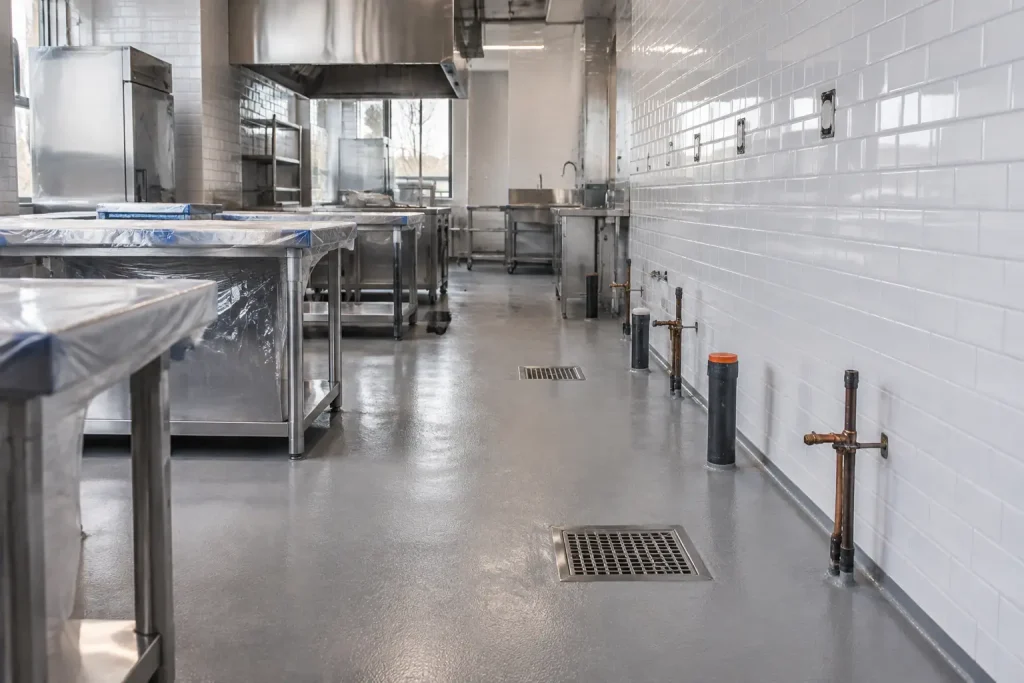
A commercial kitchen sink setup needs three sink types under the FDA Food Code: a three-compartment warewashing sink (4-301.12), handwashing sinks at prep, dispensing and dish areas (5-204.11) and a service sink for mop water (5-203.13).
Key takeaways
- The FDA Food Code 2026 §4-301.12 requires a sink with at least three compartments for manual washing, rinsing and sanitizing, with each compartment large enough to immerse the largest equipment and utensils.
- The handwashing sink minimum fell from 100°F in the 2017 Food Code to 85°F in the 2022 Food Code, but FDA’s 2024 adoption report counts only 7 states on the 2022 edition, covering 16.06 percent of the U.S. population.
- Under the NYC Plumbing Code 2022 §802.1.8, an IPC-based text, sinks that wash utensils, dishes or pots drain indirectly through an air gap or air break, while hand sinks may connect directly.
- California is stricter than the federal model: Health and Safety Code §114099 requires two integral metal drainboards, and §113953 requires a 6-inch metal splashguard when a hand sink sits within 24 inches of the warewashing drainboards.
- A three-bay sink with 20 by 28 inch bowls filled 10 inches deep holds about 72.7 gallons, and with two 24-inch drainboards it runs 108 inches (9.0 feet) before end splashes (CB&C calculation, October 2026).
- The Food Code (§4-205.10) deems equipment certified to an ANSI standard such as NSF/ANSI 2 by an accredited program to meet its design and construction rules.
| Key number | Rule | Source |
|---|---|---|
| 3 compartments | Minimum for manual warewashing | FDA Food Code 2026 §4-301.12(A) |
| 110°F | Minimum manual wash solution, or the detergent label temperature | Food Code 2026 §4-501.19 |
| 171°F for 30 seconds | Hot water sanitizing by immersion | Food Code 2026 §4-501.111, §4-703.11(A) |
| 85°F | Minimum water temperature at a handwashing sink | Food Code 2022 and 2026 §5-202.12(A) |
| 15 seconds | Minimum flow from a self-closing or metering hand sink faucet | Food Code 2026 §5-202.12(C) |
| 1 inch | Minimum air gap on a water supply inlet, and at least twice the inlet diameter | Food Code 2026 §5-202.13 |
| 2 x opening | Minimum air gap between an indirect waste pipe and the floor sink rim | NYC Plumbing Code 2022 §802.2.1 |
| 34 inches | Maximum rim height for an accessible sink or lavatory | 2010 ADA Standards §606.3 |
Sink placement is part of the commercial kitchen design plan review, the drains run through the floor system in our commercial kitchen flooring guide, and the full code map sits on our commercial kitchen page.
Which sinks does a commercial kitchen need?
A commercial kitchen needs one sink per job, because the FDA Food Code bans crossover: §2-301.15 bars handwashing in prep, warewashing and service sinks, and §5-205.11 bars any other use of a hand sink. The federal baseline is a three-compartment sink, enough hand sinks for each work area and one service sink. Many health departments add a dedicated food prep sink.
The table pairs each sink with the section that creates it and the plumbing rule that governs its drain. Where a state rule is shown, it is California’s, because its Retail Food Code sets dimensions the federal model leaves open. Your health department’s plan reviewer applies the edition your state adopted, so confirm it before you order equipment.
| Sink | What it is for | Code that requires it | Drain connection | Source |
|---|---|---|---|---|
| Three-compartment (warewashing) sink | Wash, rinse and sanitize utensils, pots and equipment | Food Code 2026 §4-301.12 | Indirect, air gap or air break (NYC PC §802.1.8) | FDA Food Code 2026 |
| Handwashing sink | Employee handwashing only | Food Code 2026 §5-203.11, §5-204.11 | May connect directly (NYC PC §802.1.8 exception) | NYC Plumbing Code ch. 8 |
| Food prep sink | Washing, soaking or thawing food | California HSC §114163 (not a federal requirement) | Indirect through an air gap to a floor sink (HSC §114193) | Cal. HSC §114163 |
| Service (mop) sink | Rinsing mops and dumping mop water | Food Code 2026 §5-203.13; 1 service sink for restaurants in NYC PC Table 403.1 | Direct, per plumbing code | NYC Plumbing Code ch. 4 |
| Pot sink or prerinse sink | Heavy soil before warewashing | Part of the warewashing setup | Indirect; to a grease interceptor where the utility requires one (NYC PC §1003.3.1) | NYC Plumbing Code ch. 10 |
Second-generation restaurant spaces often already have a three-compartment sink and floor sinks in place, so a walk-through with a builder should check bowl sizes against the 4-301.12 immersion rule before anyone reuses them. Our guide to restaurant build-out contractors covers the hood, grease and permit systems that sit around the sinks.
What does the Food Code require of a three-compartment sink?
FDA Food Code 2026 §4-301.12 requires a sink with at least three compartments for manually washing, rinsing and sanitizing equipment and utensils. Each compartment must be large enough to immerse the largest item. If an item does not fit, the operator must use a warewashing machine or approved alternative equipment, and §4-301.13 adds drainboards for soiled and clean items.
The drainboard rule in §4-301.13 is written as capacity, not inches: drainboards, utensil racks or tables must hold all soiled and cleaned items that accumulate during hours of operation. Section 4-501.16 adds that a warewashing sink used to wash produce or thaw food must be cleaned and sanitized before and after each such use.
- Scrape and stage soiled items on the soiled-side drainboard (§4-301.13).
- Wash in a detergent solution held at 110°F or more, or at the temperature on the detergent label (§4-501.19).
- Rinse in clear water in the middle compartment, a distinct step required for three-compartment sinks (§4-603.16(A)).
- Sanitize in 171°F water for at least 30 seconds, or in a chemical sanitizer at the concentration, temperature and contact time in §4-501.114 and §4-703.11.
- Air-dry on the clean-side drainboard or rack (§4-301.13).
When is a two-compartment sink allowed?
A two-compartment sink is allowed under Food Code 2026 §4-301.12(D) only when the regulatory authority approves it, the number of kitchenware items is limited and warewashing is a batch job, such as between cutting two raw meats or at the end of a shift. Section 4-301.12(E) bars it for any continuous or intermittent flow of tableware.
The batch operation must also make up and drain its solutions immediately before and after use and sanitize with a detergent-sanitizer under §4-501.115, or use a hot water immersion step under §4-603.16(C). California HSC §114099.3 carries the same two-compartment conditions.
How big should a three-compartment sink be?
Size a three-compartment sink from the largest item you wash, not from the floor space left over. FDA Food Code §4-301.12(B) requires full immersion of the largest equipment and utensils. If your largest item is an 18 by 26 inch pan, bowls of 20 by 28 inches give about 2 inches of clearance, and three such bowls hold about 72.7 gallons at a 10-inch fill.
The volumes below use 231.0 cubic inches per U.S. gallon, derived from NIST Special Publication 811, Appendix B.9 (1 gallon equals 3.785412 liters). The 10-inch fill in a 12-inch-deep bowl is a CB&C assumption that leaves 2 inches of freeboard; adjust it to your own fill line.
| Bowl, inches (left to right x front to back x deep) | Water per bowl at 10 in fill (in³) | Gallons per bowl | Gallons, three bowls | Source |
|---|---|---|---|---|
| 16 x 20 x 12 | 3,200 | 13.9 | 41.6 | CB&C calculation |
| 18 x 18 x 12 | 3,240 | 14.0 | 42.1 | CB&C calculation |
| 18 x 24 x 12 | 4,320 | 18.7 | 56.1 | CB&C calculation |
| 20 x 28 x 12 | 5,600 | 24.2 | 72.7 | CB&C calculation |
| 24 x 24 x 12 | 5,760 | 24.9 | 74.8 | CB&C calculation |
Length is the second check. Three 20-inch bowls take 60 inches, and two 24-inch drainboards add 48 inches, so the sink runs 108 inches (9.0 feet) before end splashes. California HSC §114099 requires the two drainboards to be integral and metal; the federal §4-301.13 accepts racks or tables instead, if they hold a full service period of ware.
Water volume drives the hot water plan. A 24.2-gallon wash bowl must hold 110°F under §4-501.19, and California HSC §114192 requires hot water of at least 120°F at the faucet. Hot water sanitizing requires the sanitizing water to stay at 171°F or above (§4-501.111), 51°F above that faucet minimum, so decide between hot water and chemical sanitizing during mechanical and electrical design, not at the equipment order.
What temperatures and sanitizer strengths does each compartment need?
The FDA Food Code 2026 sets the wash compartment at 110°F or more (§4-501.19) and the sanitizing step at 171°F water for 30 seconds or a chemical solution matched to its temperature, pH and contact time (§4-501.114, §4-703.11). Chlorine at 50 to 99 mg/L needs 100°F water at pH 10 or less, or 75°F at pH 8 or less.
| Method | Concentration | Minimum water temperature | Minimum contact time | Source |
|---|---|---|---|---|
| Wash solution | Detergent per label | 110°F | Not set | Food Code 2026 §4-501.19 |
| Hot water immersion | Not applicable | 171°F | 30 seconds | Food Code 2026 §4-501.111, §4-703.11(A) |
| Chlorine | 25 to 49 mg/L | 120°F | 10 seconds | Food Code 2026 §4-501.114(A), §4-703.11(C)(1) |
| Chlorine | 50 to 99 mg/L | 100°F at pH 10 or less; 75°F at pH 8 or less | 10 seconds; 7 seconds at 50 mg/L | Food Code 2026 §4-501.114(A), §4-703.11(C)(2) |
| Chlorine | 100 mg/L | 55°F | 10 seconds | Food Code 2026 §4-501.114(A) |
| Iodine | 12.5 to 25 mg/L, pH 5.0 or less | 68°F | 30 seconds | Food Code 2026 §4-501.114(B), §4-703.11(C)(3) |
| Quaternary ammonium | Per EPA label; water hardness 500 mg/L or less | 75°F | 30 seconds | Food Code 2026 §4-501.114(C), §4-703.11(C)(3) |
California writes its own numbers. California HSC §114099.6 sets 100 ppm chlorine for 30 seconds, 25 ppm iodine for one minute and 200 ppm quaternary ammonium for one minute, and §114099.2 sets the wash solution at 100°F rather than 110°F. A test kit for the chosen sanitizer belongs on the equipment list either way.
How many handwashing sinks are required, and where?
FDA Food Code 2026 §5-203.11 sets no fixed count: it requires at least one handwashing sink, enough for convenient use in each area listed in §5-204.11, and no fewer than local law requires. Section 5-204.11 places them in food preparation, food dispensing and warewashing areas, and in or immediately adjacent to toilet rooms.
Each hand sink, or pair of adjacent hand sinks, needs soap (§6-301.11), towels or an air dryer (§6-301.12) and a handwashing sign for food employees (§6-301.14). Section 6-301.13 bars those aids at prep, utensil and service sinks. FDA’s Annex 3 cites a 2007 study in the Journal of Food Protection that found handwashing was more likely where a restaurant had more than one hand sink and one in the worker’s sight.
California adds a spacing rule. California HSC §113953(b)(2) requires a metal splashguard at least 6 inches high between a hand sink and a warewashing sink, running the full depth of the drainboard, unless the two are 24 inches or more apart. The same section requires warm water for at least 15 seconds through a mixing valve or combination faucet.
Is the hand sink minimum 85°F or 100°F?
It depends on the Food Code edition your state adopted. The 2017 Food Code §5-202.12(A) required at least 100°F, and the 2022 edition lowered it to 85°F, which the 2026 edition keeps. FDA’s 2024 adoption report lists Florida’s restaurant regulator and Texas on the 2017 edition, and California’s own code sets 100°F to 108°F where the temperature is not adjustable.
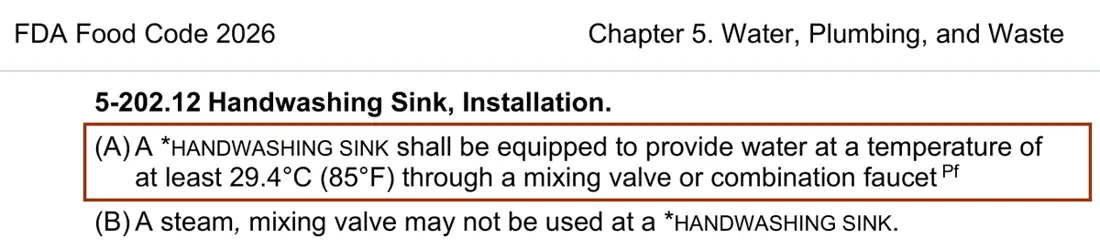
The 2022 Food Code’s summary of changes records the move: “Amend ¶ 5-202.12(A) to revise the hot water temperature at the hand sink from at least 38°C (100°F) to at least 29.4°C (85°F)” (FDA Food Code 2022, summary of changes). Annex 3 of the 2026 edition notes that the International Plumbing Code defines tempered water as 85°F to 110°F.
| State or regulator | Food Code edition adopted (effective year) | Hand sink minimum under that edition | Source |
|---|---|---|---|
| Colorado, Connecticut, Illinois, Mississippi, Ohio, Pennsylvania, Utah | 2022 | 85°F, subject to state amendments | FDA 2024 adoption report |
| Florida Department of Business and Professional Regulation (restaurants) | 2017 (2019) | 100°F, subject to state amendments | FDA 2024 adoption report; Food Code 2017 §5-202.12(A) |
| Texas Department of State Health Services | 2017 with Supplement (2021) | 100°F under the 2017 text | FDA 2024 adoption report; Food Code 2017 §5-202.12(A) |
| California Department of Public Health | 2005 (2007); state Retail Food Code governs | 100°F to 108°F if not adjustable at the faucet | Cal. HSC §113953(c) |
What are the rules for prep sinks and mop sinks?
The FDA Food Code 2026 requires a service sink or curbed cleaning facility with a floor drain (§5-203.13) but no separate food prep sink. California requires a prep sink of at least 18 by 18 inches and 12 inches deep wherever food is washed, soaked or thawed (HSC §114163). Neither sink may double as a hand sink (§2-301.15).
Food prep sink
California HSC §114163 sets the prep sink at 18 by 18 inches in length and width and 12 inches deep, with an integral drainboard or adjacent table of at least 18 by 18 inches, hot and cold water through a mixing valve and use exclusively for food. Under federal §4-501.16, a kitchen without a prep sink may wash produce in a warewashing sink only if it cleans and sanitizes that sink before and after.
Service sink for mop water
Food Code 2026 §5-203.13 requires at least one service sink or curbed cleaning facility with a floor drain, conveniently located for mop cleaning and mop water disposal, and it bars toilets and urinals for that use. The NYC Plumbing Code 2022 Table 403.1 lists 1 service sink for restaurants (NYC Plumbing Code ch. 4), and California HSC §114279 requires hot and cold water at the janitorial sink.
How must a commercial kitchen sink drain?
Most commercial kitchen sinks drain indirectly. FDA Food Code 2026 §5-402.11(A) bars a direct connection between the sewer and a drain from equipment holding food or utensils, unless local law allows it under ¶(D). The NYC Plumbing Code 2022 §802.1.8 requires utensil, dish and pot sinks to discharge through an air gap or air break, and exempts hand sinks.
| Rule | Requirement | Source |
|---|---|---|
| Food equipment drains | Indirect waste by means of an air gap; each well of a multiple-compartment sink discharges independently to a waste receptor | NYC Plumbing Code 2022 §802.1.1 |
| Utensil, dish and pot sinks | Indirect through an air gap or air break; hand sinks may connect directly | NYC Plumbing Code 2022 §802.1.8 |
| Long indirect pipes | Trapped if over 30 inches horizontal or 54 inches total developed length | NYC Plumbing Code 2022 §802.2 |
| Air gap at the receptor | At least twice the effective opening of the indirect waste pipe | NYC Plumbing Code 2022 §802.2.1 |
| Floor sink or receptor | Removable strainer or basket; not in concealed spaces, plenums or above ceilings; ready access | NYC Plumbing Code 2022 §802.3 |
| California sinks | Prep and warewashing sinks drain through an air gap into a floor sink; local building official may require direct plumbing | Cal. HSC §114193 |
| Michigan exception | A washing sink may connect directly to a hydromechanical grease interceptor where one is required | Mich. Admin. Code R 408.30792 |
Floor sink locations are hard to move once the slab is poured, so they should appear on the plumbing drawings submitted for permit and on the record set at closeout. Our guide to as-built drawings explains how to capture those final locations. The permit and plan review steps are covered in our guide to commercial building permits.
When does a sink need a grease interceptor?
A sink needs a grease interceptor when it discharges fats, oils or grease. NYC Plumbing Code 2022 §1003.3.1 requires a grease interceptor or automatic grease removal device for those fixtures in food preparation areas and bars, and the interceptor may take waste only from fixtures that discharge grease, so hand sinks and other clean fixtures stay off it. Federal rule 40 CFR 403.5(b)(3) prohibits discharges that obstruct sewer flow.
Under NYC Plumbing Code 2022 §1003.3.4, interceptors are designed and tested to PDI G101, ASME A112.14.3 or ASME A112.14.4, and §1003.3.4.2 requires a vented flow control ending at least 6 inches above the flood rim. The sizing rule belongs to the local utility, which enforces 40 CFR 403.5. Food Code §5-402.12 requires any grease trap to be easily accessible for cleaning.
What should a commercial kitchen sink be built to?
Specify sinks certified to NSF/ANSI 2, the food equipment standard that NSF says covers the materials, design, fabrication, construction and performance of equipment including sinks. FDA Food Code 2026 §4-205.10 deems equipment certified to an ANSI standard by an ANSI-accredited program to comply with the Code’s materials and design rules in Parts 4-1 and 4-2.
The current edition is NSF/ANSI 2-2025, which revises the 2022 edition (ANSI, February 25, 2026). Ask the supplier for the certification listing, not a sticker photo, and match the model number on the listing to the submittal. Stainless type and gauge are maker specifications; the codes cited here set cleanability and immersion rules rather than a gauge.
For a price reference, the Indian Health Service paid $15,500 in May 2022 to have one three-compartment sink fabricated for a hospital dietary department in Zuni, New Mexico (USAspending 75H70722P00143). Federal prices for dish machines, ovens and refrigeration are in our commercial kitchen equipment guide.
Do commercial kitchen sinks have to meet ADA height rules?
Public sinks and lavatories do; most kitchen work sinks do not. The 2010 ADA Standards §606.3 caps the rim or counter of an accessible sink at 34 inches above the floor, and §606.4 requires metering faucets to stay open at least 10 seconds. Under §203.9, employee-only work areas need only let people with disabilities approach, enter and exit.
Restroom lavatories that serve customers fall under §606 in full (2010 ADA Standards). The §203.9 advisory adds that employers still owe reasonable accommodation, so an adjustable or lower hand sink near a prep line costs less at rough-in than as a later retrofit.
What do sink buying guides leave out?
A top-ranking retail guide to compartment sinks, last updated May 21, 2024, cites no Food Code section, calls drainboards an optional upgrade and says nothing about drains beyond one drain per bowl. The table sets five questions such guides leave open against the primary text, as we read it in October 2026, so an owner can check a quote or a layout against the code.
| Question guides leave open | What the primary source says | Source |
|---|---|---|
| What water temperature must a hand sink deliver? | Model code minimum is 85°F since the 2022 edition; 100°F remains in states on the 2017 edition, and California requires 100°F to 108°F if not adjustable | Food Code 2022 and 2026 §5-202.12(A); Cal. HSC §113953(c) |
| Are drainboards optional? | Not federally: §4-301.13 requires drainboards, utensil racks or tables sized to the day’s ware; California requires two integral metal drainboards | Food Code 2026 §4-301.13; Cal. HSC §114099 |
| Does a dishwasher replace the three-compartment sink? | Section 4-301.12(A) still requires the sink; a warewashing machine is the fallback when items are too large to immerse | Food Code 2026 §4-301.12(A) and (B) |
| Can each bowl drain straight into the sewer? | Utensil, dish and pot sinks drain through an air gap or air break; only hand sinks are exempt | NYC Plumbing Code 2022 §802.1.8 |
| Is a two-compartment sink enough for a small kitchen? | Only with approval, for limited batch washing, never for a continuous flow of tableware | Food Code 2026 §4-301.12(D) and (E) |
Edition lag explains why answers differ by state. FDA’s 2024 report counts 24 states on the 2022 or 2017 edition, covering 51.92 percent of the U.S. population, and 36 states on one of the three newest editions, covering 64.64 percent; 98.14 percent of Americans live in a state where at least one agency adopted some edition. A guide written for one state’s code reads as wrong in another.
Which commercial kitchen sink decision fits your project?
Use the table to turn the code sections into equipment and plumbing choices. Each row starts from a condition you can check on the drawings or the menu and ends with the action and the section behind it. Where a state rule differs from the FDA Food Code 2026, the row names the state text that controls.
| If | Then | Source |
|---|---|---|
| Your largest pot or pan cannot be fully immersed in a bowl | Choose larger bowls, or add a warewashing machine or approved alternative equipment | Food Code 2026 §4-301.12(B), (C) |
| You want a two-compartment sink | Get approval first; limit it to batch washing with a detergent-sanitizer or hot water immersion | Food Code 2026 §4-301.12(D), (E) |
| Your state adopted the 2022 Food Code or newer | Hand sinks need at least 85°F water through a mixing valve or combination faucet | Food Code 2022 and 2026 §5-202.12(A) |
| Your state is on the 2017 or an older edition | Hand sinks need at least 100°F water | Food Code 2017 §5-202.12(A) |
| You build in California and a hand sink is within 24 inches of the dish drainboard | Add a metal splashguard at least 6 inches high | Cal. HSC §113953(b)(2) |
| A sink washes utensils, dishes or pots | Drain it indirectly through an air gap or air break to a floor sink | NYC Plumbing Code 2022 §802.1.8 |
| A pot or prerinse sink discharges grease | Route it to a grease interceptor or automatic grease removal device sized to the utility’s rules | NYC Plumbing Code 2022 §1003.3.1; 40 CFR 403.5(b)(3) |
| You sanitize with 50 mg/L chlorine at pH 8 or less | Keep the water at 75°F or more and contact at 7 seconds or more | Food Code 2026 §4-501.114(A), §4-703.11(C)(2) |
| A sink or lavatory serves the public | Keep the rim at 34 inches or less with forward-approach knee clearance | 2010 ADA Standards §606.2, §606.3 |
Put the sink schedule, bowl sizes and drain types on the drawings before you price the job, so every bidder carries the same floor sinks and interceptor. Our guide on how to compare construction bids shows how to line up exclusions. A build-out in leased space is a tenant improvement project, and the landlord’s work letter often decides who pays for a new interceptor.
Health inspectors check sinks at the pre-opening inspection, so missing splashguards, soap or signs show up late. Add each sink rule to the construction punch list and confirm the health permit sequence alongside the certificate of occupancy. Our commercial project checklist lists the other pre-opening items.
This page summarizes model and state codes as published in October 2026; it is not legal advice, and your health department and plumbing official decide which edition and amendments apply.
How we compiled this
We read 22 primary documents in October 2026: the FDA Food Code 2026, 2022 and 2017 texts, FDA’s 2024 adoption report, three chapters of the NYC Plumbing Code 2022, nine California Health and Safety Code sections, a Michigan rule, 40 CFR 403.5, the 2010 ADA Standards, NSF and ANSI descriptions of NSF/ANSI 2 and a NIST conversion table. We excluded retailer prices and county handouts we could not open; the one sink price is a federal award record from USAspending.gov.
Frequently asked questions
What are the requirements for a commercial kitchen sink?
Under the FDA Food Code 2026, a kitchen needs a sink with at least three compartments for manual warewashing (4-301.12), handwashing sinks in prep, dispensing and warewashing areas and by toilet rooms (5-204.11), and a service sink or curbed cleaning facility for mop water (5-203.13). States add rules: California also requires a food prep sink of at least 18 by 18 by 12 inches.
Do I need a three-compartment sink if I have a dishwasher?
Usually yes. FDA Food Code 2026 §4-301.12(A) requires a sink with at least three compartments for manual washing, rinsing and sanitizing, and treats a warewashing machine as the route for items too large for the sink. Some health departments accept alternatives under §4-301.12(C), but only with approval, so ask before you drop the sink from the plan.
What size should a 3 compartment sink be?
Big enough to immerse your largest item, under FDA Food Code §4-301.12(B). For an 18 by 26 inch pan, 20 by 28 inch bowls leave about 2 inches of clearance. Three such bowls hold about 72.7 gallons at a 10-inch fill, and with two 24-inch drainboards the sink runs 108 inches before end splashes (CB&C calculation).
What temperature does a hand sink need to be?
At least 85°F under §5-202.12(A) of the 2022 and 2026 FDA Food Code, delivered through a mixing valve or combination faucet. States on the 2017 edition, including Florida’s restaurant regulator and Texas, keep the older 100°F minimum. California requires 100°F to 108°F where the temperature is not adjustable at the faucet (HSC §113953).
Does a 3 compartment sink need a grease trap?
Often yes, if it receives greasy pots and pans. NYC Plumbing Code 2022 §1003.3.1 requires a grease interceptor or automatic grease removal device for fixtures that discharge fats, oils or grease in food preparation areas, and the local utility sets the size under its pretreatment program. Michigan R 408.30792 lets the washing sink connect directly to a hydromechanical interceptor.
Can you wash hands in a prep sink or three-compartment sink?
No. FDA Food Code 2026 §2-301.15 bars food employees from cleaning their hands in a sink used for food preparation or warewashing, or in a service sink. Section 4-501.16(A) repeats the ban for warewashing sinks, and §6-301.13 bars soap and towel dispensers at those sinks so they are not used as hand sinks.
Sources
- U.S. Food and Drug Administration, FDA Food Code 2026 (full text PDF), accessed October 20, 2026.
- U.S. Food and Drug Administration, Food Code 2026 page, accessed October 20, 2026.
- U.S. Food and Drug Administration, FDA Food Code 2022, including Summary of Changes, accessed October 20, 2026.
- U.S. Food and Drug Administration, FDA Food Code 2017, accessed October 20, 2026.
- U.S. Food and Drug Administration, Adoption of the FDA Food Code by State and Territorial Agencies, 2024 report, accessed October 20, 2026.
- NYC Department of Buildings, 2022 NYC Plumbing Code, Chapter 8: Indirect/Special Waste, accessed October 20, 2026.
- NYC Department of Buildings, 2022 NYC Plumbing Code, Chapter 10: Traps, Interceptors and Separators, accessed October 20, 2026.
- NYC Department of Buildings, 2022 NYC Plumbing Code, Chapter 4: Fixtures, Faucets and Fixture Fittings, accessed October 20, 2026.
- Legal Information Institute, Cornell, Mich. Admin. Code R. 408.30792, Food utensils, dishes, pots and pans sinks, accessed October 20, 2026.
- Legal Information Institute, Cornell, 40 CFR 403.5, National pretreatment standards: prohibited discharges, accessed October 20, 2026.
- California Legislative Information, California Health and Safety Code §114099, accessed October 20, 2026.
- California Legislative Information, California Health and Safety Code §114099.2, accessed October 20, 2026.
- California Legislative Information, California Health and Safety Code §114099.3, accessed October 20, 2026.
- California Legislative Information, California Health and Safety Code §114099.6, accessed October 20, 2026.
- California Legislative Information, California Health and Safety Code §113953, accessed October 20, 2026.
- California Legislative Information, California Health and Safety Code §114163, accessed October 20, 2026.
- California Legislative Information, California Health and Safety Code §114192, accessed October 20, 2026.
- California Legislative Information, California Health and Safety Code §114193, accessed October 20, 2026.
- California Legislative Information, California Health and Safety Code §114279, accessed October 20, 2026.
- U.S. Department of Justice, 2010 ADA Standards for Accessible Design, accessed October 20, 2026.
- U.S. Department of the Treasury, USAspending.gov award 75H70722P00143, fabrication of a three-compartment sink, accessed October 26, 2026.
- NSF, Food Equipment Standards (NSF/ANSI 2), accessed October 20, 2026.
- American National Standards Institute, NSF/ANSI 2-2025: Food Handling Equipment, accessed October 20, 2026.
- National Institute of Standards and Technology, NIST Guide to the SI, Appendix B.9, accessed October 20, 2026.