Progressive design build is design-build in two phases: the owner hires one firm on qualifications, pays it to design and price the work in Phase 1, then accepts its Phase 2 price or exits.
Key takeaways
- DBIA Document 544 (2024, Second Edition) splits the job into Phase 1 (preliminary design and an open-book Phase 2 price) and Phase 2 (final design, construction, commissioning and warranty), priced as a lump sum or cost of the work plus a fee with an optional guaranteed maximum price (GMP).
- If the owner does not accept the Phase 2 proposal, DBIA 544 §1.3.2.3 gives it three options: change the proposal, continue on cost reimbursement with no contract price, or terminate for convenience.
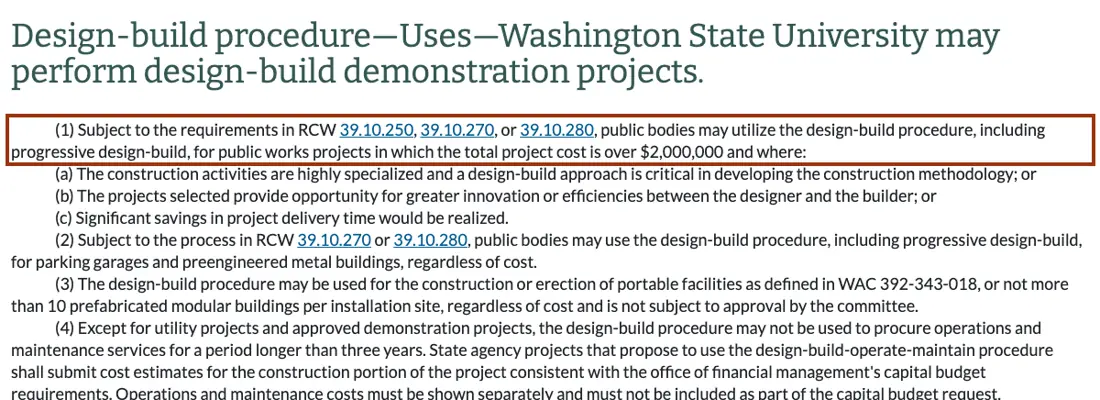
- Washington RCW 39.10.300(1) lets public bodies use design-build “including progressive design-build” on projects over $2,000,000 that meet one of three tests; parking garages and pre-engineered metal buildings qualify at any cost.
- Missouri RSMo 67.5060.15, in effect from August 28, 2026, requires a two-stage selection with a shortlist of 2 to 3 firms, bars construction pricing in proposals and expires August 28, 2036.
- Wilsonville, Oregon signed a $4,804,723 Phase 1 agreement in June 2022; its third GMP came in at $36,836,661.92, 41.2% above the $26,082,917 budget, and staff weighed the off-ramp before recommending approval (Wilsonville URA Resolution 338 packet).
How does progressive design build work, phase by phase?
Progressive design build runs as a qualifications-based selection, then a paid Phase 1 in which the design-builder develops the design and an open-book price, then a Phase 2 that finishes design and builds. The owner commits to construction only when it accepts the Phase 2 proposal. DBIA Document 544 defines Phase 1 as completing preliminary design, setting the construction plan and establishing Phase 2 costs.
The selection step is what separates it from fixed-price design-build. Missouri’s statute bars price or fees from the qualifications stage and allows only preconstruction pricing, “in the form of proposed rates, fees, or other acceptable forms”, at the proposal stage (RSMo 67.5060.15(5) and (8)(d)). Washington likewise says cost or price factors “are not permitted” in the request for qualifications (RCW 39.10.330(1)(d)).
- Request for qualifications. Firms submit experience, key staff and their primary design consultants and trade partners; no price or fee (RSMo 67.5060.15(4) and (5)).
- Shortlist and proposals. Missouri narrows to no more than 3 and no fewer than 2 firms; Washington allows up to 5 finalists and requires an honorarium for unsuccessful finalists (RCW 39.10.330(2) and (9)). Proposals describe design, preconstruction and construction approach with no construction price (RSMo 67.5060.15(8)(b)).
- Negotiate the Phase 1 agreement. The owner negotiates a preconstruction services agreement with the top-ranked firm and may move to the next-ranked firm if talks fail (RSMo 67.5060.15(8)(f)).
- Validate the criteria. The design-builder reviews the owner’s project criteria in writing and recommends changes before design proceeds (DBIA 544 §1.1.2).
- Design and estimate open-book. Design advances to the level defined in Exhibit B, either a percent of design completion or a list of deliverables (DBIA 544 §1.2.1).
- Phase 2 proposal. The firm prices the rest of the job as a lump sum or as cost of the work plus fee with an optional GMP, with the basis of design documents attached (DBIA 544 §1.3.1).
- Owner decision. Acceptance becomes a Contract Price Amendment and a notice to proceed (§1.3.2.2); rejection triggers the off-ramp options (§1.3.2.3).
- Phase 2. The firm completes design, procures, builds, starts up, commissions and warrants the work (§1.2.2). In Washington, the performance and payment bond is due before construction starts, not for design or preconstruction (RCW 39.10.330(7)).
What goes into the Phase 2 proposal?
DBIA 544 §1.3.1 lists 12 items the Phase 2 proposal includes unless the parties agree otherwise. The owner reviews them, sends written comments, and the design-builder adjusts the proposal before acceptance (§1.3.2.1). Owners who want a single document to compare against their budget should insist on items 1 to 4 at minimum, because they fix price, scope and time.
| # | Proposal item (DBIA 544 §1.3.1) | Why the owner checks it |
|---|---|---|
| 1 | Contract price: lump sum, or fee plus estimated cost of the work with optional GMP, including the design-builder’s contingency | Sets the payment basis for Phase 2 |
| 2 | Basis of design documents, including the owner’s project criteria | Defines what the price buys |
| 3 | Assumptions and clarifications | Exclusions that later become change orders |
| 4 | Scheduled substantial completion date and project schedule | Ties the price to a duration |
| 5 to 7 | Allowance items and values; alternate prices; unit prices | Shows which costs are still estimates |
| 8 | Additional services not included | Future price increases already named |
| 9 to 10 | Savings provision; performance incentives | Who keeps money left under a GMP |
| 11 | Time limit for acceptance | Starts the off-ramp clock if missed |
| 12 | Owner’s permit list | Permits and approvals the owner must obtain |
What is the off-ramp, and who keeps the design?
The off-ramp is the owner’s right to stop after Phase 1 if it cannot agree a Phase 2 price. Under DBIA 544 §1.3.2.3, a rejected or unanswered proposal is “deemed withdrawn”, and the owner picks one of three options. If the owner then finishes the project with another firm using the design-builder’s work product, DBIA 544 §4.3.2 requires an additional payment that the parties should set before signing.
| Who acts | Option | What follows | Clause |
|---|---|---|---|
| Owner | i. Suggest modifications to the proposal | If the design-builder accepts in writing, the proposal is accepted | §1.3.2.3 i |
| Owner | ii. Continue the work on cost reimbursement | No contract price applies; paid under §6.1.2 | §1.3.2.3 ii |
| Owner | iii. Terminate for convenience | No §8.2 payment for uncompleted work; work-product use fee under §4.3.2 if the design is reused | §1.3.2.3 iii; §4.3 |
| Design-builder, if the owner picks none | (a) continue and be paid as under option ii; (b) suspend; (c) give notice that the agreement is completed | If the owner does not act within 10 days of that notice, the agreement is deemed completed | §1.3.2.3 |
DBIA’s instruction sheet says the owner “should not use the Termination for Convenience Clause to obtain Design-Builder’s valuable design concepts, and then seek lower bids” (DBIA 544 instructions, §4.3). Statutes are thinner here: Missouri’s PDB subsection says the parties “may amend the contract to authorize construction” once price is accepted (RSMo 67.5060.15(8)(g)) but does not say who owns the drawings if they never agree. Put the §4.3.2 work-product fee and the deliverables list in the Phase 1 agreement before signing; this page is not legal advice, and your attorney should confirm how a public-records or state licensing rule affects design ownership.
Progressive design build vs design build: what changes?
The difference is when the price is fixed and how the firm is chosen. In fixed-price (lump-sum) design-build, competing teams submit a conceptual design and a firm price, and price carries real weight in the award. In progressive design build, the owner selects on qualifications and a preconstruction fee, then negotiates the construction price with one firm after Phase 1. Missouri’s statute sets both processes side by side.
| Feature | Fixed-price design-build | Progressive design build | Source |
|---|---|---|---|
| Selection stages | Three: qualifications, technical proposal with conceptual design, cost proposal | Two: qualifications, then approach proposal | RSMo 67.5060.8(2), .15(2) |
| Price in the award | Firm, fixed cost of design and construction, with bid security; at least 40% of points | Preconstruction rates or fees only; no construction pricing | RSMo 67.5060.13(1)-(2), .15(8)(b), (d) |
| Design in the proposal | Design to the level the request for proposal sets; at least 40% of points | Approach to design development, estimating and value engineering | RSMo 67.5060.12(2), (6); .15(8)(c) |
| Stipend to losing shortlisted firms | Yes, for Phase II design work | Not defined for PDB in Missouri; Washington honorarium applies to all design-build finalists | RSMo 67.5060.1(12); RCW 39.10.330(9) |
| When the price is set | At award | After Phase 1, at the level set in Exhibit B | DBIA 544 §1.2.1 |
| Phase 2 price form | Lump sum | Lump sum, or cost plus fee with or without a GMP | DBIA 544 §1.3 |
| Exit before construction | Not built in; termination clauses only | Off-ramp after the Phase 2 proposal | DBIA 544 §1.3.2.3 |
| Owner staffing | Review design against criteria | Also audit open-book estimates and each GMP package | Wilsonville Res. 338 staff report |
DBIA’s own guidance on which Phase 2 price form to choose is specific: cost-plus with a GMP “is desirable” when project criteria remain uncertain after Phase 1, while a lump sum “may be suitable” when criteria and design are settled (DBIA 544 instructions). For the wider comparison of design-build with the traditional route, see our guide to design-build vs design-bid-build.
Is progressive design build the same as CMAR?
No. Construction manager at risk keeps two contracts, one with the architect and one with the builder, while progressive design build puts design and construction under one contract with one firm. Both negotiate a GMP during design. Arizona’s transportation statute defines CMAR as a construction contract “separate from the contract for design services” (ARS 28-7361), which is the structural line between the two. Our construction management at risk guide covers the two-contract version.
Which states authorize progressive design-build for public owners?
Public owners need statutory authority to skip low-bid award, and only some statutes name progressive design-build. In the statutes we read as of November 2026, Washington and Missouri authorize it by name for public bodies, Mississippi for its transportation commission, and DBIA reports Illinois and South Carolina authority; other states may allow it under general design-build language. Private owners need no statute.
| State | Statute | Who may use PDB | Key limits | Checked against |
|---|---|---|---|---|
| Washington | RCW 39.10.300, .270, .280, .330 | Public bodies that are certified (3 years, needs 1 design-build project in the prior 5) or get project approval; WSDOT is exempt from certification | Over $2,000,000 and specialized, innovative or time-saving; garages and pre-engineered metal buildings at any cost; RFQ without price; up to 5 finalists | Statute text, RCW 39.10.270 and RCW 39.10.280 |
| Missouri | RSMo 67.5060.15 and .16 (2026 H.B. 2474) | All political subdivisions; water and wastewater projects named in .16 | Two-stage; 2 to 3 firms; no construction price in proposals; PDB subsection expires August 28, 2036 | Statute text (revisor.mo.gov) |
| Mississippi | Miss. Code 65-1-85(11), amended by 2024 S.B. 2645 | Mississippi Transportation Commission only | Defines PDB as progressing “toward a final design, scope, schedule and contract price” | Bill text as sent to the Governor |
| Illinois | Progressive Design-Build Pilot Program Act | State construction agency pilot | 2026 S.B. 3645 moves the PDB sunset from January 1, 2027 to January 1, 2028 | DBIA 2026 legislative update; statute site did not load |
| South Carolina | S. 831, Act No. 177, signed May 18, 2026 | SCDOT, as “phased design-build” | Paired with public-private partnership authority | DBIA 2026 legislative update |
Washington’s text shows how authority is usually written: progressive design-build is a sub-type of the design-build procedure, so it inherits the design-build thresholds and award rules in RCW 39.10.330. An uncertified Washington body must show the project review committee that low-bid lump sum “is not practical” or that the alternative gives “a substantial fiscal benefit”, plus staff with construction experience and a written management plan (RCW 39.10.280(2)). Check your own state’s public contracting code before issuing an RFQ; a bill passing is not the same as authority for your agency type.
What does a real progressive design-build price look like?
Public agenda packets show the numbers that guides leave out. In Wilsonville, Oregon, a road, sewer and bridge program, the Phase 1 agreement was $4,804,723, or 16.7% of the $28,831,288 fiscal 2022-23 budget. The third GMP package arrived at $36,836,661.92 against a $26,082,917 budget, a $10,753,744.92 gap, and staff documented the off-ramp alternative for the board’s December 4, 2023 meeting.
| Line | Amount | Source |
|---|---|---|
| Phase 1 agreement, not to exceed (design, permitting, right-of-way support), June 6, 2022 | $4,804,723.00 | URA Res. 324 staff report |
| Fiscal 2022-23 budget, five capital projects | $28,831,288 | URA Res. 324 staff report |
| Phase 1 as share of that budget | 16.7% | CB&C calculation |
| GMP 3 (sewer, street, roundabout, bridge, water relocation), December 4, 2023 | $36,836,661.92 | URA Res. 338 staff report |
| Fiscal 2023-24 amended budget for the same items | $26,082,917 | URA Res. 338 staff report |
| GMP 3 over budget | $10,753,744.92 (41.2%) | CB&C calculation |
| Phase 1 fee as share of GMP 3 | 13.0% | CB&C calculation |
Wilsonville also shows how one Phase 1 agreement can feed several GMP packages, each approved by the board as a contract amendment before that work starts:
- August 2, 2021: Resolution 2916 authorizes progressive design-build for the corridor.
- March 30, 2022: 4 proposals received; the 2 highest-scoring teams interviewed.
- June 6, 2022: Phase 1 agreement, not to exceed $4,804,723.
- February 23, 2023: GMP 1, a traffic signal needed for later detours.
- July 17, 2023: GMP 2, the Meridian Creek culvert replacement.
- December 4, 2023: GMP 3, $36,836,661.92 for the bridge, road, roundabout and sewer, on the board’s agenda with substantial completion planned for summer 2025.
The staff report names the causes as added scope from soil conditions and regional inflation, citing a 20% rise in the ENR Seattle construction cost index since 2021. To test the price, the city used independent cost estimators on every pay item, got a second estimate on the GMP 3 schedule of values, and required competitive low-bid pricing for 41 trade and supplier categories (Res. 338 packet).
The off-ramp analysis listed three risks of cancelling and bidding GMP 3: no guarantee of a lower price, the city taking on the risk that the design documents were complete, and a construction delay of at least six months that would push the bridge past the opening of a new school. Staff recommended approving GMP 3. That is the off-ramp working as designed: a real choice priced in time and risk, not a free exit.
How can Phase 1 change before any price is set?
Phase 1 can absorb scope changes that would void a fixed-price award. Fresno, California awarded Phase One design of a 234-stall parking structure for $1,612,769 on June 12, 2025, under a modified DBIA progressive design-build agreement. When state grant money arrived, the council approved an amendment on August 28, 2025 adding $341,890 so the structure could grow to 600 or more stalls (Fresno legislation ID 25-1120).
| Fresno parking structure | Original Phase One | After Amendment 1 |
|---|---|---|
| Stalls | 234 | 600 or more |
| Phase One contract | $1,612,769 | $1,954,659 (+21.2%) |
| Contingency | $160,000 (derived: $195,000 minus $35,000) | $195,000 |
| Phase One cost per stall (CB&C calculation) | $6,892 | $3,258 at 600 stalls |
Both projects show the same pattern: the Phase 1 fee is a real cost, equal to 13.0% of GMP 3 and 16.7% of the fiscal 2022-23 budget in Wilsonville’s civil program, and the owner’s bargaining power at the GMP stage comes from independent estimates and its contingency plan, not from competing bids.
When should an owner choose progressive design build?
Choose progressive design build when the scope cannot yet be written tightly enough for competitors to price, when site or existing-building conditions are unknown, or when funding arrives in stages. Choose fixed-price design-build when a design criteria package can carry a firm price. In Washington, also confirm the project clears the $2,000,000 floor or is a garage or pre-engineered metal building.
| If | Then | Basis |
|---|---|---|
| Washington public project at or under $2,000,000 that is not a parking garage or pre-engineered metal building | PDB is not available under RCW 39.10.300; use another method | RCW 39.10.300(1)-(2) |
| You can issue a design criteria package that firms can price as a firm, fixed cost | Fixed-price design-build; price counts for at least 40% of points in Missouri’s model | RSMo 67.5060.13 |
| You need a construction price before spending on design | Fixed-price design-build or design-bid-build | DBIA 544 §1.3 sets price only after Phase 1 |
| Soils, utilities or an existing structure are unknown | PDB, with the GMP set after investigation | Wilsonville GMP 3 soil-driven scope |
| Funding or program size may change during design | PDB; amend Phase 1 rather than rebid | Fresno Amendment 1, 234 to 600+ stalls |
| No staff or owner’s representative can audit open-book estimates | Hire that capacity before choosing PDB | RCW 39.10.280(2)(c) |
| Criteria still uncertain after Phase 1 | Phase 2 as cost plus fee with a GMP | DBIA 544 instructions |
| Criteria and design settled after Phase 1 | Phase 2 as a lump sum | DBIA 544 instructions |
Owners comparing the Phase 2 payment forms can read our explainers on the cost-plus contract and the other types of construction contracts. If you are still deciding whether design-build fits at all, our page on hiring design-build contractors covers the broader choice.
What does DBIA publish on progressive design-build?
The Design-Build Institute of America (DBIA) publishes a standard-form agreement, a water-sector variant and best-practice guides for progressive design-build. Its March 3, 2026 primer, Progressive Design-Build Done Right, is free and covers procurement, contracting and execution. DBIA says PDB is roughly one-third of design-build procurements, citing FMI’s 2024 Design-Build Utilization Study (DBIA, March 2026).
| Document | Edition or date | What it covers | Access |
|---|---|---|---|
| DBIA 544, Standard Form of Progressive Design-Build Agreement | 2024, Second Edition | Two-phase agreement; Phase 2 price as lump sum or cost plus fee with optional GMP; off-ramp §1.3.2.3 | Paid, one-year license; free sample with instructions |
| DBIA 545, PDB Agreement for Water and Wastewater Projects | Current store listing | Water and wastewater variant | Paid |
| Progressive Design-Build Done Right primer | March 3, 2026 | Owner readiness, qualifications-focused procurement, phased contracting, transparent cost validation | Free download |
| Deeper Dive: Progressive Design-Build | Store listing | The PDB process and its key phases | DBIA bookstore |
| PDB: Recommendations for Owners and PDB Teams | Store listing | ACEC Research Institute, Charles Pankow Foundation and DBIA study of practice and outcomes | DBIA bookstore |
DBIA 544 also offers an alternate in which the design-builder guarantees only its general conditions line inside the GMP (§6.1). If you are drafting the Phase 1 scope, our preconstruction services guide lists deliverables that fit Exhibit B, and our performance bond guide explains the Phase 2 bond.
For the contract forms behind each phase, see our design-build contract guide and how CMAR compares with design-build.
How we compiled this
We read 10 primary documents in November 2026: Washington RCW 39.10.270, .280, .300 and .330; Missouri RSMo 67.5060 as effective August 28, 2026; Mississippi 2024 S.B. 2645; Arizona ARS 28-7361; the DBIA 544 (2024) sample and instructions; and Wilsonville and Fresno council records. Illinois and South Carolina come from DBIA’s 2026 summary because the Illinois statute site did not load. We left out California, whose code site blocked access, and Arizona’s 2023 PDB bill, which is not in current ARS 28-7361. CB&C calculations are labelled.
Frequently asked questions
What is the difference between design-build and progressive design build?
In fixed-price design-build, competing teams submit a conceptual design and a firm price, and price weighs in the award; Missouri’s model gives cost at least 40% of points (RSMo 67.5060.13). In progressive design build, the owner selects on qualifications and a preconstruction fee, pays for Phase 1 design, and negotiates the construction price with that one firm afterward.
What is an off-ramp in progressive design build?
It is the owner’s right to stop after Phase 1 if it will not accept the Phase 2 price. Under DBIA 544 §1.3.2.3 the owner can suggest changes, continue on cost reimbursement, or terminate for convenience. If it reuses the design with another firm, §4.3.2 requires an extra work-product payment that the parties should fix before signing.
How is the design-builder paid in Phase 1?
Phase 1 is a separate paid scope, usually a negotiated fee or rates for design and preconstruction services. Wilsonville, Oregon set a $4,804,723 not-to-exceed amount in 2022, and Fresno, California awarded $1,612,769 for a parking structure in 2025. Missouri lets owners consider only preconstruction pricing at selection (RSMo 67.5060.15(8)(d)).
At what percent of design is the GMP set in progressive design build?
No statute or standard form fixes a single percent. DBIA 544 §1.2.1 leaves it to Exhibit B, expressed as a percent of design completion or a list of deliverables, and DBIA’s instructions warn that setting the GMP too early leaves too little scope definition while setting it too late delays the owner’s price decision.
Can private owners use progressive design build?
Yes. Private owners need no statute; they adopt the two-phase structure by contract, commonly DBIA 544 (2024) with its Exhibit B Phase 1 scope. Statutes such as Washington RCW 39.10.300 and Missouri RSMo 67.5060.15 matter only to public bodies that would otherwise have to award construction to the lowest responsive bidder.
Is progressive design build faster than design-bid-build?
It can start construction earlier because design and pricing overlap and early GMP packages can buy long-lead materials; Wilsonville’s first of three GMPs, approved February 23, 2023, built a traffic signal needed for detours before the bridge package was priced. No statute guarantees a time saving, and Washington requires owners to justify one under RCW 39.10.300(1)(c) or another listed reason.
Sources
- Washington State Legislature, RCW 39.10.300, RCW 39.10.330, RCW 39.10.270, RCW 39.10.280, accessed 2026-11-21.
- Missouri Revisor of Statutes, RSMo 67.5060 (effective August 28, 2026), accessed 2026-11-21.
- Arizona Legislature, ARS 28-7361, accessed 2026-11-21.
- Mississippi Legislature, S.B. 2645, 2024 Regular Session, as sent to the Governor, accessed 2026-11-21.
- Design-Build Institute of America, DBIA Document 544 sample and instruction sheet, 2024 Second Edition, accessed 2026-11-21.
- Design-Build Institute of America, New PDB Best Practices Now Available Free, March 3, 2026, and 2026 State Legislative Update, accessed 2026-11-21.
- City of Wilsonville Urban Renewal Agency, June 6, 2022 packet, Resolution 324 and December 4, 2023 packet, Resolution 338, accessed 2026-11-21.
- City of Fresno, Legislation ID 25-1120, Amendment No. 1 to Progressive Design-Build Agreement, approved August 28, 2025, accessed 2026-11-21.