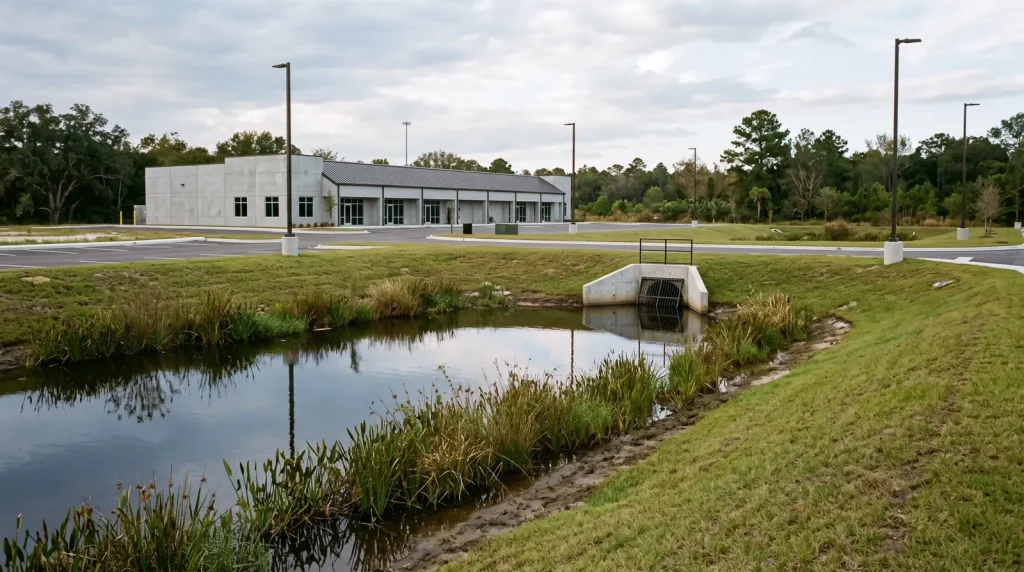
A retention pond is a stormwater basin that keeps a permanent pool of water and releases storm runoff slowly; a detention pond drains dry between storms. Florida rules flip the labels: there, “retention” means a dry infiltration basin.
Key takeaways
- A Florida commercial project needs an Environmental Resource Permit, and with it a stormwater system, once it adds more than 4,000 sq ft of impervious surface used by vehicles, more than 9,000 sq ft of impervious surface in total, or covers more than 5 acres, under Rule 62-330.020(2), F.A.C..
- Florida’s ERP Applicant’s Handbook Volume II (effective June 28, 2024, section 5.0.1) defines a “retention system” as storage that soaks into the ground and is normally dry; the permanent-pool pond most guides call a retention pond is “wet detention” in a Florida permit.
- Unincorporated Harris County, Texas requires at least 0.75 acre-foot of detention storage per acre when a commercial tract outfalls to a County storm sewer, and 1.0 acre-foot per acre for a roadside ditch outfall, under section 6.03 of its Infrastructure Regulations (July 9, 2019 edition).
- With the NCDEQ Simple Method, a 5-acre site at 80% impervious cover must treat 13,976 cubic feet of runoff from a 1.0-inch storm, and a North Carolina Piedmont wet pond with a 5-foot average depth needs about 4,508 sq ft of pool surface.
- On October 27, 2026, two contractors bid $2.35 to $4.04 per cubic yard to excavate detention pond volume for Brazoria County MUD No. 61 and No. 83 in Manvel, Texas, plus $9.75 to $15.85 per cubic yard to haul spoil off site.
- Florida wet detention ponds need a certified inspection every 3 years (every 2 years with a planted littoral zone), with the report filed within 30 days on Form 62-330.311(1), under section 12.5 and Table 12-1 of ERP Applicant’s Handbook Volume I.
What is a retention pond, and what does it do?
A retention pond is an engineered basin that holds a permanent pool below its outlet and stores storm runoff above that pool, releasing it over 2 to 5 days in North Carolina designs (NCDEQ C-3 Wet Pond, MDC 7). The pool lets sediment settle and lets algae and plants take up nutrients, so one pond handles flood peaks and water quality.
EPA’s December 2021 wet pond fact sheet (EPA-832-F-21-031BB) summarises the effect with median concentrations from a national performance database (Clary et al., 2017). Sediment and bacteria drop sharply; dissolved nitrogen barely moves.
| Pollutant | Median entering the pond | Median leaving the pond | Source |
|---|---|---|---|
| Total suspended solids | 38.9 mg/L | 12.0 mg/L | EPA wet pond fact sheet, Table 2 (2021) |
| Total phosphorus | 0.18 mg/L | 0.10 mg/L | Same |
| Total nitrogen | 1.50 mg/L | 1.31 mg/L | Same |
| E. coli | 780 MPN/100 mL | 180 MPN/100 mL | Same |
| Total copper | 8.24 µg/L | 4.00 µg/L | Same |
The weak nitrogen result matters under Florida’s 2024 rule, which requires most new sites to cut nitrogen load by 55 percent (Volume I, section 8.3.2). Volume II, section 5.2.10 lets designers chain practices in a “BMP treatment train”, such as swales ahead of the pond, to reach that number.
Retention pond vs detention pond: what is the difference?
In national usage, a retention pond holds water permanently and a detention pond empties within days after a storm. Both slow runoff through an outlet. For an owner, the practical differences are land, safety and upkeep: a wet pond needs enough inflow to keep its pool, while a dry pond needs mowing and a bottom sloped to drain, at least 0.75 percent in Harris County, section 6.03.3.
| Feature | Retention (wet) pond | Detention (dry) pond | Source |
|---|---|---|---|
| Water between storms | Permanent pool | Drains almost dry | NCDEQ C-3; NCDEQ C-12 |
| Release of stored storm volume | 2 to 5 days (NC); half the treatment volume in 48 to 60 hours (FL) | 2 to 5 days (NC); 4 days maximum (Harris County) | NC MDC 7; FL Vol. II 5.2.3; Harris County 6.03.2.E(3) |
| Depth rule | Average 3 to 8 ft (NC); 6 ft minimum permanent water (Harris County) | Bottom slope 0.75% minimum, pilot channel 0.1% | NC MDC 2; Harris County 6.03.3 |
| Dissolved pollutant removal | Yes, through algae and plant uptake in the pool | Low, no permanent pool | EPA wet ponds; EPA dry detention ponds (2021) |
| Construction cost, 2019 dollars | $35,000 to $75,000 per impervious acre treated | $45,000 to $80,000 per impervious acre treated | EPA fact sheets citing King and Hagan (2011) |
| Routine upkeep per year | About 3% of construction cost | 2% to 6% of construction cost | Same |
| Name in a Florida permit | Wet detention | Dry detention; “retention” means an infiltration basin | FL Vol. II 5.0.1, 5.2.1 |
Florida permits use the opposite vocabulary. The Volume II handbook (section 5.0.1) defines a retention system as storage that infiltrates through permeable soils into the shallow aquifer, is normally dry after drawdown, and never discharges its treatment volume to surface water. The permanent-pool pond is a wet detention system (section 5.2.1). The table compares what top-ranking guides say with the primary text.
| What several top-ranking guides (2024 to 2026) say | What the primary source says | Why it matters on a commercial site |
|---|---|---|
| A retention pond always holds water. | Florida 5.0.1: a retention pond is normally dry and must recover its volume within 72 hours by infiltration (5.0.3). | A Florida plan sheet labelled “retention” may be a grassed basin, not a lake. |
| Choose retention for water quality and detention for flood control. | Florida 8.3.2 sets a nutrient target (80% phosphorus, 55% nitrogen) any practice mix may meet; Harris County 6.03.2 sets storage per acre for flooding. | Two separate tests; one pond can pass both. |
| Detention ponds are dry. | Florida wet detention ponds keep a permanent pool sized for a 21-day residence time in the wet season (5.2.5). | Ask which test the pond must pass, not which name it carries. |
| Retention ponds are 4 to 8 feet deep (no source given). | NC average 3 to 8 ft (MDC 2); Florida maximum 12 ft (5.2.7); Harris County minimum 6 ft of permanent water (6.03.3.D). | Depth comes from the local manual and changes the excavation quantity. |
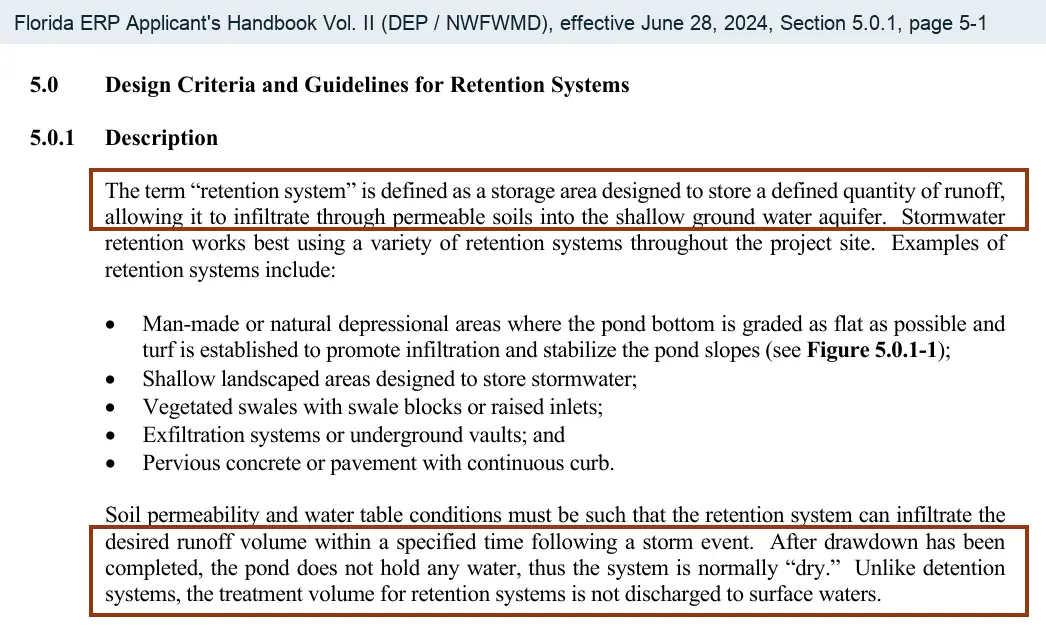
When do stormwater rules require a pond on a commercial site?
No national rule requires a pond. Ponds follow from state and local post-construction rules that set a treatment target, a storage volume per acre, or both, once a site crosses an impervious-area or acreage threshold. The construction-phase permit, a SWPPP for 1 acre or more of disturbance under the EPA construction stormwater program, is a separate, temporary requirement.
| Jurisdiction | Trigger | What the rule demands | Source |
|---|---|---|---|
| Florida, statewide ERP | More than 4,000 sq ft impervious surface subject to vehicles; more than 9,000 sq ft impervious total; more than 5 acres of project area; or more than 40 acre-feet impounded | 80% removal of total suspended solids; the greater of 80% phosphorus and 55% nitrogen load reduction, or no increase over predevelopment load | Rule 62-330.020(2); Vol. I 8.3.1, 8.3.2 |
| Florida, upstream of an Outstanding Florida Water | Same triggers | 90% phosphorus and 80% nitrogen reduction; 95% total suspended solids | Vol. I 8.3.1, 8.3.3 |
| Florida, redevelopment | Same triggers | Alternative standard: 80% phosphorus and 45% nitrogen; sites under 1 acre outside impaired or OFW watersheds may ask for an exemption | Vol. I 8.3.5, 8.3.6 |
| Harris County, Texas (unincorporated) | Commercial outfall to a County roadside ditch, or to a County storm sewer with less capacity allocated than projected | Minimum 1.0 acre-foot per acre (ditch) or 0.75 acre-foot per acre (storm sewer); 4-day maximum drain time | Infrastructure Regulations 6.03 (2019) |
| Harris County, redevelopment | No added impervious cover or outfall capacity | No detention required | 6.03.1.A(2) |
| North Carolina, state stormwater programs | High-density projects | Treat runoff from a 1.0-inch storm (1.5 inches in coastal counties) in an approved control such as a wet pond | NCDEQ manual B; 15A NCAC 02H .1053 |
Florida’s nutrient standards took effect on June 28, 2024 under section 373.4131, Florida Statutes, and Harris County applies the larger of its own storage rate and the Flood Control District’s rate (section 6.03.1.D). This page is general information, not engineering or legal advice: ask the civil engineer which manual, edition and section govern the site before the layout is fixed, because EPA puts a wet pond at 1 to 3 percent of its drainage area.
Stormwater approval often runs on a separate track from the building permit, as our guide to commercial building permits explains. Clearing the pond footprint is usually the first site cost, priced in our guide to land clearing cost per acre.
How big does a retention pond need to be?
Pond size comes from two separate numbers: a water-quality volume, the first inch or so of runoff treated in the pool, and, where a flood rule applies, a detention storage volume per acre. For a 5-acre commercial site at 80 percent impervious cover, the first is about 0.32 acre-feet in the North Carolina Piedmont; the second is 3.75 to 5.0 acre-feet in Harris County, Texas.
Worked example A uses North Carolina’s method because it is published as a formula and a lookup table (NCDEQ manual section B, revised March 15, 2017; C-3 Wet Pond, revised November 23, 2020). Florida’s 2024 rule sizes ponds by modelling nutrient loads (Volume I, section 9), so it has no one-line formula.
| Step | Input or formula | Result |
|---|---|---|
| 1. Drainage area (A) | All roof, paving and landscape draining to the pond | 5.0 acres |
| 2. Impervious fraction (IA) | 4.0 acres of roof and paving ÷ 5.0 acres | 0.80 |
| 3. Runoff coefficient Rv = 0.05 + 0.9 × IA | 0.05 + 0.9 × 0.80 | 0.77 |
| 4. Design storm depth (RD) | Piedmont county; coastal counties use 1.5 inches | 1.0 inch |
| 5. Design volume DV = 3630 × RD × Rv × A | 3630 × 1.0 × 0.77 × 5.0 | 13,976 cu ft (0.32 acre-foot) |
| 6. Same site in a coastal county | 3630 × 1.5 × 0.77 × 5.0 | 20,963 cu ft (0.48 acre-foot) |
| 7. Main pool surface, SA/DA Table 1 (80% impervious, 5.0 ft average depth) | 2.07% × 5.0 acres | 0.1035 acre = 4,508 sq ft |
| 8. Main pool volume | 4,508 sq ft × 5.0 ft average depth | 22,542 cu ft |
| 9. Forebay, 15 to 20% of main pool volume (MDC 5) | 0.15 to 0.20 × 22,542 | 3,381 to 4,508 cu ft |
| 10. Sediment storage (MDC 3) | Added below the design bottom | 6 inches |
| 11. Release rate to empty DV in 2 to 5 days (MDC 7) | 13,976 cu ft ÷ 172,800 to 432,000 seconds | 0.08 to 0.03 cfs |
| 12. Coastal pool surface, SA/DA Table 2 | 3.65% × 5.0 acres | 7,950 sq ft |
Worked example B applies Harris County’s storage rates to the same 5-acre commercial tract, then prices the digging with unit bids from the October 27, 2026 Valencia lake and detention tabulation for Brazoria County MUD No. 61 and No. 83 in Manvel, Texas.
| Step | Input | Result |
|---|---|---|
| 1. Storm sewer outfall, 0.75 acre-foot per acre (6.03.2.D(2)) | 0.75 × 5.0 acres | 3.75 acre-feet = 163,350 cu ft = 6,050 CY |
| 2. Roadside ditch outfall, 1.0 acre-foot per acre (6.03.2.D(1)) | 1.0 × 5.0 acres | 5.0 acre-feet = 217,800 cu ft = 8,067 CY |
| 3. Drain time longer than 4 days (Figure 3) | 5, 6 or 7 days | Add 5%, 15% or 25% to the volume |
| 4. Excavation with spoil kept on site | 6,050 CY × $2.35 to $4.04 | $14,218 to $24,442 |
| 5. Extra to haul spoil 1 to 1.5 miles off site | 6,050 CY × $9.75 to $15.85 | $58,988 to $95,893 more |
On the same site, the flood-storage rule needs 12 to 16 times the volume of the water-quality rule (3.75 to 5.0 acre-feet against 0.32). Where a county sets storage per acre, that rate, not the treatment volume, sets the pond footprint.
How deep is a retention pond, and what shape must it be?
Manuals set depth as a range, not one number. North Carolina requires an average main-pool depth of 3 to 8 feet, Florida’s northwest district caps wet detention ponds at 12 feet, and Harris County requires at least 6 feet of permanent water in wet-bottom basins. Each manual adds shelf, slope, forebay and outlet rules that change the excavation quantity and the land the pond takes.
| Element (as labelled in the diagram) | Florida, NWFWMD Vol. II (2024) | North Carolina, C-3 (2020) | Harris County (2019) |
|---|---|---|---|
| Treatment volume (temporary pool) | Half drains in 48 to 60 hours (5.2.3) | Drains in 2 to 5 days (MDC 7) | Drain time 4 days maximum (6.03.2.E(3)) |
| Control elevation (normal pool) | At or above the normal on-site water table (5.2.9) | Set by the lowest outlet above the pond bottom | Static water surface; shelf sits 1 ft above it (6.03.3.D(2)) |
| Forebay: 15 to 20% of main pool volume | Not set in section 5.2 | Required; clean out when depth falls below 75% of design (MDC 5) | Not set |
| Littoral shelf: 6:1 or flatter, 6 ft min. width | 6:1 or flatter; 30% to 40% of surface when used; 80% plant cover within 24 months (5.2.6) | Vegetated shelf at least 6 ft wide at 6:1 or flatter; 50 plants per 200 sq ft (MDC 6, 11) | Shelf at least 6 ft wide (6.03.3.D(2)) |
| Side slope: 4:1 to 2 ft below control elevation | Required, or fence the pond (2.4.1, 5.2.10) | No fixed ratio; safety benches recommended | 3:1 or flatter (6.03.3.A) |
| Average depth 3 to 8 ft (NC); max 12 ft (FL) | 12 ft maximum unless no stratification is shown (5.2.7) | Average 3 to 8 ft; only the top 8 ft counts (MDC 2) | 6 ft minimum permanent water (6.03.3.D(1)) |
| 6 in sediment storage | Not set in section 5.2 | Required (MDC 3) | Dry bottoms slope 0.75% instead |
| Outlet riser with orifice and trash rack | Anti-clog device on orifices under 3 inches (5.2.4) | Trash rack required (MDC 10) | Release limited to the tract’s allocated capacity (6.03.4.A) |
| Emergency spillway | Not set in section 5.2 | Strongly recommended, hardened (Recommendation 2) | Not set |
| Shape | Length to width at least 2:1 (5.2.8) | Long and narrow to avoid short-circuiting (MDC 4) | Not set |
Whether a wet pond holds its pool, or a dry basin drains within 72 hours, depends on the water table and soil type, which come from the boring logs in a geotechnical report. Where soils leak, the October 2026 Brazoria County bid added a 2-foot compacted clay liner at $2.94 to $6.81 per square yard.
What safety rules apply to side slopes and fencing?
Safety rules target the drop-off at the water’s edge. Florida requires any pond able to hold more than 2 feet of water to have side slopes of 4 horizontal to 1 vertical or flatter down to 2 feet below the control elevation, or to be fenced or otherwise closed to the public. Harris County sets 3:1 slopes, and North Carolina leaves fencing to the local reviewer.
| Rule | Requirement | Source |
|---|---|---|
| Florida slope or fence | 4H:1V or flatter to 2 ft below the control elevation; otherwise fence or restrict public access | FL Vol. II 2.4.1 |
| Florida wet detention use | Not designed for swimming, fishing or boating; fencing, signage or other measures must keep out people, vehicles and boats | FL Vol. II 5.2.1 |
| Harris County basins | Side slopes 3:1 or flatter; wet-bottom shelf at least 6 ft wide, 1 ft above static water | Harris County 6.03.3 |
| North Carolina | Trash racks sized so children cannot enter; fences around spillway, embankment and slopes; shallow safety benches; warning signs; fencing may be required locally | NCDEQ C-3, Recommendation 4 |
| North Carolina shelf | Vegetated shelf at least 6 ft wide discourages children from entering | NCDEQ C-3, MDC 6 |
A 4:1 slope takes 8 horizontal feet to drop the first 2 feet below the pool, which costs land on every side; fencing is the trade on a tight lot. Federal fence work at ponds ran $72,014 for a replacement in Beaufort, South Carolina (February 2025) and $158,801 for a new fence at West Point, New York (July 2025); neither record states fence length.
How much does a retention pond cost to build?
EPA’s December 2021 fact sheet puts wet pond construction at $35,000 to $75,000 per acre of impervious surface treated, in 2019 dollars, from Maryland county data. For the 5-acre example with 4 impervious acres, that is $140,000 to $300,000. Earthwork alone costs far less where spoil stays on site: $2.35 to $4.04 per cubic yard in an October 2026 Texas bid.
The Valencia tabulation (bid opening October 27, 2026, two bidders, LJA job 2791) lists each pond line item with a unit price. These are Gulf Coast prices for a district-financed lake and detention expansion, not a single commercial pad.
| Line item | Unit | Low to high bid | Quantity bid |
|---|---|---|---|
| Excavate detention volume, spoil placed and compacted on site | CY | $2.35 to $4.04 | 2,700 to 15,300 CY per item |
| Extra to haul spoil off site, 1 to 1.5 miles | CY | $9.75 to $15.85 | 2,174 CY |
| Remove 2 ft of unsuitable soil, place 2 ft clay liner | SY | $2.94 to $6.81 | 8,230 to 19,100 SY |
| Groundwater control (well points, sumps, pumps) | Acre | $1,938.33 to $5,000 | 2.1 to 4.1 acres |
| Hydromulch seeding and fine grading of side slopes | Acre | $2,750 to $2,762.13 | 1.6 acres |
| 5-inch concrete slope paving with toe walls | SY | $128 to $243.17 | 138 SY |
| Backslope swale interceptor structure | Each | $15,000 to $19,716.46 | 1 |
| 36-inch reinforced concrete storm sewer pipe | LF | $113.48 to $162 | 247 LF |
| Temporary coffer dam for the outfall | Each | $4,897.75 to $12,000 | 1 |
Read the bid as a package: the low bidder’s detention and drainage subtotal for MUD No. 61 was $201,515.03 for 18,500 cubic yards of detention excavation. CB&C works that out to $10.89 per cubic yard with pipes, structures, slope paving and seeding included ($11.52 for the second bidder).
| Item | Basis | 5-acre example (4.0 impervious acres) |
|---|---|---|
| Wet pond, all-in | $35,000 to $75,000 per impervious acre (EPA, 2021, 2019 dollars) | $140,000 to $300,000 |
| Dry detention pond, all-in | $45,000 to $80,000 per impervious acre (EPA, 2021, 2019 dollars) | $180,000 to $320,000 |
| Routine wet pond upkeep | About 3% of construction cost per year (EPA) | $4,200 to $9,000 per year |
| Harris County detention earthwork only, 6,050 CY | $2.35 to $4.04 per CY (October 2026 bid) | $14,218 to $24,442 |
| Same, if spoil must leave the site | Add $9.75 to $15.85 per CY | $58,988 to $95,893 more |
Three items move the total most: whether spoil can stay on site (off-site haul cost more per yard than the digging in the 2026 bid), whether groundwater must be pumped during excavation ($1,938 to $5,000 per acre), and whether the soil needs a clay liner to hold a pool ($2.94 to $6.81 per square yard). Carry those open items in a construction contingency.
Federal award records show the scale of whole pond jobs and service contracts; amounts are total obligations on USAspending.gov, and none states pond size.
| Agency, place, start date | Scope in the record | Award | Record |
|---|---|---|---|
| FEMA, Emmitsburg, Maryland, Aug 2023 | Install a retention pond to meet the MS4 permit (1 offer) | $2,582,564 | 70FA2023C00000006 |
| Army, Redstone Arsenal, Alabama, Aug 2024 | New detention pond at a soil borrow pit | $1,910,073 | W9124P24F0462 |
| Army Corps, Biloxi, Mississippi, Feb 2026 | Cedar Grove detention pond project (7 offers) | $955,684 | W9127826FA059 |
| Navy, Camp Lejeune, North Carolina, Sep 2025 | Edging and vegetation upkeep on 17 stormwater ponds | $442,810 | N4008525F1316 |
| Army, West Point, New York, Jul 2025 | Install fence around a retention pond area | $158,801 | W911SD25FA036 |
| Navy, Jacksonville, Florida, Sep 2022 | Stormwater pond cleanout | $100,796 | N6945022F0929 |
| Navy, Beaufort, South Carolina, Feb 2025 | Retention pond fence replacement | $72,014 | N4008525F2626 |
| GSA, Fort Hancock, Texas, Mar 2023 | Regrade around a retention pond, 4 to 6 ft riprap on side slopes (3 offers) | $44,083 | 47PH0423F0020 |
| USDA, Columbus, Ohio, Aug 2023 | Dredge a detention pond | $21,809 | 12405B23F0212 |
| USDA, Gainesville, Florida, Jul 2026 | Retention pond vegetation removal (25 offers) | $15,570 | 1232SA26P0358 |
In Texas, whoever builds a pond under contract has lien rights: Texas Property Code §53.021(a)(4) names “construction of a retention pond” in its landscaping clause. Collect a signed release with each payment, as our guide to lien waivers explains. Filing deadlines by state are in our mechanics lien laws by state table.
What maintenance does the owner owe after construction?
The owner, or the operation and maintenance entity named in the permit, owes inspections, repairs and records for the life of the pond. In Florida, the permit needs a written O&M plan at application and a certified inspection every 1 to 5 years depending on the practice, with the report filed within 30 days. Routine wet pond upkeep runs about 3 percent of construction cost a year (EPA, 2021).
| Practice (Florida Table 12-1) | Minimum inspection frequency | Source |
|---|---|---|
| Dry retention basins | Once every 3 years | FL Vol. I, Table 12-1 |
| Wet detention systems | Once every 3 years | Same |
| Wet detention with littoral zones | Once every 2 years | Same |
| Exfiltration trenches | Once every 2 years | Same |
| Underground retention; underground vaults and chambers | Once every year | Same |
| Pump systems | Twice every year | Same |
| Manufactured devices | As the maker specifies, at least once a year | Same |
| Vegetated natural buffers | Once every 5 years | Same |
A Florida owner may propose its own schedule, up to a 5-year maximum (section 12.5(h)). A cycle that meets the North Carolina and EPA schedules:
- First 6 weeks after planting: water the shelf plants twice a week if needed (NCDEQ C-3, maintenance item 1).
- After the first year: check for 50% plant survival in the littoral zone and remove invasive plants (EPA Table 1).
- Quarterly, and within 24 hours after any storm over 1.0 inch (1.5 inches in NC coastal counties): inspect inlets, the outlet orifice, the trash rack and the shoreline; remove trash; repair erosion (NCDEQ C-3).
- Once a year: have a dam safety professional inspect the embankment and remove any trees or shrubs on it (NCDEQ C-3).
- When the forebay loses a quarter of its design depth (below 75%): dredge it (NCDEQ C-3, MDC 5).
- Every 1 to 3 years: measure sediment in the main pool and forebay and remove it if needed (EPA Table 1).
- Every 2 or 3 years in Florida: have a qualified inspector certify the system and file Form 62-330.311(1) within 30 days (FL Vol. I, 12.5).
Upkeep contracts give a price check: $442,810 for vegetation work on 17 Camp Lejeune ponds in 2025, about $26,048 per pond (CB&C arithmetic); one Gainesville, Florida pond was cleared of vegetation for $15,570 in July 2026; dredging one Columbus, Ohio detention pond cost $21,809 in 2023.
Florida also requires the as-built plans inside the O&M plan (Volume I, 12.4.1(b)), and a permit in the operation phase transfers to a buyer only if the seller gives written notice within 30 days (section 6.3.2.1). Our guide to as-built drawings covers what to collect at closeout.
Which pond fits your site?
Pick the pond type by soil and water table first, then by drainage area and land. Dry retention only works where soils absorb the treatment volume within 72 hours (Florida 5.0.3). A wet pond needs enough inflow to keep its pool, which EPA puts at 10 to 20 acres of drainage in humid regions. Smaller or tighter sites can use a dry pond or an underground vault, which Florida inspects every year.
| If | Then | Rule behind it |
|---|---|---|
| No stormwater rule applies (Florida: 4,000 sq ft or less paved for vehicles and under the other thresholds) | Document the exemption | Rule 62-330.020(2) |
| Soils infiltrate the treatment volume within 72 hours and the water table is low | Dry retention basin (Florida meaning) | FL Vol. II 5.0.3 |
| Drainage area is 10 acres or more (5 acres in some states), or the water table is high | Wet pond (wet detention); set the control elevation at or above normal groundwater | EPA, 2021; FL Vol. II 5.2.9 |
| Drainage area is under 5 acres, or no room for a pond covering 1% to 3% of the drainage area | Dry detention pond, underground vault, or parking-lot ponding up to 9 inches over the inlet (Harris County) | EPA, 2021; Harris County 6.03.2.F |
| Pond holds more than 2 ft of water and slopes are steeper than 4:1 | Fence it or otherwise restrict access | FL Vol. II 2.4.1 |
| Average depth would exceed 8 ft (NC) or 12 ft (FL) | Only the top 8 ft counts in NC; Florida needs proof of no stratification | NC MDC 2; FL Vol. II 5.2.7 |
| Florida redevelopment under 1 acre that cuts impervious area, outside impaired or OFW watersheds | Ask in writing for the performance-standard exemption | FL Vol. I 8.3.6 |
| Harris County redevelopment adds no impervious cover or outfall capacity | No detention required | Harris County 6.03.1.A(2) |
| Florida pond would impound more than 40 acre-feet | ERP threshold and dam provisions apply | Rule 62-330.020(2)(e) |
During construction the site also needs the erosion controls and inspections in our SWPPP guide.
How we compiled this
CB&C compiled this page in November 2026 from 13 primary documents: Florida’s ERP Applicant’s Handbook Volumes I and II (effective June 28, 2024), Rule 62-330.020 and section 373.4131, Florida Statutes; Harris County’s Infrastructure Regulations (July 9, 2019 edition); three NCDEQ Stormwater Design Manual chapters; two EPA fact sheets and EPA’s construction stormwater page; Texas Property Code chapter 53; and one October 27, 2026 bid tabulation, plus 10 USAspending.gov award records. We did not design, build or inspect any pond. The City of Houston design manual was excluded because its files were not reachable, and depth figures that other guides give without a source were not used.
Frequently asked questions
Do retention ponds always have water?
A wet retention pond keeps a permanent pool between storms, though the level rises after rain until the outlet releases the stored volume over 2 to 5 days (NCDEQ C-3, MDC 7). In a Florida permit, a “retention” basin is the opposite: it is built to soak its volume into the ground within 72 hours and sit dry (ERP Applicant’s Handbook Volume II, sections 5.0.1 and 5.0.3).
How deep is a retention pond?
Depth is set by the local manual. North Carolina requires an average main-pool depth of 3 to 8 feet plus 6 inches of sediment storage (NCDEQ C-3, MDC 2 and 3). Florida’s northwest district caps wet detention ponds at 12 feet unless the engineer shows the water will not stratify (Volume II, 5.2.7). Harris County, Texas requires at least 6 feet of permanent water in wet-bottom basins.
Can you swim or fish in a retention pond?
Not by design. Florida’s ERP Applicant’s Handbook Volume II (section 5.2.1) says wet detention ponds should not be designed for swimming, fishing or boating, and requires fencing, signage or other measures to keep people, vehicles and boats out. North Carolina’s design manual (C-3, Recommendation 3) notes a documented case where irrigation spray from an algae-laden pond made several people ill.
Can an underground vault or parking lot replace a pond?
Often, if the local rule accepts it. Florida lists exfiltration systems and underground vaults as retention systems (Volume II, 5.0.1) and requires a yearly inspection of underground retention and vaults (Volume I, Table 12-1). Harris County allows parking-lot detention with no more than 9 inches of ponding over the inlet grate (section 6.03.2.F). Vaults save land but need inspection every year instead of every 3.
Who is responsible for maintaining a retention pond?
The permit names an operation and maintenance entity, usually the owner or an association. In Florida, if a contractor does the work, the permittee stays responsible for every requirement (Volume I, 12.4.1(c)). Inspections from June 28, 2025 must be done by a registered professional, someone working under one, or an inspector trained within the prior 5 years (12.5(c)).
Can a contractor file a lien for building a retention pond in Texas?
Yes. Texas Property Code §53.021(a)(4) gives a lien to a person who, under a contract with the owner or a contractor, provides labor, plant material or other supplies for landscaping, “including the construction of a retention pond, retaining wall, berm”. A waiver and release is enforceable only on the statutory forms in Subchapter L (§53.281), so collect those forms with each payment.
Sources
- Florida DEP and Northwest Florida Water Management District, ERP Applicant’s Handbook Volume II, NWFWMD (effective June 28, 2024), accessed November 2, 2026.
- Florida DEP and the five water management districts (SFWMD copy), ERP Applicant’s Handbook Volume I (effective June 28, 2024), accessed November 2, 2026.
- Florida DEP via Legal Information Institute, Rule 62-330.020, F.A.C., Environmental Resource Permits Required, accessed November 2, 2026.
- Florida Senate, Section 373.4131, Florida Statutes (2024), accessed November 2, 2026.
- Harris County Engineering Department, Regulations of Harris County, Texas for the Approval and Acceptance of Infrastructure (effective July 9, 2019), accessed November 2, 2026.
- Texas Legislature, Texas Property Code, Chapter 53, accessed November 2, 2026.
- LJA, Inc. for Brazoria County MUD No. 61 and No. 83, Bid tabulation: Lake B Expansion Phase 2 and Lake J to serve Valencia (October 27, 2026), accessed November 2, 2026.
- NC Department of Environmental Quality, Stormwater Design Manual, C-3 Wet Pond (revised November 23, 2020), accessed November 2, 2026.
- NC Department of Environmental Quality, Stormwater Design Manual, B. Stormwater Calculations (revised March 15, 2017), accessed November 2, 2026.
- NC Department of Environmental Quality, Stormwater Design Manual, C-12 Dry Pond (revised November 23, 2020), accessed November 2, 2026.
- U.S. EPA, Stormwater Best Management Practice: Wet Ponds, EPA-832-F-21-031BB (December 2021), accessed November 2, 2026.
- U.S. EPA, Stormwater Best Management Practice: Dry Detention Ponds, EPA-832-F-21-031A (December 2021), accessed November 2, 2026.
- U.S. EPA, Stormwater Discharges from Construction Activities, accessed November 2, 2026.
- USAspending.gov, Award 70FA2023C00000006 (FEMA, Emmitsburg, MD), accessed November 2, 2026.
- USAspending.gov, Award W9124P24F0462 (Army, Redstone Arsenal, AL), accessed November 2, 2026.
- USAspending.gov, Award W9127826FA059 (Army Corps, Biloxi, MS), accessed November 2, 2026.
- USAspending.gov, Award N4008525F1316 (Navy, Camp Lejeune, NC), accessed November 2, 2026.
- USAspending.gov, Award W911SD25FA036 (Army, West Point, NY), accessed November 2, 2026.
- USAspending.gov, Award N6945022F0929 (Navy, Jacksonville, FL), accessed November 2, 2026.
- USAspending.gov, Award N4008525F2626 (Navy, Beaufort, SC), accessed November 2, 2026.
- USAspending.gov, Award 47PH0423F0020 (GSA, Fort Hancock, TX), accessed November 2, 2026.
- USAspending.gov, Award 12405B23F0212 (USDA, Columbus, OH), accessed November 2, 2026.
- USAspending.gov, Award 1232SA26P0358 (USDA, Gainesville, FL), accessed November 2, 2026.