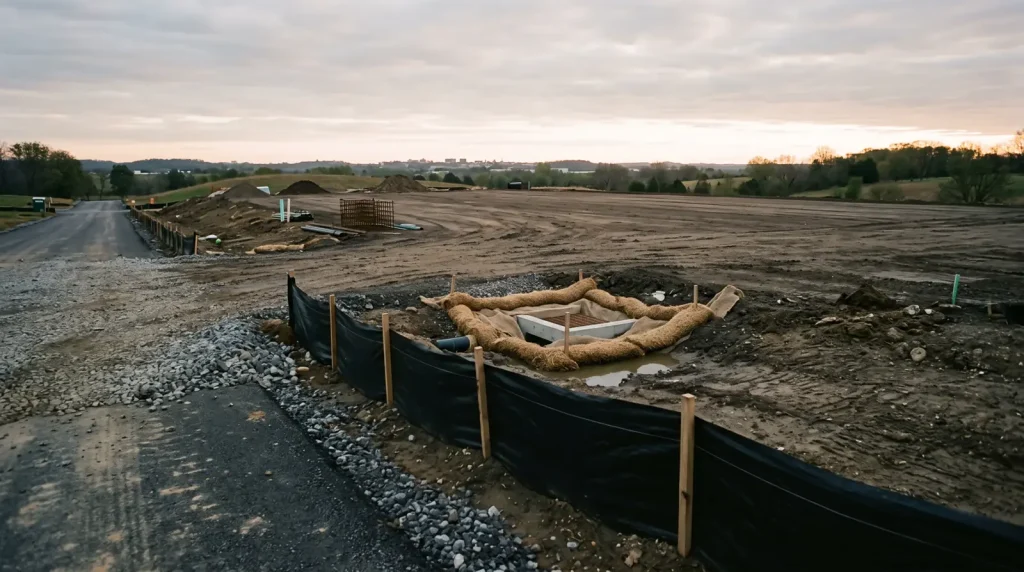
A SWPPP (stormwater pollution prevention plan) is the written erosion, sediment and pollution control plan a construction operator must finish before filing a Notice of Intent when work disturbs 1 acre or more.
Key takeaways
- Coverage starts at 1 acre of disturbance, or less than 1 acre inside a common plan that will disturb 1 acre or more, under EPA 2022 Construction General Permit Part 1.1.2.
- In EPA-permitted areas the SWPPP comes first, then the Notice of Intent (NOI) at least 14 calendar days before work starts (CGP Part 1.4.1 and Table 1); Florida DEP asks for 2 days and a $250 or $400 fee.
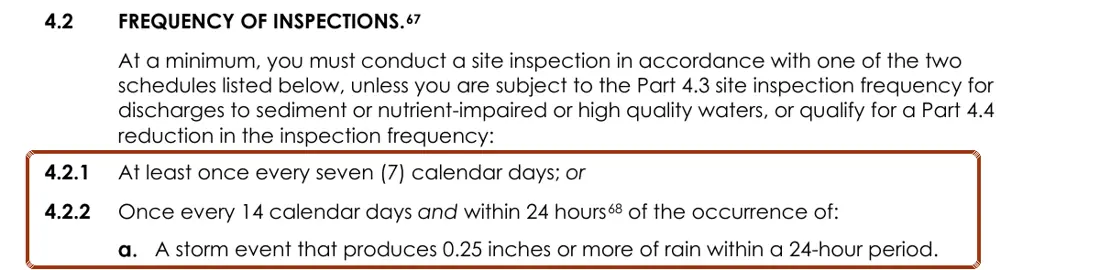
- A qualified person inspects every 7 calendar days, or every 14 days plus within 24 hours of 0.25 inches of rain (CGP Part 4.2); a new or replacement control must work within 7 calendar days of discovery (Part 5.2.1).
- In 43 bids on 8 Texas district contracts opened in September and October 2026, the SWPPP compliance lump sum ran $100 to $9,600, median $1,508 (LJA bid tabulations); Oklahoma DOT averaged $10,268.73 across 192 lump-sum awards.
- Civil penalties reach $68,445 per day per violation under 40 CFR 19.4; an EPA expedited settlement worksheet for a 12.75-acre Colorado school site totaled $21,900.
What is a SWPPP?
A SWPPP is a site-specific document, not a form. It names every operator and the stormwater team, maps the site and the waters it drains to, and specifies each erosion control, sediment control and pollution prevention measure with its design, maintenance routine and install date. Under the 2022 CGP, Part 7 sets the minimum contents, and the permit itself sets the enforceable limits.
The Construction General Permit (CGP) is a general permit under the Clean Water Act’s National Pollutant Discharge Elimination System (NPDES). Coverage is needed by each “operator”: the party that controls the plans and specifications, and the party with day-to-day control of the site (CGP Part 1.1.1). On a commercial job that can mean both the owner or developer and the general contractor; subcontractors generally are not operators. Texas calls the same document a SWP3 under TCEQ permit TXR150000.
Several operators may share one group SWPPP, but each stays responsible if another fails to act (CGP Part 7.1, footnote 84). The numbers below are the ones a project team works to most often.
| Item | Figure | Rule |
|---|---|---|
| Disturbance trigger | 1 acre, or less inside a common plan of 1 acre or more | CGP Part 1.1.2 |
| NOI lead time, EPA areas | At least 14 calendar days before work | CGP Table 1 |
| Routine inspection | Every 7 days, or every 14 days and within 24 hours of 0.25 in of rain | CGP Part 4.2 |
| Corrective action | Next business day; 7 calendar days for a new or replacement control | CGP Part 5.2.1 |
| Stabilization after work stops 14+ days | Complete within 14 days, or 7 days if over 5 acres are open | CGP Table 2 |
| Record retention | 3 years for inspection reports and the corrective action log | CGP Parts 4.7.4, 5.4.4 |
| Notice of Termination (NOT) | Within 30 calendar days of final stabilization | CGP Part 8.4 |
| Maximum civil penalty | $68,445 per day per violation | 40 CFR 19.4 |
When does a construction site need a SWPPP?
A site needs a SWPPP when it needs construction stormwater permit coverage, and the federal trigger is disturbing 1 acre or more, or less than 1 acre inside a common plan of development or sale that will ultimately disturb 1 acre or more (EPA construction stormwater program). The Texas, Florida and California permits use the same 1-acre floor.
Disturbance means clearing, grading, excavating and similar earthwork, so the clock usually starts with the clearing crew. Prices for that first phase are in our guide to land clearing cost per acre. Routine maintenance that keeps the original line, grade and capacity of a facility is excluded under 40 CFR 122.26(b)(15). For example, a 0.8-acre outparcel inside a shopping center plan that will disturb 12 acres in total is covered.
Sites under 5 acres can sometimes skip coverage with a rainfall erosivity waiver: 40 CFR 122.26(b)(15)(i)(A) lets the permitting authority waive the requirements where the rainfall erosivity factor R is below 5 for the construction period. Texas offers it as the Low Rainfall Erosivity Waiver. The flowchart and table below run the same four questions.
| Question | If yes | If no | Rule |
|---|---|---|---|
| 1. Will the work disturb 1 acre or more? | Go to question 3 | Go to question 2 | CGP Part 1.1.2 |
| 2. Is it part of a common plan that will disturb 1 acre or more in total? | Go to question 3 | No construction stormwater permit. Check local grading or erosion rules. | 40 CFR 122.26(b)(15) |
| 3. Under 5 acres, and is the rainfall erosivity factor R below 5 for the schedule? | Erosivity waiver may apply under 40 CFR 122.26(b)(15). Confirm with the permitting authority. | Go to question 4 | 40 CFR 122.26(b)(15)(i)(A) |
| 4. Is EPA the permitting authority? MA, NH, NM, DC, PR, Indian country or federal land listed in CGP Appendix B | EPA 2022 CGP: write the SWPPP, then file the NOI in NeT at least 14 days before work starts | State permit: write the SWPPP (SWP3 in Texas), then file the state NOI or post the site notice | CGP Appendix B |
Who issues construction stormwater permits in your state?
EPA issues the 2022 CGP itself only where no state runs the program: statewide in Massachusetts, New Hampshire, New Mexico, the District of Columbia and Puerto Rico, plus Indian country, listed federal facilities and Pacific territories (CGP Appendix B). Every other state issues its own construction general permit, with its own NOI form, fee and deadlines.
The state permits follow the same federal minimums in 40 CFR 450.21, so the SWPPP structure carries over, but the paperwork does not. This summary of public permit text is not legal advice; the permit your site is covered under controls.
| Jurisdiction | Permit | Plan name | Notice before work | Ends with | Source |
|---|---|---|---|---|---|
| EPA areas (MA, NH, NM, DC, PR, Indian country, listed federal land) | 2022 CGP, expires February 16, 2027 | SWPPP | NOI in NeT at least 14 calendar days before work | NOT within 30 days | EPA CGP Table 1, Part 8.4 |
| Texas | TXR150000, effective March 5, 2023, expires March 5, 2028 | SWP3 | Small sites (1 to under 5 acres) post a site notice; large sites (5+ acres) file an NOI in STEERS | NOT in STEERS | TCEQ |
| Florida | DEP construction generic permit, 5-year term | SWPPP | NOI at least 2 calendar days before; $250 for 1 to 5 acres, $400 for 5+ acres | NOT within 14 days after final stabilization | Florida DEP |
| California | Order 2022-0057-DWQ, effective September 1, 2023 | SWPPP | Filed in SMARTS; Lake Tahoe Basin uses Lahontan Order R6T-2016-0010 | Per the order | State Water Board |
What must a SWPPP contain?
Under CGP Part 7.2, a SWPPP has 11 required sections, from a list of every operator to a signed certification, and 10 of them are written before the NOI is filed. The site map and the control descriptions carry most of the work: each control needs a design specification, a maintenance routine and an installation date. EPA publishes a free 2022 CGP SWPPP template in Word format.
The right column shows what EPA’s 2023 construction stormwater expedited settlement schedule charges when that section is missing, which shows how EPA weighs each gap. Section numbers follow the 2025 modified permit.
| CGP part | Section | What it must show | EPA settlement amount if missing |
|---|---|---|---|
| 7.2.1 | All site operators | Every other operator and the area each controls | $600 |
| 7.2.2 | Stormwater team and training proof | Names, roles, who inspects, inspector training certificates (Part 6.3) | $300 |
| 7.2.3 | Nature of construction activities | Property size; disturbed area to the nearest quarter acre; most area open at one time; schedule from clearing to removal of controls; pollutant sources; business hours | $120 to $600 per item |
| 7.2.4 | Site map | Boundaries, slopes, stockpiles, exits, receiving waters within 1 mile downstream, drainage before and after grading, control locations | $600 with no map; $60 per missing feature |
| 7.2.5 | Non-stormwater discharges | Authorized ones that will occur, such as Part 1.2.2 discharges | $600 |
| 7.2.6 | Stormwater control descriptions | Each control, its design specification, maintenance and install schedule | $300 per missing control, capped at $900 per group |
| 7.2.7 | Inspection and corrective action | Inspection schedule, rain gauge or weather station, checklists | $600; $120 per omission |
| 7.2.8 | Turbidity monitoring (dewatering) | Sampling procedures where Part 3.3 applies | Priced under dewatering items |
| 7.2.9 | Species, historic, UIC records | Endangered species, historic property and underground injection documentation | $600 each |
| 7.2.10 | Signed certification | Signature under Appendix G, Part G.11 | $600 |
| 7.2.11 | NOI, NeT letter, permit copy | Added after authorization | $300 each |
After authorization the plan becomes a working file: inspection reports (24 h), corrective action log, edits within 7 days (Part 7.4), kept on site or easily accessible (Part 7.3). A missing on-site copy is a $600 item in the same EPA Region 8 settlement worksheet. Known hazardous materials such as PCBs and asbestos must be listed under Part 7.2.3, and the site history behind that list often comes from a Phase I environmental site assessment.
How often must you inspect, and how fast must problems be fixed?
Under CGP Part 4.2, a qualified person must inspect at least once every 7 calendar days, or once every 14 calendar days and within 24 hours of a storm producing 0.25 inches of rain in 24 hours. Routine maintenance must be finished by the close of the next business day, and a new or replacement control must be working within 7 calendar days of discovery.
| Event | Deadline | CGP part |
|---|---|---|
| Before the NOI | Write and sign the SWPPP | 1.4.1, 7.1 |
| NOI: 14+ days ahead | At least 14 calendar days before work in EPA areas; Florida 2 days | Table 1 |
| Day 0: work starts | Perimeter, exit and inlet controls in place where work begins | 2.1.3 |
| Every 7 days | Or every 14 days and within 24 hours of 0.25 in of rain | 4.2 |
| Impaired or Tier 2, 2.5 or 3 receiving water | Every 7 days and within 24 hours of 0.25 in of rain | 4.3 |
| Area fully stabilized | Twice in the first month, then monthly | 4.4.1 |
| Inspection report | Within 24 hours of the inspection | 4.7.1 |
| Problem found | Fix by next business day; new control or big repair within 7 days | 2.1.4, 5.2.1 |
| Corrective action log entry | Within 24 hours of finding and of finishing | 5.4.1 |
| SWPPP edits after a change | Within 7 calendar days | 5.2.1, 7.4.1 |
| Sediment tracked onto a paved road | Removed by end of the same business day | 2.2.4 |
| Work stops 14+ days | Start by next business day; stabilize within 14 days; 7 days if over 5 acres are open at one time | Table 2 |
| NOT within 30 days | After final stabilization (70% cover) with photos | 8.2.1, 8.4 |
Who counts as a qualified inspector?
For projects covered on or after February 17, 2023, the inspector must have passed EPA’s construction inspection course and exam, or hold a current certification that covers erosion and sediment control principles, installation and maintenance (CGP Part 6.3). Inspections are only required during normal working hours (Part 4.2, footnote 67), and a site on the 14-day schedule must name in its SWPPP the rain gauge or weather station that triggers storm inspections (Part 7.2.7).
How do the Notice of Intent and Notice of Termination work?
The NOI is the operator’s application for coverage, and the NOT ends it. In EPA areas both are filed in the NPDES eReporting Tool (NeT): the NOI at least 14 calendar days before work and only after the SWPPP is done, and the NOT within 30 calendar days of final stabilization. Coverage under the 2022 CGP ends at midnight on the day a complete NOT is submitted (Part 8.5).
- Confirm the permitting authority in CGP Appendix B and the size class; Texas splits small (1 to under 5 acres) and large (5 acres or more) sites.
- Complete and sign the SWPPP (Parts 7.1 and 7.2.10), form the stormwater team and finish inspector training (Part 6).
- File the NOI in NeT at cdx.epa.gov at least 14 calendar days before work; authorization starts 14 calendar days after EPA confirms a complete NOI (Table 1). Florida needs 2 days and a $250 or $400 fee.
- Post a sign visible from the nearest public road with the NPDES ID, a contact name and phone number, and how to get the SWPPP (Part 1.5).
- Add the NOI, the NeT acknowledgment letter and a copy of the permit to the SWPPP (Part 7.2.11).
- If the operator changes, the new operator files an NOI at least 14 days before the transfer and the old operator files an NOT (Part 1.4.4).
- At the end, reach final stabilization (70 percent of native vegetative cover, or permanent non-vegetative cover), remove temporary controls that are not biodegradable, take before and after photos, and file the NOT within 30 calendar days (Parts 8.2.1, 8.4). Florida’s deadline is 14 days after final stabilization.
Timing matters for long jobs: the 2022 CGP expires February 16, 2027, and the proposed 2027 CGP was noticed in the Federal Register on August 3, 2026, with comments due September 17, 2026 (EPA). Sites still under construction after expiry need coverage under the replacement permit (CGP Part 1.4.5). The NOT and its photos fit naturally into closeout, next to the paperwork for substantial completion.
Which BMPs does the CGP require, and what do they cost?
BMPs (best management practices) are the physical controls and housekeeping rules a SWPPP specifies. The CGP sets minimums: perimeter controls downslope, stabilized exits, inlet protection, stockpile barriers, sediment basins sized for 3,600 cubic feet per acre drained, leak-proof concrete washout and stabilization deadlines. Public bid prices from 2025 and 2026 show what each costs to install.
| BMP | CGP rule | Public price (scope, place, date) | Source |
|---|---|---|---|
| Silt fence or other perimeter control | Downslope of disturbed soil; remove sediment at one-half of its height; ends turned upslope (2.2.3) | $3.27 per LF average over 1,635,270 LF, Oklahoma highways, April 2025 to September 2026; $0.50 to $4.00 per LF installed, maintained and removed, Waller County MUD 69, Texas, September 2026 | ODOT item 221(B)2300; LJA tab 5454-2604 |
| Stabilized construction exit | Every exit onto a paved road; track-out removed the same business day (2.2.4) | $500 to $3,304 each, Waller County MUD 69, September 2026; $1,525 and $4,500 each, Plum Creek MD 1A, October 2026 | LJA 5454-2604; LJA 3301-3007 |
| Inlet protection | At inlets carrying site water; clear sediment same or next business day (2.2.10) | $1 to $143 each for 50 Stage II inlets, Waller County MUD 69, September 2026 | LJA 5454-2604 |
| Concrete washout | Leak-proof container or lined pit, away from inlets and waters (2.3.4) | $827 to $11,215 each, Waller County MUD 69; $500 and $610 each, Plum Creek MD 1A, 2026 | LJA 3301-3007 |
| Sediment basin | 2-year, 24-hour storm or 3,600 cubic feet per acre drained; surface outlet (2.2.12) | $2,811.48 each average over 32 temporary basins, Oklahoma, 2025 to 2026 | ODOT item 221(D)2500 |
| Stabilization | Start by next business day once work stops 14+ days; final cover 70 percent (2.2.14) | Seeding $1,726.20 per acre over 1,089.98 acres; solid slab sod $2.94 per SY, Oklahoma, 2025 to 2026 | ODOT items 232(B)9300, 230(A)7200 |
| Natural buffer | 50-foot undisturbed buffer, or equivalent controls, for waters within 50 feet (2.2.1) | Not bid as a line item; it holds a 50-foot strip out of the work area | CGP Part 2.2.1 |
The sediment basin in CGP Part 2.2.12 is a construction control: under Part 8.2.1 it comes out before the NOT unless it is kept for long-term use. Permanent post-construction detention or retention ponds are a separate design item set by local stormwater rules. Soil data for both designs can come from the geotechnical report.
How much does a SWPPP cost?
In 43 bids on 8 Texas utility district contracts opened between September 2 and October 8, 2026, the SWPPP compliance lump sum ran $100 to $9,600, median $1,508. Oklahoma DOT paid an average of $10,268.73 for SWPPP documentation and management across 192 lump-sum awards on state transportation contracts from April 2025 to September 2026. The controls themselves cost more than the paperwork.
In these Texas bid sets the SWPPP line pays the contractor to administer, maintain and remove controls shown on the engineer’s plans; the Pomona lift station line reads “to be maintained until contractor’s notice of termination is submitted.” The fee for writing the plan does not appear in these 8 tabulations, so ask the civil engineer to quote it as a separate line.
| Project (bid opening) | Work | Bids | Low | Median | High | Low base bid | Source |
|---|---|---|---|---|---|---|---|
| Fort Bend County MUD 134C, Westmoor Court Sec. 2 (Sep 2, 2026) | Water, sewer, drainage, paving | 11 | $150 | $1,000 | $3,250 | $2,931,350.30 | LJA 1680-114102A&B |
| Harris County MUD 539, Anniston Sec. 21 (Oct 7, 2026) | Water, sewer, drainage | 9 | $500 | $1,500 | $3,366.47 | $732,000.00 | LJA 0390-2511 |
| Brazoria County MUD 40, Pomona Commercial Area A (Sep 9, 2026) | Water, sewer, drainage, paving | 6 | $1,200 | $1,745 | $3,239.84 | $1,017,160.78 | LJA 2149-3925 |
| Waller County MUD 69, 11th Street utilities (Sep 22, 2026) | Street and off-street utilities | 4 | $1,800 | $2,640 | $5,099 | $6,196,666.66 | LJA 5454-2604 |
| Plum Creek MD 1A, commercial conveyance (Oct 8, 2026) | Detention and drainage | 2 | $3,474 | $5,487 | $7,500 | $2,005,000.00 | LJA 3301-3007 |
| Montgomery County MUD 113, Woodforest Sec. 110 (Sep 18, 2026) | Water, sewer, drainage | 3 | $1,200 | $2,100 | $8,500 | $380,381.67 | LJA 1173-1114 |
| Brazoria County MUD 40, Pomona lift station and WWTP (Sep 11, 2026) | Lift station, 0.90 MGD plant | 4 | $500 | $1,125 | $9,600 | $926,148.00 | LJA 1840-5202 |
| Harris County MUD 542, lift station generator (Oct 8, 2026) | Generator install | 4 | $100 | $1,600 | $8,165.67 | $144,169.00 | LJA 2510-0023 |
| Oklahoma DOT, 192 lump-sum awards (Apr 2025 to Sep 2026) | SWPPP documentation and management | 192 | $1,750 (district-quarter average) | $10,268.73 (average) | $79,500 (district-quarter average) | n/a | ODOT item 220 1100 |
Earlier tabulations land in the same band: Fort Bend County MUD 24 drew $1,313 and $3,500 in March 2025 (LJA 1931-124001), and MUD 213 drew $2,500 from both bidders in August 2025 for a line that included inspections, the NOI and the NOT (LJA 7777-1305G). Three 2026 tabs priced every SWPPP item, which shows the full cost of compliance.
| Project | All SWPPP items, low bidder | Low base bid | SWPPP share (CB&C arithmetic) | Largest item |
|---|---|---|---|---|
| Waller County MUD 69 | $8,856.00 | $6,196,666.66 | $8,856.00 / $6,196,666.66 = 0.14% | 9,412 LF silt fence, $4,706.00 |
| Brazoria County MUD 40, Pomona Commercial Area A | $4,796.78 | $1,017,160.78 | $4,796.78 / $1,017,160.78 = 0.47% | Washout, $2,500.00 |
| Plum Creek MD 1A | $29,792.00 | $2,005,000.00 | $29,792.00 / $2,005,000.00 = 1.49% | 13,700 LF silt fence at $1.45, $19,865.00 (67%) |
Silt fence footage moves the price most: at Plum Creek it was $19,865 of the $29,792 SWPPP group. Inspection frequency, project length and whether the line includes street sweeping and washout move the lump sum. Monthly pay applications show stormwater cost only if it has its own lines in the schedule of values. Check silt fence, exit and washout unit prices item by item when you compare construction bids.
What several guides say vs what the record shows
Three claims on pages that rank for SWPPP in November 2026 do not match the primary sources checked on November 2, 2026: an unsourced cost table, an outdated penalty figure, and a required section the 2022 CGP does not list for most sites. Each is described here without naming the publisher.
| Claim | What a ranking page says | What the primary source says | Source |
|---|---|---|---|
| SWPPP cost | A form-hosting site dated June 2, 2026 lists $5,000 to $20,000 for a site under 1 acre and $20,000 to $100,000 for a mid-sized commercial site, with no source | A stand-alone site under 1 acre needs no federal permit (CGP Part 1.1.2); public 2026 bids put the compliance line at $100 to $9,600 and all SWPPP items at 0.14% to 1.49% of the base bid | LJA tabulations |
| Maximum penalty | A contractor software blog published January 8, 2025 cites $64,618 per violation per day | $68,445 per day per violation for penalties assessed on or after January 8, 2025, and $66,712 for the year before | 40 CFR 19.4 |
| Required parts | A topic guide updated July 16, 2026 lists a sampling and analysis plan as a required component | Part 7.2 requires turbidity monitoring procedures only for dewatering sites under Part 3.3 | CGP Part 7.2.8 |
What are the penalties for SWPPP violations?
As of the January 8, 2025 inflation adjustment in 40 CFR 19.4, a court can impose up to $68,445 per day for each Clean Water Act violation, and EPA administrative penalties reach $342,218. Many construction cases settle far lower: EPA’s expedited settlement schedule prices a missing SWPPP at $6,000 and each missed inspection at $300.
| Route | Statute | Maximum or scheduled amount | Source |
|---|---|---|---|
| Civil judicial | 33 U.S.C. 1319(d) | $68,445 per day per violation | 40 CFR 19.4, Table 1 |
| Class I administrative | 33 U.S.C. 1319(g)(2)(A) | $27,378 per violation, $68,445 total | 40 CFR 19.4 |
| Class II administrative | 33 U.S.C. 1319(g)(2)(B) | $27,378 per day, $342,218 total | 40 CFR 19.4 |
| Expedited settlement: no SWPPP at inspection | CGP Part 7.1 | $6,000 | EPA 2023 construction ESA worksheet |
| Expedited settlement: SWPPP written after work started | CGP Part 7.1 | $1,000 per month, up to $6,000 | EPA ESA worksheet |
| Expedited settlement: discharge without coverage | CWA 301 | $600 per month | EPA ESA worksheet |
| Expedited settlement: each missed inspection | CGP Parts 4.2 to 4.4 | $300 | EPA ESA worksheet |
| Expedited settlement: final stabilization not met | CGP Part 2.2.14 | $1,200 | EPA ESA worksheet |
One public example shows how the counts add up. EPA Region 8 inspected a 12.75-acre school construction site in Colorado Springs on April 11, 2024, and the settlement worksheet filed September 30, 2024 under docket CWA-08-2024-0013 totals $21,900: $16,200 for 27 dewatering violations at $600 each, $3,000 for 10 control-maintenance failures at $300 each, and smaller items for track-out, signage and report gaps (EPA Region 8 filing).
What should an owner put in the contract?
Owners settle 3 things before bid day: who files as operator, who writes and maintains the SWPPP, and how compliance is priced. The table pairs common situations with the action the permit text supports. The same stormwater scope then belongs in the bid form, the closeout checklist and the general conditions.
| If | Then | Rule or record |
|---|---|---|
| The site disturbs 1 acre or more, or sits in a common plan of 1 acre or more | Budget for the SWPPP, NOI, inspections and NOT; require the plan before the NOI | CGP Parts 1.1.2, 1.4.1 |
| The owner controls the plans and the GC runs the site | Both file NOIs, or share a group SWPPP with written duties | CGP Part 1.1.1; Part 7.1, footnote 84 |
| The bid form has a single SWPPP lump sum | Ask for silt fence per LF, exits, inlet protection and washouts as unit items | Plum Creek: silt fence was $19,865 of $29,792 |
| More than 5 acres will be open at one time | Phase the grading or plan for 7-day stabilization | CGP Table 2 |
| A receiving water is within 50 feet of disturbance | Keep a 50-foot natural buffer or design equivalent controls | CGP Part 2.2.1 |
| The site drains to an impaired or Tier 2, 2.5 or 3 water | Inspect every 7 days and after 0.25 in of rain; 7-day stabilization | CGP Parts 4.3, 2.2.14 |
| Dewatering is planned | Add turbidity monitoring; the benchmark is a 50 NTU weekly average | CGP Parts 3.3, 5.1.5 |
| Work in an EPA area runs past February 16, 2027 | Plan to move coverage to the 2027 CGP | CGP Part 1.4.5 |
| Closeout is near | Tie release of retainage to the NOT, photos and removal of controls | CGP Part 8.2.1 |
The closeout row works best when the contract ties the CGP Part 8.2.1 conditions to payment up front. How holdbacks are released is covered in our guide to retainage in construction. Local building and site permits are separate from the stormwater permit and are listed in our guide to commercial building permits.
Many sites also need a permanent stormwater pond after construction, explained in our retention pond guide.
How we compiled this
We read the EPA 2022 Construction General Permit as modified in April 2025 (Parts 1 to 8 and Appendix B), 40 CFR 19.4 and 122.26, an EPA Region 8 expedited settlement worksheet, three state program pages, Oklahoma DOT’s October 15, 2026 price report and 10 LJA Engineering bid tabulations: 21 primary documents, accessed November 2026. We excluded USAspending.gov SWPPP awards because they price industrial facility plans, not construction sites. No site visits or interviews; medians and shares are CB&C arithmetic.
Frequently asked questions
Who is responsible for the SWPPP on a construction site?
Every operator is responsible. Under EPA CGP Part 1.1.1 that is the party controlling the plans and specifications and the party with day-to-day control of the site, which can be both the owner and the general contractor. They may share one group SWPPP, but each remains liable if the other fails to act. Subcontractors generally are not operators.
Do I need a SWPPP for a project under 1 acre?
Only if the project is part of a larger common plan of development or sale that will disturb 1 acre or more in total, such as a pad site inside a retail center plan. A stand-alone project under 1 acre needs no federal construction stormwater permit, though city or county grading and erosion rules may still require an erosion control plan.
Is a SWPPP the same as an erosion control plan?
Not exactly. A SWPPP under CGP Part 7.2 covers erosion and sediment controls plus the operators, the stormwater team, pollution prevention for fuel, washout and waste, inspection procedures and permit records. Part 7.2.6 lets the SWPPP cite a local erosion and sediment control manual or ordinance as the design basis for each control, so the two documents often overlap.
How long must SWPPP records be kept?
Under the 2022 CGP, inspection reports and the corrective action log must be kept for at least 3 years (Parts 4.7.4 and 5.4.4). Inspection reports are due within 24 hours of each inspection, and corrective action entries within 24 hours of finding and of fixing the problem. Electronic copies count if they are as readable and accessible as paper.
Can a contractor write its own SWPPP?
Yes. EPA publishes a free Construction SWPPP Template in Word format aligned with the 2022 CGP, plus inspection report and corrective action log templates. The permit endorses no vendor (Part 7.1, footnote 85). Inspectors must still meet Part 6.3 training: the EPA construction inspection course and exam, or a current equivalent certification.
What changes when the 2022 Construction General Permit expires?
The 2022 CGP expires at 11:59 pm on February 16, 2027. EPA published the proposed 2027 CGP on August 3, 2026 and extended comments to September 17, 2026. Sites still under construction in EPA areas after expiry must obtain coverage under the replacement permit (Part 1.4.5), so long projects should budget a fresh NOI and SWPPP review.
Sources
All sources below were accessed on November 2, 2026, except the two 2025 LJA tabulations, accessed November 1, 2026.
- National Pollutant Discharge Elimination System Construction General Permit, 2022, as modified April 2025, U.S. EPA.
- 2022 CGP Appendix B: Permit Areas Eligible for Coverage, U.S. EPA.
- Stormwater Discharges from Construction Activities, U.S. EPA, updated August 10, 2026.
- Construction General Permit Resources, Tools and Templates, U.S. EPA.
- 40 CFR 122.26, Storm water discharges, eCFR, current as of October 29, 2026.
- 40 CFR 19.4, Statutory civil monetary penalties, as adjusted for inflation, eCFR, current as of October 29, 2026.
- Expedited Settlement Offer Worksheet, Docket CWA-08-2024-0013, U.S. EPA Region 8, filed September 30, 2024.
- Stormwater Permits for Construction Sites (TXR150000), Texas Commission on Environmental Quality.
- Construction Activity (CGP), Florida Department of Environmental Protection.
- Construction Stormwater Program, California State Water Resources Control Board.
- Weighted Average Item Price Report, April 1, 2025 to September 30, 2026, Oklahoma Department of Transportation, October 15, 2026.
- Fort Bend County MUD 134C, Westmoor Court Section 2, September 2, 2026, LJA Engineering bid tabulation.
- Harris County MUD 539, Anniston Section 21, October 7, 2026, LJA Engineering bid tabulation.
- Brazoria County MUD 40, Pomona Commercial Area A, September 9, 2026, LJA Engineering bid tabulation.
- Waller County MUD 69, 11th Street and off-street utilities, September 22, 2026, LJA Engineering bid tabulation.
- Plum Creek Management District 1A, commercial conveyance and drainage, October 8, 2026, LJA Engineering bid tabulation.
- Montgomery County MUD 113, Woodforest Section 110, September 18, 2026, LJA Engineering bid tabulation.
- Brazoria County MUD 40, Pomona Lift Station 1 and WWTP Phase 5, September 11, 2026, LJA Engineering bid tabulation.
- Harris County MUD 542, Lift Station 1 generator, October 8, 2026, LJA Engineering bid tabulation.
- Fort Bend County MUD 24, Winfield Lakes Phase 1, March 28, 2025, LJA Engineering bid tabulation.
- Fort Bend County MUD 213, Manor Lakes Estates, August 19, 2025, LJA Engineering bid tabulation.