An SBA 504 loan splits the cost of an owner-occupied building three ways: a bank loan for 50%, a fixed-rate CDC debenture for up to 40% (capped at $5 million) and at least 10% from the owner.
Key takeaways
- The owner puts in at least 10% of project cost, 15% if the business has operated 2 years or less or the building is limited or special purpose, and 20% if both apply (13 CFR 120.910).
- The 504 debenture is capped at $5,000,000 outstanding per borrower and affiliates; small manufacturers and energy projects get $5,500,000 per project (13 CFR 120.931).
- Your business must occupy at least 51% of an existing building or 60% of a new one, and may lease out no more than 20% of a new building long term (13 CFR 120.131).
- For loans approved October 1, 2026 to September 30, 2027, SBA charges a 0.50% upfront guaranty fee and a 0.203% annual service fee, both waived for manufacturers, food supply chain businesses and rural borrowers (SBA Information Notice 5000-881796).
- Since October 1, 2025, each project must create or retain one job per $95,000 of SBA-guaranteed debenture, or $150,000 for small manufacturers and energy projects (SBA notice, 90 FR, September 30, 2025).
How does an SBA 504 loan work?
A 504 project has three funders. A bank or other third-party lender makes a first-lien loan for at least 50% of cost, a Certified Development Company (CDC, a nonprofit lender certified by SBA) makes a second-lien loan for up to 40%, funded by an SBA-guaranteed debenture, and the owner covers the rest. The 40% piece may not exceed 40% of project cost plus eligible administrative costs (13 CFR 120.930).
The 50/40/10 split is the standard case, not a fixed rule. When the business has operated 2 years or less, or the building is limited or special purpose, the bank loan must be at least 50% of project cost (13 CFR 120.920) and the CDC share shrinks to make room for a larger owner contribution, per SBA SOP 50 10 8.1 (the lender rulebook effective October 1, 2026).
| Situation | Bank (first lien) | CDC / SBA (second lien) | Owner | Source |
|---|---|---|---|---|
| Existing business (over 2 years), general-purpose building | 50% | 40% | 10% | 13 CFR 120.910(a)(4); SOP 50 10 8.1 |
| Business 2 years old or less, OR limited or special purpose building | 50% | 35% | 15% | 13 CFR 120.910(a)(1), (2); 120.920(a) |
| Business 2 years old or less AND special purpose building | 50% | 30% | 20% | 13 CFR 120.910(a)(3); SOP 50 10 8.1 |
SBA’s own list of limited or special purpose properties in SOP 50 10 8.1 includes hospitals, surgery and urgent care centers, hotels and motels, car washes, gas stations, cold storage where more than 50% of the floor is refrigerated, funeral homes with crematoriums, nursing homes, marinas, theaters and wineries. The CDC must state in its credit memo whether the property is special purpose, so ask early which column your building falls in.
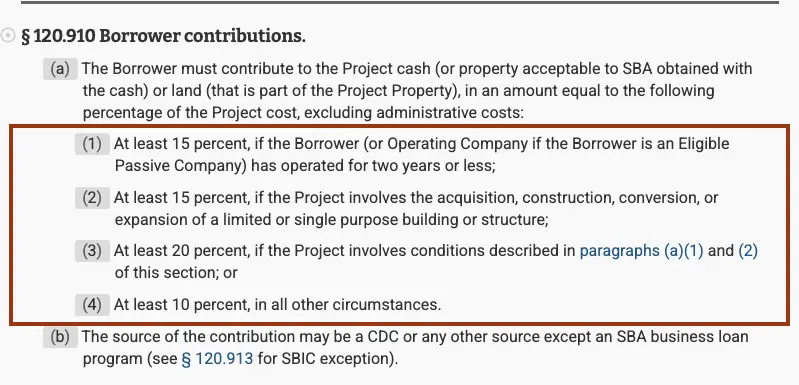
Land already owned counts toward the owner share. Land bought less than 2 years before the application counts at cost; land held 2 years or more counts at appraised fair market value (SBA SOP 50 10 8.1). The contribution may come from any source except another SBA business loan program (13 CFR 120.910(b)).
Who qualifies for an SBA 504 loan?
A for-profit operating business that is small under SBA size rules and will occupy the building qualifies. The simplest size test is the alternative size standard: tangible net worth of $20 million or less and average net income after federal tax of $6.5 million or less over the 2 prior years (13 CFR 121.301). Investors buying rental property do not qualify (SBA 504 program page).
| Requirement | Threshold | Source |
|---|---|---|
| Size (alternative standard, with affiliates) | Tangible net worth $20 million or less; average net income after tax $6.5 million or less (2 full fiscal years) | 13 CFR 121.301; SOP 50 10 8.1 |
| Occupancy, existing building | Business occupies at least 51%; may lease up to 49% | 13 CFR 120.131(b) |
| Occupancy, new construction | Occupies at least 60% now; plans to occupy more within 3 years and all non-leased space within 10 years; long-term leases up to 20% | 13 CFR 120.131(a) |
| Jobs or policy goal | 1 job created or retained per $95,000 of debenture ($150,000 for small manufacturers and energy projects), or a community development or public policy goal | SBA notice, Sept 30, 2025; 13 CFR 120.862 |
| Repayment | Debt service coverage of 1.15 or better, historical or projected | SOP 50 10 8.1 |
| Personal guaranty | Every owner of 20% or more signs an unlimited guaranty | SOP 50 10 8.1 |
| Eligible uses | Land, buildings, construction, renovation, machinery with at least 10 years of useful life, eligible refinancing | SBA 504 program page; 13 CFR 120.882 |
| Not eligible | Working capital, inventory, rental real estate investment, speculation | SBA 504 program page |
The job rule is less strict than it looks. A project that misses the $95,000-per-job ratio can still qualify through one of the goals in 13 CFR 120.862, such as revitalizing a business district under a written plan, expanding a woman-owned or veteran-owned business, or cutting energy use by at least 10%, if the CDC’s portfolio still meets its average. On the $1,654,000 debenture in our worked example below, the ratio means about 17.4 jobs, which an existing 18-person business can meet by retention.
If the owner holds the real estate in a separate company that leases it to the operating business, SBA treats that holding company as an Eligible Passive Company. The operating company must then meet the same 51% or 60% occupancy test and normally guarantees the loan (SOP 50 10 8.1).
How much can you borrow with an SBA 504 loan?
The debenture runs from $25,000 to $5,000,000 outstanding per borrower and affiliates, and $5,500,000 per project for small manufacturers (NAICS 31 to 33, all production in the U.S.) and qualifying energy projects (13 CFR 120.931). Because the debenture is normally 40% of cost, a standard 50/40/10 structure tops out near a $12.5 million project before the bank must carry more.
| Limit | Amount | What it means for project size | Source |
|---|---|---|---|
| Minimum debenture | $25,000 | Floor for very small projects | 13 CFR 120.930(b) |
| Standard maximum (per borrower and affiliates, outstanding) | $5,000,000 | 40% share hits the cap at a $12,500,000 project | 13 CFR 120.931(a), (b) |
| Small manufacturer, per project | $5,500,000 | Cap hit at a $13,750,000 project | 13 CFR 120.931(c)(1); SOP 50 10 8.1 |
| Energy project (10% energy cut, or renewables over 15% of site use), per project | $5,500,000 | Does not count against the $5,000,000 limit for other 504 projects | 13 CFR 120.931(c)(2), (3); SOP 50 10 8.1 |
| Combined 7(a) plus 504, from July 4, 2026 | $10,000,000 | Only when the borrower takes the 7(a) loan first: $5,000,000 + $5,000,000 | SBA release, May 18, 2026 |
| Debenture share of project | 40% of cost plus administrative costs | SBA may approve up to 50% for good cause | 13 CFR 120.930(a) |
Above $12.5 million there is no 504 ceiling on project size, only on the debenture. The bank takes a larger first-lien share and the owner still puts in at least 10%, so a $15,000,000 project could pair a $5,000,000 debenture with an $8,500,000 bank loan and $1,500,000 of owner money. The SBA-wide figures for construction firms, such as the 681 504 loans approved to contractors in fiscal 2025, are in our research report on SBA loans for construction companies.
What does an SBA 504 loan cost in November 2026?
The debenture rate is fixed for the full term at the monthly debenture sale, pegged to the 10-year Treasury (13 CFR 120.932; SBA SOP 50 10 8.1). For the November 2026 sale, 25-year effective rates including ongoing fees were 6.57% on Growth Corp’s Interest Rate History and 6.807% on Granite State Development Corporation’s SBA 504 Rate History, against a 10-year Treasury of 4.84% on November 5, 2026 (Federal Reserve H.15).
| Rate | Value | Date | Note | Source |
|---|---|---|---|---|
| 10-year Treasury (constant maturity) | 4.84% | Nov 5, 2026 | Benchmark for 20 and 25-year debentures | Federal Reserve H.15, Nov 6, 2026 |
| Bank prime rate | 7.00% | Nov 5, 2026 | Common base for the bank’s first-lien loan | Federal Reserve H.15 |
| 504 effective rate, 25-year, October 2026 sale | 6.97% | Oct 2026 | Includes ongoing fees | Growth Corp; Ohio Statewide Development Corporation, SBA 504 Rate History, accessed Nov 8, 2026 |
| 504 effective rate, 25-year, November 2026 sale | 6.57% to 6.81% | Nov 2026 | Gap reflects CDC servicing fees | Growth Corp; Granite State Development Corporation, accessed Nov 8, 2026 |
| Maximum rate on the bank’s 504 loan | Prime + 6.00% (13.00% at 7.00% prime) | From Oct 1, 2026 | Ceiling, not a typical price | SBA notice, 91 FR 62585 |
The debenture rate already bundles most ongoing costs. The bank piece does not: its rate, term and any prepayment terms are negotiated, and it must run at least 10 years when the 504 loan is 20 or 25 years (13 CFR 120.921).
Upfront fees are mostly financed inside the debenture. SBA’s pricing method in SOP 50 10 8.1 adds the guaranty, funding and processing fees and up to $10,000 of closing costs to the net debenture, divides by 0.996 for a 20 or 25-year term, and rounds up to the next even thousand (13 CFR 120.883).
| Fee | Rate | On a $1,600,000 net debenture | Who pays | Source |
|---|---|---|---|---|
| SBA upfront guaranty fee (FY2027) | 0.50% | $8,000 (waived for manufacturers, food supply chain, rural) | Borrower, financed | SBA Information Notice 5000-881796 |
| Funding fee | 0.25% | $4,000 | Borrower, financed | 13 CFR 120.971(e) |
| CDC processing fee | Up to 1.5% | $24,000 | Borrower, financed or paid upfront | 13 CFR 120.971(a)(1) |
| CDC closing fee | Reasonable; up to $10,000 financed | $10,000 | Borrower | 13 CFR 120.883(e) |
| Underwriter’s fee | 0.40% of gross debenture (0.375% for 10-year) | $6,616 | Borrower, financed | SOP 50 10 8.1 |
| Third-party lender participation fee | 0.50% of the bank’s senior loan | $10,000 on a $2,000,000 bank loan | Bank, CDC or borrower | 13 CFR 120.972 |
| SBA annual service fee (FY2027) | 0.203% of balance per year | Inside the effective rate | Borrower | SBA Information Notice 5000-881796 |
| CDC servicing fee | 0.625% minimum; over 1% (1.5% rural) needs SBA approval | Inside the effective rate | Borrower | 13 CFR 120.971(a)(3) |
On that example the financed upfront costs total $52,616, or 3.3% of the net debenture, in line with SBA’s own estimate of about 3%. A CDC may also take an application deposit of $2,500 or 1% of the net debenture, whichever is less, refundable if the loan is declined (13 CFR 120.935).
What does an SBA 504 loan look like on a $4,000,000 building?
Take a 15,000 sq ft owner-occupied flex building, new construction, for a business operating 6 years. Total project cost is $4,000,000. Under 504 the owner puts in $400,000; under a conventional loan at 80% of cost the owner puts in $800,000. The 504 monthly payment is higher because more is borrowed, but $1.65 million of it is fixed for 25 years.
| Input | Value | Basis |
|---|---|---|
| Land | $600,000 | CB&C assumption |
| Construction (15,000 sq ft at $200/sq ft) | $3,000,000 | CB&C assumption |
| Soft costs (design, permits, appraisal, environmental) | $250,000 | CB&C assumption; eligible under 13 CFR 120.882(c) |
| Contingency (5% of construction) | $150,000 | Inside the 15% cap in SOP 50 10 8.1 |
| Total project cost | $4,000,000 | Sum |
| Bank rate, both paths | 7.50%, 25-year amortization, 10-year term | Prime 7.00% plus an assumed 0.50% |
| 504 debenture rate | 6.81%, 25 years, fixed | Granite State Development Corporation, November 2026 (6.807%, rounded) |
| Line | SBA 504 | Conventional at 80% of cost | How it was worked |
|---|---|---|---|
| Owner cash | $400,000 (10%) | $800,000 (20%) | 13 CFR 120.910(a)(4); 80% assumption |
| Bank loan | $2,000,000 (50%) | $3,200,000 | 13 CFR 120.920 |
| Net debenture | $1,600,000 (40%) | None | 40% of $4,000,000 |
| Gross debenture after financed fees | $1,654,000 | None | ($1,600,000 + $46,000) / 0.996, rounded up |
| Monthly payment, bank loan | $14,780 | $23,648 | Standard amortization formula |
| Monthly payment, debenture | $11,490 | None | $1,654,000 at 6.81% over 25 years |
| Total monthly payment | $26,270 | $23,648 | Sum |
| Bank balance due at year 10 (balloon) | $1,594,350 | $2,550,960 | Remaining balance after 120 payments |
The trade is clear in the numbers. The 504 path keeps $400,000 more cash in the business and cuts the year-10 refinance risk by $956,610, at a cost of $2,622 more per month. Bank fees are left out of both columns, and at the November 2026 lower rate of 6.57% the debenture payment drops to $11,240. Building costs for your region are on our commercial construction cost per square foot page.
How long does an SBA 504 loan take, step by step?
SBA does not publish an average 504 closing time, so plan from the steps. The bank’s interim loan funds construction; the debenture is sold only after the project is complete and the interim loan is fully disbursed (SBA SOP 50 10 8.1). SBA requires full disbursement within 48 months of approval, which sets the outer limit for a build.
- Line up a bank and a CDC. The CDC may take a deposit of $2,500 or 1% of the net debenture, whichever is less (13 CFR 120.935).
- CDC underwrites. It checks the 51% or 60% occupancy test, the job ratio and debt service coverage of at least 1.15 (SOP 50 10 8.1).
- SBA approves. SBA issues its Terms and Conditions; the loan must be disbursed within 48 months of approval.
- Interim loan funds the build. The owner contribution goes in and the bank pays monthly draws against inspected work; our lien waiver guide covers the waivers each draw needs.
- Project complete. If unused contingency exceeds 2% of the debenture, the debenture is reduced by the excess (13 CFR 120.930(c)).
- Monthly debenture sale. The CDC submits the closing package by SBA’s published deadline for that month’s sale; the rate is fixed at the sale.
- Takeout. Debenture proceeds repay the interim lender; the borrower then pays the bank and, through the Central Servicing Agent, the CDC loan.
The interim period is where 504 projects stall. The bank carries 90% of the cost (its 50% plus the CDC’s 40%) until the sale, so it will want a fixed-price contract, builder’s risk coverage and a draw schedule. Our commercial construction loan guide explains draws, inspections and the interim interest reserve; this page stays on the 504 rules. Before signing a contractor, use our checklist for comparing construction bids line by line.
SBA 504, SBA 7(a) or a conventional loan: which fits?
Use 504 when the business will occupy the building and wants the smallest down payment with a long fixed rate. Use 7(a) when one lender and one loan up to $5,000,000 matter more, or when the deal includes working capital. Use a conventional loan when the property will be leased to others or the business occupies less than 51%.
| Feature | SBA 504 | SBA 7(a) | Conventional bank loan | Source |
|---|---|---|---|---|
| Owner money | 10%, 15% or 20% of project cost | Lender judgment; 10% for start-ups | Bank policy | 13 CFR 120.910; SOP 50 10 8.1 |
| Maximum | $5,000,000 debenture ($5,500,000 mfg/energy) plus bank loan | $5,000,000 | Bank policy | 13 CFR 120.931; SOP 50 10 8.1 |
| Rate | Debenture fixed at sale; bank piece negotiated | Variable, capped over prime | Negotiated | 13 CFR 120.932; 120.214 |
| Term | 10, 20 or 25 years; real estate up to 25 | Up to 25 years for real estate | Bank policy, often a balloon | SOP 50 10 8.1 |
| Uses | Fixed assets only | Fixed assets and working capital | Any | SBA 504 program page |
| Occupancy | 51% existing, 60% new | 51% existing, 60% new | None | 13 CFR 120.131 |
| If | Then | Rule |
|---|---|---|
| Your business will occupy less than 51% of an existing building or 60% of a new one | 504 and 7(a) are out; price a conventional loan | 13 CFR 120.131 |
| The building is a hotel, car wash, surgery center or other special purpose property | Budget 15% owner money; 20% if the business is also 2 years old or less | 13 CFR 120.910 |
| Project cost is above $12,500,000 | Debenture stays at $5,000,000; the bank loan grows | 13 CFR 120.931 |
| You are a manufacturer (NAICS 31 to 33), food supply chain business or rural borrower | FY2027 504 guaranty and annual service fees are waived; mfg cap is $5,500,000 | SBA Notice 5000-881796; 13 CFR 120.931 |
| You also need working capital or more than $5,000,000 of SBA money | Take the 7(a) loan first; combined limit is $10,000,000 | SBA release, May 18, 2026 |
| The project cannot show 1 job per $95,000 of debenture | Ask the CDC which 120.862 policy goal fits, or reduce the debenture | SBA notice, Sept 30, 2025; SOP 50 10 8.1 |
Contractors can use 504 for their own premises: a shop, yard building or office the firm occupies, plus equipment with at least 10 years of useful life. A firm building space to rent or sell is ineligible. SBA 504 financing is no substitute for the surety bonds a public owner requires; those are covered on our construction surety bonds page.
What do several guides get wrong about the SBA 504 loan?
Three errors repeat in ranking pages, including SBA’s own program page. The most common is a flat $5.5 million cap; the regulation sets $5,000,000 per borrower for standard projects and $5,500,000 per project only for small manufacturers and energy projects. Check each claim against the cited section.
| Claim | What the primary source says | Source |
|---|---|---|
| “The maximum loan amount for a 504 loan is $5.5 million” (SBA program page, accessed November 2026, and a lender page) | $5,000,000 outstanding per borrower and affiliates; $5,500,000 per project only for small manufacturers and energy projects | 13 CFR 120.931; SOP 50 10 8.1 |
| New construction needs 61% owner occupancy (a guide updated July 22, 2026) | 60% now, plus plans to occupy more within 3 years and all non-leased space within 10 | 13 CFR 120.131(a) |
| The $5.5 million ceiling is for renewable energy projects (a guide published June 2023) | It also covers small manufacturers with all production facilities in the U.S. | 13 CFR 120.931(c)(1) |
| Fees are “approximately 3%” | True for the financed costs; the 0.50% guaranty fee is waived in FY2027 for manufacturers, food supply chain and rural borrowers | SBA Information Notice 5000-881796 |
Changes in scope during construction are priced and approved through the process in our change order guide.
For a worked example of the 15% special purpose contribution, see our guide to the cost to build a car wash.
How we compiled this
We read 13 CFR Part 120 and 121.301 on eCFR, SBA SOP 50 10 8.1 (effective October 1, 2026), SBA Information Notice 5000-881796, two Federal Register notices and the Federal Reserve H.15 release, 9 primary documents in all, in November 2026. Debenture rates come from three Certified Development Companies’ published rate histories (Growth Corp, Granite State Development Corporation, Ohio Statewide Development Corporation) because SBA does not post them. The worked example uses labelled assumptions. This is general information, not financial or legal advice; confirm terms with your CDC and bank.
Frequently asked questions
What is the 50/40/10 rule in an SBA 504 loan?
It is the standard split of project cost: a bank lends 50% on a first lien, a Certified Development Company lends 40% on a second lien funded by an SBA-guaranteed debenture, and the owner puts in 10%. The owner share rises to 15% for a business 2 years old or less or a special purpose building, and to 20% when both apply, under 13 CFR 120.910.
Can I use an SBA 504 loan to build a new building?
Yes. Ground-up construction is an eligible 504 use if your business occupies at least 60% of the new building at once, plans to occupy more within 3 years and all non-leased space within 10 years, and leases no more than 20% long term (13 CFR 120.131). A bank interim loan funds construction and the debenture repays it after completion.
Is the SBA 504 interest rate fixed?
The CDC portion is fixed for the full 10, 20 or 25-year term at the monthly debenture sale, pegged to the 10-year Treasury. Two CDC rate histories showed 25-year effective rates of 6.57% (Growth Corp) and 6.807% (Granite State Development Corporation) for the November 2026 sale. The bank’s 50% loan is negotiated separately and may be fixed or variable, up to prime plus 6.00%.
Can I lease out part of a building bought with a 504 loan?
Yes, within limits. In an existing building your business must occupy at least 51% and may lease up to 49%. In a new building you must occupy at least 60% and may lease up to 20% long term, with the rest reserved for your own growth (13 CFR 120.131). Rental income cannot count toward projected debt service coverage.
Do I need a personal guarantee for an SBA 504 loan?
Yes, if you own 20% or more of the business. SBA SOP 50 10 8.1 requires every owner of 20% or more to sign an unlimited full guaranty, and the CDC or SBA may ask others who are critical to the business to guarantee too. If the real estate sits in a separate holding company, the operating company usually guarantees as well.
Can a construction company use an SBA 504 loan?
A contractor can use 504 for property it occupies, such as a shop, office or equipment yard, and for machinery with at least 10 years of useful life. It cannot use 504 to build space for rent or sale. Construction firms received 681 SBA 504 loans in fiscal 2025, per SBA loan-level data compiled in our research report.
Sources
- eCFR / SBA: 13 CFR 120.131, Leasing part of new construction or existing building (accessed November 8, 2026)
- eCFR / SBA: 13 CFR 120.862, Other economic development objectives (accessed November 8, 2026)
- eCFR / SBA: 13 CFR 120.882, Eligible Project costs for 504 loans (accessed November 8, 2026)
- eCFR / SBA: 13 CFR 120.883, Eligible administrative costs for 504 loans (accessed November 8, 2026)
- eCFR / SBA: 13 CFR 120.910, Borrower contributions (accessed November 8, 2026)
- eCFR / SBA: 13 CFR 120.920, Required participation by the Third Party Lender (accessed November 8, 2026)
- eCFR / SBA: 13 CFR 120.921, Terms of Third Party loans (accessed November 8, 2026)
- eCFR / SBA: 13 CFR 120.930, Amount (accessed November 8, 2026)
- eCFR / SBA: 13 CFR 120.931, 504 Lending limits (accessed November 8, 2026)
- eCFR / SBA: 13 CFR 120.932, Interest rate (accessed November 8, 2026)
- eCFR / SBA: 13 CFR 120.935, Deposit from the Borrower (accessed November 8, 2026)
- eCFR / SBA: 13 CFR 120.940, Prepayment of the 504 loan or Debenture (accessed November 8, 2026)
- eCFR / SBA: 13 CFR 120.971, Allowable fees paid by Borrower (accessed November 8, 2026)
- eCFR / SBA: 13 CFR 120.972, Third Party Lender participation fee and CDC fee (accessed November 8, 2026)
- eCFR / SBA: 13 CFR 121.301, size standards for SBA business loans (alternative size standard) (accessed November 8, 2026)
- U.S. Small Business Administration: SOP 50 10 8.1, Lender and Development Company Loan Programs (effective October 1, 2026) (accessed November 8, 2026)
- U.S. Small Business Administration: 504 loans (program page) (accessed November 8, 2026)
- U.S. Small Business Administration: Information Notice 5000-881796, 504 Fees for Fiscal Year 2027 (published September 3, 2026) (accessed November 8, 2026)
- Federal Register / SBA: Development Company Loan Program: Job Creation and Retention Requirements (September 30, 2025) (accessed November 8, 2026)
- Federal Register / SBA: Interest Rates notice, 91 FR 62585 (October 1, 2026) (accessed November 8, 2026)
- U.S. Small Business Administration: SBA Doubles Cumulative 7(a) and 504 Loan Limit to $10 Million (May 18, 2026) (accessed November 8, 2026)
- Board of Governors of the Federal Reserve System: H.15 Selected Interest Rates, November 6, 2026 (accessed November 8, 2026)
- Growth Corp (CDC): Interest Rate History, SBA 504 (Oct and Nov 2026 sales) (accessed November 8, 2026)
- Granite State Development Corporation (CDC): SBA 504 Rate History (November 2026 sale) (accessed November 8, 2026)
- Ohio Statewide Development Corporation (CDC): SBA 504 Rate History (October 2026 sale) (accessed November 8, 2026)