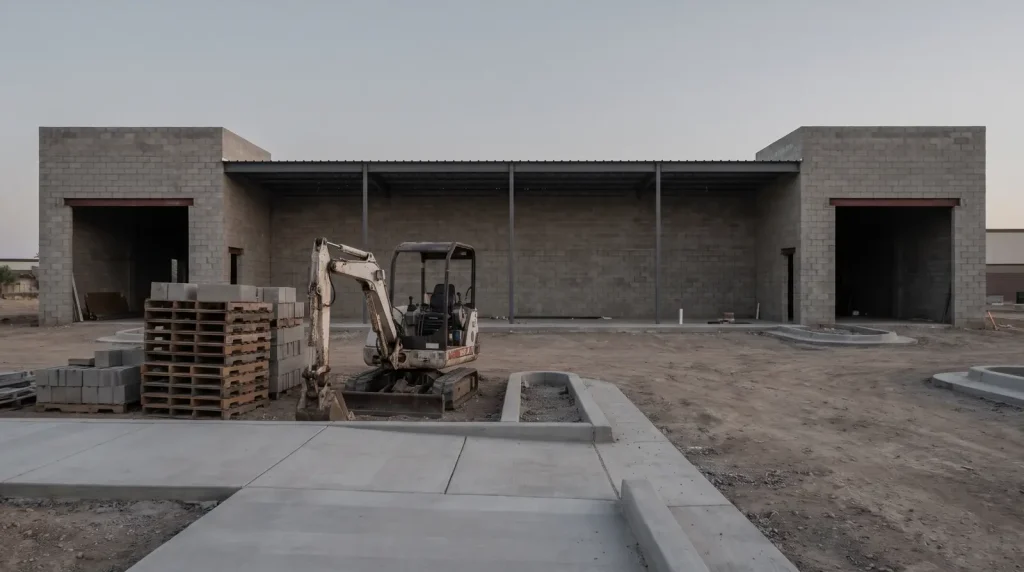
The cost to build a car wash in Texas public records is a median $1.25 million for building and site work, or $279 per sq ft, across 452 projects registered 2022 to 2026. Express tunnels run a median $1.5 million.
Key takeaways
- Across 452 stand-alone, ground-up car wash registrations filed with the Texas Department of Licensing and Regulation from January 2022 to October 2026, the median estimated construction cost was $1,250,000 and the median building was 4,556 sq ft (TDLR TABS).
- The 230 records that name a tunnel, express or drive-through format had a median of $1.5 million and $326 per sq ft; the middle half ran $227 to $463 per sq ft (TDLR TABS).
- Registrations filed in 2026 had a median of $329 per sq ft, against $271 to $282 in each year from 2022 to 2025 (TDLR TABS).
- A car wash is a special purpose building for SBA 504 loans, so the owner puts in at least 15% of project cost, or 20% for a business 2 years old or less (13 CFR 120.910).
- A water reclaim system cuts a wash’s fresh water use by 50% to 83%, and EPA’s target for new conveyor washes is 35 gallons of fresh water per vehicle (EPA WaterSense at Work, Section 5.4, November 2023).
How much does it cost to build a car wash?
Filed Texas records put a new stand-alone car wash at a median $1.25 million in estimated construction cost, with the middle half of 452 projects between $900,000 and $2.0 million. That figure is the owner’s or architect’s estimate of building and site work at registration. It excludes land, and it may or may not include the wash equipment package.
| Format (as stated in the record) | Records | Median cost | Middle half of cost | Median $ per sq ft | Median size |
|---|---|---|---|---|---|
| All stand-alone car washes | 452 | $1,250,000 | $900,000 to $2,000,000 | $279 | 4,556 sq ft |
| Express, tunnel or drive-through | 230 | $1,500,000 | $1,000,000 to $2,000,000 | $326 | 4,750 sq ft |
| Express or tunnel, registered 2025 to 2026 | 63 | $1,500,000 | $1,200,000 to $2,100,000 | $345 | 4,696 sq ft |
| Format not stated in the record | 213 | $1,000,000 | $725,000 to $1,650,000 | $259 | 4,432 sq ft |
| In-bay automatic and self-serve (named records below) | 9 | $175,000 to $500,000 for single sites | see table below | $148 to $350 | 1,000 to 2,760 sq ft |
Source: Texas Department of Licensing and Regulation, TABS project search, records registered January 13, 2022 to October 16, 2026, queried November 9, 2026; medians by CB&C. Filtered to new construction, car wash only (no fuel, convenience store, lube or dealership work), one record per address and size, $25 to $1,500 per sq ft.
Texas is the only state that publishes this data at scale. Under the Texas Architectural Barriers Act, projects with an estimated construction cost of $50,000 or more are registered with TDLR before construction, with a $175 filing fee (TDLR project fees). Each record lists the estimated cost, square footage, scope and planned start and finish dates, and 99.8% of the car wash records we kept were privately funded.
What do filed Texas car wash projects cost per square foot?
Express tunnel registrations from 2025 and 2026 ranged from $145 to $959 per sq ft in estimated construction cost, with a median of $345. The low end is CMU (concrete block) buildings with a simple scope; the high end usually bundles site work, vacuum canopies and equipment rooms into one number. The table lists ten records you can open on the TDLR site.
| TABS record | County, year registered | Size | Estimated cost | $ per sq ft | Scope in the record |
|---|---|---|---|---|---|
| TABS2026016218 | Galveston, 2026 | 6,204 sq ft | $900,750 | $145 | Single tunnel with conveyor, 2 pay lanes, 23 vacuum stalls, CMU walls, paving, MEP, landscaping |
| TABS2025015468 | Dallas, 2025 | 4,675 sq ft | $900,000 | $193 | One-story express wash, vacuum canopies, pay station canopy |
| TABS2025021927 | Tarrant, 2025 | 1,975 sq ft | $450,000 | $228 | Compact express wash, equipment room, restroom, vacuums, paving and utilities |
| TABS2025019713 | McLennan, 2025 | 3,900 sq ft | $1,200,000 | $308 | New express tunnel |
| TABS2025019202 | Brazoria, 2025 | 4,586 sq ft | $1,500,000 | $327 | New tunnel car wash |
| TABS2026016861 | El Paso, 2026 | 4,889 sq ft | $2,000,000 | $409 | Ground-up tunnel; same plan and estimate filed 6 times in 5 counties |
| TABS2025013304 | Tarrant, 2025 | 5,000 sq ft | $2,200,000 | $440 | Tunnel plus site improvements |
| TABS2026012563 | Denton, 2026 | 5,440 sq ft | $2,700,000 | $496 | Tunnel, equipment room, office, break room, public restroom |
| TABS2026006211 | Bexar, 2025 | 5,165 sq ft | $2,800,000 | $542 | Fully automated tunnel with vacuum equipment |
| TABS2025013724 | Collin, 2025 | 4,721 sq ft | $4,526,500 | $959 | Drive-through wash with outside vacuum canopies |
Repeat filings show how these numbers are set. One 4,889 sq ft tunnel plan was registered six times in 2025 and 2026, in Harris, Travis, El Paso, Montgomery and Galveston counties, each at exactly $2,000,000. That is a prototype budget, not a bid, so treat a single TABS figure as the owner’s planning number and the median of many as the market signal.
| Texas market (counties) | Records | Median cost | Median $ per sq ft | Middle half, $ per sq ft |
|---|---|---|---|---|
| Dallas-Fort Worth (Dallas, Tarrant, Collin, Denton) | 108 | $1,300,000 | $315 | $227 to $499 |
| Rest of Texas | 152 | $1,275,000 | $294 | $209 to $408 |
| San Antonio (Bexar) | 53 | $1,250,000 | $278 | $239 to $468 |
| Houston (Harris, Fort Bend, Montgomery) | 102 | $1,000,000 | $264 | $147 to $394 |
| Austin (Travis, Williamson, Hays) | 12 | $1,200,000 | $258 | $202 to $480 |
| Rio Grande Valley (Hidalgo, Cameron) | 25 | $1,200,000 | $242 | $120 to $308 |
Does building size change the cost per square foot?
Yes, but not in a straight line. Buildings of 4,500 to 5,499 sq ft, the common express tunnel size, had the highest median at $327 per sq ft across 185 records. Small buildings under 2,000 sq ft also ran high at $336, because a tunnel, pay lanes and utilities cost about the same whether the building is short or long.
| Building size | Records | Median cost | Median $ per sq ft | Middle half, $ per sq ft |
|---|---|---|---|---|
| 600 to 1,999 sq ft | 32 | $475,000 | $336 | $179 to $657 |
| 2,000 to 3,499 sq ft | 20 | $750,000 | $218 | $141 to $481 |
| 3,500 to 4,499 sq ft | 156 | $1,000,000 | $268 | $206 to $384 |
| 4,500 to 5,499 sq ft | 185 | $1,600,000 | $327 | $242 to $486 |
| 5,500 to 7,999 sq ft | 48 | $1,500,000 | $251 | $156 to $342 |
| 8,000 sq ft and up | 11 | $2,500,000 | $177 | $68 to $249 |
About 80% of the tunnel records fall between 3,500 and 5,499 sq ft. Above 8,000 sq ft the price per sq ft drops to a median of $177, because those buildings add lobbies, detail bays or multi-format wash bays that cost less per foot than the tunnel itself. For how car washes compare with offices, retail and warehouses, our commercial construction cost per square foot guide has the wider table.
What do in-bay automatic and self-serve car washes cost?
Few single-format small washes are registered in Texas, so the evidence is a short list rather than a median. New in-bay automatic and self-serve records ran $175,000 to $500,000 in estimated construction cost for 1,000 to 2,760 sq ft. A combined site with 3 automatic bays and 6 self-serve bays was filed at $3.0 million.
| TABS record | County, year | Work | Size | Estimated cost | Per unit |
|---|---|---|---|---|---|
| TABS2024024375 | Harris, 2024 | New automatic in-bay car wash | 1,198 sq ft | $213,194 | $178 per sq ft |
| TABS2024001085 | Wilbarger, 2023 | New 40 ft x 20 ft wash with 12 ft x 32 ft utility room | 1,184 sq ft | $175,000 | $148 per sq ft |
| TABS2022023487 | Webb, 2022 | New self-serve wash, 8 bays with vacuum stations | 1,000 sq ft | $350,000 | $43,750 per bay |
| TABS2023007888 | Comal, 2022 | Dual-bay wash added at a convenience store | 2,760 sq ft | $500,000 | $250,000 per bay |
| TABS2023002419 | Grayson, 2022 | In-bay automatic added to a self-serve site (addition) | 1,052 sq ft | $350,000 | $333 per sq ft |
| TABS2022022055 | Travis, 2022 | Second automatic wash added to a service building (addition) | 1,370 sq ft | $250,000 | $182 per sq ft |
| TABS2023017689 | Wise, 2023 | Add-on to an existing bay to install automatic equipment | 367 sq ft | $100,000 | $272 per sq ft |
| TABS2022014720 | Wichita, 2022 | New site: 3 automatic bays, 6 self-serve bays, 12 vacuum stalls | 8,200 sq ft | $3,000,000 | $366 per sq ft |
| TABS2026007889 | Dallas, 2025 | Convert an in-bay wash into a tunnel (renovation) | 2,032 sq ft | $1,600,000 | $787 per sq ft |
Federal contract awards signed from 2019 to 2022 add four more priced data points, three of them outside Texas. They are public projects built to federal specifications, so read them as a labelled contrast, not a private-market price. The $184,449 tunnel brush system award is equipment only and shows what a single wash package line can cost.
| Award | Agency, place, date signed | Scope | Amount | Source |
|---|---|---|---|---|
| FA481922C0040 | Air Force, Panama City, FL, Sept. 26, 2022 | Design-build car wash | $2,629,040 | USAspending.gov |
| N6247319C0203 | Navy, San Diego, CA, May 6, 2019 | Car wash at Marine Corps Recruit Depot | $2,596,181 | USAspending.gov |
| 70B01C20F00001258 | Customs and Border Protection, Eagle Pass, TX, Sept. 15, 2020 | Construct stand-alone car wash facility | $843,299 | USAspending.gov |
| FA700020P0027 | Air Force, Arvada, CO, Mar. 20, 2020 | Brush-type wash system for a tunnel (equipment only) | $184,449 | USAspending.gov |
What does the filed cost include, and what do you add?
A TABS estimate covers the building and, in many of the 452 records, the paving, utilities and vacuum canopies. Land is never in it. Wash equipment, impact fees, design fees, financing costs and contingency often sit outside it, so a full project budget starts from the construction figure and adds those lines from your own quotes and the rules below.
| Budget line | In a typical TABS figure? | Where the number comes from | What moves it |
|---|---|---|---|
| Building shell and finishes | Yes | TABS medians above; architect estimate | CMU vs pre-engineered metal; tunnel length; lobby or office |
| Site work: paving, grading, drainage, vacuum canopies | Often (scope says “site work” or “site improvements”) | Civil engineer estimate on the site plan | Stacking lane length; number of vacuum stalls; storm detention |
| Wash equipment: conveyor, arches, dryers, pay stations | Varies by filer | Equipment maker quote; federal award above shows $184,449 for one brush system (2020) | Tunnel length, friction vs touchless, number of pay lanes |
| Water reclaim and oil separator | Plumbing is in; reclaim tanks vary | Equipment and plumbing quotes | Local reclaim rule; IPC 2021 Section 1003.4; sewer discharge limits |
| Utility connections and impact fees | Taps sometimes; fees no | Water and sewer utility fee schedule by meter size | Meter size, which tracks gallons per car and cars per hour |
| Design, permits, accessibility review | No | Proposals; TDLR filing fee $175 | Zoning hearings for a conditional use permit or variance |
| Contingency | No | GSA P120 carries 7% for new construction | Design completeness, ground conditions |
| Land | No | Broker comps and appraisal | Corner lot, stacking depth, separation rules |
Our commercial site plan guide covers what the civil set must show for drives, utilities and stormwater, which is where the 200 ft stacking lane and the separator get priced.
Which rules add cost to a car wash?
Five rules drive most of the cost that is unique to car washes: an oil separator under IPC 2021 Section 1003.4, water reclaim mandates, stacking lane minimums in zoning, a ban on wash water reaching storm drains, and noise limits that push vacuum screening. Each one adds equipment, pavement or land, and the stricter versions show up as conditions on a car wash approval.
| Rule | What it says | Cost effect | Source |
|---|---|---|---|
| Oil separator | Car washing facilities must discharge oil-bearing and grease-bearing waste through an oil separator before the building drain | Separator, sampling access and pumping contract in the plumbing budget | IPC 2021 Section 1003.4 |
| Water reclaim | A reclaim system is required to recycle water to the maximum degree the equipment allows | Reclaim tanks and treatment; cuts fresh water use 50% to 83% (EPA) | Tallmadge, Ohio Ord. 2023-82, item xxi |
| Stacking lanes | At least 10 off-street stacking spaces per car wash lane, each 8 ft x 20 ft | 200 ft of queue and 1,600 sq ft of pavement per lane | Tallmadge Ord. 2023-82, item xiii |
| No off-site wash water | Wash water may not leave the property, sheet flow off the site or drain to a stormwater conveyance | Trench drains to the sanitary sewer through the separator; grading | Tallmadge Ord. 2023-82, item xxiv |
| Noise | 45 dB(A) at the property line from 9 PM to 7 AM and 55 dB(A) at other hours; noise study approved by the city engineer | Vacuum enclosures, screen walls, acoustic study fee | Tallmadge Ord. 2023-82, items xvii and xviii |
| Separation | Car wash lots at least 500 ft from homes, parks, trails, schools and places of worship | Fewer eligible sites, higher land price | Tallmadge Ord. 2023-82, item i |
| Drought programs | Georgia requires car wash certification; Denver Water and San Antonio Water System run car wash programs | Reclaim and nozzle limits (3.0 gallons per minute self-serve) to keep operating in drought | EPA WaterSense at Work 5.4 |
The Tallmadge, Ohio text is used here because it states each rule in one place; it was filed for a council hearing on October 25, 2023, and other cities set different numbers. Before you buy land, pull your city’s car wash use regulations and ask the planner three things: how many stacking spaces per lane, whether reclaim is required, and whether a car wash needs a hearing. Where a hearing is required, our guide to the conditional use permit process covers findings and timing.
Water use sets the meter size and the sewer bill. EPA’s November 2023 guidance reports conveyor washes averaging 30 gallons of fresh water per vehicle in a 2018 industry study, against 65.8 gallons for a friction conveyor with no reclaim, and in-bay automatics at 44.8 gallons, or as little as 19.1 with reclaim (EPA WaterSense at Work, Section 5.4). Car washes are Group B occupancies under IBC Section 304.1, the same group as offices, which our occupancy classification guide explains.
Worked example: what does a 4,750 sq ft express tunnel cost?
A 4,750 sq ft express tunnel, the median Texas tunnel size, comes to about $1.75 million for construction plus contingency at 2025 to 2026 filed prices. Equipment, land and fees are added from quotes. Under SBA 504, the owner’s minimum cash on the construction portion alone is $263,019, because a car wash counts as a special purpose building.
| Line | Input | Arithmetic | Result | Source |
|---|---|---|---|---|
| Building and site work | 4,750 sq ft at $345 per sq ft | 4,750 x $345 | $1,638,750 | TABS tunnel median, 2025 to 2026 registrations |
| Contingency | 7% for new construction | $1,638,750 x 0.07 | $114,713 | GSA P120 |
| Construction subtotal | $1,638,750 + $114,713 | $1,753,463 | Arithmetic | |
| SBA 504 owner money, special purpose | 15% of project cost | $1,753,463 x 0.15 | $263,019 | 13 CFR 120.910(a)(2) |
| Same, if the building were not special purpose | 10% | $1,753,463 x 0.10 | $175,346 | 13 CFR 120.910(a)(4) |
| Stacking pavement, 2 pay lanes | 10 spaces x 8 ft x 20 ft per lane | 2 x 1,600 sq ft | 3,200 sq ft before aisles | Tallmadge Ord. 2023-82 |
| Fresh water at 100,000 cars a year, with reclaim | 30 gallons per vehicle | 100,000 x 30 | 3,000,000 gallons | EPA WaterSense 5.4 |
| Fresh water, friction conveyor without reclaim | 65.8 gallons per vehicle | 100,000 x 65.8 | 6,580,000 gallons | EPA WaterSense 5.4 |
The 100,000 cars a year is an input to replace with your own traffic study; the gallons scale in a straight line with it. The SBA rule adds $87,673 of owner cash on this subtotal compared with an office building, and the gap grows once equipment and land are added to project cost. Our guide to the SBA 504 loan shows the full 50/40/10 structure, and the commercial construction loan guide covers the 80% loan-to-value cap banks use on the rest.
How long does it take to build a car wash?
Texas car wash registrations plan a median of 8.1 months from construction start to completion, and the middle half plan 6.1 to 12.0 months. The 230 tunnel records alone plan a median of 8.4 months. These are the dates filed before work begins, so they exclude land purchase, zoning hearings and design, which come first.
| Group | Records | 25th percentile | Median | 75th percentile |
|---|---|---|---|---|
| All stand-alone car washes | 452 | 6.1 months | 8.1 months | 12.0 months |
| Express, tunnel or drive-through | 230 | 6.2 months | 8.4 months | 12.0 months |
Source: planned start and completion dates in TDLR TABS records, 2022 to 2026, computed by CB&C. Our construction schedule guide shows the same planned-duration data for warehouses, restaurants and retail.
Which car wash type fits your site and budget?
Start from the construction budget you can finance without land, then test the lot against stacking, drains, water and financing rules. Filed Texas records show in-bay and self-serve sites at $175,000 to $500,000, and the middle half of tunnels at $1.0 million to $2.0 million. The table and flowchart hold the same logic.
| If | Then | Basis |
|---|---|---|
| Construction budget excluding land is under $500,000 | Price an in-bay automatic or self-serve site; a tunnel is unlikely | TABS in-bay and self-serve records: $175,000 to $500,000 |
| Budget is $1.0 million to $2.0 million | An express tunnel of 4,200 to 5,180 sq ft fits the middle of the market | Middle half of 230 TABS tunnel records |
| Budget is above $2.5 million | Check what the scope adds: only 10% of 452 projects were filed above that | TABS records 2022 to 2026 |
| The lot cannot hold 200 ft of queue per lane | Ask about a conditional use permit or variance, or switch to an in-bay format | Tallmadge Ord. 2023-82 item xiii as an example rule |
| The wash bay has floor or trench drains | Budget an oil separator before the building drain | IPC 2021 Section 1003.4 |
| The city or water utility requires reclaim or drought certification | Specify reclaim; design to 35 gallons per car (tunnel) or 40 (in-bay) | EPA WaterSense at Work 5.4 |
| You will finance with SBA 504 | Plan 15% owner money, 20% if the business is 2 years old or less | 13 CFR 120.910 |
If the lot fails the stacking test, our guide to a zoning variance explains the hardship standard a board applies before it relaxes a numeric rule such as a 10-car queue.
Lot layout limits are covered in our setback requirements guide, and the screen walls many towns require are priced in our cinder block wall cost guide.
How we compiled this
We queried the TDLR TABS project search on November 9, 2026 for names containing “car wash” or “carwash” registered since January 1, 2022 (615 records), read each project page, and kept 452 new, stand-alone car wash records after removing fuel, convenience store, lube and dealership projects, duplicate filings and per sq ft outliers. We added 4 USAspending.gov awards, the IPC 2021, EPA WaterSense guidance, one municipal ordinance and 13 CFR 120.910. TABS costs are owner estimates at registration, not final costs, and this page is not legal or lending advice.
Frequently asked questions
How much does it cost to build a car wash?
In Texas public records, a new stand-alone car wash had a median estimated construction cost of $1,250,000, or $279 per sq ft, across 452 projects registered from 2022 to 2026. The middle half ran $900,000 to $2.0 million. Land, impact fees and often the wash equipment are extra (TDLR TABS).
How much does an express tunnel car wash cost to build?
The 230 Texas records that name a tunnel, express or drive-through format had a median estimated construction cost of $1.5 million and $326 per sq ft for a median 4,750 sq ft building. Records filed in 2025 and 2026 had a median of $345 per sq ft (TDLR TABS).
How much does an in-bay automatic car wash cost?
A new automatic in-bay car wash in Harris County, Texas was registered in 2024 at $213,194 for 1,198 sq ft, and an in-bay added to a Grayson County self-serve site was filed at $350,000 in 2022. Both figures are construction estimates and exclude land (TDLR TABS).
How much does a self-serve car wash cost to build?
A new 8-bay self-serve car wash with vacuum stations in Webb County, Texas was registered in 2022 at an estimated $350,000, or $43,750 per bay, for a 1,000 sq ft building. Self-serve nozzles should flow no more than 3.0 gallons per minute under EPA WaterSense guidance (EPA, 2023).
Is a water reclaim system required for a car wash?
It depends on the city or water utility. Tallmadge, Ohio’s 2023 car wash ordinance requires a reclaim system and bans wash water leaving the lot, and Georgia requires car wash certification. EPA reports reclaim cuts fresh water use by 50% to 83% (EPA WaterSense at Work 5.4).
How much down payment do you need for a car wash SBA loan?
Under the SBA 504 program a car wash is a limited or special purpose building, so the borrower contributes at least 15% of project cost, or 20% if the business has operated two years or less, against 10% for an ordinary building (13 CFR 120.910). This is not lending advice.
Sources
- Texas Department of Licensing and Regulation, TABS project search and project pages (615 records queried), accessed November 9, 2026.
- TDLR, Architectural Barriers project fees, accessed November 9, 2026.
- U.S. EPA, WaterSense at Work, Section 5.4 Vehicle Washes (November 2023), accessed November 9, 2026.
- International Code Council, International Plumbing Code 2021, Chapter 10, Section 1003.4, accessed November 9, 2026.
- City of Tallmadge, Ohio, Ordinance 2023-82, Exhibit A, Section 1104.07 E(8), accessed November 9, 2026.
- eCFR, 13 CFR 120.910 Borrower contributions, accessed November 9, 2026.
- U.S. General Services Administration, P120 PBS Cost and Schedule Management Policy Requirements, accessed November 9, 2026.
- USAspending.gov, awards FA481922C0040, N6247319C0203, 70B01C20F00001258 and FA700020P0027, accessed November 9, 2026.