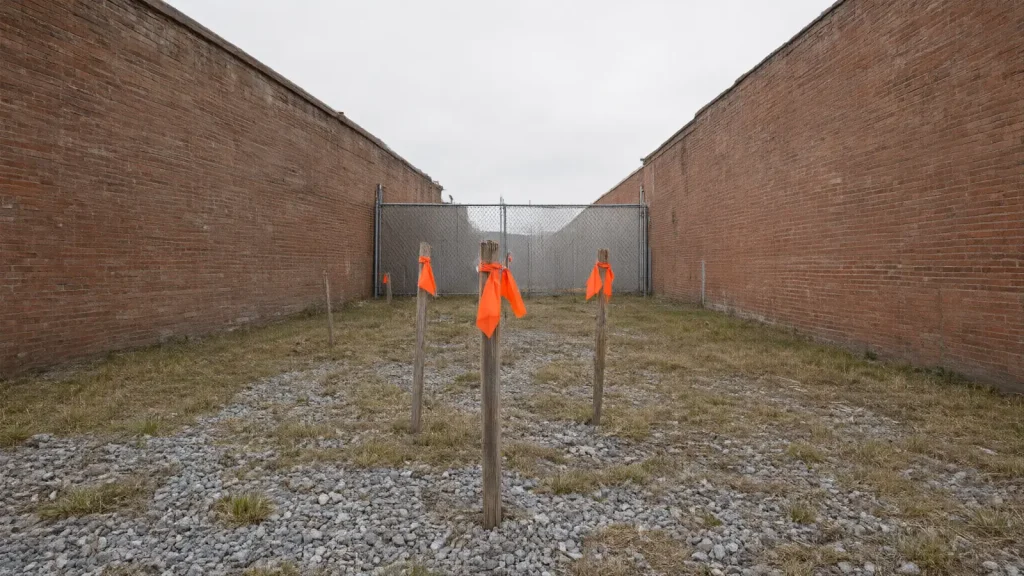
A zoning variance is a board of adjustment’s permission to break one rule of the zoning code on one lot: an area variance relaxes a number like a setback, and a use variance allows a banned use.
Boards grant it only when the lot itself causes the hardship. In Philadelphia, the Zoning Board of Adjustment granted 2,023 of 2,225 variance appeals it decided on the merits from 2023 to 2025, or 90.9%, according to the city’s open appeals dataset (pulled November 8, 2026). This page summarizes public statutes and records and is not legal advice.
Key takeaways
- New York’s Town Law §267-b sets two different tests: a use variance needs “competent financial evidence” that no permitted use earns a reasonable return, while an area variance is a 5-factor balancing test.
- Pennsylvania’s Municipalities Planning Code §910.2 requires 5 findings for any variance, starting with “unique physical circumstances or conditions” of the lot, and the hardship cannot be created by the applicant.
- Texas boards need a 75% concurring vote to grant a variance under Local Government Code §211.009(c), so a 5-member board needs 4 yes votes.
- Filing fees run from $450 in Daytona Beach, Florida, to $811 for commercial lots in Philadelphia (effective August 1, 2026) and $3,950 to $11,200 at New York City’s Board of Standards and Appeals, by floor or lot area.
- Philadelphia variance appeals took a median of 196 days from filing to decision in 2023 to 2025, and 943 of 2,023 grants (47%) came with provisos attached.
What is the difference between an area variance and a use variance?
An area variance, also called a dimensional or bulk variance, lets a permitted use break a numeric standard: a setback, height limit, lot coverage, parking count or sign size. A use variance lets the owner put a use on the lot that the district does not permit at all, such as a warehouse in a retail district. Every statute reviewed here treats the use variance as the harder request, and New York’s §267-b(2) adds a financial-evidence element for use variances only.
Some places do not allow use variances at all. The Daytona Beach, Florida, 2026 Board of Adjustment application states that “no change in permitted uses or maximum densities may be authorized by variance”, so a barred use there needs a rezoning. Philadelphia’s ZBA application instructions (version 2025.1) allow both types on the same form, ZBA-01.
| Question | Area (dimensional) variance | Use variance | Source |
|---|---|---|---|
| What it changes | A number: setback, height, lot coverage, parking spaces, sign area | The use itself: retail, warehouse, auto service where not listed | Philadelphia ZBA instructions 2025.1 |
| New York test | Balancing of 5 factors, including whether the request is “substantial” and whether the difficulty was self-created | All 4 elements required, including no reasonable return shown by “competent financial evidence” | NY Town Law §267-b(2), (3) |
| Pennsylvania test | Same 5 findings as use variances under the statute text | Same 5 findings, each made “where relevant in a given case” | PA MPC §910.2(a) |
| Allowed in Daytona Beach, Florida? | Yes: height, yard setback, lot coverage and similar numeric standards | No: uses and densities cannot change by variance | Daytona Beach LDC Art. 3 §3.4(V) |
| Typical commercial example | Building 6 feet into a 25 foot rear yard on a shallow lot | Contractor yard on a lot zoned neighborhood commercial | Illustration |
What hardship standard does a zoning variance have to meet?
The core test in most states is “unnecessary hardship” caused by a physical feature of the lot, not by the owner’s plans or the ordinance itself. Texas §211.009, Pennsylvania §910.2, New York §267-b and New York City §72-21 all write the test into statute or code, and the wording differs enough to change how an application is built. The table quotes each one.
| Jurisdiction and section | What the applicant must show | Notable twist | Source |
|---|---|---|---|
| Texas, Local Gov’t Code §211.009(a)(3) | Variance is not contrary to the public interest; due to special conditions, literal enforcement causes unnecessary hardship; spirit of the ordinance observed | §211.009(b-1), added in 2021, lets boards count compliance cost over 50% of the structure’s appraised value, or loss of at least 25% of the developable lot area, as hardship | Tex. Loc. Gov’t Code ch. 211 |
| Pennsylvania, MPC §910.2(a)(1) to (5) | Unique physical conditions (irregular, narrow or shallow lot, topography); no possibility of developing in strict conformity; hardship not created by the appellant; no harm to neighborhood character or public welfare; minimum variance | Applies outside Philadelphia and Pittsburgh: the MPC’s definition of municipality in §107 covers second class A and third class cities, boroughs, townships and counties | PA Act 247 of 1968 |
| New York towns, Town Law §267-b | Use: no reasonable return, unique hardship, no change to essential character, not self-created. Area: weigh 5 factors | Self-created difficulty “shall not necessarily preclude” an area variance under §267-b(3)(b)(5) | NY Town Law §267-b |
| New York City, Zoning Resolution §72-21 | Findings (a) to (e): unique physical conditions; no reasonable return from a conforming building; no change to essential character; hardship not created by the owner; minimum variance necessary | Nonprofits are exempt from the reasonable-return finding (b) | NYC ZR §72-21 |
| Daytona Beach, Florida, LDC Art. 3 §3.4(V) | 8 standards, including extraordinary conditions not caused by the owner, no special privilege, minimum variance and consistency with the comprehensive plan | Approval needs “competent substantial evidence in the record” of the hearing | Daytona Beach 2026 BOA packet |
How does the board of adjustment process work, step by step?
The variance process starts with a denied permit and ends with a written decision and an appeal window. The names change by place: board of adjustment in Texas and Philadelphia, zoning board of appeals in New York towns, zoning hearing board in Pennsylvania boroughs and townships, and the Board of Standards and Appeals in New York City. These 8 steps hold across the 5 codes reviewed.
- Get the refusal in writing. In Philadelphia, a variance appeal is filed against a Notice of Refusal on form ZBA-01, within 30 days of the refusal date (ZBA instructions 2025.1). Your commercial building permit application usually produces this refusal.
- Hold the pre-application meeting. Daytona Beach requires one before filing under LDC Art. 3 §3.4.V.3.a.
- File by the board’s cutoff. Daytona Beach’s 2026 calendar sets a November 23 deadline for the December 17 hearing, 24 days ahead.
- Give notice. Daytona Beach applicants mail owners within 150 feet and post placards at least 10 days before the hearing, then file a notarized affidavit 7 days before. Pennsylvania requires posting on the tract at least 1 week before the hearing under MPC §908(1). Philadelphia applicants also present the appeal at a neighborhood meeting.
- Present at the public hearing. Bring the site survey, the dimensioned plan showing the exact deviation, photos of the physical condition and any expert testimony.
- Count the votes. Texas needs 75% of all board members (§211.009(c)); New York towns need a majority of the full board under Town Law §267-a(13)(a).
- Get the written decision filed. New York town boards decide within 62 days after the hearing and file within 5 business days (§267-a(8), (9)).
- Watch the appeal window. Neighbors who object have 10 days in Texas, 30 days in New York and 30 days in Pennsylvania to go to court.
How long does a zoning variance take?
Statutes set outer limits, and real boards run slower. Pennsylvania’s MPC requires the first hearing within 60 days of the application and a written decision within 45 days after the last hearing, so a single-hearing case closes by about day 105. Philadelphia, which sets its own rules, took a median of 196 days from filing to decision for the 2,225 variance appeals granted or denied in 2023 to 2025.
| Clock | Deadline | If missed | Source |
|---|---|---|---|
| Pennsylvania: first hearing | Within 60 days of the application; later hearings within 45 days of the prior one; applicant’s case within 100 days of the first hearing | Variance deemed granted unless the applicant agreed to an extension | MPC §908(1.2), (9) |
| Pennsylvania: written decision | Within 45 days after the last hearing | Deemed granted; board must give public notice within 10 days | MPC §908(9) |
| Pennsylvania: court appeal | 30 days after the decision is entered | Appeal barred | MPC §1002-A |
| New York towns: notice to parties | Mailed at least 5 days before the hearing | Procedural defect | Town Law §267-a(10) |
| New York towns: decision | Within 62 days after the hearing; filed within 5 business days | Extendable by mutual consent | Town Law §267-a(8), (9) |
| New York towns: court review | Article 78 petition within 30 days after the decision is filed | Review barred | Town Law §267-c |
| Texas: court review | Verified petition within 10 days after the decision is filed | Review barred | Loc. Gov’t Code §211.011(b) |
| Philadelphia: filing the appeal | Within 30 days of the refusal | Appeal may be returned | ZBA instructions 2025.1 |
How much does a zoning variance cost to file?
Public fee schedules put a commercial variance filing at $450 to $11,200 before any consultant time. Philadelphia charges $811 per property for anything other than a 1 or 2 family dwelling as of August 1, 2026, and New York City’s Board of Standards and Appeals scales its fee by floor or lot area, from $3,950 up to 10,000 square feet to $11,200 for lots over 100,000 square feet.
| Jurisdiction | Application | Fee | Effective | Source |
|---|---|---|---|---|
| Daytona Beach, FL | Variance, all properties other than single-family | $450 | 2026 packet, updated December 2025 | Daytona Beach BOA packet |
| Philadelphia, PA | Variance or special exception, all other properties | $811 per property | August 1, 2026 | Philadelphia ZBA fee schedule |
| Philadelphia, PA | Accelerated hearing (added to the application fee) | $995 per property; $2,985 cap per group | August 1, 2026 | Philadelphia ZBA fee schedule |
| New York City BSA | Variance, other buildings, 10,000 sq ft or less | $3,950 | July 11, 2011 schedule | BSA filing fees |
| New York City BSA | Variance, over 20,000 to 40,000 sq ft | $7,040 | July 11, 2011 schedule | BSA filing fees |
| New York City BSA | Variance, over 100,000 sq ft of lot area | $11,200 | July 11, 2011 schedule | BSA filing fees |
| Residential contrast | Philadelphia 1 or 2 family dwelling; NYC 1 or 2 family | $125; $1,100 | 2026; 2011 | Same schedules |
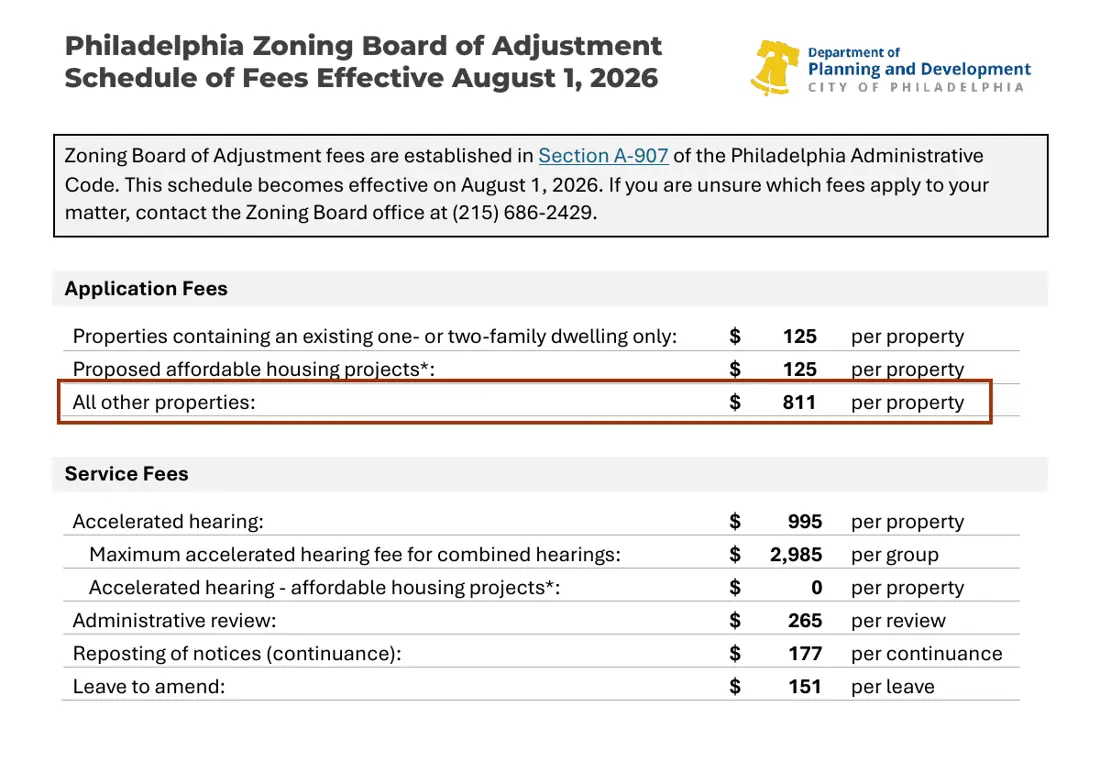
The filing fee is rarely the largest line. Philadelphia adds $177 each time a continuance forces new notices and $151 for each leave to amend the plans, so a commercial appeal that takes the accelerated track, one continuance and one plan change reaches $2,134 in city fees alone.
| Philadelphia commercial appeal, worked example | Fee | Running total |
|---|---|---|
| Application fee, all other properties | $811 | $811 |
| Accelerated hearing | $995 | $1,806 |
| Reposting of notices after 1 continuance | $177 | $1,983 |
| Leave to amend plans, once | $151 | $2,134 |
Source: Philadelphia ZBA Schedule of Fees, effective August 1, 2026; CB&C arithmetic. Survey, architect, traffic or appraisal work for the hearing is extra and is not published by these boards.
How often are zoning variances approved?
Few boards publish outcome data, but Philadelphia does. Of 2,820 variance appeals the Philadelphia Zoning Board of Adjustment closed from 2023 to 2025, 2,023 were granted, 202 denied and 578 dismissed or withdrawn. That is 90.9% of cases decided on the merits, and 71.7% of all closed cases, because weak cases tend to drop out before the vote.
| Decision year | Closed | Granted | Denied | Dismissed or withdrawn | Granted, share of granted plus denied | Granted, share of all closed |
|---|---|---|---|---|---|---|
| 2023 | 927 | 662 | 59 | 201 | 91.8% | 71.4% |
| 2024 | 903 | 680 | 70 | 147 | 90.7% | 75.3% |
| 2025 | 990 | 681 | 73 | 230 | 90.3% | 68.8% |
| 2023 to 2025 | 2,820 | 2,023 | 202 | 578 | 90.9% | 71.7% |
| Commercial keywords only | 644 | 451 | 32 | 158 | 93.4% | 70.0% |
Source: City of Philadelphia appeals table, appeal type “ZBA Permit Denial: Variance”, by decision date, pulled November 8, 2026 from the city’s Carto SQL API. Seventeen cases with other outcomes are counted in “Closed” only. The commercial row keeps appeals whose description names retail, office, restaurant, warehouse, commercial, industrial, medical, hotel or similar uses.
A high grant rate is not an easy board. Philadelphia applicants have already paid for plans, met with the neighborhood group and posted notice, and 943 of the 2,023 grants (46.6%) carried provisos, such as a time limit or a trash storage location. Expect conditions, and price them before the hearing.
What evidence wins a variance hearing?
Winning files tie every request to a measured physical fact about the lot and ask for the smallest deviation that solves it. Pennsylvania’s §910.2(a)(5) and New York City’s §72-21(e) both require the “minimum variance”, so a request for 10 feet when 6 would work invites a partial grant or a denial.
- A boundary and topographic survey showing the irregular shape, shallow depth, slope or easement that makes compliance impossible: the “unique physical circumstances” in PA MPC §910.2(a)(1).
- A dimensioned plan with the code requirement, the proposed number and the difference, the format Columbia, South Carolina, asks for on its administrative adjustment form (for example 15 feet required, 14 feet proposed, 6.5% change).
- A compliant alternative drawn and costed, to answer New York’s second area factor: whether the benefit “can be achieved by some method” other than a variance (§267-b(3)(b)(2)).
- Financial evidence for a use variance in New York: appraisals and income figures for each permitted use, since §267-b(2)(b) requires “competent financial evidence”.
- Chain of title and purchase date, to show the condition existed before you, since Pennsylvania, New York, New York City and Daytona Beach all weigh self-created hardship.
- Neighbor and civic group letters, which Philadelphia’s process builds in through its required neighborhood meeting.
Worked example: the Texas 50% and 25% grounds
Texas is the one state reviewed that writes numeric hardship grounds into statute. Under §211.009(b-1), a board may treat compliance as an unnecessary hardship when it costs more than 50% of the structure’s appraised value on the certified roll, or when it takes at least 25% of the area where development can physically occur.
| Input (illustration, not a real case) | Value | Test | Result |
|---|---|---|---|
| Appraised value of the existing structure (certified roll) | $1,200,000 | Cost of compliance over 50%? | $640,000 / $1,200,000 = 53.3%: ground met |
| Developable lot area | 40,000 sq ft | Loss of at least 25%? | 10,400 / 40,000 = 26.0%: ground met |
| Board size | 5 members | 75% concurring vote | 0.75 x 5 = 3.75, so 4 yes votes |
| Board size | 7 members | 75% concurring vote | 0.75 x 7 = 5.25, so 6 yes votes |
Source: Tex. Loc. Gov’t Code §211.009(b-1), (c); CB&C arithmetic. Meeting a (b-1) ground lets the board consider hardship; it does not require a grant.
Variance, administrative adjustment, conditional use or rezoning: which one fits?
A variance is the right tool only when the use is allowed and the lot cannot meet a number, or when a barred use has no other path and the code allows use variances. Small numeric misses often qualify for an administrative adjustment decided by staff without a hearing. Columbia, South Carolina, allows staff to adjust up to 20% of a setback, height, lot width or lot area standard and up to 10% of a parking count.
| If your project | Then file | Who decides | Source |
|---|---|---|---|
| Misses a setback or height by 20% or less in Columbia, SC (10% or less for parking count or fence height) | Administrative adjustment | Zoning staff, under UDO Sec. 17-2.5(r)(4) standards | Columbia administrative adjustment form |
| Misses a numeric standard by more than the staff cap, because of lot shape, slope or size | Area (dimensional) variance | Board of adjustment after a public hearing | PA MPC §910.2; Tex. §211.009 |
| Proposes a use the code lists as conditional or special in that district | Conditional use permit or special exception | Planning commission, council or board, by local code | Philadelphia form ZBA-02 |
| Proposes a use the district bans, where use variances are allowed | Use variance with financial proof | Board of adjustment | NY Town Law §267-b(2) |
| Proposes a banned use where use variances are barred, or the hardship is shared by the whole district | Rezoning (map amendment) or text amendment | City council, after published notice (Texas: before the 15th day before the hearing) | Tex. §211.006(a); Daytona Beach §3.4(V) |
| Fails a numeric standard because of your own design choice, with no lot condition | Redesign | Self-created hardship counts against the applicant under PA §910.2(a)(3), NY §267-b and NYC §72-21(d) | NYC ZR §72-21(d) |
Parking relief is a common commercial request; check the stall and aisle sizes in our guide to parking space dimensions before asking for fewer spaces. A zoning variance on parking count does not reduce the accessible spaces required by the 2010 ADA Standards, which our ADA parking requirements guide lists by lot size.
Zoning use and building code occupancy are separate questions: a use variance for a warehouse does not settle its IBC Chapter 3 group, such as S-1 storage, which our guide to occupancy classification covers.
What happens after a variance is granted or denied?
A granted variance has a shelf life. Daytona Beach variances are valid for 12 months from approval with no extensions, and the City of Austin says on its Board of Adjustment support page that all variances expire one year after approval unless the decision says otherwise. Pull permits inside that window, and carry each proviso into the drawings so the certificate of occupancy inspection matches what the board approved.
A denial can go to court, but the windows are short: 10 days in Texas under §211.011(b), and 30 days in New York towns under §267-c and in Pennsylvania under MPC §1002-A. Many owners instead refile with a smaller deviation, which Daytona Beach treats as a new application.
Build the variance into the schedule before design is final; at Philadelphia’s 196-day median, it can outlast design development. Our commercial construction process guide shows where entitlements sit, the project checklist puts zoning review ahead of permit drawings, and preconstruction services can price the compliant alternative a board will ask about.
Uses that need a hearing rather than relief from a dimension follow the process in our conditional use permit guide.
Before filing for a setback variance, check the numbers in our guide to setback requirements for commercial buildings, which also lists the encroachments most codes allow without relief.
How we compiled this
We read 4 state statutes (New York Town Law §§267-a to 267-c, Pennsylvania Act 247 of 1968, Texas Local Government Code chapter 211) and 2 city codes or forms (NYC Zoning Resolution §72-21, Daytona Beach LDC §3.4(V)), 3 public fee schedules and 1 administrative adjustment form, all accessed November 8, 2026. We counted Philadelphia variance appeal outcomes ourselves from the city’s open appeals table. We excluded California, Chicago and Austin fee figures we could not confirm at the primary source.
Frequently asked questions
What is an example of a zoning variance?
A shallow commercial lot that cannot fit a building and a 25 foot rear yard is a typical area variance case: the owner asks the board to allow, say, a 19 foot yard. A use variance example is a contractor yard on land zoned neighborhood commercial. Pennsylvania’s MPC §910.2 and New York’s Town Law §267-b both require the hardship to come from the lot, not the plans.
How long does a zoning variance take?
Pennsylvania’s Municipalities Planning Code requires a first hearing within 60 days and a decision within 45 days after the last hearing, about 105 days for a one-hearing case. New York towns must decide within 62 days after the hearing. Philadelphia’s board took a median of 196 days from filing to decision for variance appeals decided in 2023 to 2025.
How much does a zoning variance cost?
City filing fees for commercial property run from $450 in Daytona Beach, Florida, to $811 in Philadelphia (effective August 1, 2026) and $3,950 to $11,200 at New York City’s Board of Standards and Appeals, scaled by floor or lot area. Surveys, plans, appraisals and representation at the hearing cost extra and are not published by these boards.
What is the difference between a variance and a rezoning?
A variance is relief for one lot from one rule, granted by a board of adjustment after a hearing on that lot’s hardship. A rezoning changes the zoning map or text and is a legislative vote of the city council; in Texas it needs notice published before the 15th day before the hearing under Local Government Code §211.006(a).
How many votes does a zoning variance need?
Texas requires a concurring vote of 75% of board members under Local Government Code §211.009(c), so 4 of 5 members must vote yes. New York town boards need a majority of all members of the board as fully constituted under Town Law §267-a(13)(a), so 3 of 5, regardless of absences or vacancies. Local codes set the count elsewhere.
Can I get a variance because complying costs too much?
Usually cost alone is not enough. Pennsylvania’s §910.2 and New York City’s §72-21 tie hardship to physical conditions of the lot. Texas is the exception that writes cost in: since 2021, §211.009(b-1) lets a board consider compliance costing more than 50% of the structure’s appraised value as a hardship ground, though the board still decides.
Sources
- New York Town Law §267-b, Permitted action by board of appeals, NY State Senate, accessed 2026-11-08.
- New York Town Law §267-a, Board of appeals procedure, NY State Senate, accessed 2026-11-08.
- New York Town Law §267-c, Judicial review, NY State Senate, accessed 2026-11-08.
- Texas Local Government Code chapter 211, Municipal Zoning Authority, Texas Legislature, accessed 2026-11-08.
- Pennsylvania Municipalities Planning Code, Act 247 of 1968, Pennsylvania General Assembly, accessed 2026-11-08.
- NYC Zoning Resolution §72-21, Findings required for variances, NYC Department of City Planning, accessed 2026-11-08.
- Schedule of BSA Filing Fees (effective July 11, 2011), NYC Board of Standards and Appeals, accessed 2026-11-08.
- Zoning Board of Adjustment Schedule of Fees, effective August 1, 2026, City of Philadelphia, accessed 2026-11-08.
- Zoning Board of Adjustment Application Instructions, version 2025.1, City of Philadelphia, accessed 2026-11-08.
- Licenses and Inspections appeals table (Carto SQL API), City of Philadelphia, pulled 2026-11-08.
- 2026 Board of Adjustment Variance Application Packet (updated December 2025), City of Daytona Beach, accessed 2026-11-08.
- Administrative Adjustment Application, City of Columbia, SC, accessed 2026-11-08.
- Board of Adjustment Support, City of Austin, accessed 2026-11-08.