A conditional use permit is a zoning approval for a use your district allows only after a public hearing, written findings and attached conditions; San Francisco approved 97% of decided requests opened from 2016 to 2025.
Key takeaways
- San Francisco opened 1,809 conditional use authorization records from 2016 to 2025: 1,167 were approved, 33 disapproved and 487 withdrawn or cancelled, so 97.2% of decided cases were approved (DataSF Planning Department Non-Projects dataset, pulled November 8, 2026).
- Approval took a median 250 days from record opening to closing in that San Francisco set, and 36% of approvals opened from 2016 to 2022 took more than a year (same dataset, our calculation).
- Minnesota gives cities 60 days to approve or deny a complete zoning request; a request not denied in 60 days is approved by law (Minn. Stat. 15.99, subd. 2).
- Published 2026 fees run from $300 in Chester, Vermont to $14,711 for a Planning Commission approval in Rancho Cucamonga, California, and about $22,505 for a $2 million project in San Francisco (SF Planning fee schedule, updated June 15, 2026).
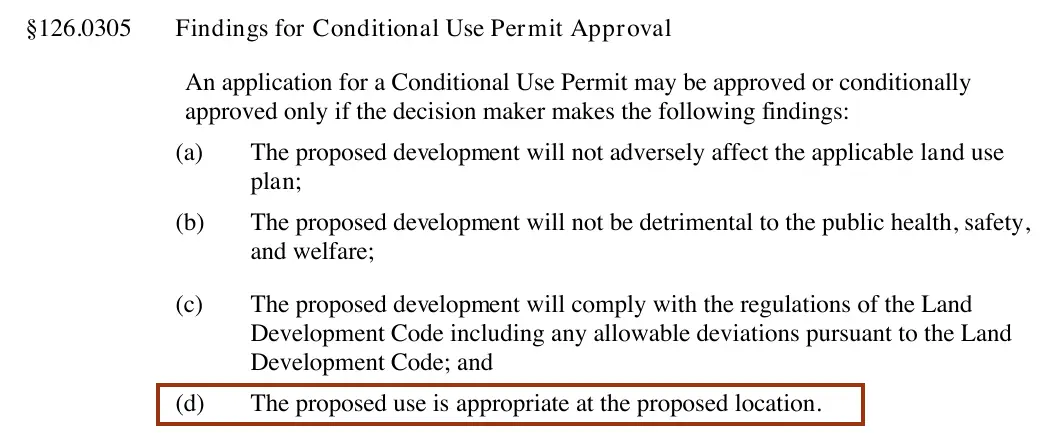
- San Diego will approve a conditional use permit only on 4 findings, including that the use is appropriate at the proposed location (San Diego Municipal Code 126.0305).
What is a conditional use permit?
A conditional use permit (CUP) approves a use that the zoning code lists for a district but does not allow by right. The city reviews the specific site at a public hearing, decides whether the use fits, and attaches conditions such as hours, screening or parking. San Diego describes CUP uses as uses “not permitted by right in the applicable zone” (SDMC 126.0301).
Zoning use tables mark each use per district. San Francisco’s tables mark uses as permitted as of right (P), conditionally permitted (C) or not permitted (NP), according to its Conditional Use Authorization application packet. Under Planning Code Section 303, a “C” in your district’s column for your use is the signal that you need this permit before a building permit can issue.
The name changes by place. The University of Wisconsin Extension land use training guide notes that Wisconsin courts use conditional use, special use and special exception interchangeably. The approval is quasi-judicial: the board applies standards already written in the ordinance to the facts of one site, and the applicant carries the burden of showing each standard is met (guide content last validated in 2020).
| Jurisdiction | Name used | Who decides | Source |
|---|---|---|---|
| San Francisco, CA | Conditional Use Authorization (CUA) | Planning Commission hearing | Planning Code Section 303, CUA packet |
| San Diego, CA | Conditional Use Permit | Decision process tier set by use, Process Two to Process Five | SDMC 126.0303 |
| King County, WA | Conditional Use Permit | Permitting Division; appeals to the Hearing Examiner | KCC 21A.44.040, King County |
| Minnesota cities | Conditional use permit | Governing body or other designated authority | Minn. Stat. 462.3595, subd. 1 |
| Wisconsin | Conditional use, special use or special exception | Plan commission, governing body or zoning board | UW Extension |
How is a conditional use permit different from a variance or a rezoning?
A conditional use permit approves a use the code already lists as possible in the district. A rezoning changes the district itself through a legislative vote. A variance relaxes a dimensional rule, such as a setback or height limit, when the owner shows a hardship. Minnesota law bars cities from granting any use not allowed in the zone as a variance (Minn. Stat. 462.357, subd. 6).
The test the applicant must meet is the practical difference. For a CUP, Minnesota requires a showing that the ordinance’s general and use-specific standards “will be satisfied” (462.3595, subd. 1). For a variance, Minnesota requires “practical difficulties” unique to the property and not created by the owner, and economic considerations alone do not qualify. Our separate zoning variance guide covers that test in full.
| Approval | What it changes | Test to pass | Example fee, Rancho Cucamonga FY 2026-27 | Source |
|---|---|---|---|---|
| Permitted use (P) | Nothing; the use is allowed by right | Meets the code; building permit only | No zoning fee for the use | SF use charts, CUA packet |
| Conditional use permit | Adds a listed use at one site, with conditions | Findings that the use fits the site and plan | $8,153 administrative, $14,711 Planning Commission | Rancho Cucamonga fee schedule, July 1, 2026 |
| Variance | Relaxes a dimensional rule, never the use (Minnesota) | Practical difficulties or hardship unique to the lot | $10,071 | Minn. Stat. 462.357, subd. 6; Rancho Cucamonga |
| Rezoning (map amendment) | Moves the parcel into a different district | Legislative judgment by the council | $25,389 | Rancho Cucamonga fee schedule |
Which commercial uses usually need a conditional use permit?
Uses with traffic, noise, late hours or large crowds usually land in the conditional column. San Diego’s code lists automobile service stations, child care centers, parking facilities as a primary use and assembly uses, including places of religious assembly, in one tier, and hospitals, nightclubs and bars over 5,000 sq ft and theaters over 5,000 sq ft in a higher tier (SDMC 126.0303, February 2025 edition).
| San Diego CUP tier (SDMC 126.0303) | Commercial uses listed | Size threshold in the code |
|---|---|---|
| Process Three | Automobile service stations, child care centers, educational facilities, parking facilities as a primary use, assembly and entertainment uses including places of religious assembly | Assembly uses under circumstances in Section 141.0602 |
| Process Four | Hospitals and nursing facilities, nightclubs and bars, privately operated recreational facilities, theaters, exhibit halls and convention centers | Nightclubs and bars over 5,000 sq ft; recreation over 40,000 sq ft; theaters outdoor or over 5,000 sq ft |
| Process Five | Airports, amusement parks, sports arenas and stadiums, very heavy industrial uses | None stated |
San Francisco’s records show which commercial requests come up most. We searched the description field of the 1,809 conditional use records opened from 2016 to 2025; one record can match more than one row, so the rows overlap.
| Description mentions | Records | Approved | Disapproved | Withdrawn or cancelled | Approved share of decided |
|---|---|---|---|---|---|
| Restaurant, bar or liquor | 252 | 183 | 3 | 55 | 98.4% |
| Parking | 247 | 169 | 2 | 53 | 98.8% |
| Formula retail (chain stores) | 210 | 160 | 5 | 33 | 97.0% |
| Wireless or telecom facility | 114 | 65 | 1 | 41 | 98.5% |
| Cannabis | 92 | 72 | 1 | 16 | 98.6% |
| Child care, school or institutional | 87 | 61 | 0 | 19 | 100% |
| Hotel or tourist use | 47 | 29 | 1 | 11 | 96.7% |
| Use size over the district limit | 43 | 30 | 2 | 7 | 93.8% |
How does the conditional use permit process work?
Most codes follow the same 8 steps: confirm the use is conditional, meet staff, file the application and fee, pass a completeness check, give public notice, hold a hearing with written findings, issue a decision with conditions, and wait out the appeal period. Only then does the building permit review start. Minnesota’s statutes set clocks on several of these steps.
- Zoning check. Find your parcel’s district on the zoning map and your use in the district use table. A “C” means a conditional use permit; also read any use-specific standards, such as San Diego’s Section 141.0602 rules for assembly uses.
- Pre-application meeting. King County lists a pre-application meeting request as the first form in its CUP packet (King County CUP page). Ask staff which findings will draw the most scrutiny and which studies they expect, such as traffic or noise.
- Application and fee. San Francisco’s packet asks for written facts supporting each Section 303(c) finding plus a response to the 8 priority policies in Planning Code Section 101.1. Fees follow the city’s schedule; San Francisco bases its fee on construction cost.
- Completeness review. In Minnesota the 60-day decision clock restarts only if the city tells you in writing within 15 business days what is missing (Minn. Stat. 15.99, subd. 3(a)).
- Public notice. Minnesota CUP hearings follow the zoning hearing rules: notice published in the official newspaper at least 10 days before the hearing (Minn. Stat. 462.357, subd. 3, applied by 462.3595, subd. 2).
- Hearing and findings. The decision body takes testimony and votes on written findings. In Minnesota a denial must state its reasons in writing (15.99, subd. 2(a)).
- Decision and conditions. Minnesota requires a certified copy of the permit to be recorded with the county recorder (462.3595, subd. 4). San Diego makes CUP conditions a covenant that binds each later owner (SDMC 126.0302(c)).
- Appeal window. In King County an aggrieved party has 24 days after the notice of decision to appeal to the Hearing Examiner. Plan the building permit filing for the day after this window closes.
How long does a conditional use permit take?
Published clocks are short and real timelines are longer. Minnesota’s limit is 60 days from a complete application, extendable once by up to 60 days with written notice (15.99, subd. 3(f)). San Francisco’s approved records took a median 250 days from opening to closing; the middle half took 155 to 420 days, based on DataSF records pulled November 8, 2026.
| Timing rule or measure | Days | Applies to | Source |
|---|---|---|---|
| Decision deadline after complete application; silence is approval | 60 | Minnesota cities and counties | Minn. Stat. 15.99, subd. 2 |
| Notice of missing information | 15 business days | Minnesota | Minn. Stat. 15.99, subd. 3(a) |
| City extension by written notice | Up to 60 more | Minnesota | Minn. Stat. 15.99, subd. 3(f) |
| Published hearing notice, minimum | 10 | Minnesota | Minn. Stat. 462.357, subd. 3 |
| Appeal period after notice of decision | 24 | Unincorporated King County, WA | King County |
| Median record open to close, approved CUAs opened 2016 to 2025 | 250 | San Francisco | DataSF y673-d69b |
| 25th to 75th percentile, same set | 155 to 420 | San Francisco | DataSF, our calculation |
How much does a conditional use permit cost?
Application fees in 2026 schedules range from a few hundred dollars in small towns to over $100,000 for large San Francisco projects. Smaller places charge a flat fee; larger California cities charge a flat fee near $15,000 or a deposit billed against staff hours, and San Francisco scales the fee with construction cost.
| Jurisdiction | CUP fee | Basis | Effective | Source |
|---|---|---|---|---|
| Chester, VT | $300 | Flat | 2026 schedule | Chester zoning fees 2026 |
| Goshen Township, OH | $1,400 | Flat, residential or commercial | Approved January 27, 2026 | Goshen 2026 BZA and zoning fees |
| Monroe, WA | $1,131 plus $1,000 hearing examiner deposit | Fee plus deposit | January 1, 2026 | Monroe Schedule A |
| Irvine, CA | $10,000 initial deposit, billed at $217.64 per hour | Deposit, major CUP | FY 2026-27 | Irvine fee schedule |
| Rancho Cucamonga, CA | $14,711 | Flat, Planning Commission approval | July 1, 2026 | Rancho Cucamonga FY 2026-27 |
| San Francisco, CA | $3,077 to $151,950 | Base fee plus a percentage of construction cost | Effective August 29, 2025; updated June 15, 2026 | SF Planning fee schedule |
Worked example: San Francisco’s fee by project size
San Francisco’s worksheet subtracts the bracket minimum from the construction cost, multiplies by the bracket rate, then adds the base fee and a $240 surcharge (Fee Schedule, Worksheet 7, note 1). Staff time beyond the initial fee can be billed as time and materials after the hearing.
| Construction cost | Bracket and rate | Variable part | Base fee | Surcharge | CUA fee |
|---|---|---|---|---|---|
| $500,000 tenant build-out | $10,000 to $999,999 at 0.921% | $490,000 x 0.921% = $4,512.90 | $2,028 | $240 | $6,780.90 |
| $2,000,000 new restaurant building | $1,000,000 to $4,999,999 at 1.096% | $1,000,000 x 1.096% = $10,960 | $11,305 | $240 | $22,505 |
| $12,000,000 hotel addition | $10,000,000 to $19,999,999 at 0.479% | $2,000,000 x 0.479% = $9,580 | $102,880 | $240 | $112,700 |
| $20,000,000 or more | Flat top bracket | None | $151,710 | $240 | $151,950 |
The application fee is rarely the largest cost. Budget for consultant reports the findings need, such as traffic or noise studies, plus the carrying cost of 155 to 420 days of review on a leased or optioned site. Our guide to construction contingency shows how owners size a reserve for that kind of schedule risk.
What findings does the board have to make?
A board can approve a CUP only if it can write findings that the use fits the site, will not harm health, safety or welfare, and complies with the code and the comprehensive plan. San Diego requires 4 findings, San Francisco requires 3 general findings plus use-specific ones, and King County lists 7 criteria. A missing finding is grounds for denial.
| Finding theme | San Diego, SDMC 126.0305 | San Francisco, Section 303(c) | King County, KCC 21A.44.040 |
|---|---|---|---|
| Fits the location | (d) Use is appropriate at the proposed location | Necessary or desirable for, and compatible with, the neighborhood | Compatible with the character of the vicinity and the site’s physical traits |
| No harm to neighbors | (b) Not detrimental to public health, safety and welfare | Not detrimental; covers site shape, traffic, parking, noise, glare, dust, odor, screening | Traffic not hazardous; not in conflict with health and safety |
| Code and plan | (a) Not adverse to the land use plan; (c) complies with the Land Development Code | Complies with the code; does not adversely affect the General Plan | Not in conflict with the Comprehensive Plan or KCC 21A |
| Services | Not listed separately | Use-specific findings in 303(g) onward | Adequate public facilities and services |
Write your application as one answer per finding, with a fact for each: trip counts from a traffic study, decibel readings at the property line, parking stall counts against the code minimum, and operating hours. San Francisco’s packet asks for “facts sufficient to establish each finding” under Section 303(c), and the same structure works in any city.
What conditions get attached, and how long does the permit last?
Conditions limit how the use operates so it fits the site: hours, screening, lighting, parking, deliveries and noise. In Minnesota a CUP stays in effect as long as the conditions are observed (462.3595, subd. 3), and in San Diego a permit can carry an expiration date (SDMC 126.0302(d)). Breaking a condition in San Diego is a strict liability violation (SDMC 126.0306).
- Operating hours. San Francisco hears extension of hours as its own CUA category, with a $2,268 fee when there is no construction (Worksheet 7, line B).
- Screening and landscaping. King County weighs walls, fences and screening vegetation under KCC 21A.44.040.
- Traffic, parking and loading. San Francisco Section 303(c) names off-street parking and loading adequacy.
- Noise, glare, dust and odor. Section 303(c) also requires safeguards against these emissions.
- Proportionality. The UW Extension guide says conditions must be reasonable and tied to a legitimate regulatory purpose, the essential nexus test.
The permit follows the land, not the tenant. San Francisco states that authorizations “run with the property, not the operator,” and Minnesota records the permit against the legal description under 462.3595, subd. 4. A buyer or new tenant inherits the conditions, so read the recorded permit during due diligence along with the Phase I environmental site assessment.
How often are conditional use permits approved?
When a case reaches a vote, approval is the norm. Of 1,200 San Francisco conditional use records opened from 2016 to 2025 and decided by November 8, 2026, 1,167 were approved and 33 disapproved, a 97.2% approval rate. The bigger risk is dropping out: 487 records, 26.9% of all filed, were withdrawn or cancelled.
| Year opened | Records | Approved | Disapproved | Withdrawn or cancelled | Approved share of decided |
|---|---|---|---|---|---|
| 2016 | 204 | 144 | 5 | 54 | 97% |
| 2017 | 202 | 130 | 5 | 61 | 96% |
| 2018 | 207 | 154 | 4 | 48 | 97% |
| 2019 | 216 | 142 | 7 | 56 | 95% |
| 2020 | 180 | 110 | 2 | 57 | 98% |
| 2021 | 166 | 100 | 2 | 45 | 98% |
| 2022 | 202 | 130 | 1 | 57 | 99% |
| 2023 | 159 | 101 | 2 | 44 | 98% |
| 2024 | 136 | 79 | 2 | 39 | 98% |
| 2025 | 137 | 77 | 3 | 26 | 96% |
| Total 2016 to 2025 | 1,809 | 1,167 | 33 | 487 | 97.2% |
Variances in the same dataset were approved at a lower rate: 991 approved and 59 disapproved of 1,533 records opened from 2016 to 2025, or 94.4% of decided cases. Withdrawals likely include projects redesigned to avoid a denial, so the 97.2% figure measures cases that reached a decision, not the odds for any filing. These are one city’s records; a city with a different code and politics can produce a different rate.
Do churches and cell towers get special rules?
Yes, federal law limits local review for both. The Religious Land Use and Institutionalized Persons Act bars land use rules that treat a religious assembly on less than equal terms with a nonreligious assembly (42 U.S.C. 2000cc(b)(1)). Federal rules set presumptive decision deadlines of 60 to 150 days for wireless facility applications (47 CFR 1.6003(c)).
For a church, compare how your district treats theaters, halls and clubs. If those are permitted by right and churches need a CUP, RLUIPA, 42 U.S.C. 2000cc may apply. Our church construction guide covers RLUIPA’s tests and Justice Department enforcement in more detail.
| Federal rule (applies across all states) | Deadline or rule | Source |
|---|---|---|
| Small wireless facility on an existing structure | 60 days | 47 CFR 1.6003(c)(1)(i) |
| Other wireless collocation on an existing structure | 90 days | 47 CFR 1.6003(c)(1)(ii) |
| Small wireless facility on a new structure | 90 days | 47 CFR 1.6003(c)(1)(iii) |
| Other wireless facility on a new structure (macro tower) | 150 days | 47 CFR 1.6003(c)(1)(iv) |
| Religious assembly treated worse than nonreligious assembly | Barred | 42 U.S.C. 2000cc(b)(1) |
Which approval does your commercial project need?
Start from the district use table and the site plan. The use column tells you whether you need a CUP or a rezoning, and the dimensional rules tell you whether you also need a variance. In Minnesota a variance can never add a use (462.357, subd. 6), so a single project can need both a CUP and a variance, and both come before the building permit.
| If | Then | Rule or source |
|---|---|---|
| Your use is marked P in the district | Skip zoning review and file for the commercial building permit | SF use charts, CUA packet |
| Your use is marked C in the district | Apply for a conditional use permit; budget 155 to 420 days in a city like San Francisco | SDMC 126.0303; DataSF |
| Your use is NP or not listed | Seek a rezoning or text amendment; a variance cannot add a use in Minnesota | Minn. Stat. 462.357, subd. 6 |
| The use is allowed but a setback or height rule fails | Seek a variance under the hardship or practical difficulties test | Minn. Stat. 462.357, subd. 6 |
| A Minnesota city has not acted 60 days after a complete filing | Ask in writing whether it extended the deadline; if not, the request is approved by law | Minn. Stat. 15.99, subd. 2 |
| The project is a church and comparable secular assembly is permitted by right | Raise RLUIPA equal terms in the record before the hearing | 42 U.S.C. 2000cc(b)(1) |
| You are buying or leasing a site with an existing CUP | Pull the recorded permit and read every condition before closing | Minn. Stat. 462.3595, subd. 4; SDMC 126.0302(c) |
A CUP approves the use, not the building. After it, the project still needs plan review, inspections and a certificate of occupancy, and the building code will place the use in an occupancy classification that sets exits, fire ratings and sprinklers under IBC Chapter 3. For a restaurant, our restaurant build-out guide covers hood, grease and health review, and our construction schedule guide shows where zoning sits in the timeline. This page summarizes codes and statutes and is not legal advice; ask a land use attorney which findings your city weighs most and how its appeal deadlines run.
A use that is allowed but cannot meet a setback or size rule needs a different approval, explained in our zoning variance guide, and the drawings for either go through the review in our site plan guide.
Car washes often need one because of stacking and noise rules, which add to the cost to build a car wash.
A use permit does not relax yard rules, so a conditional use still has to meet the district’s setback requirements, including the wider yards most codes add next to housing.
How we compiled this
We read 2 state statutes in full (Minnesota 15.99 and 462.3595, with 462.357), 3 local code texts or packets (San Diego, San Francisco, King County), 1 federal regulation, and 6 published 2026 fee schedules, all accessed November 8, 2026. Approval rates and durations come from our own count of 8,518 conditional use records and 9,220 variance records in DataSF dataset y673-d69b, limited to records opened from 2016 to 2025. We excluded proposed fee schedules and fees we could not open at the source.
Frequently asked questions
Is a special use permit the same as a conditional use permit?
In most places, yes. The University of Wisconsin Extension notes that courts use conditional use, special use and special exception interchangeably, and San Francisco calls the same approval a Conditional Use Authorization. Some codes reserve special exception for small dimensional changes, so read your city’s definitions section before you file.
Does a conditional use permit transfer to a new owner?
Usually it does. San Diego makes CUP conditions a covenant that binds every later owner (SDMC 126.0302(c)), San Francisco says authorizations run with the property and not the operator, and Minnesota records the permit with the county recorder (462.3595, subd. 4). A buyer inherits both the right to the use and every condition.
Can a conditional use permit be revoked?
Yes, if the conditions are broken. Minnesota keeps a CUP in effect only as long as its conditions are observed (Minn. Stat. 462.3595, subd. 3), and San Diego treats operating contrary to a CUP’s conditions as a strict liability violation under SDMC 126.0306. Some permits also carry an expiration date set at approval.
How long does it take to get a conditional use permit?
Statutes set short clocks and real cases run longer. Minnesota requires a decision within 60 days of a complete application, extendable by 60 days. San Francisco’s approved conditional use records opened from 2016 to 2025 took a median 250 days from opening to closing, with the middle half between 155 and 420 days.
Can neighbors stop a conditional use permit?
Neighbors can testify and appeal, but the board must decide on the code’s written standards. In San Francisco only 33 of 1,200 decided records opened from 2016 to 2025 were disapproved. Minnesota requires written reasons for any denial, and King County gives an aggrieved party 24 days after the decision to appeal.
Do I still need a building permit after a conditional use permit?
Yes. The CUP approves the use of the land; the building permit approves the construction drawings against the building code. Plan to file for the building permit after the CUP’s appeal window closes, which is 24 days in King County, Washington, so a late appeal cannot strand a permit already paid for. The CUP’s conditions then carry into plan review and inspections.
Sources
- City and County of San Francisco, DataSF, Planning Department Non-Projects (dataset y673-d69b), accessed November 8, 2026.
- San Francisco Planning Department, Fee Schedule (updated June 15, 2026; effective August 29, 2025), accessed November 8, 2026.
- San Francisco Planning Department, Conditional Use Authorization informational and supplemental application packet (v. 01.25.2023), accessed November 8, 2026.
- City of San Diego, San Diego Municipal Code Chapter 12, Article 6, Division 3, Sections 126.0301 to 126.0306 (2-2025), accessed November 8, 2026.
- King County Department of Local Services, Conditional use: land use permit process (KCC 21A.44.040), accessed November 8, 2026.
- Minnesota Office of the Revisor of Statutes, Minnesota Statutes 15.99, Time deadline for agency action, accessed November 8, 2026.
- Minnesota Office of the Revisor of Statutes, Minnesota Statutes 462.3595, Conditional use permits, accessed November 8, 2026.
- Minnesota Office of the Revisor of Statutes, Minnesota Statutes 462.357, Official controls: zoning ordinance, accessed November 8, 2026.
- University of Wisconsin Extension, Conditional Uses (plan commission training), accessed November 8, 2026.
- eCFR, National Archives, 47 CFR 1.6003, Reasonable periods of time to act on siting applications, accessed November 8, 2026.
- Legal Information Institute, Cornell Law School, 42 U.S.C. 2000cc, Protection of land use as religious exercise, accessed November 8, 2026.
- City of Rancho Cucamonga, Community Development Fee Schedule FY 2026-27 (effective July 1, 2026), accessed November 8, 2026.
- City of Irvine, Community Development and Public Works fee schedule FY 2026-27, accessed November 8, 2026.
- City of Monroe, Washington, Schedule A, General Development Permits and Fees (effective January 1, 2026), accessed November 8, 2026.
- Goshen Township, Ohio, 2026 BZA and Zoning Commission fee schedule, accessed November 8, 2026.
- Town of Chester, Vermont, Zoning Fees 2026, accessed November 8, 2026.