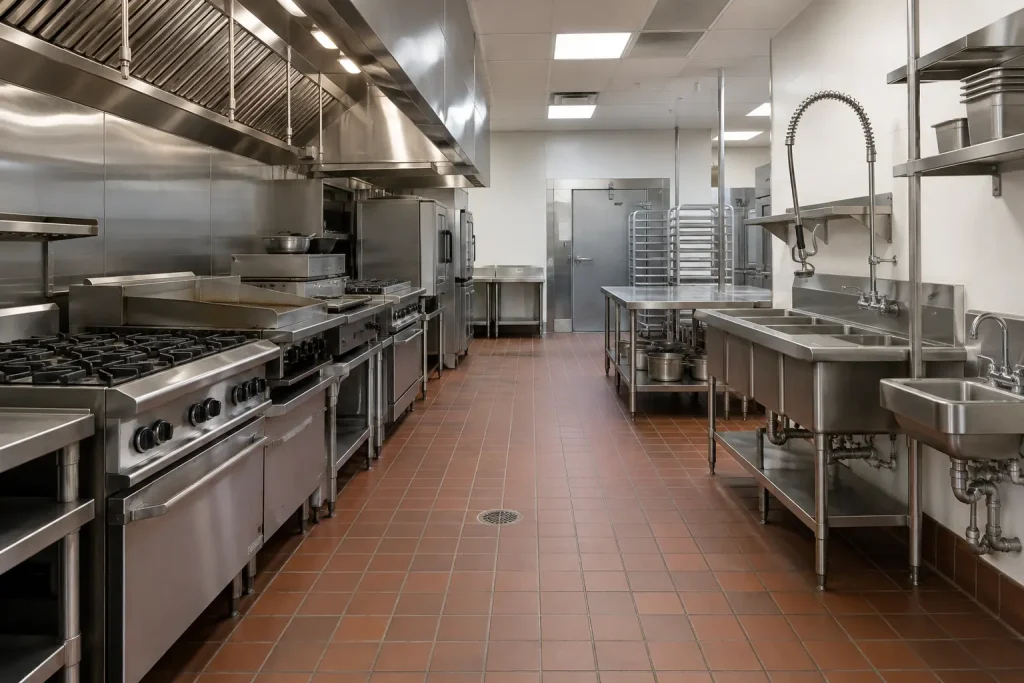
A commercial kitchen is any kitchen that stores, prepares or serves food for consumers under a health permit: the FDA Food Code calls it a food establishment, and it requires approved plans before one is built.
Key takeaways
- The FDA Food Code 2026, Section 1-201.10, counts restaurants, commissaries, catering operations, institutions and delivery-only kitchens as food establishments, whether or not the food is sold for a charge (FDA Food Code 2026).
- As of the FDA’s 2024 adoption report, 11 of 64 state agencies enforced the 2022 Food Code, 19 enforced 2017, 16 enforced 2013 and 2 had adopted no edition (FDA adoption report, 2024).
- Florida splits oversight among three agencies: DBPR restaurants on the 2017 edition, the Department of Health on 2013, and the Department of Agriculture’s retail food stores on 2017 (FDA, Table 7).
- Food Code Section 8-201.12 requires plans to show the menu, expected food volume, layout, finish schedules and each piece of equipment by manufacturer and model number (FDA Food Code 2026 PDF).
- The Defense Department’s FY2026 pricing guide puts a new dining facility, kitchen equipment and installation included, at $841.18 per square foot, and federal kitchen renovation contracts signed 2022 to 2026 ran from $167,561 to $8.8 million (DoD Facilities Pricing Guide; USAspending.gov).
- Cooking that produces grease or smoke needs a Type I hood with automatic fire suppression under the 2024 International Mechanical Code (IMC), Sections 507.2 and 507.2.11 (International Code Council).
| Key number | Value | Source |
|---|---|---|
| State agencies on the 2022 Food Code | 11 of 64 (end of 2024) | FDA adoption report, 2024 |
| US population in a state on the 2022 or 2017 edition | 51.92% | FDA adoption report, 2024 |
| New dining facility, kitchen equipment included | $841.18 per sq ft (October 2025 prices, national average) | DoD Facilities Pricing Guide, Table 2 |
| Manual warewashing sink | At least 3 compartments | Food Code 2026, 4-301.12(A) |
| Light at food preparation surfaces | 540 lux (50 foot-candles) | Food Code 2026, 6-303.11(C) |
| Cold holding of time/temperature control foods | 41°F or less | Food Code 2026, 3-501.16(A)(2) |
| Gravity grease interceptor capacity | Peak drain flow in gpm times 30 minutes | IPC 2024, 1003.3.7 |
| Florida cottage food sales cap | $250,000 gross a year | Fla. Stat. 500.80(1)(a) |
What is a commercial kitchen?
A commercial kitchen is a kitchen that prepares, stores or serves food for people outside the operator’s household under a permit from a health authority. The legal test in most states comes from FDA Food Code 2026 Section 1-201.10, which calls any such operation a food establishment, whether the food is eaten on site, picked up or delivered, and whether or not it is sold.
The definition is broad on purpose. Paragraph (B)(2) adds mobile, temporary and permanent facilities and any central preparation facility that supplies a vending or satellite feeding location. The exclusions in paragraph (B)(3) are narrow, and they are where most “do I need a commercial kitchen” questions get answered.
| Operation | Food establishment under 1-201.10? | Food Code 2026 paragraph |
|---|---|---|
| Restaurant, cafe or bar that serves food | Yes | (B)(1)(a) |
| Commissary or central kitchen supplying satellite or vending sites | Yes | (B)(1)(a) and (B)(2)(a) |
| Catering operation serving consumers | Yes | (B)(1)(a) |
| Delivery-only (ghost) kitchen | Yes: food reaches consumers through a delivery service | (B)(1)(b) |
| School, hospital or jail kitchen | Yes: listed as an institution | (B)(1)(a) |
| Food truck or temporary event stand | Yes: mobile or temporary facility | (B)(2)(b) |
| Store selling only prepackaged foods that need no time or temperature control | No | (B)(3)(a) |
| Wholesale food manufacturer | No: regulated as a food processing plant | (B)(3)(c) |
| Home kitchen baking for a charity sale, with a placard, where state law allows | No | (B)(3)(d) |
| Owner-occupied bed-and-breakfast: up to 6 guest bedrooms, breakfast only, up to 18 guests | No | (B)(3)(f) |
The line between a commercial and a home kitchen is also drawn in the building codes. Food establishment work may not happen in a private home or in any room that opens into living or sleeping quarters (Food Code Section 6-202.111). A domestic range used for commercial cooking needs a Type I or Type II hood (IMC 2024 Section 507.1.2). Only dwelling units and private living quarters are exempt from the grease interceptor rule in the 2024 International Plumbing Code, or IPC (Section 1003.3.4).
What does a commercial kitchen cost to build?
No public price list covers private restaurant kitchens, but government records give real anchors. The Defense Department’s pricing guide puts a new enlisted dining facility, kitchen equipment and installation included, at $841.18 per square foot at a 50,434 square foot reference size, in October 2025 dollars. Federal contracts to renovate existing kitchens, signed 2022 to 2026, ran from $167,561 to $8.8 million.
The $841.18 figure comes from Table 2 of UFS 3-701-01, DoD Facilities Pricing Guide (June 2026), averaged from 3 new-construction awards and normalized to a national-average location. It covers the whole building, dining room included, built to military criteria, and leaves out site work, design fees and contingency. Treat it as a reference point for a full new build, not a quote for a tenant fit-out.
| Federal project (place) | Scope as written in the award | Award | Signed | Source |
|---|---|---|---|---|
| ICE Krome Service Processing Center (Miami, FL) | Dining facility construction | $13,178,352 | Sep 2022 | USAspending 70CMSW22C00000009 |
| Army, Fort Belvoir Building 20 Officers’ Club (VA) | Kitchen renovation | $8,800,096 | Sep 2023 | USAspending W912DR23C0034 |
| Navy, Dahlgren Hall (Annapolis, MD) | Kitchen renovation | $8,024,123 | Jan 2023 | USAspending N4008023C0002 |
| VA, project 459-24-002 (Honolulu, HI) | Kitchen renovation | $1,698,531 | Nov 2024 | USAspending 36C26125N0220 |
| VA, project 649-26-606 (Prescott, AZ) | Domiciliary kitchen renovation | $617,282 | Aug 2026 | USAspending 36C26226C0276 |
| Navy (Washington, DC) | Commercial kitchen renovation | $167,561 | Apr 2022 | USAspending N4008022F4351 |
None of these awards states a floor area, so they cannot be turned into a cost per square foot; they show how far scope moves the total. A leased restaurant prices a different scope: the landlord delivers the shell, and a second-generation space may already have a hood, grease duct and interceptor. Health plan review adds a fee: Los Angeles County charges $1,044 to $2,723 for a new restaurant, by size (LA County form, Rev 11/2025). Item-by-item equipment prices from federal purchase records are in our commercial kitchen equipment guide.
Which food code applies to a commercial kitchen in your state?
The FDA Food Code is a model code: it has no legal force until a state or local agency adopts it, often with amendments. The FDA’s 2024 adoption report counts 64 state agencies across the 50 states and the District of Columbia, spread over seven editions from 1995 to 2022, plus 2 agencies that adopted none. Plan reviewers check drawings against the edition their own agency adopted.
The spread matters on a drawing. Under the 2017 edition, a handwashing sink had to deliver at least 100°F water; the 2022 edition cut that to 85°F, according to the 2022 Summary of Changes. A reviewer in a state still on 2013 or 2017 may apply the older figure unless the state amended it. The report also found that 38 of the 62 adopting agencies (61.3%) kept at least one provision less strict than the edition they adopted, so the state rule, not the FDA PDF, is the document to design to.
| State agency (selected) | Oversees | Food Code edition | Effective year | Source |
|---|---|---|---|---|
| California Department of Public Health | Restaurants and retail | 2005 | 2007 | FDA 2024 report, Table 7 |
| Texas Department of State Health Services | Restaurants and retail | 2017 with Supplement | 2021 | FDA 2024 report, Table 7 |
| Florida DBPR, Division of Hotels and Restaurants | Restaurants | 2017 | 2019 | FDA 2024 report, Table 7 |
| Florida Department of Health | Institutions such as schools, jails and assisted living | 2013 | 2018 | FDA 2024 report, Table 7 |
| Florida Department of Agriculture and Consumer Services | Retail food stores | 2017 | 2020 | FDA 2024 report, Table 7 |
| Georgia Department of Public Health | Restaurants | 2013 | 2015 | FDA 2024 report, Table 7 |
| Illinois Department of Public Health | Restaurants and retail | 2022 | 2024 | FDA 2024 report, Table 7 |
| Pennsylvania Department of Agriculture | Restaurants and retail | 2022 with Supplement | 2024 | FDA 2024 report, Table 7 |
| North Carolina DHHS | Restaurants and retail | 2017 with Supplement | 2021 | FDA 2024 report, Table 7 |
| New York State Department of Health | Restaurants | None adopted | Not applicable | FDA 2024 report, Table 7 |
| South Dakota Department of Health | Restaurants and retail | 1995 | 1997 | FDA 2024 report, Table 7 |
The newest edition has not reached most kitchens yet. The FDA issues a full edition every four years and published the 2026 Food Code in 2026, but its own report shows agencies moving slowly: 0 agencies were on the 2017 edition in 2016 and 19 were in 2024. Hawaii and Virginia completed rulemaking for the 2022 edition with effective dates in March and February 2025.
| Food Code edition | State agencies in 2016 | State agencies in 2024 | Source |
|---|---|---|---|
| 2022 | 0 | 11 | FDA 2024 report, Table 4 |
| 2017 | 0 | 19 | FDA 2024 report, Table 4 |
| 2013 | 21 | 16 | FDA 2024 report, Table 4 |
| 2009 | 24 | 8 | FDA 2024 report, Table 4 |
What does a commercial kitchen need to pass plan review?
Plans and specifications go to the health authority before a food establishment is built, before an existing building is converted to one, and before any remodel the authority decides needs review (Food Code 2026 Section 8-201.11). The food permit issues only after the plans are approved and a preoperational inspection finds the kitchen built to them (Section 8-303.10). Section 8-201.12 lists what the package shows.
The six required contents of Section 8-201.12 are the intended menu; the expected volume of food stored, prepared and sold; the layout, mechanical schematics, construction materials and finish schedules; each piece of equipment by type, manufacturer, model number, location, dimensions, capacity and installation; evidence of a food safety management system; and anything else the authority asks for. Florida’s Division of Hotels and Restaurants also requires review when a restaurant reopens after being closed at least 18 months, and says online applications are reviewed within 30 days (Florida DBPR plan review page).
- Confirm zoning and utility capacity. Ask the planning office whether food service is a permitted use and ask the utilities for gas, power, water and sewer capacity before you sign a lease; a builder’s preconstruction services cover this check.
- Freeze the menu and equipment list. Hood length, interceptor size and electrical load all follow from it.
- Draw plans to Food Code 8-201.12. Include model numbers, finish schedules and the mechanical schematics.
- File health plan review and building permit. Where your jurisdiction allows it, file them in parallel. The building side is explained in our guide to commercial building permits.
- Build and install equipment. Install to the approved plans, since the inspection compares the room to them.
- Test hood suppression, pass trade finals. IMC 2024 Section 507.2.11 requires an automatic system on every Type I hood.
- Preoperational inspection (8-203.10). The health authority confirms the kitchen matches the approved plans.
- Food permit (8-303.10) and certificate of occupancy. The building side closes with the certificate of occupancy.
What are the build requirements for a commercial kitchen, system by system?
A commercial kitchen is built to two rule sets at once: the Food Code edition your health authority adopted, which governs sinks, finishes, lighting and equipment, and the building, mechanical, plumbing and fire codes your building official enforces, which govern hoods, makeup air, suppression and grease interceptors. The table maps each system to the section that controls it, using the 2026 Food Code and the 2024 ICC codes.
| System | Governing section | What it requires | Source |
|---|---|---|---|
| Handwashing sinks | Food Code 5-203.11, 5-204.11, 5-202.12 | In each prep, dispensing and warewashing area and at toilet rooms; water at least 85°F; metering faucets run at least 15 seconds | FDA Food Code 2026 |
| Warewashing | Food Code 4-301.12 | Sink with at least 3 compartments large enough for the largest utensil, or a dish machine | FDA Food Code 2026 |
| Mop sink | Food Code 5-203.13 | At least 1 service sink, or a curbed cleaning facility with a floor drain | FDA Food Code 2026 |
| Backflow | Food Code 5-202.13, 5-203.14 | Air gap at least twice the inlet diameter and not less than 1 inch, or an approved device | FDA Food Code 2026 |
| Floors, walls, ceilings | Food Code 6-201.11, 6-201.13, 6-201.14 | Smooth and easily cleanable; coved floor junctures closed to 1/32 inch; no carpet in prep, walk-in, warewashing or toilet areas | FDA Food Code 2026 |
| Lighting | Food Code 6-303.11 | 50 foot-candles at prep surfaces; 20 at handwashing, warewashing and inside reach-ins; 10 in walk-ins and dry storage | FDA Food Code 2026 |
| Holding temperatures | Food Code 3-501.16, 4-301.11 | Enough equipment to hold food at 41°F or less, or 135°F or above | FDA Food Code 2026 |
| Equipment sanitation | Food Code 4-205.10 | Equipment certified to an American National Standard by an ANSI-accredited program is deemed to comply | FDA Food Code 2026 |
| Exhaust hood | IMC 507.2, 507.2.3, 507.3 | Type I over grease or smoke, built of No. 18 gage steel or No. 20 stainless; Type II over heat or moisture only | IMC 2024 |
| Makeup air | IMC 508.1 | Approximately equal to the exhaust, started with the exhaust fan | IMC 2024 |
| Fire suppression | IMC 507.2.11; IFC 904.14; NFPA 96 | Automatic system on each Type I hood; wet and dry chemical systems tested to UL 300 | IFC 2024 |
| Grease interceptor | IPC 1003.3.1; Food Code 5-402.12; 40 CFR 403.5(b)(3) | Required for grease-laden fixtures; easily accessible for cleaning; the sewer utility enforces its grease program | IPC 2024 |
Fire officials enforce the NFPA 96 edition their state adopted, which may trail the 2027 edition that NFPA lists as current on its NFPA 96 page. The federal pretreatment rule at 40 CFR 403.5(b)(3) bans solid or viscous discharges that obstruct sewer flow, which is the legal root of every local grease program.
Which NSF/ANSI standards cover commercial kitchen equipment?
Food Code 2026 Section 4-205.10 deems food equipment compliant with the Code’s design and construction rules when an ANSI-accredited program certifies it to a recognized American National Standard. The FDA’s list of those standards, dated December 10, 2019, names 21 NSF/ANSI standards and one UL standard. A reviewer can check that mark on each data plate against the model numbers listed under Section 8-201.12(D).
| Standard | Covers | Typical kitchen items | Source |
|---|---|---|---|
| NSF/ANSI 2 | Food equipment | Work tables, sinks, shelving | FDA list of American National Standards |
| NSF/ANSI 3 | Commercial warewashing equipment | Dish machines | FDA list |
| NSF/ANSI 4 | Commercial cooking, rethermalization and powered hot food holding | Ranges, fryers, ovens, holding cabinets | FDA list |
| NSF/ANSI 5 | Water heaters and hot water supply boilers | Booster heaters | FDA list |
| NSF/ANSI 7 | Commercial refrigerators and freezers | Walk-ins, reach-ins, prep tables | FDA list |
| NSF/ANSI 8 | Commercial powered food preparation equipment | Mixers, slicers | FDA list |
| NSF/ANSI 12 | Automatic ice making equipment | Ice machines | FDA list |
| NSF/ANSI 52 | Supplemental flooring | Floor coatings and toppings | FDA list |
| NSF/ANSI 59 | Mobile food carts | Carts and kiosks | FDA list |
How are grease interceptors sized for a commercial kitchen?
IPC 2024 Section 1003.3.1 requires a grease interceptor or automatic grease removal device for pot sinks, prerinse sinks, soup kettles, wok stations, floor drains that kettles empty into, automatic hood wash units and dishwashers without a prerinse sink. Hydromechanical units are sized by flow-through rating under Table 1003.3.5.1; gravity units hold 30 minutes of peak drain flow under Section 1003.3.7.
The example flows below are illustrative inputs to show the arithmetic, not design values; your plumbing engineer calculates peak drain flow from the fixture schedule, and the sewer utility can require a larger unit under its grease program. Section 1003.3.2 also bars food waste disposers from discharging into the interceptor.
| Case | Input | Rule applied | Result |
|---|---|---|---|
| Hydromechanical interceptor | 35 gpm flow-through rating | Table 1003.3.5.1 | 70 lb grease retention |
| Hydromechanical interceptor | 50 gpm flow-through rating | Table 1003.3.5.1 | 100 lb grease retention |
| Hydromechanical interceptor | 150 gpm flow-through rating | Over 100 gpm: double the rating (note a) | 150 x 2 = 300 lb |
| Gravity interceptor | 50 gpm peak drain flow | Section 1003.3.7: gpm x 30 minutes | 50 x 30 = 1,500 gallons |
| Gravity interceptor | 75 gpm peak drain flow | Section 1003.3.7: gpm x 30 minutes | 75 x 30 = 2,250 gallons |
Hoods follow a similar duty test. IMC 2024 Section 507.1 waives the hood for recirculating systems listed to UL 710B and for electric appliances listed to UL 197 for reduced grease emissions, which lets some cafes and kiosks run without a ducted hood. The fire marshal still decides whether the listing fits the menu.
What types of commercial kitchens are there?
Commercial kitchens differ by who eats the food and where it goes, and that decides which agency reviews the plans. In Florida, a restaurant goes to DBPR under Fla. Stat. 509.013(5)(a), a school or assisted living kitchen goes to the Department of Health under Fla. Stat. 381.0072(2)(c), and a grocery kitchen goes to the Department of Agriculture, each on its own Food Code edition.
| Kitchen type | What sets it apart | Florida regulator | Build point with a rule |
|---|---|---|---|
| Restaurant | Cooks and serves to order on site or for takeout | DBPR (2017 edition) | Class K extinguisher within 30 feet of cooking equipment where suppression is required (DBPR) |
| Commissary or shared-use kitchen | Prepares food for trucks, carts or satellite sites | DBPR | Mobile units must empty waste at an approved servicing area (Food Code 5-402.14) |
| Delivery-only (ghost) kitchen | No dining room; food leaves by courier | DBPR | Still a food establishment under 1-201.10(B)(1)(b) |
| Catering kitchen | Cooks for off-site events | DBPR | Holding equipment sized to keep food at 135°F or above in transit (3-501.16) |
| Institutional kitchen | Schools, jails, assisted living, hospices | Department of Health (2013 edition) | Covers detention facilities, schools, assisted living and hospices listed in Fla. Stat. 381.0072(2)(c) |
| Home cottage food operation | Non-time/temperature control foods sold direct | None for permits under 500.80 | Sales cap of $250,000 a year; no wholesale (Fla. Stat. 500.80) |
Most restaurant kitchens are built as a fit-out inside leased space, so the shell matters as much as the code. A second-generation space may already have a hood, a grease duct and an interceptor. How shell and second-generation space change the scope is explained in our guide to tenant improvement contractors. If you are hiring a builder for a restaurant specifically, the schedule drivers, ADA seating rules and bid checks are on our page about restaurant build-out contractors.
Where do common commercial kitchen guides get the rules wrong?
Four claims in top-ranking commercial kitchen guides do not match the primary text. The most common error is the handwashing sink temperature: FDA Food Code 2026 Section 5-202.12(A) requires at least 85°F, not 110°F, and which states still apply 100°F is set out in our commercial kitchen sink guide. The other three involve cold holding, the legal status of the Food Code, and the reach of an OSHA fire standard.
| What a guide says | What the primary source says | Source |
|---|---|---|
| An equipment retailer’s guide, published March 2026: handwashing sinks must provide hot water of at least 110°F | At least 85°F through a mixing valve or combination faucet; the International Plumbing Code treats 85°F to 110°F as tempered water | Food Code 2026, 5-202.12(A) and Annex 3 |
| The same guide: refrigerators must hold 32°F to 40°F | Time/temperature control food must be held at 41°F or less | Food Code 2026, 3-501.16(A)(2) |
| A kitchen rental company’s guide: the “Federal Food Code” sets the rules | It is a model code; 2 of 64 state agencies had adopted no edition at the end of 2024 | FDA adoption report, 2024 |
| The same guide: OSHA 1910.164 requires restaurants to have automatic fire detection | 1910.164 applies to fire detection systems installed to meet a particular OSHA standard | 29 CFR 1910.164(a) |
Which path fits your commercial kitchen project?
The right path depends on what you sell, how much and where. A Florida home baker under $250,000 a year can skip the commercial kitchen entirely under Fla. Stat. 500.80, a food truck needs an approved base for waste under Food Code 5-402.14, and anyone cooking with grease needs a Type I hood and an interceptor. Use the table to find your row, then confirm it with your health authority.
| If | Then | Rule |
|---|---|---|
| You do not sell, serve or give food to consumers | Not a food establishment | Food Code 1-201.10 |
| You sell only prepackaged foods that need no time or temperature control | Excluded from the definition; ask your state agency about a retail permit | Food Code 1-201.10(B)(3)(a) |
| Florida home kitchen, non-time/temperature control foods, sales up to $250,000 a year, no wholesale | Cottage food operation: no permit, but a label is required | Fla. Stat. 500.80(1)(a), (2), (3) |
| Sales above $250,000, foods that need temperature control, or wholesale | Food establishment: submit plans before building and pass a preoperational inspection | Food Code 8-201.11, 8-203.10 |
| You run a food truck | Line up a commissary or servicing area for waste and water | Food Code 5-402.14 |
| Cooking makes grease or smoke | Type I hood with suppression and makeup air | IMC 507.2, 507.2.11, 508.1 |
| Only UL 710B recirculating or UL 197 electric appliances | A hood may not be required; confirm with the fire marshal | IMC 507.1, exceptions |
| Grease-laden drains (pot sink, prerinse, wok, kettle floor drain) | Grease interceptor or automatic grease removal device | IPC 1003.3.1 |
| Florida restaurant remodeled, converted, or reopening after 18 months or more closed | New DBPR plan review | Florida DBPR plan review page |
Once your row is clear, get bids on the same drawings and equipment list so the hood, suppression, interceptor and utility work are priced alike. Exclusions and allowances are covered in our guide on how to compare construction bids. A coffee kiosk on UL 197 equipment and a full Type I cooking line share few line items, so price your own drawings rather than a per-square-foot average; the method for using published ranges is in our guide to commercial construction cost per square foot. This page is general information, not legal advice: your health authority and building official decide what applies to your plans.
The hood, suppression and layout rules above each have a full guide: the commercial kitchen hood, its fire suppression system and commercial kitchen design.
How we compiled this
We read 15 primary documents and 6 federal contract records in October 2026: the FDA Food Code 2026 and 2022 PDFs, the DoD Facilities Pricing Guide (UFS 3-701-01) and its data tables, contract awards on USAspending.gov, the FDA’s 2024 Food Code adoption report and its list of food equipment standards, the 2024 IMC, IPC and IFC chapters on the International Code Council’s public viewer, the NFPA 96 page, two eCFR sections, three Florida statutes and the Florida DBPR plan review page. We read five top-ranking guides only to find gaps; none is cited as a source. We did not inspect kitchens, test equipment or survey operators, and the cost figures are government records, not quotes.
Frequently asked questions
What is considered a commercial kitchen?
Any kitchen that stores, prepares or serves food for consumers, directly or through delivery, counts as a food establishment under FDA Food Code 2026 Section 1-201.10. That covers restaurants, commissaries, caterers, institutions, food trucks and delivery-only kitchens, whether or not the food is sold. Kitchens selling only prepackaged foods that need no time or temperature control are excluded.
Can I turn my home kitchen into a commercial kitchen?
Usually not for a food establishment: Food Code 2026 Section 6-202.111 bars food establishment work in a private home or a room opening into living quarters. Florida carves out cottage food operations under Fla. Stat. 500.80, which need no permit if they sell non-time/temperature control foods directly, stay at or under $250,000 in annual gross sales and do not sell wholesale.
Does commercial kitchen equipment have to be NSF certified?
The Food Code does not name NSF, but Section 4-205.10 deems equipment certified to an American National Standard by an ANSI-accredited program compliant with its design rules. The FDA lists NSF/ANSI 2, 4 and 7 among those standards. Plan reviewers compare the listed model numbers in your Section 8-201.12 submission against those certifications, so uncertified equipment can draw questions.
How much does it cost to build a commercial kitchen?
No public price list covers private restaurants. The Defense Department’s FY2026 pricing guide puts a new dining facility, kitchen equipment included, at $841.18 per square foot, a reference point for a full new build. Federal kitchen renovations signed from 2022 to 2026 ran from $167,561 to $8.8 million. A leased second-generation space with a hood and grease interceptor already in place has fewer trades to price.
Does every commercial kitchen need a hood?
No. IMC 2024 Section 507.2 requires a Type I hood where cooking produces grease or smoke, and Section 507.3 requires a Type II hood over light-duty appliances and dishwashers that give off only heat or moisture. Section 507.1 waives the hood for recirculating systems listed to UL 710B and electric appliances listed to UL 197 for reduced grease emissions.
Does a commercial kitchen need a grease trap?
If it has grease-laden fixtures, yes. IPC 2024 Section 1003.3.1 requires a grease interceptor or automatic grease removal device for pot sinks, prerinse sinks, wok stations, kettle floor drains, hood wash units and dishwashers without a prerinse sink. Food Code 5-402.12 requires the trap to be easy to reach for cleaning, and your sewer utility may set a larger size.
How long does commercial kitchen plan review take?
Each agency sets its own review time. In Florida, the DBPR Division of Hotels and Restaurants says online plan review applications can expect review within 30 days, and it requires review for new, converted and remodeled restaurants and those reopening after 18 months closed. Ask your county or state health authority for its published review time before you set an opening date.
Sources
- FDA Food Code 2026 (PDF), U.S. Food and Drug Administration; edition page Food Code 2026. Accessed October 20, 2026.
- FDA Food Code 2022 (PDF), Summary of Changes, U.S. Food and Drug Administration. Accessed October 20, 2026.
- Adoption of the FDA Food Code by State and Territorial Agencies, 2024, FDA Office of Retail Food Protection; summary at FDA adoption page. Accessed October 20, 2026.
- List of American National Standards for Food Equipment, FDA National Retail Food Team, December 10, 2019. Accessed October 20, 2026.
- 2024 International Mechanical Code, Chapter 5, International Code Council. Accessed October 20, 2026.
- 2024 International Plumbing Code, Chapter 10, International Code Council. Accessed October 20, 2026.
- 2024 International Fire Code, Chapter 9, International Code Council. Accessed October 20, 2026.
- NFPA 96, Standard for Ventilation Control and Fire Protection of Commercial Cooking Operations, National Fire Protection Association. Accessed October 20, 2026.
- 40 CFR 403.5, Prohibited discharges, eCFR. Accessed October 20, 2026.
- 29 CFR 1910.164, Fire detection systems, eCFR. Accessed October 20, 2026.
- Fla. Stat. 500.80, Cottage food operations, Florida Legislature. Accessed October 20, 2026.
- Fla. Stat. 381.0072, Food service protection, Florida Legislature. Accessed October 20, 2026.
- Fla. Stat. 509.013, Definitions, Florida Legislature. Accessed October 20, 2026.
- Hotels and Restaurants: Plan Review, Florida Department of Business and Professional Regulation. Accessed October 20, 2026.
- UFS 3-701-01, DoD Facilities Pricing Guide (June 6, 2026) and FY2026 data tables, Table 2, U.S. Department of Defense via WBDG. Accessed October 26, 2026.
- USAspending.gov award records 70CMSW22C00000009, W912DR23C0034, N4008023C0002, 36C26125N0220, 36C26226C0276 and N4008022F4351, U.S. Department of the Treasury. Accessed October 26, 2026.
- Retail Food Facility Plan Review Service Request, Rev 11/2025, Los Angeles County Department of Public Health. Accessed October 26, 2026.