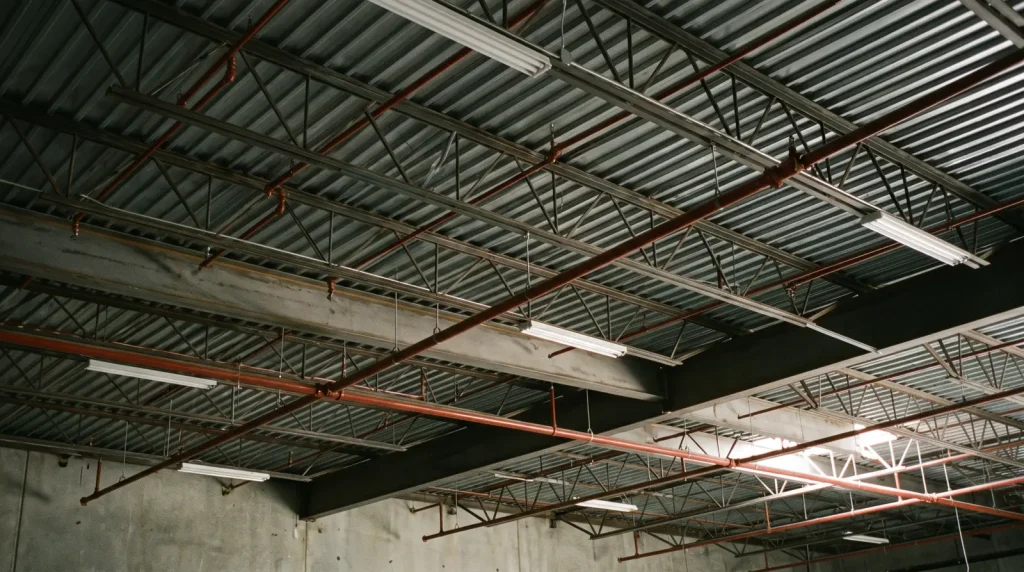
Commercial fire sprinkler system cost ran a median $7.74 per sq ft in 13 Massachusetts school estimates for 2024 and 2025 construction starts, before contractor markups; Texas retrofit registrations ran $5.66 to $44.91 per sq ft.
Key takeaways
- The fire protection line (sprinklers, standpipes and specialties) in 13 Massachusetts school estimates with 2024 or 2025 starts had a median of $7.74 per sq ft, up from $4.13 for 2014 starts (MSBA schematic design cost data, April 2024).
- Across 97 of those school estimates, fire protection was a median 1.65% of the building cost, so a $10 million building carries about $165,000 of sprinkler work before markups (MSBA middle school data).
- Texas owners registered sprinkler installs in two existing Harris County warehouses at $5.66 and $8.12 per sq ft, while eight Midland school retrofits that included new ceilings averaged $26.49 per sq ft (TDLR TABS project registrations).
- Under the 2024 International Building Code, most assembly, school, factory, retail and storage buildings need sprinklers once one fire area passes 12,000 sq ft; restaurants and bars (Group A-2) trigger at 5,000 sq ft or 100 occupants (IBC Section 903.2).
- Seven federal fire pump replacements awarded from November 2024 to September 2026 cost $63,623 to $221,196, median $163,659, which can rival the piping budget of a mid-size building (USAspending.gov award records).
How much does a fire sprinkler system cost per square foot?
For new commercial buildings, the best public record of sprinkler cost is the fire protection line in Massachusetts School Building Authority estimates: a median $7.74 per sq ft for the 13 schools with 2024 or 2025 construction starts, ranging from $6.06 to $9.54. Those figures are trade costs before the general contractor’s conditions, fee, insurance, bonds and contingency, which added a median 23.8% on the same projects (MSBA cost data).
The Massachusetts School Building Authority (MSBA) publishes the schematic design estimate of every school it funds, line by line in the Uniformat format, with the gross square footage. Line D40 “Fire Protection” covers sprinklers, standpipes and fire protection specialties. We divided D40 by the gross area for 97 schools and took the median by assumed construction start year.
| Construction start year | Schools | Median fire protection cost per sq ft | Source |
|---|---|---|---|
| 2014 | 11 | $4.13 | MSBA, April 2024 data |
| 2015 | 7 | $4.25 | MSBA, April 2024 data |
| 2016 | 7 | $4.81 | MSBA, April 2024 data |
| 2017 | 7 | $4.50 | MSBA, April 2024 data |
| 2018 | 4 | $4.69 | MSBA, April 2024 data |
| 2019 | 12 | $4.63 | MSBA, April 2024 data |
| 2020 | 8 | $5.38 | MSBA, April 2024 data |
| 2021 | 9 | $5.29 | MSBA, April 2024 data |
| 2022 | 11 | $5.91 | MSBA, April 2024 data |
| 2023 | 8 | $5.82 | MSBA, April 2024 data |
| 2024 | 5 | $7.29 | MSBA, April 2024 data |
| 2025 | 8 | $8.12 | MSBA, April 2024 data |
| School (district) | Gross sq ft | Fire protection line | Per sq ft | Start | Source |
|---|---|---|---|---|---|
| Hatherly Elementary (Scituate) | 106,084 | $879,600 | $8.29 | Sep 2025 | MSBA |
| Clinton Middle School (Clinton) | 136,000 | $1,108,276 | $8.15 | Jul 2025 | MSBA |
| Elmwood (Hopkinton) | 175,002 | $1,669,150 | $9.54 | Aug 2025 | MSBA |
| Pierce, addition and renovation (Brookline) | 246,123 | $1,492,560 | $6.06 | Nov 2024 | MSBA |
| Plains ES (South Hadley) | 63,377 | $259,465 | $4.09 | May 2014 | MSBA |
Two limits apply. These are Massachusetts public schools, a high-cost labor market, and the numbers are estimates at schematic design, not bids. They still give a dated, sized and named baseline that the per sq ft ranges in most online guides do not, and they show the cost of the fire protection line roughly doubling between 2014 and 2025 starts.
Fire protection was a median 1.65% of the building cost across the 97 MSBA estimates. For the cost of the whole building around the sprinkler system, our commercial construction cost per square foot guide lists the published ranges by building type.
What does a sprinkler retrofit cost in an existing building?
Retrofits cost more per sq ft because crews work around finished ceilings, occupants and an existing water service. In Texas registrations, sprinkler installs in two open warehouses were estimated at $5.66 and $8.12 per sq ft, while eight Midland elementary school retrofits that also replaced ceilings and connected new utility lines ran $16.56 to $44.91 per sq ft in 2025 (TDLR TABS).
Texas requires many commercial projects to be registered with the Texas Department of Licensing and Regulation (TDLR) Architectural Barriers program, and each registration states an estimated cost, the square footage and the scope. We searched the public registry for sprinkler, fire protection and fire suppression projects since 2019 and kept the 16 whose scope was sprinkler work.
| Project (county) | Registered | Scope as registered | Sq ft | Estimated cost | Per sq ft | Source |
|---|---|---|---|---|---|---|
| BMC Warehouse Building 6 (Harris) | Jun 2021 | Install sprinklers in existing warehouse | 26,500 | $150,000 | $5.66 | TABS2021017204 |
| BMC Warehouse Building 8 (Harris) | Jun 2021 | Install sprinkler system | 30,800 | $250,000 | $8.12 | TABS2021017178 |
| Table of Friends Church (Tarrant) | Jan 2022 | Sprinklers plus 2 walls and 2 doors | 9,900 | $140,000 | $14.14 | TABS2022008785 |
| Midland ISD, 8 elementary schools (Midland) | Apr 2025 | Sprinkler piping, utility connection, ceiling replacement | 56,771 to 78,891 each | $967,700 to $2,813,450 | $16.56 to $44.91 (pooled $26.49) | TABS2025017420 to 17430 |
| DFW Rental Car Center, Level 1 (Dallas) | Nov 2022 | Replace Level 1 dry system with a nitrogen-based system | 450,000 | $3,300,000 | $7.33 | TABS2023006122 |
| Mary and John Gray Library (Jefferson) | Mar 2021 | Replace and rearrange existing system | 174,000 | $5,501,598 | $31.62 | TABS2021011894 |
| Zaragoza Warehouse (Travis) | Oct 2019 | Upgrade plus related mechanical and architectural work | 25,000 | $416,000 | $16.64 | TABS2020003729 |
| UHS RBG Annex (Bexar) | Jan 2023 | Sprinkler upgrade | 52,788 | $250,000 | $4.74 | TABS2023009410 |
| Ingenia Polymers plant (Harris) | Aug 2021 | Upgrade to re-permit for high-piled storage | 137,756 | $150,000 | $1.09 | TABS2021022216 |
The spread follows the scope line. An open warehouse with exposed structure needs pipe, hangers and a riser; a school with finished ceilings needed new ceilings and a utility connection, which pushed the Midland projects to a pooled $14,287,605 for 539,340 sq ft. Before comparing a retrofit quote with any per sq ft figure, ask the bidder to price the ceiling, patching, water service and after-hours work as separate lines.
Churches and other Group A-3 buildings must add sprinklers once a fire area passes 12,000 sq ft or 300 occupants under IBC Section 903.2.1.3, and our church construction guide works through those triggers for a sample sanctuary.
How do published cost ranges compare with public project records?
Most cost guides quote $1.50 to $3 per sq ft for a new wet sprinkler system without naming a project, place or date. The public records we compiled run higher: $7.74 per sq ft median for 2024 to 2025 Massachusetts school estimates before markups, and $5.66 to $8.12 for the two plain warehouse retrofits in Texas (MSBA).
| What a guide says | What the primary record shows | Primary source |
|---|---|---|
| A top-ranking guide, updated July 2026, puts new wet-pipe systems at $1.50 to $3 per sq ft, citing one contractor estimate | Fire protection lines in 13 school estimates for 2024 and 2025 starts: $6.06 to $9.54 per sq ft, median $7.74, before 23.8% median markups | MSBA schematic design data, April 2024 |
| A guide dated September 2026 puts retrofits at $2 to $7 per sq ft from its own pricing | Texas sprinkler retrofits registered at $5.66 to $44.91 per sq ft; the low end is open warehouses, the high end schools with ceiling replacement | TDLR TABS registrations, 2021 to 2025 |
| The same guide says some assembly occupancies need sprinklers at 5,000 sq ft, without naming the group | Only Group A-2 (food and drink) triggers at a 5,000 sq ft fire area or 100 occupants; A-1, A-3 and A-4 trigger at 12,000 sq ft or 300 occupants | IBC 2024 Sections 903.2.1.1 to 903.2.1.4 |
| A guide updated December 2023 gives $0.80 to $7 per sq ft for all systems | That range is attributed to a home-services cost guide; commercial systems follow NFPA 13 and the IBC triggers, not the NFPA 13D home standard | IBC 2024 Sections 903.3.1.1 and 903.3.1.3 |
When does the building code require sprinklers?
Under the 2024 International Building Code (IBC), sprinklers are required by occupancy group and fire area, the floor area bounded by fire walls, fire barriers or exterior walls. Most groups trigger at a 12,000 sq ft fire area, restaurants and bars at 5,000 sq ft or 100 occupants, every hotel and apartment building at any size, and offices only for ambulatory care or high floors (IBC Section 903.2).
| Occupancy group | Typical buildings | Sprinklers required when | IBC 2024 section |
|---|---|---|---|
| A-2 | Restaurants, bars, banquet halls | Fire area over 5,000 sq ft, 100 or more occupants, or off the exit discharge level | 903.2.1.2 |
| A-1, A-3, A-4 | Theaters, churches, gyms, arenas | Fire area over 12,000 sq ft, 300 or more occupants, or off the exit discharge level | 903.2.1.1, 903.2.1.3, 903.2.1.4 |
| E | Schools | Fire area over 12,000 sq ft, 300 or more occupants, or off the exit discharge level | 903.2.3 |
| F-1, M, S-1 | Factories, stores, warehouses, self storage | Fire area over 12,000 sq ft, over 3 stories above grade, or all such fire areas over 24,000 sq ft combined | 903.2.4, 903.2.7, 903.2.9 |
| R | Hotels, apartments, dormitories | Always, throughout the building | 903.2.8 |
| S-2 parking | Parking garages | Enclosed garage fire area over 12,000 sq ft or beneath other uses; open garage over 48,000 sq ft | 903.2.10 |
| B | Offices, outpatient clinics | Ambulatory care with 4 or more patients unable to self-evacuate (or 1 off the exit discharge level), or any building with a 30-person story 55 ft or more above fire access | 903.2.2.1, 903.2.11.3 |
Sprinklers also buy floor area. IBC Table 506.2 caps a one-story Type VB (combustible, unprotected) Group A-3 building at 6,000 sq ft without sprinklers and 24,000 sq ft with them, so owners often sprinkler a building the code does not force them to (IBC Chapter 5). Our self-storage construction guide compares sprinklering against splitting a building into fire areas of 12,000 sq ft or less.
Wet, dry, pre-action, NFPA 13 or 13R: how does the system type move cost?
A wet pipe system, with water held in the pipe, is the default and the least equipment. Dry pipe and pre-action systems add a valve, an air or nitrogen supply and more testing; NFPA 13R is a lighter standard allowed only in Group R buildings of 4 stories or fewer (IBC Section 903.3.1.2). The public records we compiled do not split cost by type, so the table shows the scope each adds.
| System or standard | Where it is used | What it adds or saves | Source |
|---|---|---|---|
| Wet pipe, NFPA 13 | Heated buildings; the IBC default design standard | Baseline; quarterly gauge and alarm inspections, annual main drain test | IBC 903.3.1.1; NFPA 25 Table 5.1.1.2 (EBMUD, 2024) |
| Dry pipe | Unheated garages, docks, freezers | Dry pipe valve and air or nitrogen supply; annual trip test, 3-year air leakage and full-flow trip tests; one Texas nitrogen dry replacement ran $7.33 per sq ft | NFPA 25 Table 13.1.1.2; TABS2023006122 |
| Pre-action | Data rooms, archives, water-sensitive spaces | Detection and releasing panel; preaction valve interior and strainer inspection every 5 years | NFPA 25 Table 13.1.1.2 (EBMUD, 2024) |
| NFPA 13R | Group R up to 4 stories, top floor 30 ft or less above fire access (R-2: roof under 45 ft) | Residential standard; lighter than NFPA 13 but limited to these buildings | IBC 903.3.1.2 |
| NFPA 13D | Group R-3 and R-4 Condition 1 homes and small care homes | Home standard; not used for commercial occupancies | IBC 903.3.1.3 |
| Limited area system | Small hazards inside an otherwise unsprinklered building | Not more than 6 sprinklers in any single fire area | IBC 903.3.8.1 |
Hotels are the common case for the NFPA 13 versus 13R choice, and our hotel construction guide shows where the 4-story and 30 ft limits fall. Cooking lines are protected by a separate hood system under its own standards, covered in our commercial kitchen fire suppression system guide.
What does the water supply add to the budget?
The pipe inside the building is often not the largest unknown. A fire service line and tap, a backflow preventer to protect the public water, and, where the hydrant flow test falls short, a fire pump can add six figures. Seven federal fire pump replacements awarded from 2024 to 2026 cost $63,623 to $221,196 each (USAspending.gov).
| Item | What it does | Public price example | Source |
|---|---|---|---|
| Fire line connection fee | Utility charge to connect a dedicated fire service | Village of Sparta, Michigan: $2,500 one-time fire line fee, against $140,800 for a 6-inch water connection (January 1, 2026) | Sparta utility rates 2026 |
| Fire line tap | Utility tapping work on the main | Grand Junction, Colorado bills fire line connections on time and material; its 6-inch domestic tap fee is $22,664.61 (2026) | Grand Junction connection fees |
| Backflow preventer | Keeps sprinkler water out of the potable supply, required through the plumbing code | GSA emergency replacement of a fire pump backflow preventer, Washington, D.C.: $31,125.91 (June 2026) | USAspending award 47PE5326F0078; IFC 912.6 |
| Fire pump | Boosts pressure when the city main cannot meet the design demand; installed to NFPA 20 | EPA Cincinnati, replace a 1,000 gpm, 55 psi pump: $163,658.69 (September 2025) | USAspending award 68HERC25C0069; IBC 913.1 |
| Fire pump | Same scope, federal office buildings | Boston $221,195.60 (Sep 2025); Birmingham $182,778.83 (Jun 2026); Washington, D.C. $177,870 (Aug 2026); Tampa $142,593.60 (Jun 2026); West Haven $113,564.64 (Nov 2024); Kansas City $63,622.59 (Sep 2026) | Boston, Birmingham, D.C., Tampa, West Haven, Kansas City |
| Supervision | Valves, pumps and waterflow switches monitored by a listed fire alarm control unit | Required for NFPA 13 systems; price it with the fire alarm scope | IFC 903.4.1 |
Order the hydrant flow test before design. IFC Section 903.3.5 requires the design to use a water supply test adjusted for seasonal and daily pressure swings, and that adjusted number decides whether a fire pump, with its room, controller and backup power, enters the budget (IFC 2024 Chapter 9). Buildings of 4 or more stories also need Class III standpipes under IBC Section 905.3.1, which share the same supply.
What does NFPA 25 inspection and testing involve?
Once the system is live, the International Fire Code makes the owner inspect, test and maintain it under NFPA 25 and keep the records (IFC Sections 901.6.1 and 901.6.3). For a wet system that means quarterly checks of gauges, alarm devices and the fire department connection, an annual sprinkler and main drain inspection, and an internal pipe inspection every 5 years (NFPA 25).
| Interval | Sprinkler system items | NFPA 25 table |
|---|---|---|
| Quarterly | Inspect waterflow alarm devices, fire department connections, gauges, valve supervisory switches, alarm valve exterior, electrically supervised control valves; test dry pipe priming water and quick-opening devices | 5.1.1.2, 13.1.1.2 |
| Semiannually | Test vane and pressure-switch waterflow devices; supervisory test of control valves | 5.1.1.2, 13.1.1.2 |
| Annually | Inspect sprinklers, spare sprinklers, pipe and fittings, hangers and braces, signs; check building heat before freezing weather; main drain test; control valve operation; dry pipe trip test and low air alarm; maintain sprinklers protecting commercial cooking | 5.1.1.2, 13.1.1.2 |
| Every 3 years | Dry pipe air leakage test and full-flow trip test | 13.1.1.2 |
| Every 5 years | Internal inspection of piping for obstructions; interiors of alarm, check and preaction valves; extra-high temperature solder sprinklers | 5.1.1.2, 13.1.1.2 |
| At 20 years, then every 10 | Test fast-response sprinklers | 5.1.1.2 |
These intervals are as reproduced from NFPA 25 in a 2024 inspection contract issued by the East Bay Municipal Utility District, which buys weekly, monthly, quarterly and annual service for its own wet, pre-action and fire pump systems (EBMUD RFP Appendix A). Ask any inspection bidder which NFPA 25 edition your fire official enforces and whether the price covers the 5-year internal pipe inspection.
Worked example: what would a 40,000 sq ft warehouse cost to sprinkler?
A one-story, 40,000 sq ft Group S-1 warehouse built as one fire area passes the 12,000 sq ft trigger in IBC Section 903.2.9, so it needs sprinklers throughout. Using the 2024 to 2025 Massachusetts median and markup, the sprinkler work comes to about $383,285, or $9.58 per sq ft, before any fire pump (IBC 903.2.9).
| Line | Basis | Amount | Source |
|---|---|---|---|
| Sprinkler trade cost | 40,000 sq ft x $7.74 per sq ft (median, 13 schools, 2024 and 2025 starts) | $309,600 | MSBA |
| General contractor markups | 23.8% of trade cost (median mark-up factor 1.238, same 13 schools) | $73,685 | MSBA |
| Subtotal, sprinkler work | $309,600 + $73,685; $9.58 per sq ft | $383,285 | CB&C arithmetic |
| Fire line connection fee | Example: Village of Sparta, Michigan flat fee | $2,500 | Sparta 2026 |
| Total without fire pump | $383,285 + $2,500; $9.64 per sq ft | $385,785 | CB&C arithmetic |
| Fire pump, only if the flow test falls short | Median of 7 federal replacement awards, 2024 to 2026 | $163,659 | USAspending.gov |
| Total with fire pump | $385,785 + $163,659; $13.74 per sq ft | $549,444 | CB&C arithmetic |
Three inputs would move this estimate most. High-piled or rack storage changes the sprinkler design under the fire code, which is why one Texas plant re-permitted for high-piled storage registered a $150,000 upgrade. A Texas open-warehouse retrofit at $5.66 to $8.12 per sq ft would put the trade cost at $226,400 to $324,800. Our warehouse construction guide covers the rack, dock and slab decisions that feed the sprinkler design.
Which budget path fits your building?
Start with the occupancy group and the largest fire area, then price the water supply before the piping. The table pairs 7 common situations with the rule and the cost record behind each, so a bid can be checked line by line against public data. Our guide on how to compare construction bids covers the scope-leveling steps.
| If | Then | Rule or record |
|---|---|---|
| New Group F-1, M or S-1 building with one fire area over 12,000 sq ft | Budget NFPA 13 sprinklers throughout; start near $7.74 per sq ft trade cost plus markups, adjusted for your market | IBC 903.2.4, 903.2.7, 903.2.9; MSBA 2024 data |
| Restaurant or bar over 5,000 sq ft or 100 occupants | Budget sprinklers for the A-2 fire area, plus a separate hood system | IBC 903.2.1.2 |
| Office building with no ambulatory care, all floors under 55 ft | Sprinklers are not required by occupancy, but price them if they buy allowable area or a tenant needs them | IBC 903.2.2, 903.2.11.3; Table 506.2 |
| Hotel or apartment, 4 stories or fewer, top floor 30 ft or less above fire access | NFPA 13R is allowed; compare its price with NFPA 13 | IBC 903.3.1.2 |
| Existing building with finished ceilings | Ask for ceiling, patching and after-hours work as separate lines; Texas school retrofits ran $16.56 to $44.91 per sq ft | TDLR TABS, Midland ISD 2025 |
| Unheated area, dock or garage | Price a dry pipe system and its annual and 3-year tests | NFPA 25 Table 13.1.1.2 |
| City main pressure is low on the flow test | Add a fire pump; recent federal replacements ran $63,623 to $221,196 | IBC 913.1; USAspending.gov |
The NFPA 13 acceptance test and the fire official’s sign-off under IFC Section 901 usually sit on the path to occupancy, which our certificate of occupancy guide lays out step by step. CB&C matches owners with builders and does not give engineering or code advice; the building and fire officials decide which edition and amendments apply.
Emergency lights run on their own schedule, a 30-second test every month and a 90-minute test every year under NFPA 101, as set out in our guide to emergency lighting requirements.
If you split the building into fire areas instead, IBC Table 707.3.10 sets the separation at 2 to 4 hours, and our guide to the fire rated wall shows how those walls are built and inspected.
Which trigger applies depends on the building’s group, and a 12,000 sq ft mixed-use example in our occupancy classification guide shows how one restaurant sprinklers a whole story.
A retrofit usually means opening the ceiling, and our guide to drop ceiling cost prices tear-out at $3.29 per sq ft and new grid and tile at $4.60 to $6.20.
How we compiled this
We compiled 97 Massachusetts school estimates from the MSBA April 2024 cost data files, 16 sprinkler-scope project registrations from the Texas TDLR TABS registry, 8 federal award records from USAspending.gov, 2 municipal water fee schedules, IBC and IFC 2024 Chapter 9 and NFPA 25 tables as reproduced in a public utility contract, all accessed in November 2026. We left out per-head and pipe-material prices and residential sprinkler costs that we could not trace to a primary record.
Frequently asked questions
How much does a fire sprinkler system cost per square foot?
For new commercial buildings, the fire protection line in 13 Massachusetts school estimates with 2024 or 2025 starts had a median of $7.74 per sq ft before markups, or about $9.58 with the median 23.8% general contractor markups (MSBA). Retrofits registered in Texas ran $5.66 to $8.12 per sq ft in open warehouses and $16.56 to $44.91 in schools that replaced ceilings.
Why does a sprinkler retrofit cost more than new construction?
A retrofit pays for work around what already exists: removing and replacing finished ceilings, patching, working after hours and bringing a new fire service into an old building. Eight Midland, Texas school retrofits registered in April 2025 combined sprinkler piping with ceiling replacement and utility connections and averaged $26.49 per sq ft, against $5.66 and $8.12 for two open warehouses (TDLR TABS).
Does an office building need fire sprinklers?
Not by occupancy alone. Under the 2024 IBC, Group B offices need sprinklers only for ambulatory care with 4 or more patients unable to self-evacuate, or when a story with 30 or more occupants sits 55 ft or more above fire department access (IBC 903.2.2 and 903.2.11.3). Owners still add them to gain allowable area under Table 506.2 or to meet a tenant or local amendment.
How often does a commercial sprinkler system need inspection?
Under NFPA 25, which IFC Section 901.6.1 adopts, gauges, alarm devices and fire department connections are inspected quarterly, sprinklers and pipe annually with a main drain test, and the inside of the piping every 5 years (NFPA 25 tables, EBMUD 2024). Dry pipe systems add an annual trip test and 3-year air leakage and full-flow trip tests.
Is it cheaper to add sprinklers or divide a building with fire walls?
It depends on the layout, so price both. For Group F-1, M and S-1, IBC Sections 903.2.4, 903.2.7 and 903.2.9 require sprinklers once one fire area passes 12,000 sq ft or all fire areas pass 24,000 sq ft combined. Sprinklers also raise the allowed area: a one-story Type VB A-3 building goes from 6,000 to 24,000 sq ft (IBC Table 506.2).
What is the difference between NFPA 13 and NFPA 13R?
NFPA 13 is the full commercial sprinkler standard and the IBC default. NFPA 13R is a residential standard that the 2024 IBC allows only in Group R buildings of 4 stories or fewer, with the top floor 30 ft or less above fire access, or for Group R-2 a roof under 45 ft (IBC 903.3.1.2). Hotels and apartments above those limits need NFPA 13.
Sources
- Massachusetts School Building Authority, Estimated Construction & Total Project Cost Data at Schematic Design, Elementary School (April 2024), accessed November 1, 2026.
- Massachusetts School Building Authority, Estimated Construction & Total Project Cost Data at Schematic Design, Middle Schools (April 2024), accessed November 1, 2026.
- Massachusetts School Building Authority, CP Information Cost Data, accessed November 1, 2026.
- Texas Department of Licensing and Regulation, TABS project search, sprinkler and fire protection registrations 2019 to 2026, accessed November 1, 2026.
- International Code Council, 2024 International Building Code, Chapter 9 (Sections 903, 905, 913), accessed November 1, 2026.
- International Code Council, 2024 International Building Code, Chapter 5 (Table 506.2), accessed November 1, 2026.
- International Code Council, 2024 International Fire Code, Chapter 9 (Sections 901.6, 903.3.5, 903.4.1, 912.6), accessed November 1, 2026.
- National Fire Protection Association, NFPA 25 document page, accessed November 1, 2026.
- East Bay Municipal Utility District, RFP Appendix A: fire sprinkler and fire pump inspection, testing and maintenance (NFPA 25 Tables 5.1.1.2, 8.1.1.2, 13.1.1.2), August 2024, accessed November 1, 2026.
- Village of Sparta, Michigan, Utility Rates January 1, 2026, accessed November 1, 2026.
- City of Grand Junction, Colorado, Water Connection Fee (2026 connection fees), accessed November 1, 2026.
- USAspending.gov (EPA), Contract 68HERC25C0069, AWBERC fire pump replacement, accessed November 1, 2026.
- USAspending.gov (GSA), Order 47PE5526F0222, Timberlake Annex fire pump replacement, accessed November 1, 2026.
- USAspending.gov (GSA), Order 47PB0025F0443, T.P. O’Neill Federal Building fire pump replacement, accessed November 1, 2026.
- USAspending.gov (VA), Contract 36C24124C0065, VAMC West Haven fire pump replacement, accessed November 1, 2026.
- USAspending.gov (GSA), Order 47PE5526F0431, Robert Vance Federal Building fire pump replacement, accessed November 1, 2026.
- USAspending.gov (GSA), Order 47PD5326F0374, Bolling Federal Building fire pump replacement, accessed November 1, 2026.
- USAspending.gov (GSA), Order 47PE5326F0263, DOI Headquarters fire pump replacement, accessed November 1, 2026.
- USAspending.gov (GSA), Order 47PE5326F0078, LBJ building fire pump backflow preventer replacement, accessed November 1, 2026.