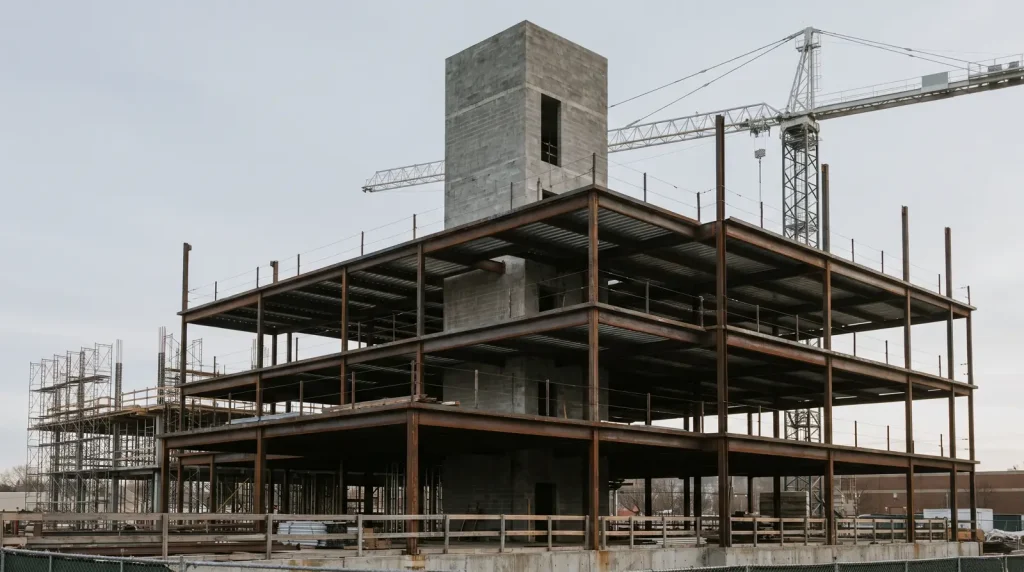
A commercial elevator cost a median $225,000 to add in 18 Texas registrations from 2022 to 2026, from $60,000 to $904,793; low-rise elevator replacements ran a median $239,836 per car in public records.
Key takeaways
- Owners registered 18 single-elevator additions to existing Texas buildings between November 2022 and October 2026 at a median estimated cost of $225,000; the 13 private jobs had a median of $200,000 and the 5 public jobs $500,000 (TDLR TABS project registrations).
- Seven public records that state the number of stops work out to $34,500 to $264,167 per stop, with a median of $99,966, about $100,000 per stop (USAspending.gov and TDLR TABS).
- Eight low-rise replacements and modernizations from 2024 to 2026 cost $125,000 to $400,000 per elevator, median $239,836; high-rise bank modernizations ran $384,391 to $925,000 per car (TDLR TABS, USAspending.gov).
- Under the 2010 ADA Standards, a private building needs an elevator once it has 3 or more stories and 3,000 sq ft or more per story, or at any size if it is a shopping center or the professional office of a health care provider (ADA 206.2.3).
- A 2026 federal maintenance award for 10 elevators and 1 lift in North Carolina came to $5,673 per unit per year, and Washington State charges a $197.40 to $246.70 annual operating permit per elevator (USAspending.gov, WAC 296-96-01085).
How much does a commercial elevator cost to install?
Public records put one commercial elevator at roughly $150,000 to $600,000 installed, with the job type moving the price more than the drive type. Small private additions in Texas cluster at $150,000 to $300,000, public-agency additions at $500,000 or more, and new cars in a federal building at $910,738 each in 2025 (TDLR TABS, GSA award).
Every figure below is a public record with a date and scope. Texas registrations are the owner’s estimated construction cost when the project is filed with the Texas Department of Licensing and Regulation (TDLR) for accessibility review, so they include the hoistway, pit, lobby and finishes the job needed. Federal awards are contract values and carry federal wage rules under the Davis-Bacon Act (40 U.S.C. 3141).
| Project type | Per elevator | Basis and date | Source |
|---|---|---|---|
| Cab interior refresh only | $14,444 | 9 cabs for $130,000, Las Colinas, registered 2025 | TABS2025025333 |
| Single elevator added, private owner | $200,000 median | 13 Texas jobs, $60,000 to $500,000, 2023 to 2026 | TDLR TABS |
| Low-rise replacement or modernization | $239,836 median | 8 records, $125,000 to $400,000, 2024 to 2026 | TDLR TABS, USAspending |
| Conveying line in a new school (all elevators) | $261,000 median | 11 Massachusetts schools, 2024 or 2025 starts, before markups | MSBA, April 2024 |
| Single elevator added, public owner | $500,000 median | 5 Texas jobs, $190,000 to $904,793, 2023 to 2025 | TDLR TABS |
| High-rise bank modernization | $590,909 | 11 cars for $6,500,000, City Tower, registered 2025 | TABS2025024734 |
| New cars in a federal office building | $910,738 | 3 passenger and 1 service car for $3,642,950, Grand Rapids, 2025 | USAspending |
The spread is mostly scope. A $14,444 cab refresh replaces finishes; a $200,000 private addition buys a car, a new shaft and a pit in a low building; a $590,909 high-rise modernization replaces machines and controllers on cars that travel many floors. Labor is a large share at every level: the U.S. Bureau of Labor Statistics put the median elevator installer wage at $52.84 an hour in May 2025 (BLS Occupational Outlook Handbook).
For context on whole-building budgets, our guide to commercial construction cost per square foot shows where elevators sit inside the shell budget.
What did recent elevator additions cost in Texas?
Eighteen Texas owners registered a single new elevator in an existing building from November 2022 to October 2026, at estimated costs from $60,000 for a warehouse office to $904,793 for a public facade addition. The median was $225,000, and the planned schedule from start to completion ran a median 8 months, from 1 month to 23.9 months (TDLR TABS).
| TABS project | County | Scope as registered | Estimated cost | Planned start |
|---|---|---|---|---|
| Warehouse office addition | Harris | New pit, foundation, shaft and lobby | $60,000 | June 2024 |
| North Tower infill | Harris | Infill new elevator in existing construction | $85,000 | July 2025 |
| Charter school storage building | Harris | Elevator to an existing 2-level storage space | $100,000 | March 2024 |
| 2-story hotel | Bexar | New elevator addition, 2 stories | $150,000 | November 2026 |
| Tulia ISD | Swisher | Elevator addition with MEP work | $190,000 | January 2023 |
| Courand House | Bexar | Basement to second level, 3 stops | $200,000 | March 2023 |
| Office and warehouse | Collin | Elevator, lobby and 1-hour separation, 2 stories | $200,000 | September 2025 |
| Multi-tenant retail | Hidalgo | Exterior rear elevator addition | $200,000 | May 2026 |
| Law office | Cameron | New walls and elevator | $300,000 | June 2024 |
| Office campus | Bexar | Second elevator in an existing hoistway with MEP | $400,000 | March 2024 |
| Church | Ellis | Modular elevator system | $500,000 | January 2024 |
| Historic building, public | El Paso | 5-stop elevator plus 2 accessible parking stalls | $600,000 | June 2023 |
| Transit facility, public | Harris | Elevator and vestibule on the north facade | $904,793 | April 2023 |
Two patterns stand out. Jobs that reuse an existing hoistway were not cheap: the office campus car in an existing shaft was registered at $400,000 and a county forensic lab car at $500,000 (TABS2025017079), because a new car, machine and controls are most of the cost. Exterior additions with their own small tower, such as the $150,000 hotel and $200,000 retail jobs, were among the lowest.
How much does a commercial elevator cost per stop?
Seven public records that state stops put elevator work at $34,500 to $264,167 per stop, with a median of $99,966, so about $100,000 per stop is a fair 2023 to 2026 planning number. Per-stop cost falls as stops rise because the machine, controller and car are bought once (USAspending.gov, TDLR TABS).
| Record | Stops | Cost | Per stop | Source |
|---|---|---|---|---|
| Freight hydraulic, component replacement, Madison WI, 2024 | 4 | $138,000 | $34,500 | USAspending |
| Addition, basement to second level, Bexar County TX, 2023 | 3 | $200,000 | $66,667 | TABS2023006333 |
| Addition to a 2-story hotel, Bexar County TX, 2026 | 2 | $150,000 | $75,000 | TABS2027003560 |
| 7-stop hydraulic replacement, West Point NY, 2026 | 7 | $699,760 | $99,966 | USAspending |
| Addition with lobby, Collin County TX, 2025 | 2 | $200,000 | $100,000 | TABS2026000813 |
| 5-stop addition, historic public building, El Paso County TX, 2023 | 5 | $600,000 | $120,000 | TABS2023012174 |
| Two 3-stop additions with machine rooms, Wichita County TX, 2024 | 3 each | $792,500 each | $264,167 | TABS2024019222 |
Hydraulic, machine-room-less traction or LULA: which costs less?
In public records the drive type matters less than travel, building type and who owns the job. Hydraulic cars dominate 2 to 7 stop work, machine-room-less (MRL) traction replaces them where owners want to drop the oil tank and machine room, and a limited-use/limited-application (LULA) elevator is a smaller car allowed only where the ADA does not require a full elevator (ADA 206.6).
| Type | What it is | Public price record | Where it fits | Source |
|---|---|---|---|---|
| Hydraulic | Car pushed by an oil-driven piston; machine room near the pit | $699,760 to replace a 7-stop car (2026); $230,623 per car to modernize 2 cars (2026) | Low-rise offices, schools, garages | USAspending, USAspending |
| Machine-room-less traction | Roped car with the machine in the hoistway | $248,365 to replace a hydraulic car with an MRL car, U.S. embassy library, Cairo (2024) | Owners removing hydraulic oil and the machine room | USAspending |
| Traction with machine room | Roped car, machine room above or beside the shaft | $792,500 per car for two 3-stop cars with machine rooms (2024) | Mid-rise and high-rise | TABS2024019222 |
| LULA | Small passenger car under ADA 408 and ASME A17.1 | $504,560 for a LULA addition plus second-floor classroom renovation (2026) | Buildings exempt under ADA 206.2.3 or allowed a platform lift | TABS2026012724 |
| Vertical platform lift (contrast) | Open lift under ADA 410, not an elevator | $82,817 to replace a courthouse wheelchair lift (2022) | Performance areas, small spaces listed in ADA 206.7 | USAspending |
No public record we found isolated a LULA car price; the only LULA registration bundled classroom work into one $504,560 figure. The LULA saving comes from size: ADA 408.4.1 allows a 42 by 54 inch car with a 32 inch door, against the 80 by 51 inch car and 42 inch door in ADA Table 407.4.1, which means a smaller hoistway (2010 ADA Standards).
| Car | Minimum inside size | Minimum door | Rule |
|---|---|---|---|
| Standard passenger, centered door | 80 in wide x 51 in to front return (54 in to door face) | 42 in | ADA Table 407.4.1 |
| Standard passenger, side door | 68 in wide x 51 in | 36 in | ADA Table 407.4.1 |
| LULA | 42 in wide x 54 in deep, or 51 x 51 in | 32 in at narrow end, or 36 in | ADA 408.4.1 |
| Stretcher car | Fits a 24 x 84 in stretcher lying flat, 5 in corner radius | Not set by this rule | IBC 3002.4 as adopted in WAC 51-50-30020 |
Door and corridor widths elsewhere in the building follow the same ADA chapter; our guide to ADA door width lists the clear-width rules.
What does elevator modernization or replacement cost?
Modernizing or replacing a low-rise car cost $125,000 to $400,000 per elevator in eight 2024 to 2026 public records, median $239,836. High-rise banks cost more per car: $384,391 at a 6-car hospital bank and $925,000 per car at a 4-car hospital bank, both registered in Texas in 2024 (TDLR TABS).
| Project | Cars | Total | Per car | Year | Source |
|---|---|---|---|---|---|
| Church, remove car, enlarge shaft and pit, new car | 1 | $125,000 | $125,000 | 2026 | TABS2026006025 |
| County inmate processing center, traction modernization | 3 | $500,000 | $166,667 | 2026 | TABS2026003446 |
| Events center and stadium, hydraulic to traction | 5 | $950,000 | $190,000 | 2026 | TABS2026010074 |
| USDA lab, Riverside CA, hydraulic modernization | 2 | $461,245 | $230,623 | 2026 | USAspending |
| High school elevator replacement | 1 | $249,050 | $249,050 | 2026 | TABS2026009679 |
| State office, Fort Worth, modernization | 2 | $581,000 | $290,500 | 2024 | TABS2024022285 |
| High school, bring car to current A17.1 | 1 | $300,000 | $300,000 | 2024 | TABS2024018232 |
| County detention annex, hydraulic upgrade | 2 | $800,000 | $400,000 | 2025 | TABS2025026855 |
| Hospital 6-car bank, finishes and controls | 6 | $2,306,347 | $384,391 | 2024 | TABS2023027090 |
| City office tower, controls and equipment | 11 | $6,500,000 | $590,909 | 2025 | TABS2025024734 |
| Cancer center bank, machines and controls | 4 | $3,700,000 | $925,000 | 2024 | TABS2024013004 |
The first eight rows are the low-rise set behind the $239,836 median. Elevators are excluded from qualified improvement property under 26 U.S.C. 168(e)(6), so a modernization does not get the 15-year recovery period that interior tenant work can (26 U.S.C. 168). This is general information, not tax advice; ask your CPA how the new equipment will be classed on your depreciation schedule. Our page on the tenant improvement allowance covers the interior work that does qualify.
What do the pit, hoistway, power and fire service add?
The elevator contract buys the car, rails, machine and controls; the building contract supplies a rated shaft, a pit with a sump, a power feeder and fire alarm tie-ins. Under IBC Section 713.4 a shaft connecting fewer than 4 stories needs a 1-hour enclosure and one connecting 4 or more needs 2 hours, and federal records price single items from $4,695 to $150,310 (IBC 2024 Chapter 7).
| Builder’s work item | Rule that drives it | Public price record | Source |
|---|---|---|---|
| Hoistway enclosure | IBC 713.4: 1-hour under 4 stories, 2-hour at 4 or more | No isolated public price found; carried in the shell budget | IBC 2024 Ch. 7 |
| Pit sump pump | Groundwater or sprinkler water collects in the pit | $4,695 to replace one sump pump (Lubbock TX, 2025); $10,953 for pit sump assemblies (El Paso TX, 2026); $77,900 to add one in an existing pit (Spokane WA, 2022) | USAspending, USAspending, USAspending |
| Shunt trip power disconnect | Sprinklers in the hoistway or machine room require power shutdown before discharge (ASME A17.1 2.8.3.3, NFPA 72) | $24,505 for elevator shunt trips, federal building, Brooklyn NY (2022) | USAspending |
| Fire service recall | Phase I recall from lobby smoke detectors (ASME A17.1 2.27.3) | $150,310 to add recall modules to existing courthouse cars, Brooklyn NY (2026) | USAspending |
| Elevator plan review | State elevator program | Texas: $200 per unit, $5,000 cap | TDLR |
| Installation permit | State elevator program | Washington: $554.00 plus $13.30 per $1,000 above $15,000 | WAC 296-96-01085 |
Retrofits pay more for these items than new buildings because the shaft and pit are cut into existing floors. The Texas warehouse job at $60,000 included a new pit, foundation and shaft, while the 6-floor addition registered in Potter County at $1,700,000 added 256 sq ft per floor of new structure (TABS2024024582). A sprinklered shaft also ties the elevator to the fire protection budget in our fire sprinkler system cost guide, and the rated shaft walls follow the assemblies in our fire-rated wall guide. The elevator feeder and disconnect are sized by the electrical engineer on the building’s service, often 3-phase, covered in our three-phase power guide.
When is a commercial elevator required?
Under the 2010 ADA Standards, Section 206.2.3, every story needs an accessible route, but a private building is exempt if it has fewer than 3 stories or less than 3,000 sq ft per story. The exemption does not cover shopping centers, the professional office of a health care provider, transit stations or airport terminals, and the IBC adds egress and stretcher rules at 4 stories (ADA 206.2.3).
| If the building is | Then | Rule |
|---|---|---|
| Private, 1 or 2 stories, not one of the listed types | No elevator required for the ADA; a LULA is allowed if you add one | ADA 206.2.3 Exc. 1; ADA 206.6 Exc. 1 |
| Private, 3 or more stories but under 3,000 sq ft per story | No elevator required for the ADA | ADA 206.2.3 Exc. 1 |
| Private, 3 or more stories and 3,000 sq ft or more per story | Passenger elevator to every story, car per ADA 407 | ADA 206.2.3, 206.6 |
| A health care provider office, shopping center or transit station of any height | Accessible route to every story, usually an elevator | ADA 206.2.3 Exc. 1 (not available) |
| Public (government) and 2 stories, upper story has 5 or fewer occupants and no public use space | That story may be left unconnected | ADA 206.2.3 Exc. 2 |
| Required accessible floor 4 or more stories above or below the level of exit discharge | Elevator counts as an accessible means of egress, on standby power | IBC 1009.2.1, 1009.4 |
| 4 or more stories above or below grade plane, with elevators | One car must fit a 24 x 84 in stretcher | IBC 3002.4 |
| Washington State R-1, R-2 or I occupancy with an elevator, any height | Stretcher car required | WAC 51-50-30020 |
| Occupied floor more than 120 ft above fire department vehicle access | Fire service access elevators | IBC 403.6.1, 3007 |
The stretcher rule is the one owners miss. In Washington the amended Section 3002.4 applies to hotels, apartments and institutional buildings at any height, so a 2-story Group I-1 assisted living building with an elevator needs a car deep enough for a 24 by 84 inch stretcher (WAC 51-50-30020). The egress rule sits in IBC Section 1009.2.1, and the elevator chapter in IBC Chapter 30. Your occupancy classification decides which of these rows applies.
What does a commercial elevator cost to own each year?
Budget about $2,600 to $6,000 per elevator per year for maintenance, plus state permits and inspections. Recent federal awards ran $5,673 per unit at a North Carolina research campus in 2026 and $22,824 per car at a Mississippi lab in 2025, while a 2019 Maryland county bid priced hydraulic cars at $215 and traction cars at $338 a month (USAspending.gov, Washington County bid tab).
| Annual cost | Amount | Basis | Source |
|---|---|---|---|
| Maintenance, hydraulic passenger car | $2,580 per year ($215 a month) | Washington County MD bid PUR-1415, opened 2019 | County bid tab |
| Maintenance, electric traction passenger car | $4,056 per year ($338 a month) | Same bid, 2019 | County bid tab |
| Maintenance, wheelchair lift | $1,500 per year ($125 a month) | Same bid, 2019 | County bid tab |
| Out-of-contract repair labor | $147 an hour regular, $220.50 overtime; parts at cost plus 15% | Same bid, 2019 | County bid tab |
| Maintenance, mixed fleet | $5,673 per unit ($62,400 for 10 elevators and 1 lift) | NIEHS, Durham NC, 12 months from September 2026 | USAspending |
| Maintenance, small fleet | $22,824 per car ($68,470.56 for 2 traction and 1 hydraulic) | USDA, Stoneville MS, May 2025 to May 2026 | USAspending |
| Annual operating permit, Washington | $197.40 hydraulic or LULA; $246.70 traction plus $18.90 per opening above 2 | Effective July 1, 2026 | WAC 296-96-01085 |
| Annual inspection filing, Texas | $20 per unit, plus the private inspector’s fee | Owner hires a registered inspector each year | TDLR elevator FAQ |
Testing follows ASME A17.1, the elevator safety code that states adopt by edition; Texas enforces the 2007 edition for contracts signed after September 1, 2008 (TDLR elevator FAQ). New York City requires a Category 1 test every calendar year, a Category 3 test every 3 years on water hydraulic cars and a Category 5 full-load test every 5 years, with reports due within 60 days (NYC Department of Buildings).
| Interval | What happens | Where the rule is |
|---|---|---|
| Before use | Plan review, installation permit, acceptance inspection | TDLR plan review; WAC 296-96-01085 |
| Every year | Periodic inspection by a registered inspector; certificate renewed | TDLR elevator FAQ (Texas) |
| Every calendar year | Category 1 no-load safety test | NYC Department of Buildings |
| Every 3 years | Category 3 test, water hydraulic cars | NYC Department of Buildings |
| Every 5 years | Category 5 test at rated load and speed | NYC Department of Buildings |
Worked budget: one elevator in a new 3-story office
For a new private 3-story office with 10,000 sq ft per floor in Washington State, the ADA requires an elevator because the building has 3 stories and more than 3,000 sq ft per story. Using public medians and the 2026 state fee rule, one 3-stop car comes to about $254,384 before the shaft and electrical work, and about $5,870 a year to keep running (ADA 206.2.3, WAC 296-96-01085).
| Line | Amount | How we got it |
|---|---|---|
| Elevator equipment and installation, 3 stops | $239,836 | Median of 8 low-rise replacements per car, 2024 to 2026 (table above) |
| Pit sump pump and assembly | $10,953 | GSA El Paso award, 2026 |
| Installation permit | $3,546.50 | $554.00 + 225 x $13.30 for the $224,836 above $15,000 |
| Plan approval | $48.60 | WAC 296-96-01085(5) |
| First cost before shaft, pit concrete and feeder | $254,384.10 | Sum of the lines above |
| Maintenance per year | $5,673 | NIEHS 2026 award per unit |
| Operating permit per year, hydraulic | $197.40 | WAC 296-96-01085(7) |
| Annual cost | $5,870.40 | Maintenance plus permit |
| 10 years of operation, not escalated | $58,704 | 10 x $5,870.40 |
Three choices move this number most. Switching to a traction car raises the Washington permit to $265.60 a year with 3 openings. A 4-story version would need a 2-hour shaft under IBC 713.4 and a stretcher-size car under IBC 3002.4. A private owner who negotiates the elevator contract may land nearer the $200,000 Texas private median, which already included shaft work. Carry a reserve for the unpriced shaft and power lines, sized with our construction contingency guide.
When elevator bids come in, line them up by stops, speed in feet per minute, capacity in pounds (the 4-stop freight car above was rated 3,000 lb), cab finish and the months of maintenance included; our checklist on how to compare construction bids covers the scope gaps to look for.
Why do online commercial elevator prices disagree?
Most cost pages quote ranges with no project, date or scope, and some mix residential lifts into commercial averages. The public record is higher than the low quotes: none of the 18 Texas single-elevator additions from 2022 to 2026 was registered below $60,000, and low-rise replacements ran a median $239,836 per car (TDLR TABS).
| What some guides say | What the public record says | What to do |
|---|---|---|
| Hydraulic elevator $20,000 to $40,000 (engineering explainer, December 2025, no source named) | Lowest Texas addition $60,000 all-in (2024); low-rise replacement median $239,836 (2024 to 2026) | Treat sub-$50,000 figures as equipment only or residential |
| 2-stop hydraulic $65,000 to $75,000 installed (architecture blog, 2014, citing RSMeans) | 2-stop additions registered at $150,000 and $200,000 in 2025 and 2026 | Do not use pre-2020 figures without an index |
| About $50,000 to $100,000 per landing (cost site, 2026, citing an elevator company estimate) | Median $99,966 per stop across 7 public records, range $34,500 to $264,167 | Use $100,000 per stop only for low-rise, low-travel work |
| Full-service maintenance $3,500 to $9,000 a year (engineering explainer, 2025) | $2,580 to $4,056 (Maryland, 2019); $5,673 (NC, 2026); $22,824 (MS, 2025) | Ask bidders whether the price covers parts, callbacks and testing |
Once the elevator and the rest of the work are inspected, the building can move to its certificate of occupancy; in Texas the owner must file the inspection report and $20 fee for each unit, and an elevator without its certificate can hold that up.
Whether a building needs a lift and how wide its doors must be ties back to our occupant load factor and commercial door sizes guides.
How we compiled this
We pulled 464 Texas TDLR TABS registrations with elevator, elevators or LULA in the project name, read the detail page of 66 additions, replacements and modernizations, and kept those that state a count of elevators. We added 14 USAspending.gov award records from 2022 to 2026, the Massachusetts School Building Authority conveying lines, one county bid tabulation, two state fee rules, the 2010 ADA Standards and the IBC sections named above, all accessed in November 2026. Contractor and manufacturer names were left out, and no figure was escalated.
Frequently asked questions
How much does a 2-stop commercial elevator cost?
Two recent Texas registrations for 2-stop elevator additions to existing buildings were estimated at $150,000 for a 2-story hotel in 2026 and $200,000 for an office and warehouse in 2025, including the shaft and lobby work (TDLR TABS). The 13 private single-elevator additions registered from 2023 to 2026 had a median of $200,000, so plan on $150,000 to $300,000 for a private 2-stop job.
Is a LULA elevator cheaper than a full commercial elevator?
A LULA uses a smaller car, 42 by 54 inches under ADA 408.4.1 against 80 by 51 inches for a standard car, so the hoistway is smaller. It is allowed only where the building is exempt under ADA 206.2.3 or allowed a platform lift. The one Texas LULA registration we found, in 2026, bundled classroom work into $504,560, so no clean public LULA price exists yet.
How much does commercial elevator maintenance cost per year?
Public contracts show about $2,600 to $6,000 per elevator per year. A 2019 Maryland county bid priced hydraulic cars at $2,580 and traction cars at $4,056 a year, and a 2026 federal award for 10 elevators and 1 lift in North Carolina came to $5,673 per unit (USAspending.gov). Repairs outside the contract ran $147 an hour in the Maryland bid.
Does a two-story commercial building need an elevator?
Usually not, if it is privately owned. ADA 206.2.3 Exception 1 exempts private buildings under 3 stories or under 3,000 sq ft per story, unless the building is a shopping center, the professional office of a health care provider, a transit station or an airport terminal (2010 ADA Standards). State and local codes can be stricter, so confirm with your building official.
How long does it take to install a commercial elevator?
The 18 Texas single-elevator additions registered from 2022 to 2026 planned a median of 8 months from construction start to completion, ranging from 1 month for an exterior retail addition to 23.9 months for an office campus car (TDLR TABS). Car and machine lead times, state plan review and the acceptance inspection all sit inside that window.
Is an elevator qualified improvement property for depreciation?
No. 26 U.S.C. 168(e)(6) excludes elevators and escalators from qualified improvement property, so a new or modernized elevator does not get the 15-year recovery period that eligible interior work receives (26 U.S.C. 168). This is general information, not tax advice; ask your CPA which class life applies to the elevator equipment.
Sources
Codes, rules and agency data
- Texas Department of Licensing and Regulation, TABS project registrations and detail pages, accessed November 9, 2026.
- Texas Department of Licensing and Regulation, Elevators and related equipment FAQ (fees, annual inspection, A17.1 editions), accessed November 9, 2026.
- U.S. Access Board, 2010 ADA Standards for Accessible Design, 206.2.3, 206.6, 206.7, 407, 408, accessed November 9, 2026.
- International Code Council, International Building Code 2024, Chapter 10 (1009.2.1, 1009.4), accessed November 9, 2026.
- International Code Council, International Building Code 2024, Chapter 30 (3002.4, 3007), accessed November 9, 2026.
- International Code Council, International Building Code 2024, Chapter 7 (713.4), accessed November 9, 2026.
- Washington State Legislature, WAC 51-50-30020, Section 3002.4 stretcher amendment, accessed November 9, 2026.
- Washington State Legislature, WAC 296-96-01085, Permit and inspection fees (effective July 1, 2026), accessed November 9, 2026.
- NYC Department of Buildings, Elevator inspections and Category 1, 3 and 5 tests, accessed November 9, 2026.
- Washington County, Maryland, Elevator Maintenance Service bid tabulation PUR-1415 (2019), accessed November 9, 2026.
- U.S. Bureau of Labor Statistics, Elevator and Escalator Installers and Repairers, median pay May 2025, accessed November 9, 2026.
- Massachusetts School Building Authority, Schematic design cost data, middle schools (April 2024), accessed November 9, 2026.
- Massachusetts School Building Authority, Schematic design cost data, elementary schools (April 2024), accessed November 9, 2026.
- Legal Information Institute, Cornell Law School, 26 U.S.C. 168(e)(6), qualified improvement property, accessed November 9, 2026.
Federal award records
- USAspending.gov, Award: elevator modernization, Gerald R. Ford Federal Building (2025), accessed November 9, 2026.
- USAspending.gov, Award: 7-stop hydraulic elevator replacement, West Point (2026), accessed November 9, 2026.
- USAspending.gov, Award: modernization of 2 hydraulic elevators, Riverside CA (2026), accessed November 9, 2026.
- USAspending.gov, Award: freight hydraulic elevator component replacement, Madison WI (2024), accessed November 9, 2026.
- USAspending.gov, Award: elevator maintenance for 10 elevators and 1 lift, NIEHS (2026), accessed November 9, 2026.
- USAspending.gov, Award: annual maintenance for 3 elevators, Stoneville MS (2025), accessed November 9, 2026.
- USAspending.gov, Award: elevator pit sump pump replacement, El Paso (2026), accessed November 9, 2026.
- USAspending.gov, Award: elevator sump pump replacement, Lubbock (2025), accessed November 9, 2026.
- USAspending.gov, Award: elevator pit sump pump installation, Spokane (2022), accessed November 9, 2026.
- USAspending.gov, Award: elevator shunt trips, Brooklyn (2022), accessed November 9, 2026.
- USAspending.gov, Award: elevator recall modules, Brooklyn (2026), accessed November 9, 2026.
- USAspending.gov, Award: wheelchair lift replacement, Seattle (2022), accessed November 9, 2026.
- USAspending.gov, Award: hydraulic to MRL elevator replacement, Cairo (2024), accessed November 9, 2026.