AIA A201 is the American Institute of Architects’ General Conditions of the Contract for Construction: a 15-article rulebook, current edition 2017, that A101, A102, A103 and A133 agreements adopt for changes, payment, claims, insurance and termination.
Key takeaways
- A201-2017 has 15 articles and is the keystone of AIA’s Conventional family: A101, A102 and A103 adopt it by reference (AIA Contract Documents summary).
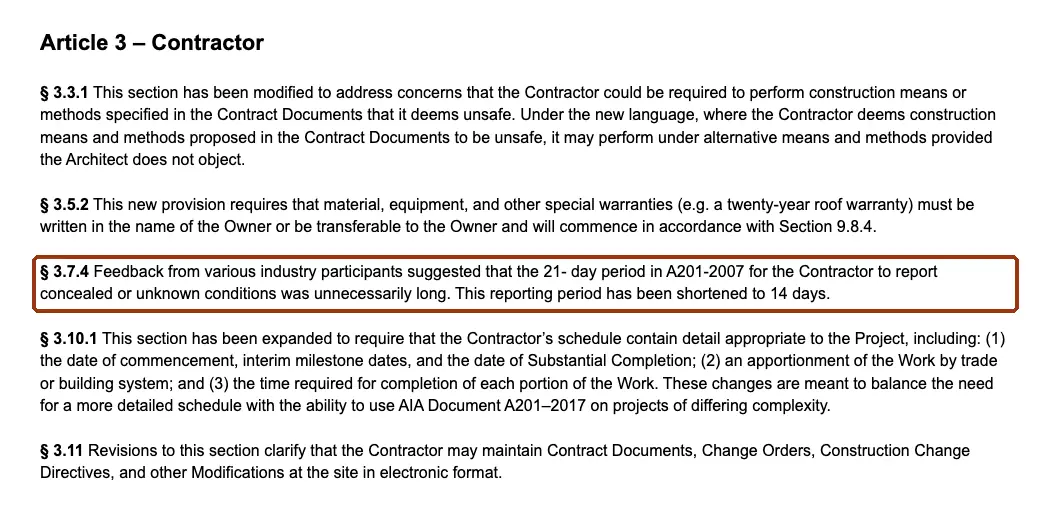
- Two deadlines cost the most when missed: a claim must be started within 21 days (§15.1.3.1), sent by certified or registered mail or courier with proof of delivery (§1.6.2), and concealed site conditions must be reported within 14 days (§3.7.4), down from 21 days in A201-2007 (A201-2017 standard form).
- Payment runs on 7-day clocks: the architect acts on a pay application within 7 days (§9.4.1), the contractor pays subcontractors within 7 days of being paid (§9.6.2), and a contractor still unpaid 7 days after the due date may stop work on 7 more days’ notice (§9.7).
- Coverage types and limits left A201 Article 11 in 2017: they now sit in Exhibit A to A101, A102 and A103, and Exhibit B to A133 (AIA exhibit FAQ).
- Read the owner’s version, not the blank form: in our section-by-section comparison, the University of Wisconsin System’s 2018 version changed 115 of 341 standard sections and deleted the §15.1.7 waiver of consequential damages, while Anderson County, Texas (2026) changed 6 (UW System copy, Anderson County copy).
- A201 sells for $179.99 for one-time use (AIA store, October 2026); AIA said in 2022 that the next update is due in 2027 (AIA).
What is AIA A201 and which agreements use it?
AIA A201-2017 is the general conditions document of the AIA Conventional, or design-bid-build, family. It is never signed on its own; how it fits with the rest of the A to G series is mapped in our guide to AIA contract documents. The owner-contractor agreement (A101-2017, A102-2017 or A103-2017) adopts it by reference, and the A401-2017 subcontract and B101-2017 owner-architect agreement incorporate it, according to the AIA summary of A201-2017.
The split is practical. The agreement holds the deal: parties, Contract Sum, dates, retainage percentage, the Initial Decision Maker and the choice of arbitration or litigation. A201 holds the procedures that run the job. The AIA store page lists A101, A102, A133 and A401 as the documents A201 “works best with”, and AIA’s Insurance and Bonds Exhibit FAQ confirms A133-2019 uses the same insurance exhibit structure (as Exhibit B). Our guide to construction management at risk and the A133 agreement covers the GMP side.
Four G-series forms carry out specific A201 sections: G701-2017 Change Order (§7.2), G714-2017 Construction Change Directive (§7.3), G702-1992 Application and Certificate for Payment (§9.3) and G704-2017 Certificate of Substantial Completion (§9.8.4). For sustainability terms, AIA lists E204-2017, Sustainable Projects Exhibit, for this family and E234-2019 for A133 projects. Where the contract fits in the project timeline is set out in the seven phases of the commercial construction process.
What do the 15 articles of A201-2017 cover?
The 15 articles of A201-2017 run from General Provisions (Article 1) to Claims and Disputes (Article 15), with 341 numbered sections in the standard form we parsed. Articles 7, 9 and 15 drive most day-to-day administration: changes, payment and claims. The table summarizes each article in our own words; the clause text is AIA copyright and is available from AIA Contract Documents.
| Article | Title | Sections | What it governs |
|---|---|---|---|
| 1 | General Provisions | §1.1 to §1.8 | What the Contract Documents are, how they are read together, ownership of drawings, notice rules (§1.6), digital data and BIM protocols |
| 2 | Owner | §2.1 to §2.5 | Owner’s information and services, evidence of financing (§2.2), the right to stop the Work (§2.4) and to carry it out after a default (§2.5) |
| 3 | Contractor | §3.1 to §3.18 | Review of documents and site, supervision, warranty (§3.5), permits and concealed conditions (§3.7), schedules, submittals, indemnification (§3.18) |
| 4 | Architect | §4.1 to §4.2 | The Architect’s role in administering the contract until the final Certificate for Payment (§4.2.1), site visits, submittal review |
| 5 | Subcontractors | §5.1 to §5.4 | Naming and objecting to subcontractors (§5.2), flow-down of terms (§5.3), contingent assignment to the Owner (§5.4) |
| 6 | Construction by Owner or by Separate Contractors | §6.1 to §6.3 | Owner’s own forces and separate prime contracts, coordination and mutual responsibility |
| 7 | Changes in the Work | §7.1 to §7.4 | Change Orders (§7.2), Construction Change Directives (§7.3), minor changes by the Architect (§7.4) |
| 8 | Time | §8.1 to §8.3 | Contract Time, calendar-day definition (§8.1.4), progress, delays and extensions (§8.3) |
| 9 | Payments and Completion | §9.1 to §9.10 | Schedule of values, applications and certificates, withholding, failure of payment (§9.7), Substantial Completion (§9.8), final payment |
| 10 | Protection of Persons and Property | §10.1 to §10.4 | Safety programs, hazardous materials (§10.3), emergencies (§10.4) |
| 11 | Insurance and Bonds | §11.1 to §11.5 | Framework only: who buys what (detail in the agreement’s exhibit), waivers of subrogation (§11.3), insured-loss settlement (§11.5) |
| 12 | Uncovering and Correction of Work | §12.1 to §12.3 | Uncovering work, the one-year correction period (§12.2.2), accepting nonconforming work |
| 13 | Miscellaneous Provisions | §13.1 to §13.5 | Governing law (§13.1), assignment, tests and inspections, interest on late payments (§13.5) |
| 14 | Termination or Suspension of the Contract | §14.1 to §14.4 | Termination by the Contractor, by the Owner for cause, suspension and termination for convenience (§14.4) |
| 15 | Claims and Disputes | §15.1 to §15.4 | Claim notice and time limits, consequential damages waiver (§15.1.7), Initial Decision Maker, mediation, arbitration |
Article 4 matters even though the Architect does not sign the owner-contractor contract: under §4.2.1 the Architect administers it and represents the Owner until the final Certificate for Payment, and under A101 §6.1 the Architect is the default Initial Decision Maker, the person who rules first on a claim before mediation.
What deadlines does AIA A201 set?
AIA A201 sets at least 15 hard deadlines, and §8.1.4 defines every “day” as a calendar day unless a clause says otherwise. The short clocks are the payment cycle (7 days), concealed conditions and subcontractor objections (14 days) and claim notice (21 days). The long ones are the one-year correction period and the 10-year outer limit on claims.
| Rule | Section | Deadline | Source |
|---|---|---|---|
| Architect acts on an Application for Payment | §9.4.1 | 7 days after receipt | A201-2017 form |
| Contractor pays each subcontractor | §9.6.2 | 7 days after receiving payment | A201-2017 form |
| Stop work for non-certification or non-payment | §9.7 | 7 days late, then 7 more days’ notice | A201-2017 form |
| Owner shows evidence of financing after start (on request) | §2.2.2 | 14 days | A201-2017 form |
| Notice of concealed or unknown conditions | §3.7.4 | Before disturbing, no later than 14 days | A201-2017 form |
| Architect objects to a proposed subcontractor | §5.2.1 | 14 days after receiving the names | A201-2017 form |
| Contractor objects to an insured-loss settlement | §11.5.2 | 14 days after notice | A201-2017 form |
| Notice that required insurance is cancelled or expiring | §11.1.4, §11.2.3 | 3 business days | A201-2017 form |
| Initiate a Claim | §15.1.3.1 | 21 days after the event or first recognition, whichever is later | A201-2017 form |
| Initial Decision Maker’s first action | §15.2.2 | 10 days after receipt | A201-2017 form |
| Claimant may skip a silent IDM | §15.2.1 | 30 days after referral | A201-2017 form |
| Demand that the other party file for mediation | §15.2.6.1 | 30 days after receiving the decision | A201-2017 form |
| Contractor may terminate after a stoppage | §14.1.1, §14.1.3 | 30 consecutive days, then 7 days’ notice | A201-2017 form |
| Correction of Work after Substantial Completion | §12.2.2.1 | 1 year | A201-2017 form |
| Outer limit for any Claim | §15.1.2 | 10 years after Substantial Completion | A201-2017 form |
Worked example: when can a contractor stop work for late payment?
Under §9.7, a contractor may stop work only after payment is 7 days late and a further 7 days’ written notice has run. With an application received on Thursday 1 October 2026 and a payment date of 2 November 2026 written into A101 §5.1.3, the earliest stop date is Monday 16 November 2026, 14 days after the due date.
| Step | Section | Date | Arithmetic |
|---|---|---|---|
| Architect receives the Application for Payment | §9.3 | Thu 1 Oct 2026 | Assumed start date |
| Architect must certify, part-certify or withhold | §9.4.1 | Thu 8 Oct 2026 | 1 Oct + 7 days |
| Owner payment due under the agreement | A101 §5.1.3 | Mon 2 Nov 2026 | Date the parties filled in (assumed) |
| Payment now late enough to trigger §9.7 | §9.7 | Mon 9 Nov 2026 | 2 Nov + 7 days |
| Earliest stop if the 7-day notice goes out that day | §9.7 | Mon 16 Nov 2026 | 9 Nov + 7 days |
| Contractor pays subcontractors once paid (say 20 Nov) | §9.6.2 | Fri 27 Nov 2026 | 20 Nov + 7 days |
The stop also extends the Contract Time and adds the contractor’s shutdown, delay and start-up costs plus interest (§9.7, with the rate from §13.5). State prompt-payment statutes can shorten these clocks on public work; the prompt payment and retainage rules by state list the statutory periods.
How does a claim move through Article 15?
A claim under A201-2017 Article 15 starts with written notice within 21 days (§15.1.3.1), goes to the Initial Decision Maker, then to mediation, then to arbitration or litigation. Mediation must happen before arbitration or litigation (§15.3.1). Work and payments continue while the claim is open (§15.1.4.1), apart from the §9.7 stop and Article 14 terminations.
- Notice: within 21 days after the event or after the claimant first recognizes the condition, whichever is later, to the other party and the Initial Decision Maker (§15.1.3.1). Delivery by certified or registered mail, or courier with proof of delivery (§1.6.2).
- Cost and time claims: give notice before doing the disputed work (§15.1.5); time claims include an estimate of cost and delay, and weather claims need data showing the weather was abnormal (§15.1.6.2).
- Initial Decision Maker: within 10 days of receipt, request data, reject, approve, suggest a compromise or say it cannot decide (§15.2.2); a party asked for data answers within 10 days (§15.2.4).
- Decision: in writing with reasons (§15.2.5). With no decision 30 days after referral, the claimant may go to mediation (§15.2.1).
- Mediation: either party may demand that the other file within 30 days of receiving the decision, and the other side then has 30 days to file (§15.2.6.1). The American Arbitration Association administers it unless agreed otherwise; fees are split equally (§15.3.2, §15.3.4).
- Binding resolution: arbitration under §15.4 or litigation, whichever box was checked in A101 §6.2. A demand to file comes 30 days after mediation ends or 60 days after it was demanded, and the recipient has 60 days (§15.3.3).
Weather is the most data-dependent claim. Section 15.1.6.2 asks for proof the conditions were abnormal for the period, and the weather workday index for 56 US metros shows the normal-year baseline from NOAA 1991 to 2020 records. If a claim involves a lien, §15.2.8 lets the claimant meet statutory lien deadlines regardless of Article 15; the mechanics lien deadlines by state give those dates.
What does the mutual waiver of consequential damages cover?
Section 15.1.7 is a mutual waiver: the Owner gives up claims for rental expenses, lost use, income, profit, financing, business and reputation, and lost management or employee productivity; the Contractor gives up principal-office expenses, lost financing, business and reputation, and lost profit other than profit on the Work itself. It applies to Article 14 terminations and does not block liquidated damages.
Owners and contractors negotiate this clause. David A. Senter of Maynard Nexsen (August 2020) lists three common edits: waiving only what insurance does not cover, carving out third-party claims, and capping consequential damages at a share of contract value, which he puts at typically 5% to 15% (Maynard Nexsen). Our comparison below found one of two public owners deleted §15.1.7 outright.
Arbitration or litigation?
A201 does not choose the forum by itself. A101-2017 §6.2 offers three boxes: arbitration under A201 §15.4, litigation, or other. If no box is checked, claims go to litigation in a court of competent jurisdiction, as the printed A101 text states (A101-2017 copy, Oakton Community College). If arbitration is chosen, §13.1 says the Federal Arbitration Act governs §15.4.
Where did the insurance terms go in A201-2017?
In A201-2017, Article 11 keeps only the insurance framework: licensed carriers, additional insureds, notice of lapses, waivers of subrogation and the Owner’s role as fiduciary for insured losses. Coverage types and dollar limits moved to the Insurance and Bonds exhibit of the owner-contractor agreement, according to the AIA summary and the AIA exhibit FAQ.
| Item | Where it sits in 2017 | Detail | Source |
|---|---|---|---|
| Coverage types and limits | Agreement exhibit, not A201 | Exhibit A to A101, A102, A103, A132 and A134; Exhibit B to A133 | AIA Insurance and Bonds Exhibit FAQ |
| Licensed insurers and sureties | A201 §11.1.1, §11.1.2 | Companies lawfully authorized in the project’s jurisdiction | A201-2017 form |
| Additional insureds | A201 §11.1.1 | Owner, Architect and the Architect’s consultants on the contractor’s CGL policy | A201-2017 form |
| Lapse in coverage | A201 §11.1.4, §11.2.3 | Notice within 3 business days; the other party may stop the Work | A201-2017 form |
| Owner skips property insurance | A201 §11.2.2 | Owner must tell the contractor in writing before work starts | A201-2017 form |
| Waivers of subrogation | A201 §11.3 | Mutual, to the extent losses are covered by property insurance | A201-2017 form |
| Insured-loss settlement | A201 §11.5 | Owner adjusts as fiduciary; contractor has 14 days to object | A201-2017 form |
Section 11.4 also has the Owner waive claims against the Contractor and Architect for loss of use of the Owner’s property due to fire or other hazards, however caused, whether or not the Owner buys loss-of-use insurance. Bond types and penal sums come from the Contract Documents under §11.1.2; the construction surety bond data covers how performance and payment bonds are priced and required. This page explains a standard form and is not legal or insurance advice; AIA itself recommends reviewing Article 11 and the exhibit with an insurance broker and counsel.
What do owners change in A201?
Owners change A201 through supplementary conditions or AIA’s Additions and Deletions process, and AIA publishes A503 as its guide for writing them. We compared two public-owner versions against the standard text, section by section: the University of Wisconsin System changed about a third of the sections, while Anderson County, Texas changed only forum, venue and governing law. Of the 33 standard sections the two owners deleted, 20 sit in Article 15.
| Provision | Standard A201-2017 | UW System (12/26/2018) | Anderson County, TX (2026) |
|---|---|---|---|
| §15.1.3.1 claim notice | 21 days | 21 days kept; adds a condition-precedent and waiver sentence | 21 days, unchanged |
| §1.6.2 how claim notice is delivered | Certified or registered mail, or courier with proof of delivery | Also allows electronic delivery with proof it was read | Unchanged |
| §3.7.4 concealed conditions | 14 days | 14 days, unchanged | 14 days, unchanged |
| §15.1.7 mutual waiver of consequential damages | Included | Deleted | Unchanged |
| §2.2 evidence of the Owner’s financing | Included | Deleted | Unchanged |
| §15.4 arbitration | Applies if chosen in A101 §6.2 | Deleted with §15.3.3 | Replaced: litigation in Anderson County |
| §13.1 governing law | Law of the project’s location; FAA governs arbitration | State of Wisconsin law | Anderson County, Texas named; FAA sentence dropped |
| Article 11 insurance | Framework plus agreement exhibit | Rewritten: insurer A.M. Best rating of at least B; owner builder’s risk at least the initial Contract Sum, replacement cost | Unchanged |
| §9.6.2 paying subcontractors | 7 days after payment | 7 calendar days, extended to every person who furnished goods or services | Unchanged |
The counts come from parsing each document into numbered sections and comparing the text of every section that appears in the standard form. The arithmetic is below; percentages are of the 341 standard sections.
| Measure | UW System 2018 | Anderson County 2026 | Arithmetic |
|---|---|---|---|
| Numbered sections in the standard form | 341 | 341 | Parsed from the AIA sample |
| Standard sections changed (text match below 97%) | 115 (33.7%) | 6 (1.8%) | 115 / 341; 6 / 341 |
| Standard sections deleted | 25 (7.3%) | 8 (2.3%) | 25 / 341; 8 / 341 |
| New sections the owner added | 156 | 0 | Section numbers absent from the standard form |
| Sections in the owner’s final version | 472 | 333 | 341 minus deleted plus added |
Two of Anderson County’s 6 changes (§1.7 and §1.8) drop a reference to E203-2013, which AIA later replaced, so they may reflect AIA’s own updated text rather than an owner edit. For bidders, the lesson is to read the owner’s version, not the form: a 21-day notice clause can carry new waiver language, as UW’s §15.1.3.1 does. That check belongs in comparing construction bids line by line and in the five checks for choosing a commercial contractor.
What changed from A201-2007, and is a 2027 edition coming?
The 2017 edition replaced A201-2007 with shorter notice for concealed conditions (21 to 14 days), formal delivery rules for claim notices, an insurance exhibit outside the general conditions and clearer dispute clocks. AIA still lists A201-2007 for sale, so check which edition a contract names; the AIA document list carries both.
| Section | A201-2007 | A201-2017 | Source |
|---|---|---|---|
| §3.7.4 concealed conditions notice | 21 days | 14 days | AIA summary |
| §1.6 notice | Notice rules sat in Article 13 | Moved to Article 1; claims notice by certified or registered mail or courier | AIA summary |
| Article 11 insurance | Detailed coverages in A201 | Moved to the agreement’s Insurance and Bonds exhibit | AIA summary |
| §14.4.3 termination for convenience | No fee fill point | Termination fee set in the agreement (A101 §7.1.1) | AIA A101 summary |
| §15.1.2 time limits on claims | In Article 13 | Moved to Article 15; 10-year outer limit | AIA summary |
| §15.2.6.1 mediation demand | Clock ran from the decision date (30 and 60 days) | Clock runs from receipt; 30 days each step | AIA summary |
| §15.3.3 demand to file binding resolution | No equivalent | New: 30 or 60 days, then 60 days to file | AIA summary |
Is there a 2027 edition of A201?
Not yet. AIA wrote in April 2022 that A201 “will be updated again in 2027” and that the update takes at least three years (AIA Contract Documents). As of October 2026, AIA’s current list shows A201-2017 as the latest edition, with no 2027 draft or release date published. The general conditions date back to 1911 (AIA history), and AIA says the ten-year cycle has run “on the sevens” since 1987.
Which form fits your project: A201 or something else?
A201-2017 fits design-bid-build and CM-at-risk projects that use A101, A102, A103 or A133. It does not fit construction manager as advisor projects, which use A232-2019, or small jobs where AIA points to A104-2017 or A105-2017. Use the table to match the situation to the form and the clause to check first.
| If | Then | Source |
|---|---|---|
| You sign a stipulated-sum agreement (A101-2017) | A201-2017 is your general conditions; fill in Exhibit A | AIA A101 summary |
| You pay cost of the work plus a fee with a GMP (A102-2017) | A201-2017 applies; the GMP terms sit in A102 | AIA A201 summary |
| You hire a construction manager at risk (A133-2019) | A201-2017 applies; insurance goes in Exhibit B; sustainability in E234-2019 | AIA exhibit FAQ |
| You use a construction manager as advisor | Use A232-2019, the CMa general conditions, not A201 | AIA document list |
| The project is small or of limited scope | AIA suggests A104-2017 or A105-2017, its abbreviated and short forms | AIA A201 summary |
| You want to change A201 terms | Write supplementary conditions; AIA’s guide is A503 | AIA document list |
| You leave A101 §6.2 blank | Claims go to litigation, not arbitration | A101-2017 text (Oakton copy) |
| A concealed condition turns up | Notice before disturbing it, and within 14 days (§3.7.4) | A201-2017 form |
Design-build, where one entity holds design and construction, uses AIA’s separate A141 family rather than A201; the trade-offs are laid out in design-build vs design-bid-build compared.
The agreement side of the pair, including the §5.1.3 payment dates and the §6.2 dispute box, is set out in our guide to the AIA A101 agreement.
How we compiled this
We read the AIA A201-2017 standard form as reproduced in a City of Rochester, NH bid package (sample PDF), 7 AIA Contract Documents pages and 3 public-owner contract copies, all accessed in October 2026. We parsed the standard form and the UW System and Anderson County versions into numbered sections and compared them with a text-similarity script, then read every flagged key section by hand. On October 26, 2026 we re-read §3.7.4, §9.3.1 to §9.7, §15.1.2 and §15.1.3.1 in the posted form and re-checked the store price. We excluded one 2018 draft whose extracted text mixed deleted and inserted words, and we did not use law-firm commentary for any section fact. This is not legal advice.
Frequently asked questions
What is the difference between AIA A101 and A201?
A101-2017 is the signed agreement: parties, Contract Sum, dates, retainage, the Initial Decision Maker, the arbitration or litigation choice and any termination fee. A201-2017 is the general conditions: the procedures for changes, payment, claims, insurance and termination. A101 adopts A201 by specific reference, so a stipulated-sum contract normally needs both documents plus Exhibit A for insurance and bonds.
Is AIA A201 free to download?
No. AIA Contract Documents sells A201 at $179.99 per document for one-time use, as listed on its store page on October 26, 2026. Copies on public bid sites are licensed project copies, often with owner edits, so they show one owner’s version rather than the standard form. AIA’s free help-center summary explains the 2017 changes section by section.
What is the 21-day rule in A201?
Section 15.1.3.1 of A201-2017 requires a claim to be started within 21 calendar days after the event, or after the claimant first recognizes the condition, whichever is later. The rule covers claims found before the one-year correction period ends. Notice goes to the other party and the Initial Decision Maker by certified or registered mail, or courier with proof of delivery.
Can a claim notice under A201 be sent by email?
Not under the standard 2017 text. Section 1.6.2 says notice of a claim counts as served only by certified or registered mail, or by courier providing proof of delivery. Email works for other notices only if the agreement sets an electronic method (§1.6.1). Owners can change this: the University of Wisconsin System’s 2018 version also accepts electronic notice with proof it was read.
Does A201 apply to construction manager projects?
Only for one of the two AIA construction manager models. For a construction manager as constructor, or CM at risk, A133-2019 adopts A201-2017, with insurance in Exhibit B and sustainability terms in E234-2019. For a construction manager as advisor, AIA publishes separate general conditions, A232-2019, so A201 is not the right document.
Is there an AIA A201-2027?
Not as of October 2026. AIA said in April 2022 that A201 would be updated again in 2027 and that the process takes at least three years, but its current document list still shows A201-2017 as the latest edition. Contracts signed now use A201-2017 or, less often, A201-2007, which AIA still sells.
Sources
- AIA Contract Documents, Summary: A201-2017, General Conditions of the Contract for Construction, accessed 19 October 2026.
- The American Institute of Architects / City of Rochester, NH, AIA Document A201-2017 standard form (sample, City of Rochester, NH bid attachment 3), accessed 19 October 2026.
- AIA Contract Documents, Summary: A101-2017, Owner and Contractor, Stipulated Sum, accessed 19 October 2026.
- AIA Contract Documents, FAQs: Insurance and Bonds Exhibit, accessed 19 October 2026.
- AIA Contract Documents, List of All Current AIA Contract Documents, accessed 19 October 2026.
- AIA Contract Documents, A201: General Conditions of the Contract for Construction (store page), accessed 19 October 2026.
- AIA Contract Documents, Five Things You Didn’t Know About AIA Contract Documents (19 April 2022), accessed 19 October 2026.
- AIA Contract Documents, The History of AIA Contract Documents, accessed 19 October 2026.
- University of Wisconsin System, A201-2017 as modified, dated 12/26/2018, accessed 19 October 2026.
- Anderson County, Texas, A201-2017 General Conditions, Anderson County AgriLife Facility (2026 bids), accessed 19 October 2026.
- Oakton Community College, A101-2017 Standard Form of Agreement (bid copy), accessed 19 October 2026.
- Maynard Nexsen (David A. Senter), Consequential Damages in Construction: The Silent Killer (10 August 2020), accessed 19 October 2026.