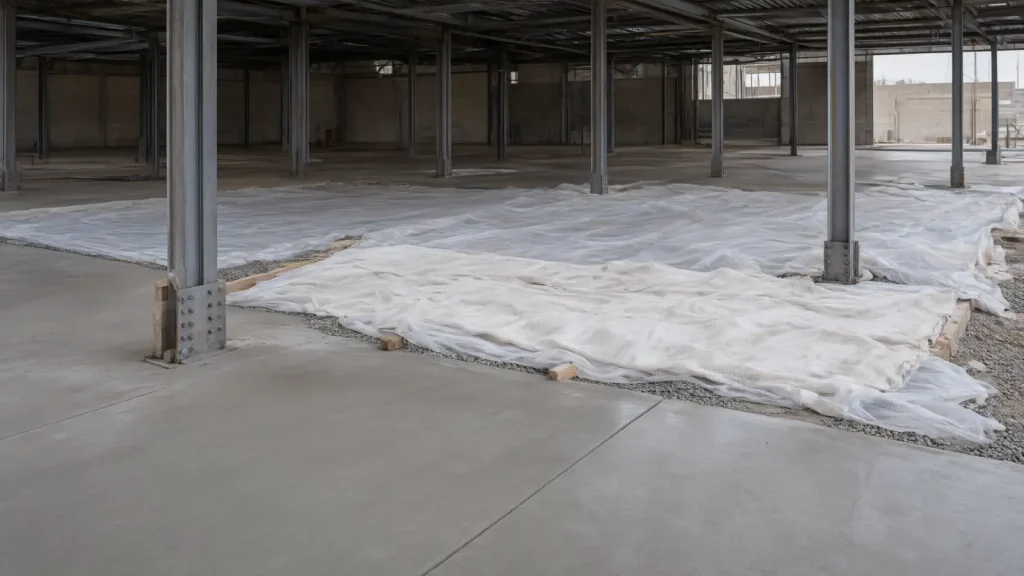
Concrete curing time on a commercial job is 7 days of protected curing under ACI 301 (3 days with high-early-strength cement), and the concrete reaches its specified design strength at 28 days.
Walking, stripping forms, driving, loading and laying flooring each have their own gate, and only some are fixed in days. The rest are strength or moisture tests, listed below with the spec section behind each one.
Key takeaways
- The default curing period is 7 days after placement, or 3 days for high-early-strength (Type III) concrete, per ACI 301 as summarized by the FHWA curing guide (FHWA-HRT-05-038).
- Curing may stop early once field-cured cylinders reach 70 percent of the specified strength (f’c), the threshold in both ACI 301 and ACI 308.1 (FHWA-HRT-05-038, 2006).
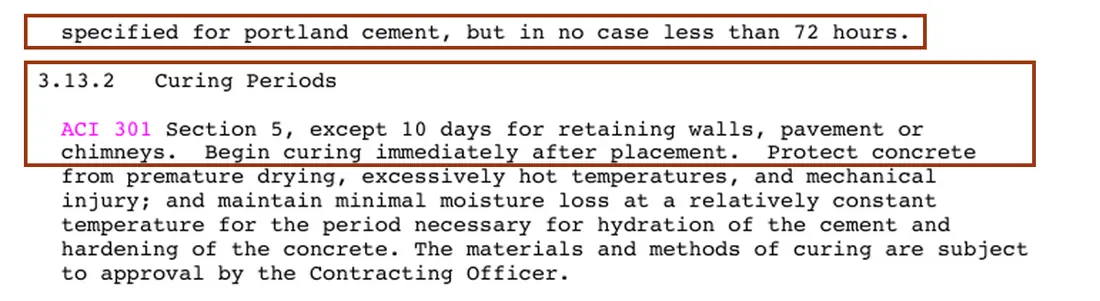
- Federal jobs cure longer: UFGS 03 30 00 section 3.13.2 requires 10 days for retaining walls, pavement and chimneys, and never less than 72 hours with Type III cement (Change 10, August 2025).
- On the ACI 209R-92 strength model (constants as published by WSDOT), moist-cured Type I concrete is at 46 percent of its 28-day strength on day 3 and 70 percent on day 7.
- Forms under slabs and beams stay until 75 percent of design strength under SCDOT specification 702.4.5 (July 2021), while exposed wall forms may come off after 5 hours.
- Flooring waits for a moisture test, not a date: the University of Houston resilient tile spec 09 65 19 requires 75 percent relative humidity or lower by ASTM F2170.
How long does concrete take to cure?
Concrete curing time is 7 days for ordinary portland cement concrete and 3 days for high-early-strength concrete under ACI 301, the standard most commercial specifications cite. Curing means keeping the concrete moist and warm so the cement keeps hydrating. It is not drying. Strength keeps rising after curing stops, and 28 days is the age at which the specified strength is tested.
ACI 301 lets the contractor end curing early when any one of three tests passes: field-cured cylinders at 70 percent of f’c, a temperature of 50°F (10°C) or higher held long enough for lab-cured cylinders to reach 85 percent of f’c, or in-place strength at f’c by an accepted nondestructive method (FHWA-HRT-05-038 summary of ACI 301-96, section 5.3.6).
| Item | Number | Source |
|---|---|---|
| Standard curing period, portland cement | 7 days after placement | ACI 301, via FHWA-HRT-05-038 |
| High-early-strength (Type III) cement | 3 days | ACI 301 and ACI 308-92, via FHWA-HRT-05-038 |
| Type II cement (ACI 308-92 recommendation) | 14 days | ACI 308-92 section 2.10, via FHWA-HRT-05-038 |
| Early end of curing | 70% of f’c in field-cured cylinders | ACI 301 and ACI 308.1, via FHWA-HRT-05-038 |
| Federal retaining walls, pavement, chimneys | 10 days | UFGS 03 30 00 3.13.2 |
| Federal Type III minimum | One-fourth of the portland cement period, never under 72 hours | UFGS 03 30 00 3.13.1 |
| Cylinder test ages on federal work | 7 and 28 days | UFGS 03 30 00 field quality control |
Is setting the same as curing?
No. Setting is the change from plastic to hard in the first hours; curing is the protection period that follows, 7 days by default under ACI 301. ACI 308-92 notes that hydration continues down to 14°F (minus 10°C) but treats 50°F (10°C) as the practical lower limit for curing, which is why cold weather stretches every date on this page (FHWA-HRT-05-038).
How strong is concrete at 3, 7 and 28 days?
Moist-cured concrete made with Type I cement reaches about 46 percent of its 28-day strength at 3 days, 70 percent at 7 days and 88 percent at 14 days on the ACI 209R-92 time-strength model. Type III cement gets to 59 percent at 3 days and 80 percent at 7 days. Your mix design and cylinder breaks replace these model values on a real job.
The model is ACI 209R-92 Equation 2-1: strength at age t equals the 28-day strength times t divided by (a + b times t), with a = 4.0 and b = 0.85 for moist-cured Type I and a = 2.3 and b = 0.92 for moist-cured Type III, from ACI 209R-92 Table 2.2.1 as listed in the WSDOT PGSuper 8.0 documentation. CB&C computed each value below from those constants.
| Age | Type I, moist cured (% of 28-day) | Type III, moist cured (% of 28-day) | 4,000 psi Type I mix (psi) |
|---|---|---|---|
| 1 day | 20.6 | 31.1 | 824 |
| 3 days | 45.8 | 59.3 | 1,832 |
| 7 days | 70.4 | 80.1 | 2,816 |
| 14 days | 88.1 | 92.2 | 3,524 |
| 28 days | 100.7 | 99.8 | 4,028 |
| 56 days | 108.5 | 104.1 | 4,340 |
| 90 days | 111.8 | 105.8 | 4,472 |
The 7-day row explains the default curing period: on this model, Type I concrete crosses the 70 percent early-termination line at 6.9 days, and Type III crosses it at 4.5 days. Which strength class to specify is a separate decision from curing time; this page uses 4,000 psi only as an example.
When can you walk, drive, strip forms and load new concrete?
Foot traffic for inspection is allowed after 24 hours and vehicles stay off membrane-cured paving for at least 72 hours under UFGS 32 13 13.06 section 3.6.4. Exposed wall forms can come off after 5 hours, column forms after 24 hours, and forms under slabs and beams only at 75 percent of design strength under SCDOT 702.4.5.
| Activity | Earliest point | What actually controls it | Source |
|---|---|---|---|
| Strip exposed vertical wall forms | 5 hours; no later than 48 hours | Removal without damaging edges and faces | SCDOT 702.4.5, item 1 |
| Strip column and pier forms | 24 hours | Fixed time in the spec | SCDOT 702.4.5, item 1 |
| Walk on a membrane-cured slab or paving | 24 hours, for inspection | Protect the curing film; repair any damage | UFGS 32 13 13.06, 3.6.4 |
| Vehicles on membrane-cured paving | Not before 72 hours | Protection of the curing film; design loads wait for strength | UFGS 32 13 13.06, 3.6.4 |
| Remove forms and shores under slabs, beams, caps | 75% of design strength | Test cylinders cured beside the member | SCDOT 702.4.5, item 2 |
| Remove any forms or shores (except slab on grade) | When strength supports its weight and loads | Plans and specs, or an ASTM strength test | OSHA 29 CFR 1926.703(e)(1) |
| Remove reshores | When supported concrete carries all loads | Adequate strength | OSHA 29 CFR 1926.703(e)(2) |
| Full design load | 28 days | Specified f’c confirmed by cylinder breaks | UFGS 03 30 00 test ages |
Why are some gates days and others strength?
Federal safety law sets no day count for shoring. OSHA 29 CFR 1926.703(e)(1) bars removing forms and shores, except for slabs on grade and slip forms, until the employer determines the concrete can carry its own weight and superimposed loads, either by following the plans and specifications or by an ASTM compressive strength test. On a suspended deck, ask the engineer of record for the stripping strength in psi and how it will be verified.
UFGS 03 30 00 section 3.3.10 lists the accepted ways to prove that strength: field-cured cylinders under ASTM C31 and C39, cast-in-place cylinders under ASTM C873 for slabs 5 to 12 inches deep, or penetration resistance under ASTM C803. ACI 301 also accepts the maturity method of ASTM C1074, which estimates strength from the temperature history logged inside the pour.
When can flooring go on a new concrete slab?
Flooring goes down only after the slab passes a moisture test, not after a set number of curing days. The University of Houston resilient tile master spec 09 65 19 requires in-slab relative humidity of 75 percent or lower by ASTM F2170, or a vapor emission rate of 3 lb per 1,000 sq ft in 24 hours or lower by ASTM F1869, before installation.
| Test | What it measures | Pass limit in the spec | Source |
|---|---|---|---|
| ASTM F2170 | Relative humidity inside the slab with in situ probes | 75% RH maximum | University of Houston spec 09 65 19 |
| ASTM F1869 | Moisture vapor emission with calcium chloride domes | 3 lb per 1,000 sq ft per 24 hours | University of Houston spec 09 65 19 |
| Federal default | F1869 or F2170, unless the flooring maker says otherwise | Flooring maker’s limit | UFGS 09 65 00 3.3 (November 2024) |
The curing method matters too. UFGS 03 30 00 section 3.13.4 requires moisture-retaining cover curing, not a membrane compound, on slabs that will get a liquid hardener or finish flooring, because section 3.13 bars curing compound where coverings will be bonded. Name the curing method in the concrete submittal so the flooring contractor is not left grinding off compound. Our guide to commercial kitchen flooring covers the floor systems most sensitive to slab moisture.
How do cold and hot weather change concrete curing time?
Below 40°F ambient, federal specs require approval before placing and heat to keep the concrete at 50°F or warmer while it cures. Above 80°F, wind breaks, shade and fog spray must be ready before the pour, and concrete must arrive at 95°F or cooler under UFGS 03 30 00 sections 3.7.3, 3.7.4, 3.13.5 and 2.5.2.5.
| Condition | Rule | Source |
|---|---|---|
| Air below 40°F, or freezing likely within 24 hours | Approval before placing; cover and heat to 50°F minimum while curing | UFGS 03 30 00, 3.7.3 |
| Cooling after heat comes off | No more than 5°F per hour and 18°F per 24 hours | UFGS 03 30 00, 3.7.3 |
| Air at 41°F or below | Concrete at 55°F minimum for the curing period (45°F if timed by maturity) | UFGS 03 30 00, 3.13.5 |
| Minimum concrete temperature by section size | 50°F to 55°F (10°C to 13°C) | ACI 301-96, via FHWA-HRT-05-038 |
| Air at 80°F or above | Wind breaks, shade, fog spray or wet light-colored covers arranged before placing | UFGS 03 30 00, 3.13.5 |
| Evaporation limit | 0.2 lb of water per sq ft per hour (1 kg per sq m per hour) | UFGS 03 30 00, 3.7.4, using ACI 305R Figure 4.2 |
| Concrete temperature as delivered | 95°F maximum (default) | UFGS 03 30 00, 2.5.2.5 |
| Sheet color | Dark sheets below 59°F (15°C); white sheets when daily highs pass 86°F (30°C) | ACI 308.1-98, via FHWA-HRT-05-038 |
Read the federal spec with care: section 3.7.3 sets a 50°F floor and an 18°F per 24 hour cooling limit, while section 3.13.5 sets a 55°F floor and a 49°F per 24 hour limit. On a project using UFGS 03 30 00, submit an RFI asking which paragraph governs before the first cold pour. For how many days a year cold or heat stops work in each metro, see our construction weather days by city research.
How does concrete curing time affect a commercial construction schedule?
On suspended concrete decks the shoring removal gate, not the 7-day curing period, usually sets the floor-to-floor cycle. Using the ACI 209R-92 model and the 75 percent rule in SCDOT 702.4.5, Type I concrete reaches the stripping strength at 8.3 days and Type III at 5.6 days, a difference of about 2.7 days per deck.
| Step | Type I, moist cured | Type III, moist cured | Basis |
|---|---|---|---|
| Stripping strength target | 75% of f’c | 75% of f’c | SCDOT 702.4.5, item 2 |
| Model age at 75%: t = 0.75a / (1 − 0.75b) | 0.75 x 4.0 / (1 − 0.6375) = 8.3 days | 0.75 x 2.3 / (1 − 0.69) = 5.6 days | ACI 209R-92 Table 2.2.1 constants |
| Rounded to the next workday | Day 9 | Day 6 | CB&C arithmetic |
| Saving per deck | Baseline | 3 days | 9 − 6 |
| Four decks (floors 2 to 4 plus roof) | Baseline | 12 days if shoring is on the critical path | 4 x 3 |
| Minimum curing, federal spec | 7 days (ACI 301) | 72 hours (7 days x 1/4 = 1.75 days, so the 72 hour floor governs) | UFGS 03 30 00, 3.13.1 |
The arithmetic is a planning estimate at moist-cured lab conditions. A November pour that sits near 50°F gains strength more slowly, so the schedule should show stripping as a test-driven milestone, with field-cured cylinders or maturity sensors as the trigger. Build these gates into the baseline in your construction schedule, and price heated enclosures and blankets as a line in the general conditions for winter pours.
Slabs on grade follow a different path: no shoring, so the critical gates are the 7-day curing period, sawcut joints and the flooring moisture test. Slab thickness, reinforcement and joint costs are priced in our guide to concrete slab cost per square foot.
What do common curing time claims get wrong?
Four claims repeat across top-ranking guides checked in November 2026, and the primary specifications state each one differently or more narrowly. The table pairs the common wording with the rule in ACI 301, ACI 209R-92, SCDOT 702.4.5, UFGS 32 13 13.06 and OSHA 29 CFR 1926.703.
| Common claim | What the primary source says | Source |
|---|---|---|
| “Concrete reaches about 90% of its strength at 28 days.” | The specified strength f’c is defined at 28 days, so a passing mix is at about 100% then; the ACI 209R-92 model gives 100.7% for Type I | UFGS 03 30 00 test ages; ACI 209R-92 constants via WSDOT |
| “Forms can come off in 24 to 48 hours.” | True for exposed vertical faces (5 to 48 hours) and columns (24 hours); forms under slabs and beams wait for 75% of design strength | SCDOT 702.4.5; OSHA 29 CFR 1926.703(e) |
| “You can drive on it after 7 days.” | The federal pavement spec sets a 72 hour minimum to protect the curing film; truck and forklift loads should wait for the strength the engineer names | UFGS 32 13 13.06, 3.6.4 |
| “Concrete is cured once it looks dry.” | Curing ends at 7 days or 70% of f’c; readiness for flooring is a separate RH test at 75% or lower | ACI 301 via FHWA-HRT-05-038; UH spec 09 65 19 |
What should you require for each pour?
Match the gate to the element: a fixed curing period for every pour, a strength test for anything that carries load before 28 days, and a moisture test for anything that receives flooring. The decision table turns the rules above into instructions an owner or builder can put in the concrete specification or a pre-pour meeting agenda.
| If | Then | Source |
|---|---|---|
| Ordinary portland cement mix, air above 50°F | Cure 7 days, or until field-cured cylinders reach 70% of f’c | ACI 301, ACI 308.1 |
| Type III (high-early) cement | Cure 3 days under ACI 301; 72 hours minimum on federal work | ACI 301; UFGS 03 30 00, 3.13.1 |
| Federal retaining wall, pavement or chimney | Cure 10 days | UFGS 03 30 00, 3.13.2 |
| Suspended slab or beam on shores | Strip at the engineer’s stripping strength, 75% of f’c in the SCDOT spec, proven by field-cured cylinders | SCDOT 702.4.5; OSHA 1926.703(e) |
| Slab receiving resilient flooring or a coating | Cover-cure, no membrane compound; install at 75% RH or lower by ASTM F2170 | UFGS 03 30 00, 3.13.4; UH spec 09 65 19 |
| Air at or below 40°F, or freezing within 24 hours | Get approval, enclose and heat to 50°F or more, and limit cooling to 5°F per hour | UFGS 03 30 00, 3.7.3 |
| Air at 80°F or above, or evaporation near 0.2 lb per sq ft per hour | Shade, wind breaks and fog spray in place before the pour; reject concrete above 95°F | UFGS 03 30 00, 3.7.4 and 3.13.5 |
| Tilt-up panels | Lift at the strength the drawings set for lifting, verified by test | Engineer of record |
For tilt-up work, the lift strength and bracing rules are in our guide to tilt-up construction. Ask for the curing method, stripping strength and test plan as part of the concrete submittals, so the schedule and the spec agree before the first pour.
The strength being measured during curing is the class chosen in our concrete psi guide.
Water added on site to raise slump also slows strength gain, as our concrete slump test guide explains with the 1 gallon per inch rule.
How we compiled this
CB&C compiled this page in November 2026 from nine primary documents: three Unified Facilities Guide Specifications (03 30 00, 32 13 13.06 and 09 65 00), the FHWA curing guide FHWA-HRT-05-038, the ACI 209R-92 constants as published by WSDOT, OSHA 29 CFR 1926.703, SCDOT supplemental specification 702.4.5, the University of Houston master spec 09 65 19 and the ASTM F2170 summary page. The ACI 301, 305, 306 and 308 standards themselves are paywalled, so their rules are cited through the FHWA and UFGS documents that quote them; check the edition your project specifies. Strength percentages are model values computed by CB&C, not test results.
Frequently asked questions
How long after pouring concrete can you walk on it?
Light foot traffic for inspection is allowed after 24 hours under UFGS 32 13 13.06 section 3.6.4, provided nobody scuffs the curing compound. Keep tools, carts and stored material off the slab until the 7-day curing period in ACI 301 ends, and repair any damage to the curing film the same day so the surface does not dry out.
How long before you can drive on new concrete?
The federal pavement spec, UFGS 32 13 13.06 section 3.6.4, keeps vehicles off membrane-cured concrete for at least 72 hours. That is a protection minimum, not a load rating. For delivery trucks, forklifts or loaded lifts, wait until cylinder tests show the strength the engineer names, which for a Type I mix the ACI 209R-92 model puts at 70 percent of f’c around day 7.
Is concrete fully cured after 28 days?
Concrete reaches its specified strength at 28 days, which is why UFGS 03 30 00 tests acceptance cylinders at that age. It keeps gaining strength afterward: the ACI 209R-92 model for moist-cured Type I concrete gives about 108 percent of the 28-day value at 56 days and 112 percent at 90 days. The protected curing period itself is usually only 7 days.
Does concrete cure faster in hot weather?
Heat speeds early strength gain but raises the risk of drying and cracking. UFGS 03 30 00 requires shade, wind breaks and fog spray when air reaches 80 degrees F, caps delivered concrete at 95 degrees F, and keeps evaporation under 0.2 lb per sq ft per hour. The curing period does not shorten; it still runs 7 days or until 70 percent of f’c.
Can concrete cure in freezing weather?
Only if it is protected. UFGS 03 30 00 section 3.7.3 requires approval to place concrete below 40 degrees F, then covers and heat that hold it at 50 degrees F or warmer while it cures, with cooling limited to 5 degrees F per hour. ACI 308-92 treats 50 degrees F as the practical lower limit for curing, so unheated concrete in the cold gains strength slowly.
How long should a slab cure before flooring is installed?
No spec sets a day count. The slab must pass a moisture test: the University of Houston master spec 09 65 19 requires 75 percent relative humidity or lower by ASTM F2170, or 3 lb per 1,000 sq ft per 24 hours by ASTM F1869. Cure with covers rather than a membrane compound under bonded flooring, as UFGS 03 30 00 section 3.13.4 requires.
Sources
- Guide for Curing Portland Cement Concrete Pavements, Volume II, Appendix A (FHWA-HRT-05-038), Federal Highway Administration, August 2006, accessed November 8, 2026.
- UFGS 03 30 00 Cast-in-Place Concrete, USACE, NAVFAC and AFCEC, February 2019, Change 10 August 2025, accessed November 8, 2026.
- UFGS 32 13 13.06 Portland Cement Concrete Pavement for Roads and Site Facilities, May 2020, accessed November 8, 2026.
- UFGS 09 65 00 Resilient Flooring, November 2024, accessed November 8, 2026.
- PGSuper 8.0 time-dependent material models (ACI 209R-92 Table 2.2.1 constants), Washington State DOT, accessed November 8, 2026.
- 29 CFR 1926.703 Requirements for cast-in-place concrete, eCFR, accessed November 8, 2026.
- Supplemental Specification: Removal of Falsework and Forms, 702.4.5, South Carolina DOT, July 1, 2021, accessed November 8, 2026.
- Master Specification 09 65 19 Resilient Tile Flooring, University of Houston Facilities Planning and Construction, accessed November 8, 2026.
- ASTM F2170-19a Relative Humidity in Concrete Floor Slabs Using in situ Probes, ASTM International, accessed November 8, 2026.