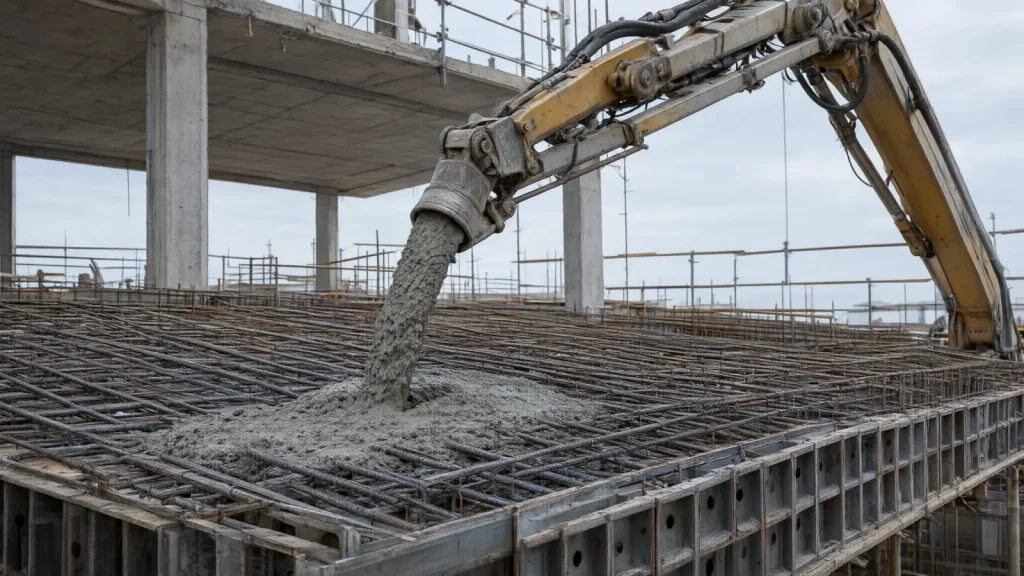
Concrete psi is the compressive strength a mix must reach at 28 days, written f’c. Building codes set a 2,500 psi floor, commercial structures typically use 4,000 psi or more, and deicing salts push the minimum to 5,000 psi.
Key takeaways
- The NRMCA Concrete in Practice sheet CIP 35 puts residential concrete at about 2,500 psi and commercial structures at 4,000 psi and higher, with some applications above 10,000 psi.
- The durability tables in the federal guide spec UFGS 03 30 00, which follow ACI 318 Chapter 19, set a 2,500 psi minimum with no exposure, 3,500 to 5,000 psi for freeze-thaw classes F1 to F3, 4,000 to 4,500 psi for sulfate classes S1 to S3 and 5,000 psi for chloride class C2.
- Higher psi costs little per yard: a Tioga County, New York bid opened January 15, 2026 priced delivered ready-mix at $161 for 2,000 psi up to $173 for 5,000 psi from the low bidder, a flat $2 per 500 psi step.
- Concrete passes when the average of 3 consecutive strength tests meets f’c and no single test falls more than 500 psi below it (10 percent above 5,000 psi), per NRMCA CIP 35 summarizing ACI 318.
- Strength carries a carbon cap on state work: New York’s Buy Clean concrete guidelines allow 360 kg CO2e per cubic yard for 3,001 to 4,000 psi mixes and 434 for 4,001 to 5,000 psi, 21 percent more.
What does concrete psi mean?
Concrete psi is pounds per square inch of compressive strength: the load that breaks a standard cylinder divided by its cross-section area. The number on the drawings is the specified strength, f’c, almost always measured at 28 days. A 4,000 psi mix must test at 4,000 psi on cylinders made under ASTM C31 and broken under ASTM C39.
The ready-mix producer designs the batch to average higher than f’c, a target called f’cr, so that few tests fall short. NRMCA CIP 35 states that with this margin the chance of a single test falling below f’c is about 10 percent, and the chance of failing the acceptance criteria is about 1 percent.
| Number | Value | What it governs | Source |
|---|---|---|---|
| Minimum f’c, no exposure (F0, S0, W0, C0) | 2,500 psi | Floor for structural concrete | UFGS 03 30 00, 2.5.2 |
| Nonstructural concrete, class F0 / F1 / F2 and F3 | 2,500 / 3,000 / 3,500 psi | Flatwork that carries no structural load | IBC 2021 Sec. 1904.2 |
| R-2 and R-3 walls exposed to weather, 3 stories or less | 3,000 psi | Residential exception, shown for contrast | IBC 2021 Sec. 1904.1 |
| Typical commercial structures | 4,000 psi and higher | Industry description, not a code rule | NRMCA CIP 35 |
| High-strength concrete | 8,000 psi or more | Definition used for carbon limits | NYS Buy Clean guidelines |
| Test age | 28 days (7, 56 or 90 if specified) | Age at which f’c is judged | UFGS 03 30 00, 2.5.1 note |
| Single test shortfall allowed | 500 psi (0.10 f’c above 5,000 psi) | Acceptance of delivered concrete | NRMCA CIP 35 |
Which concrete psi does each commercial element use?
The structural engineer sets f’c for each element from load and exposure, and the higher of the two governs. UFGS 03 30 00 lists footings, columns and walls, beams and suspended slabs, slabs-on-ground, lightweight suspended slabs and toppings as separate rows, each with its own f’c, test age and exposure classes, with 3,000 and 5,000 psi as placeholder values the designer edits.
| Element | Rule that sets the floor | Minimum by rule | What pushes it higher | Source |
|---|---|---|---|---|
| Interior slab-on-ground, warehouse or retail | IBC 1901.2 exempts non-structural slabs except Sec. 1904 and 1907; 1907.1 sets 3 1/2 in thickness | 2,500 psi (F0 nonstructural) | Forklift traffic and wear; UFGS suggests at least 1,800 psi at 3 days if construction traffic runs early | IBC 2021 Ch. 19; UFGS 03 30 00 |
| Exterior apron, sidewalk or dumpster pad, cold climate | IBC 1904.2 by freeze-thaw class | 3,000 psi (F1) to 3,500 psi (F2, F3) | Structural load or reinforcement puts it under ACI 318: 4,500 to 5,000 psi | IBC 2021 Sec. 1904.2 |
| Footings and foundation walls | ACI 318 durability via IBC 1904.1 | 2,500 psi with no exposure | Sulfate soil in the geotechnical report: 4,000 to 4,500 psi | UFGS 03 30 00, 2.5.2.4 |
| Columns, beams, suspended slabs | Structural design under ACI 318 | 2,500 psi | Load; the engineer’s calculations set f’c | UFGS 03 30 00, 2.5.1 |
| Parking deck or salted ramp with rebar | ACI 318 classes F3 and C2 | 5,000 psi, w/cm 0.40 | Prestressed members: chloride limit 0.06 percent | UFGS 03 30 00, 2.5.2.2 and 2.5.2.3 |
| Tank, pit or basement wall in contact with water | ACI 318 class W1 or W2 | 4,000 psi, w/cm 0.50 | Freeze-thaw or chlorides on the same wall | UFGS 03 30 00, 2.5.2.6 |
| Precast, tilt-up and prestressed members | Structural design | Set by engineer | Lifting stresses; Colorado DOT girders use 8,500 psi | CDOT 2023 Table 601-1 |
For a tilt-up building, the panel f’c and the strength required before lifting both belong on the construction documents, a point covered in our guide to tilt-up construction. For a warehouse floor, the slab thickness, joints and flatness usually drive cost more than the psi; see our warehouse construction guide.
What minimum psi do ACI 318 exposure classes require?
ACI 318 assigns every member an exposure class in four categories: F for freezing and thawing, S for sulfate, W for water contact and C for corrosion of reinforcement. Each class carries a maximum water-cementitious ratio (w/cm) and a minimum f’c from 2,500 to 5,000 psi. The IBC adopts these by reference in Section 1904.1, so they bind private commercial buildings too.
| Exposure class | Condition | Max w/cm | Min f’c | Other requirement |
|---|---|---|---|---|
| F0 | No freezing and thawing | N/A | 2,500 psi | None |
| F1 | Freeze-thaw, limited water | 0.55 | 3,500 psi | Air entrained, 3.5 to 6.0 percent by aggregate size |
| F2 | Freeze-thaw, frequent water | 0.45 | 4,500 psi | Air entrained, 5.0 to 7.5 percent |
| F3 | F2 plus deicing chemicals | 0.40 | 5,000 psi (4,500 plain concrete) | Fly ash at most 25 percent, slag 50 percent, silica fume 10 percent |
| S1 / S2 / S3 | Sulfates in soil or water, rising severity | 0.50 / 0.45 / 0.45 or 0.40 | 4,000 / 4,500 / 4,500 or 5,000 psi | Type II, V or V plus pozzolan or slag cement |
| W1 / W2 | In contact with water, low permeability needed | 0.50 | 4,000 psi | None |
| C1 / C2 | Reinforced, moisture / moisture plus chlorides | N/A / 0.40 | 2,500 / 5,000 psi | Chloride ion at most 0.30 / 0.15 percent of cement |
Values above are as printed in UFGS 03 30 00 (February 2019 edition, references updated July 2026), whose notes direct designers to Chapter 19 of ACI 318 for the class definitions. Editions of ACI 318 differ in some W-class values, so ask the engineer of record which edition the local code adopts; the 2021 IBC references ACI 318-19. Sulfate classes come from the water-soluble sulfate test in the geotechnical report.
What does the building code require for concrete strength?
The International Building Code (IBC) Chapter 19 sends structural concrete to ACI 318 and adds three commercial rules. Section 1904.1 requires ACI 318 durability, Section 1904.2 sets 2,500 to 3,500 psi for nonstructural concrete by freeze-thaw class, and Section 1907.1 sets a 3 1/2 inch minimum slab on ground with a 6-mil vapor retarder.
The text below matches the 2021 IBC as printed in the 2021 Seattle Building Code Chapter 19 and the 2025 California Building Code Section 1904. Local amendments change the details: Seattle’s Code Alternate CA1904.2 accepts five-sack 2,000 psi and five-and-a-half-sack 2,500 psi mixes where 3,000 psi is required, with air entrainment not required for durability.
| Section (2021 IBC) | Rule | Number | Applies to |
|---|---|---|---|
| 1901.2 | Slabs on grade are outside Chapter 19 except Sec. 1904 and 1907, unless they carry vertical or lateral loads | N/A | Most interior slabs-on-ground |
| 1904.1 | Structural concrete meets ACI 318 durability | ACI 318 class minimums | All structural concrete |
| 1904.1 exception | Walls exposed to weather, Group R-2 and R-3, 3 stories or less | 3,000 psi | Residential (contrast only) |
| 1904.2 | Nonstructural concrete by freeze-thaw class, air entrained | F0 2,500; F1 3,000; F2 and F3 3,500 psi | Flatwork and fill concrete |
| 1907.1 | Minimum slab on ground | 3 1/2 in, 6-mil vapor retarder | All floor slabs on ground |
Seattle’s Table 1905.1.10 shows why strength costs money. Where no trial-batch data exist, it requires at least 423 lb of cement per cubic yard for 2,000 psi, 470 lb for 2,500 psi, 517 lb for 3,000 psi and 611 lb for 4,000 psi, so the step from 3,000 to 4,000 psi adds 94 lb of cement, about 18 percent.
How do state DOT and federal specs label strength classes?
Public owners name mixes by class rather than psi, and the class fixes strength, air content and w/cm together. The Colorado Department of Transportation’s 2023 Table 601-1 requires 4,500 psi at 28 days for general-use Class B, 4,000 psi for Class BZ drilled shafts and up to 8,500 psi for Class PS girders. Federal projects write f’c per element into the UFGS 03 30 00 table.
| Colorado DOT class | Use | Field strength at 28 days | Air content |
|---|---|---|---|
| B | General use, air entrained | 4,500 psi | 5 to 8 percent |
| BZ | Drilled shafts | 4,000 psi | Not required unless specified |
| D, DF, DT | Dense general use, fiber reinforced, deck resurfacing | 4,500 psi | 4 to 8 or 5 to 8 percent |
| P | Pavement | 4,500 psi | 4 to 8 percent |
| S35 / S40 / S50 | Dense high-strength | 5,000 / 5,800 / 7,250 psi | 5 to 8 percent |
| PS | Prestressed girders / deck panels | 8,500 / 6,000 psi | Not required unless specified |
A county ready-mix bid can also use a DOT class name: the Ottawa County, Oklahoma bid opened June 15, 2026 priced “Class A Concrete Mix” at $148 per cubic yard, the same price both bidders gave for 4,000 psi.
How is concrete strength tested and accepted?
A strength test is the average of two 6 by 12 inch or three 4 by 8 inch cylinders from one sample, broken at 28 days under ASTM C39. UFGS 03 30 00 requires a sample at least once a day, once per 150 cubic yards and once per 5,000 sq ft of slab or wall, with at least five sets per mix on the project.
- Sample the truck at the point of delivery and mold cylinders under ASTM C31; the cylinder diameter must be at least 3 times the nominal maximum aggregate size (NRMCA CIP 35).
- Cure cylinders on site at 60 to 80 °F for the first day, then moist-cure in the lab (NRMCA CIP 10).
- Break one set at 7 days as an early warning; a 3- or 7-day result is not a basis for rejection when the spec judges at 28 days (CIP 35).
- Break the acceptance set at 28 days, loading at 28 to 42 psi per second, and report the average to the nearest 10 psi (CIP 35).
- Accept the mix when the average of any 3 consecutive tests is at least f’c and no single test is more than 500 psi below f’c, or 0.10 f’c when f’c exceeds 5,000 psi.
- If a test fails, check testing first, then drill cores under ASTM C42: the region is adequate if 3 cores average at least 85 percent of f’c and none is below 75 percent (NRMCA CIP 10).
| f’c specified | 3-test running average must reach | Lowest single test allowed | 3-core average (low test region) | Lowest single core |
|---|---|---|---|---|
| 3,000 psi | 3,000 psi | 2,500 psi | 2,550 psi | 2,250 psi |
| 4,000 psi | 4,000 psi | 3,500 psi | 3,400 psi | 3,000 psi |
| 5,000 psi | 5,000 psi | 4,500 psi | 4,250 psi | 3,750 psi |
| 6,000 psi | 6,000 psi | 5,400 psi | 5,100 psi | 4,500 psi |
The arithmetic in this table applies the CIP 35 and CIP 10 rules to each f’c. Ask the testing lab for its ACI or equivalent technician certification: CIP 35 notes that ACI 318, ACI 301 and ASTM C1077 require certified technicians, and most deviations from standard handling lower the measured strength. Hold test reports with the other construction submittals.
How much more does higher psi concrete cost per cubic yard?
In three 2026 public ready-mix bids, each 500 psi step added $0 to $5 per cubic yard, and moving from 3,000 to 4,000 psi added $4 to $10, or 2.4 to 6.1 percent. The Tioga County, New York tabulation is the only one of the three that priced every class from 2,000 to 5,000 psi.
| Public bid | Opened | 3,000 psi | 3,500 psi | 4,000 psi | 4,500 psi | 5,000 psi | Terms | Source |
|---|---|---|---|---|---|---|---|---|
| Tioga County, NY, low bidder | Jan 15, 2026 | $165 | $167 | $169 | $171 | $173 | Delivered within 10 miles, orders over 3 cu yd | Notice of award |
| Tioga County, NY, second bidder | Jan 15, 2026 | $171 | $173 | $175 | $177 | $179 | Same | Notice of award |
| Ottawa County, OK, bidder A | Jun 15, 2026 | $144 | $146 | $148 | $150 | Not bid | Delivered, 3 cu yd minimum | Bid tally |
| Ottawa County, OK, bidder B | Jun 15, 2026 | $142 | $146 | $148 | $152 | Not bid | Same | Bid tally |
| Montgomery County, TN, Highway Dept | Jun 2, 2026 | $165 | $170 | $175 | Not bid | Not bid | Supply or placed not stated | Bid tabulation |
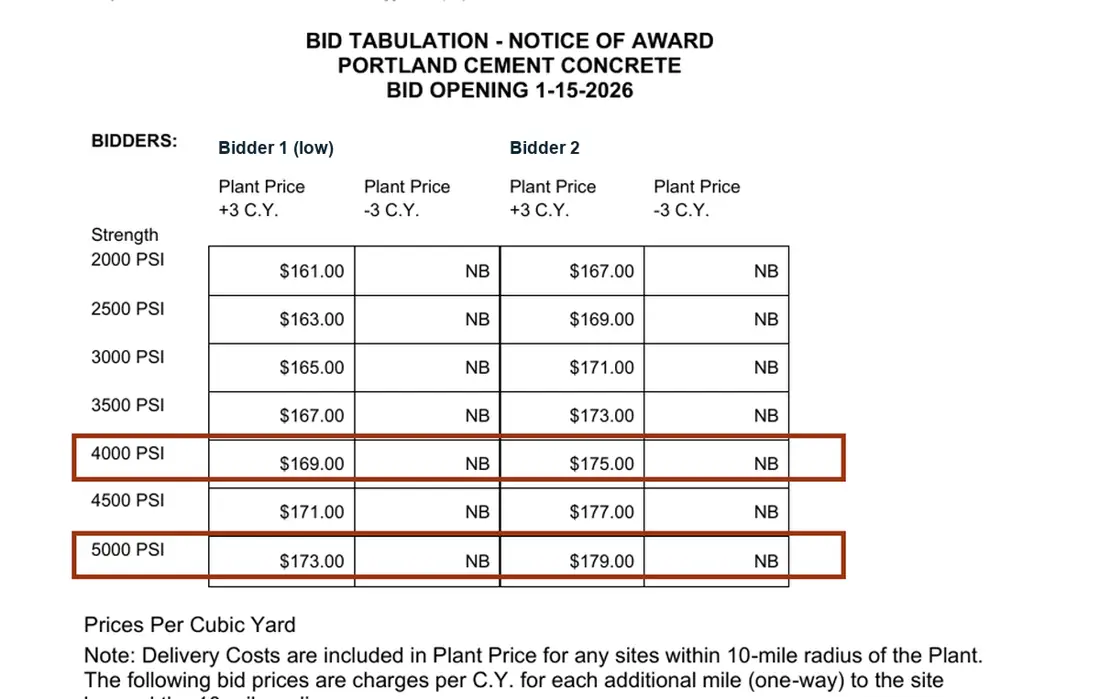
Strength is a small share of an installed slab. In the worked example below, a 50,000 sq ft, 6-inch warehouse slab needs 925.9 cubic yards before waste, and going from 3,000 to 5,000 psi at Tioga’s low bid adds $7,407, or $0.15 per sq ft. Our guide to concrete slab cost per square foot puts installed commercial slabs at about $10 to $16 per sq ft in 2026.
| Line | 3,000 psi | 4,000 psi | 5,000 psi |
|---|---|---|---|
| Slab volume: 50,000 sq ft x 0.5 ft / 27 | 925.9 cu yd | 925.9 cu yd | 925.9 cu yd |
| Price per cu yd (Tioga low bid, Jan 2026) | $165 | $169 | $173 |
| Ready-mix cost | $152,778 | $156,481 | $160,185 |
| Added over 3,000 psi | $0 | $3,704 | $7,407 |
| Added per sq ft of slab | $0 | $0.07 | $0.15 |
Plant distance, small-load fees and admixtures move the delivered price more than strength does. Tioga’s prices include delivery only within 10 miles of the plant, and none of the three bids accepted orders under 3 cubic yards at these prices. When comparing bids, ask each bidder to list psi, air, slump and delivery terms per line, as set out in our guide on how to compare construction bids.
Does higher psi concrete carry a carbon penalty?
Yes, on public work in Buy Clean states. Higher strength usually means more cement, and New York’s mandatory limits since January 1, 2025 rise from 275 kg CO2e per cubic yard at 2,500 psi or less to 541 at 6,001 to 8,000 psi. Specifying 5,000 psi where 4,000 psi meets every exposure class moves the mix into a band with a 434 kg cap instead of 360.
| Specified f’c band | Max GWP, kg CO2e per cu yd | Max GWP, kg CO2e per cubic meter | Source |
|---|---|---|---|
| 0 to 2,500 psi | 275 | 360 | NYS Buy Clean concrete guidelines |
| 2,501 to 3,000 psi | 302 | 395 | NYS |
| 3,001 to 4,000 psi | 360 | 471 | NYS |
| 4,001 to 5,000 psi | 434 | 568 | NYS |
| 5,001 to 6,000 psi | 458 | 599 | NYS |
| 6,001 to 8,000 psi | 541 | 707 | NYS |
New York’s limits equal 150 percent of NRMCA Eastern Region averages and are scheduled to tighten from January 1, 2027. Colorado sets its own caps by strength on the Office of the State Architect GWP limits page; state-by-state ceilings are compared in our Buy Clean laws by state report.
Which concrete psi should you specify?
Take the highest minimum from every exposure class that applies, compare it with the structural f’c, and specify the larger at 28 days. Specifying above that number buys little: at 2026 public prices each extra 500 psi costs about $2 to $5 per cubic yard and, on New York state work, moves the mix into a higher carbon band.
| If the element is | Then specify at least | Why | Source |
|---|---|---|---|
| Interior slab-on-ground, no structural load, heated building | 2,500 psi (F0); many specs use 3,000 to 4,000 | IBC 1904.2 floor; wear and early traffic set the rest | IBC 2021; UFGS 03 30 00 |
| Exterior flatwork with freeze-thaw, no salt, nonstructural | 3,000 psi (F1) or 3,500 psi (F2), air entrained | IBC 1904.2 | IBC 2021 Sec. 1904.2 |
| Structural member exposed to freeze-thaw and deicing salt | 5,000 psi, w/cm 0.40 | ACI 318 class F3 | UFGS 03 30 00, 2.5.2.2 |
| Reinforced concrete exposed to chlorides (parking deck, seawall) | 5,000 psi, w/cm 0.40 | ACI 318 class C2 | UFGS 03 30 00, 2.5.2.3 |
| Footing in soil the geotech report flags for sulfates | 4,000 psi (S1) or 4,500 psi (S2, S3) | ACI 318 S classes and cement type | UFGS 03 30 00, 2.5.2.4 |
| Wall or tank that must hold back water | 4,000 psi, w/cm 0.50 | ACI 318 W classes | UFGS 03 30 00, 2.5.2.6 |
| High-rise column or prestressed member | Engineer’s f’c; 8,000 psi or more counts as high strength | Structural design | NRMCA CIP 33 |
Ask the structural engineer to list f’c, exposure class and test age for each element on the drawings rather than in a general note; our guide to structural engineer cost covers what that scope includes. Curing time and reinforcement bar sizes are covered in separate CB&C guides.
Specified strength is only reached after curing, timed in our concrete curing time guide, and the steel it works with is sized in our rebar sizes guide.
Each strength sample also gets a slump reading, and our guide to the concrete slump test covers the cone procedure and the ACI 117 tolerances.
How we compiled this
We read 12 primary documents in November 2026: the UFGS 03 30 00 guide spec, 2021 IBC Chapter 19 as printed by Seattle and the 2025 California code, Colorado DOT’s 2023 Section 601, three NRMCA Concrete in Practice sheets, New York’s Buy Clean concrete guidelines and three 2026 county ready-mix bid tabulations. We did not use the ACI 318 text itself, which is sold by ACI, and quote its exposure values as reproduced in UFGS 03 30 00. Colorado’s caps are cited from our own Buy Clean report because the state page blocked automated access. Prices are as bid, not adjusted, and cover supply only.
Frequently asked questions
Is 3,000 or 4,000 psi concrete better for a commercial slab?
For an interior slab-on-ground with no structural load, the 2021 IBC Section 1904.2 floor is 2,500 psi, so both meet code. Choose 4,000 psi when forklifts, early construction traffic or freeze-thaw exposure apply. At Tioga County, New York’s January 2026 bid, the step from 3,000 to 4,000 psi cost $4 per cubic yard, about $0.07 per sq ft of 6-inch slab.
What psi concrete does a parking garage need?
A reinforced parking deck exposed to freezing, thawing and deicing salt falls under ACI 318 classes F3 and C2, which call for at least 5,000 psi and a maximum water-cementitious ratio of 0.40, as reproduced in UFGS 03 30 00. The F3 mix must also be air entrained, typically 5.0 to 7.5 percent depending on aggregate size.
What happens if concrete cylinders test below the specified psi?
One low test is not a failure. Concrete is accepted when the average of 3 consecutive tests meets f’c and no test is more than 500 psi below it (NRMCA CIP 35). If those criteria fail, check the testing first, then drill 3 cores under ASTM C42; the area is adequate if they average at least 85 percent of f’c with none under 75 percent.
Should I just order 5,000 psi concrete everywhere to be safe?
Only where an exposure class or the engineer requires it. The extra strength costs about $4 per cubic yard over 4,000 psi in Tioga County’s 2026 bid, but more cement raises shrinkage and carbon. New York’s Buy Clean cap rises from 360 to 434 kg CO2e per cubic yard between the 4,000 and 5,000 psi bands, which can rule out mixes on state work.
What does 4,000 psi at 28 days mean on a concrete spec?
It means cylinders made from the delivered concrete under ASTM C31 and broken under ASTM C39 at 28 days must average at least 4,000 psi across 3 consecutive tests. Each test is the average of two 6 by 12 inch or three 4 by 8 inch cylinders. Mixes with high fly ash or slag content are sometimes judged at 56 or 90 days instead.
How many concrete cylinders are tested on a commercial job?
UFGS 03 30 00 requires a sample at least once per day, once per 150 cubic yards and once per 5,000 sq ft of slab or wall, with at least five sample sets per mix. Each set includes cylinders broken at 7 days and 28 days, often with reserve cylinders, so a 50,000 sq ft, 6-inch slab (926 cubic yards) needs at least 10 samples: the area rule gives 10 and the volume rule only 7.
Sources
- UFGS 03 30 00 Cast-in-Place Concrete, USACE, NAVFAC and AFCEC, February 2019 edition with references updated July 2026, accessed November 8, 2026
- 2021 Seattle Building Code, Chapter 19 Concrete, City of Seattle SDCI, accessed November 8, 2026
- 2025 California Building Code, Section 1904, accessed November 8, 2026
- ACI 318-19 Building Code Requirements for Structural Concrete, American Concrete Institute, product page accessed November 8, 2026
- CIP 35 Testing Compressive Strength of Concrete, NRMCA, 2014, accessed November 8, 2026
- CIP 10 Strength of In-Place Concrete, NRMCA, accessed November 8, 2026
- CIP 33 High Strength Concrete, NRMCA, accessed November 8, 2026
- CDOT 2023 Standard Specifications, Division 600, Table 601-1, Colorado DOT, accessed November 8, 2026
- Portland cement concrete bid tabulation, opened January 15, 2026, Tioga County, NY Public Works, accessed November 8, 2026
- Bid 2026-2027.5 ready-mix concrete tally, opened June 15, 2026, Ottawa County, OK Highway Districts 1 to 3, accessed November 8, 2026
- Concrete bid tabulation, opened June 2, 2026, Montgomery County, TN Highway Department, accessed November 8, 2026
- NYS Buy Clean Concrete Guidelines, NYS Office of General Services, updated July 2025, accessed November 8, 2026
- Buy Clean Colorado maximum GWP limits, Colorado Office of the State Architect, accessed November 8, 2026