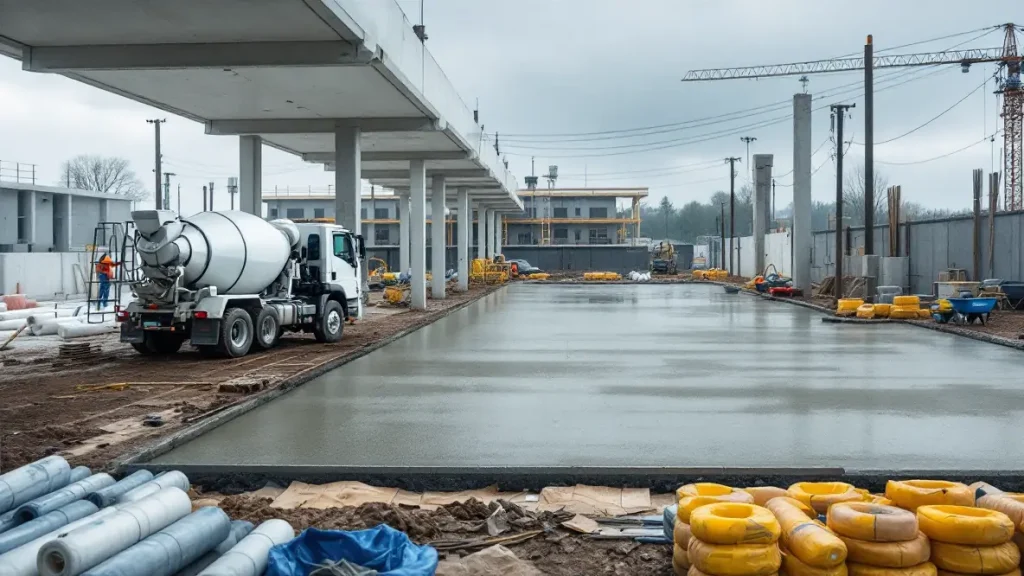
A concrete cylinder test casts fresh concrete into 4 by 8 or 6 by 12 inch molds (ASTM C31) and crushes them, usually at 28 days (ASTM C39): the mix passes when three consecutive tests average at least f’c.
Key takeaways
- One strength test is the average of two 6 by 12 inch or three 4 by 8 inch cylinders from the same sample, broken at the same age (NRMCA CIP 9; UFGS 03 30 00, Change 10, August 2025).
- Concrete passes when every running average of three consecutive tests reaches f’c and no single test falls more than 500 psi below f’c, or more than 0.10 f’c below when f’c exceeds 5,000 psi (NRMCA CIP 35, summarizing ACI 318 and ACI 301).
- Samples are taken at least once a day, once per 150 cubic yards and once per 5,000 sq ft of slab or wall, with no fewer than five sets per mix on a federal project (UFGS 03 30 00 section 3.14.3.4).
- Cylinders cure on site at 60 to 80 F (68 to 78 F above 6,000 psi) and must reach the lab within 48 hours (NRMCA CIP 34).
- If a test fails, cores drilled under ASTM C42 clear the concrete when three cores average at least 85 percent of f’c and none is below 75 percent (NRMCA CIP 10; UFGS 03 30 00 section 3.14.3.10).
What is a concrete cylinder test and what does it prove?
A concrete cylinder test measures the compressive strength of the concrete as delivered: a certified technician molds cylinders from a truck sample, the lab cures them in water or a moist room, then a press loads each one to failure. Strength equals the maximum load divided by the cross-section area, reported to the nearest 10 psi, per NRMCA CIP 35 (2014).
The result proves the potential strength of the mix, not the strength inside the slab. NRMCA CIP 10 notes that in-place strength will generally be lower than standard-cured cylinders, which is why ACI 318 accepts cores at 85 percent of f’c rather than 100 percent. The number the cylinders are judged against is the specified strength on the drawings, explained in our guide to concrete psi and specified strength.
| Item | Value | Source |
|---|---|---|
| Making and curing standard | ASTM C31/C31M (2026a edition cited by UFGS) | ASTM C31; UFGS 03 30 00 references |
| Breaking standard | ASTM C39/C39M-26 (active) | ASTM C39 |
| Sampling standard | ASTM C172, sample from the middle of the load | NRMCA CIP 34 |
| Cylinder sizes | 4 by 8 in (100 by 200 mm) or 6 by 12 in (150 by 300 mm) | NRMCA CIP 35 |
| Cylinders per test | 2 (6 by 12) or 3 (4 by 8) | NRMCA CIP 9; UFGS 3.14.3.4 |
| Acceptance age | 28 days unless the spec says 56 or 90 | NRMCA CIP 35; UFGS 3.14.3.4 |
| Loading rate | 28 to 42 psi per second in the latter half of loading | NRMCA CIP 35 |
| Report precision | Nearest 10 psi | NRMCA CIP 35; MnDOT Lab Manual 1407 |
How are concrete test cylinders made on site?
Concrete test cylinders are made from a composite sample taken from the middle of the truck discharge, never the first or last 10 percent. Molding starts within 15 minutes of sampling, the mold is filled in layers and each layer is rodded 25 times. The technician should hold ACI Field Testing Technician Grade I certification, per NRMCA CIP 34 (2014).
- Collect at least two portions from the middle of the load within 15 minutes, for a sample of at least 1 cubic foot (ASTM C172).
- Remix the sample. Start slump, air content, density and temperature tests within 5 minutes; the slump procedure is in our concrete slump test guide.
- Set the molds on a level surface, with the label on the side of the mold, not the lid.
- Rodded 6 by 12 molds get 3 equal layers; rodded 4 by 8 molds get 2. Rod each layer 25 times, entering about 1 in into the layer below.
- If slump is under 1 in, vibrate instead: 2 layers, with 2 insertions per layer in a 6 by 12 and 1 in a 4 by 8.
- Tap the outside of the mold 10 to 15 times with the mallet to close rod holes.
- Strike the top flat with a float or trowel and cover the mold with a lid or plastic bag.
| Choice | 4 by 8 in cylinder | 6 by 12 in cylinder | Source |
|---|---|---|---|
| Cylinders per strength test | 3 | 2 | NRMCA CIP 9 |
| Rodded layers | 2 layers, 25 strokes each | 3 layers, 25 strokes each | NRMCA CIP 34 |
| Vibrator insertions per layer | 1 | 2 | NRMCA CIP 34 |
| Cross-section area | 12.57 sq in | 28.27 sq in | CB&C arithmetic (pi times radius squared) |
| Largest nominal aggregate | 1 1/3 in (diameter at least 3 times aggregate) | 2 in | NRMCA CIP 35 rule, CB&C arithmetic |
| Federal set size | 9 cylinders | 6 cylinders | UFGS 03 30 00 section 3.14.3.4 |
| Acceptance criteria | Same | Same | NRMCA CIP 35 |
NRMCA CIP 35 says 4 by 8 cylinders are easier to make and handle in the field and the lab, while UFGS 03 30 00 notes that 6 by 12 cylinders give better prediction of strength and consistency. CIP 35 accepts either size when the diameter is at least 3 times the nominal maximum aggregate size.
How are cylinders cured and taken to the lab?
Standard-cured cylinders sit on site at 60 to 80 F for initial curing, or 68 to 78 F when f’c exceeds 6,000 psi, then go to the lab within 48 hours for moist curing until the break. They must not be moved until at least 8 hours after final set, and the trip should not exceed 4 hours, per NRMCA CIP 34.
Initial curing is where most low breaks start. NRMCA CIP 9 lists initial curing over 80 F, frozen cylinders, extra days in the field, damage in transport, delayed stripping and poor capping as the main causes of falsely low results. ACI 301 makes the contractor responsible for space and power on site for a curing box, so put a temperature-controlled box, with a max-min thermometer, in the concrete subcontract.
| Cylinder type | How it is cured | What the result is used for | Source |
|---|---|---|---|
| Standard-cured | 60 to 80 F on site up to 48 h, then lab moist cure (ASTM C511 tank or room) | Acceptance of the concrete and quality control | NRMCA CIP 34; MnDOT 1407.4 |
| Field-cured | Kept next to the structure under the same conditions | Stripping forms and shores, post-tensioning, ending curing, opening to traffic | NRMCA CIP 34; NRMCA CIP 9 |
Field-cured cylinders never decide acceptance. They tell the crew when the member is strong enough to strip or load, which our concrete curing time guide ties to the 70 and 75 percent of f’c thresholds in ACI 301 and state DOT specs.
How is the cylinder broken and the psi calculated?
At the break, the lab measures two diameters at mid-height, caps or grinds the ends, and loads the cylinder in a calibrated press at 28 to 42 psi per second until it fails. Strength is the peak load divided by the average area. If the two diameters differ by more than 2 percent, the cylinder is not tested, per NRMCA CIP 35 and the WSDOT FOP for AASHTO T 22 (January 2026).
- Keep the cylinder moist from the curing tank to the press.
- Measure two diameters at right angles at mid-height, to the nearest 0.01 in, and average them.
- Check that the ends are within 0.5 degrees of square and plane within 0.002 in; otherwise grind, sulfur cap (ASTM C617, applied at least 2 hours before testing) or use neoprene pads (ASTM C1231, 1,500 to 12,000 psi).
- Load continuously without shock, holding 28 to 42 psi per second through the latter half of the load.
- Load to complete failure, record the maximum load and the fracture type.
- Divide load by area, report each cylinder and the average to the nearest 10 psi.
| Specimen | Diameter | Area | Peak load | Strength |
|---|---|---|---|---|
| 4 by 8, cylinder A | 4.00 in | 12.57 sq in | 52,300 lbf | 4,160 psi |
| 4 by 8, cylinder B | 4.00 in | 12.57 sq in | 54,100 lbf | 4,310 psi |
| 4 by 8, cylinder C | 4.00 in | 12.57 sq in | 53,200 lbf | 4,230 psi |
| Test result (average of 3) | 4,230 psi | |||
| Range check | highest 4,305 minus lowest 4,162 psi, divided by the 4,234 psi average = 3.4 percent, under the 9.5 percent limit for three cylinders (NRMCA CIP 9) | |||
The loads are a CB&C example, not lab data. A 6 by 12 pair breaking at 121,500 and 124,800 lbf on 28.27 sq in gives 4,300 and 4,410 psi, a 4,360 psi test and a 2.7 percent range, inside the 8 percent limit for two cylinders. NRMCA CIP 35 says companion cylinders normally vary by 2 to 3 percent.
What do the fracture types on the report mean?
The lab records a fracture type for every cylinder so the engineer can tell a defective specimen from weak concrete when a result comes in low. MnDOT Lab Manual 1407 (January 2021) lists eight types for ASTM C39 breaks; NRMCA CIP 35 calls the conical break the common pattern.
Ask the lab to photograph and keep any cylinder in a low set, as MnDOT does when a 3-cylinder average is more than 500 psi below the requirement.
| Fracture type | What it looks like | What the source says | Source |
|---|---|---|---|
| Cone (a) | Well-formed cones on both ends | Common pattern (NRMCA CIP 35) | MnDOT 1407.5; NRMCA CIP 35 |
| Cone and split (b) | Cone on one end, vertical cracks through the other | Recorded; no note | MnDOT 1407.5 |
| Cone and shear (c) | Cone on one end, diagonal fracture to the other | Recorded; no note | MnDOT 1407.5 |
| Short shear (d-s) | Diagonal fracture within half the length, through either end | Recorded; no note | MnDOT 1407.5 |
| Long shear (d-l) | Diagonal fracture, no cracking through the ends | Recorded; no note | MnDOT 1407.5 |
| Columnar (e) | Vertical cracking through both ends, no cones | Recorded; no note | MnDOT 1407.5 |
| Crumbling (f) | Like a cone break with no well-formed cones | Typical of low-strength concrete | MnDOT 1407.5 |
| Top quarter crushing (g) | Crushing in the top 1/4 of the cylinder | Defective cylinder | MnDOT 1407.5 |
What should a 7 day break be compared with 28 days?
A 7 day break is an early warning, not an acceptance test. On the ACI 209R-92 time-strength model, moist-cured Type I cement concrete reaches about 70 percent of its 28 day strength at 7 days, so a 4,000 psi mix would read about 2,810 psi. NRMCA CIP 35 states that a 3 or 7 day test is not a basis for rejecting concrete.
| Age | Type I cement, % of 28 day | Type I, 4,000 psi mix | Type III cement, % of 28 day | Type III, 4,000 psi mix |
|---|---|---|---|---|
| 3 days | 45.8% | 1,830 psi | 59.3% | 2,370 psi |
| 7 days | 70.4% | 2,810 psi | 80.1% | 3,200 psi |
| 14 days | 88.1% | 3,520 psi | 92.2% | 3,690 psi |
| 28 days | 100.7% | 4,030 psi | 99.8% | 3,990 psi |
| 56 days | 108.5% | 4,340 psi | 104.1% | 4,160 psi |
Values come from ACI 209R-92 Equation 2-1 with the moist-cured constants (a = 4.0, b = 0.85 for Type I; a = 2.3, b = 0.92 for Type III) published in the WSDOT PGSuper 8.0 material model documentation. NRMCA CIP 10 notes that fly ash and slag cement concrete keeps gaining strength with extra curing, so a low 7 day break on those mixes says less; ask the ready-mix supplier for the 7 to 28 day ratio in its mix submittal.
How many cylinders make a test, and how often are they taken?
ACI 318-19 section 26.12.2.1 requires a strength sample for each class of concrete placed each day at least once a day, once per 150 cubic yards and once per 5,000 sq ft of slab or wall surface. The rule that produces the most samples governs. UFGS 03 30 00 adds a floor of five sets per mix design for the whole project.
| Rule | Requirement | Source |
|---|---|---|
| Per day | At least 1 sample per class of concrete per day | ACI 318-19 26.12.2.1; UFGS 3.14.3.4 |
| Per volume | At least 1 per 150 cubic yards (115 cubic meters) | ACI 318-19 26.12.2.1; UFGS 3.14.3.4 |
| Per area | At least 1 per 5,000 sq ft (450 sq m) of slab or wall surface | ACI 318-19 26.12.2.1; UFGS 3.14.3.4 |
| Project minimum | At least 5 sets per mix design | UFGS 3.14.3.4 |
| Federal set | 6 (6 by 12) or 9 (4 by 8) cylinders: one test at 7 days, one at 28 days, one test held in reserve | UFGS 3.14.3.4 |
| Private spec, common practice | A set of 2 to 6 cylinders per 150 cubic yards | NRMCA CIP 34 |
| Worked example: 20,000 sq ft slab, 6 in thick, one pour day | Arithmetic | Sets |
|---|---|---|
| Volume | 20,000 sq ft x 0.5 ft / 27 = 370 cubic yards | |
| By day | 1 day | 1 |
| By volume | 370 / 150 = 2.5, round up | 3 |
| By area | 20,000 / 5,000 | 4 |
| Governing | Largest of the three | 4 sets |
| Cylinders at the federal set size (4 by 8) | 4 sets x 9 | 36 cylinders |
How does ACI 318 decide if the concrete passes?
Under ACI 318 section 26.12.3.1, standard-cured concrete is accepted when every average of three consecutive strength tests equals or exceeds f’c and no single test is more than 500 psi below f’c (for f’c up to 5,000 psi) or below 0.90 f’c (above 5,000 psi). NRMCA CIP 9 says properly proportioned mixes fail these rules about once in 100 tests.
| Test no. | Mix A test (psi) | Mix A, average of 3 | Mix B test (psi) | Mix B, average of 3 |
|---|---|---|---|---|
| 1 | 4,185 | 3,585 | ||
| 2 | 3,960 | 4,015 | ||
| 3 | 4,435 | 4,193 (pass) | 4,040 | 3,880 (fails: below 4,000) |
| 4 | 3,745 | 4,047 (pass) | 4,780 | 4,278 (pass) |
| 5 | 4,595 | 4,258 (pass) | 3,250 | 4,023 (pass, but test 5 fails: 750 psi low) |
Both mixes are specified at 4,000 psi; the test values come from the worked table in NRMCA CIP 9, and CB&C rechecked the averages. Mix A passes even though tests 2 and 4 are below 4,000 psi, because neither is under the 3,500 psi floor. Mix B fails twice: the first running average is 3,880 psi, and test 5 is more than 500 psi low, which triggers an investigation of that part of the structure.
| Specified f’c | Running average must reach | Lowest single test allowed | Core average needed (3 cores) | Lowest single core |
|---|---|---|---|---|
| 3,000 psi | 3,000 psi | 2,500 psi | 2,550 psi | 2,250 psi |
| 4,000 psi | 4,000 psi | 3,500 psi | 3,400 psi | 3,000 psi |
| 5,000 psi | 5,000 psi | 4,500 psi | 4,250 psi | 3,750 psi |
| 6,000 psi | 6,000 psi | 5,400 psi | 5,100 psi | 4,500 psi |
| 8,000 psi | 8,000 psi | 7,200 psi | 6,800 psi | 6,000 psi |
What happens when a concrete cylinder test breaks low?
When a concrete cylinder test breaks low, the first suspect is the testing, not the concrete: NRMCA CIP 9 says improper handling, curing and testing cause most low results. Only after the records check out and the engineer confirms the strength is needed are cores drilled under ASTM C42, and the area passes at 85 percent of f’c average with no core under 75 percent.
- Collect every break report for the mix, not just the failing one, and recompute the running averages.
- Audit the cylinder history: initial curing temperatures (over 80 F lowers results), days in the field before pickup, transport damage, capping, and whether companion cylinders differ by more than 8 percent (two) or 9.5 percent (three).
- Ask the structural engineer of record whether the member needs the full f’c; if not, the engineer can accept it by analysis, per NRMCA CIP 9. Our structural engineer cost guide covers what that review is billed at.
- If the strength matters, screen the area with rebound hammer (ASTM C805) or probe penetration (ASTM C803) readings on a grid, comparing good and suspect concrete.
- Drill at least 3 cores per low test area, at least 3.7 in diameter or twice the aggregate size, avoiding the weaker top 10 to 20 percent of the member (NRMCA CIP 10).
- Test the cores under ASTM C42: the area is adequate if the 3-core average is at least 85 percent of f’c and no core is below 75 percent. Core strengths are not corrected for age.
- If cores fail, the engineer decides between a load test, strengthening or removal; an optional paragraph in UFGS 03 30 00 section 3.14.3.10 puts core testing and restoration costs on the contractor when cores show nonconforming concrete.
Cores air-dry for 7 days at 60 to 80 F before testing when the concrete is dry in service, under UFGS 03 30 00 section 3.14.3.10. Concrete with fly ash or slag cement may gain enough strength with more curing to pass later, NRMCA CIP 10 notes.
How much does concrete cylinder testing cost?
Public agency rate sheets put the break at $25 per cylinder in Utah (state Division of Facilities and Construction Management, July 2026) and $54 per cylinder at the Oregon DOT (January 2024). The field technician who samples and molds the set is billed by the hour on top: $55 in Utah and $135 in Oregon.
| Line item | Utah DFCM (July 8, 2026) | Oregon DOT (January 24, 2024) |
|---|---|---|
| Cylinder compressive strength, each | $25.00 | $54 (AASHTO T 22) |
| Field technician | $55.00 per hour (ACI Level I) | $135 per hour (CCT/QCT) |
| Special inspector | $65.00 per hour (ACI Level II) | Not listed |
| Cores | Negotiated, pre-approval required | Not listed |
| Minimum charge | Not listed | $135 |
| Source | Utah DFCM rate sheet | Oregon DOT testing fees |
| Worked cost: the 4-set slab above | Utah rates | Oregon DOT rates |
|---|---|---|
| 24 cylinders broken (3 at 7 days + 3 at 28 days per set; reserves not broken) | 24 x $25 = $600 | 24 x $54 = $1,296 |
| Technician, 8 hours on the pour (CB&C assumption) | 8 x $55 = $440 | 8 x $135 = $1,080 |
| Total | $1,040 | $2,376 |
Private lab quotes add mileage, pickup trips and overtime, so ask for a unit-rate schedule with each line above before the pour. On jobs where the building official requires special inspection of concrete under IBC Chapter 17, IBC Section 1704.2 has the owner, or the registered design professional acting for the owner, hire the agency, as our special inspections guide explains. Testing is a small line next to the concrete itself; see our concrete slab cost per square foot breakdown for that side.
Which cylinder plan should you require for your job?
Write the cylinder plan into the specification before the first pour: cylinder size, set size, test ages, who supplies the curing box, and how fast reports go out. ACI 301 requires break reports to be distributed within 7 days, and NRMCA CIP 34 recommends sending them to the producer, contractor and owner’s representative.
| If this is your situation | Then require this | Source |
|---|---|---|
| Standard building concrete, f’c up to 5,000 psi | 4 by 8 sets: 1 or 3 at 7 days, 3 at 28 days, 1 or more held; 500 psi single-test floor | NRMCA CIP 9; UFGS 3.14.3.4 |
| f’c above 6,000 psi | Initial curing at 68 to 78 F; 0.10 f’c single-test floor; sulfur caps or grinding above the pad limits | NRMCA CIP 34; NRMCA CIP 35 |
| Aggregate over 1 1/3 in | 6 by 12 molds (diameter at least 3 times aggregate) | NRMCA CIP 35 |
| Fly ash or slag mix with 56 day f’c | Extra cylinders for 56 or 90 day breaks (UFGS uses 8 per 6 by 12 set) | UFGS 3.14.3.4 |
| Early form stripping, post-tensioning or loading | Separate field-cured cylinders; never use them for acceptance | NRMCA CIP 34 |
| Hot or cold weather pour | Temperature-controlled curing box with max-min thermometer, supplied by the contractor | NRMCA CIP 34 (ACI 301) |
| A test misses the acceptance rules | Records audit first, then engineer review, then 3 cores per area under ASTM C42 | NRMCA CIP 9 and CIP 10 |
Put the 7 and 28 day break dates on the construction schedule as milestones, since a 28 day break that lands on a weekend can be moved up to 48 hours later on WSDOT work and to the next workday under MnDOT Lab Manual 1407, never earlier.
Field crews often run a slump test from the same truck, and the strength target comes from the concrete psi in the specs.
How we compiled this
We compiled this page in November 2026 from 12 primary documents: four NRMCA Concrete in Practice sheets (CIP 9, 10, 34 and 35), UFGS 03 30 00 Change 10, MnDOT Lab Manual 1407, the WSDOT T 22 field procedure, the ASTM C31, C39 and C42 scope pages, and the Utah DFCM and Oregon DOT rate sheets. ASTM and ACI texts are paywalled, so their rules are cited through these public documents. Worked loads and costs are CB&C examples with the arithmetic shown.
Frequently asked questions
How many cylinders are in a concrete test?
One strength test is the average of two 6 by 12 inch cylinders or three 4 by 8 inch cylinders made from the same sample and broken at the same age, per NRMCA CIP 9. A full set is larger: UFGS 03 30 00 (August 2025) makes six 6 by 12 or nine 4 by 8 cylinders, for one test at 7 days, one at 28 days and one held in reserve.
What is a 7 day cylinder break?
A 7 day break crushes cylinders one week after casting to catch problems early. On the ACI 209R-92 model, moist-cured Type I concrete reaches about 70 percent of its 28 day strength at 7 days, so a 4,000 psi mix reads about 2,810 psi. NRMCA CIP 35 says a 3 or 7 day result is not a basis for rejecting concrete specified at 28 days.
What happens if concrete cylinders fail?
A single test below f’c is not a failure; NRMCA CIP 35 says about 1 in 10 tests lands there. The concrete fails only if a 3-test running average falls below f’c or one test is more than 500 psi low. Then the lab records are checked, the engineer reviews the member, and 3 cores per area must average 85 percent of f’c with none under 75 percent.
How much does a concrete cylinder test cost?
Public rate sheets list $25 per cylinder break at the Utah Division of Facilities and Construction Management (July 2026) and $54 per cylinder at the Oregon DOT (January 2024). Sampling technicians bill $55 to $135 per hour on those sheets. A one-day, 370 cubic yard slab pour with 24 broken cylinders works out to about $1,040 to $2,376.
Who makes and breaks concrete test cylinders?
A field technician holding ACI Field Testing Technician Grade I certification, or an equivalent, samples the truck and molds the cylinders, per NRMCA CIP 34. A lab technician with ACI strength testing certification breaks them in a lab that meets ASTM C1077, which ACI 318 requires. On jobs with IBC special inspections, the owner hires the inspection agency under IBC Section 1704.2.
Why are 4 by 8 cylinders used instead of 6 by 12?
A 4 by 8 inch cylinder weighs less, needs a smaller press and fits aggregate up to about 1 1/3 inches, since the diameter must be at least 3 times the nominal maximum aggregate size (NRMCA CIP 35). The acceptance criteria are the same for both sizes, but a 4 by 8 test averages three cylinders instead of two.
Sources
- NRMCA CIP 35, Testing Compressive Strength of Concrete (2014), accessed November 15, 2026.
- NRMCA CIP 9, Low Concrete Cylinder Strength (2014), accessed November 15, 2026.
- NRMCA CIP 34, Making Cylinders in the Field (2014), accessed November 15, 2026.
- NRMCA CIP 10, Strength of In-Place Concrete (2014), accessed November 15, 2026.
- UFGS 03 30 00 Cast-in-Place Concrete, Change 10 (August 2025), sections 3.14.3.4 and 3.14.3.10, accessed November 15, 2026.
- MnDOT Laboratory Manual 1407, Compressive Strength of Cylindrical Concrete Specimens (January 19, 2021), accessed November 15, 2026.
- WSDOT FOP for AASHTO T 22, Materials Manual M 46-01.48 (January 2026), accessed November 15, 2026.
- ASTM C39/C39M, Compressive Strength of Cylindrical Concrete Specimens, accessed November 15, 2026.
- ASTM C31/C31M, Making and Curing Concrete Test Specimens in the Field, accessed November 15, 2026.
- ASTM C42/C42M-20, Obtaining and Testing Drilled Cores, accessed November 15, 2026.
- ACI 318-19, Building Code Requirements for Structural Concrete, accessed November 15, 2026.
- Utah DFCM Capital Project Code and Special Inspections Rates (July 8, 2026), accessed November 15, 2026.
- Oregon DOT Construction Material Testing Services fees (January 24, 2024), accessed November 15, 2026.
- WSDOT PGSuper 8.0, time-dependent material models (ACI 209R-92 constants), accessed November 8, 2026.