Commercial EV charging station installation cost runs about $6,100 to $9,500 per Level 2 port on a 10-port lot and $123,000 to $192,000 per DC fast port, per DOE, ICCT, state grant and NEVI award records.
Key takeaways
- Installing one networked Level 2 charger cost $2,305 at sites with 6 or more chargers outside California, versus $2,836 at a one-charger site, before hardware (in 2019 dollars, ICCT Working Paper 2019-14, Table 3).
- Oakland’s 2025 state grant budget priced Level 2 hardware at about $5,701 per port and 180 kW DC hardware at $86,289 per port; hardware was 34.5% of the hard-cost budget (California Energy Commission, June 11, 2025 packet).
- Washington, DC’s four NEVI fast-charging sites carry total project costs of $536,857 to $769,356 each, or $134,214 to $192,339 per port at the 4-port minimum (DDOT, October 11, 2024).
- NEC 220.57 counts each Level 2 port at 7,200 W or its nameplate, whichever is larger, so 10 ports add 72 kVA, about 200 A on a 208Y/120 V service (NFPA 70, 2023 edition).
- The federal Section 30C charger credit does not apply to property placed in service after June 30, 2026, under Pub. L. 119-21 (26 U.S.C. 30C(i)).
How much does a commercial EV charging station cost per port?
A commercial Level 2 port costs roughly $2,800 to $5,700 for hardware plus $2,300 to $4,100 to install, and a DC fast port costs $75,000 to $86,000 for hardware alone, before utility work. Those figures come from the International Council on Clean Transportation (ICCT) 2019 cost study and a 2025 California Energy Commission (CEC) grant budget. Fully built DC fast sites in public records land at $134,000 to $192,000 per port.
Level 2 means alternating current charging at 208 or 240 V, typically 6 to 19 kW per port. DC fast charging (DCFC) converts power inside the charger and delivers 50 kW or more. Electric vehicle supply equipment (EVSE) is the industry term for the charger and its cord and connector.
| Item | Price | Scope and year | Source |
|---|---|---|---|
| Level 2 hardware, networked, 2 per pedestal | $2,793 per charger | Equipment and pedestal, 2019 dollars | ICCT 2019, Table 2 |
| Level 2 hardware, non-networked, 2 per pedestal | $938 per charger | Equipment and pedestal, 2019 dollars | ICCT 2019, Table 2 |
| Level 2 hardware, dual-port units rated 19.2 kW | $5,701 per port | $501,650 for about 88 ports, Oakland fleet sites, 2025 budget | CEC packet, Resolution 25-0611-03l |
| Level 2 installation, 6+ chargers per site, outside California | $2,305 per charger | Labor, materials, permit, tax, 2019 dollars | ICCT 2019, Table 3 |
| Level 2 installation, 1 charger per site, California | $4,148 per charger | Same scope, 2019 dollars | ICCT 2019, Table 3 |
| Level 2 installation, 2,809 non-residential units | $2,979 average; workplace $2,223 | INL EV Project, installed 2011 to 2013 | U.S. DOE Vehicle Technologies Office, November 2015 |
| 150 kW DC hardware | $75,000 per charger | Equipment, 2019 dollars | ICCT 2019, Table 2 |
| 180 kW dual-port DC hardware | $86,289 per port | $1,035,468 for 12 ports, 2025 budget | CEC packet, Oakland |
| 150 kW DC, one charger, hardware plus install | $122,781 | $75,000 plus $47,781, 2019 dollars | ICCT 2019, Tables 2 and 4 |
| DC fast contract, 5 dual-port units | $144,000 per port | $1.44 million design, procure, install, Downey, California, February 2026 | The Downey Patriot, February 5, 2026 |
The 2019 ICCT figures are not escalated here because no construction index could be applied to a mixed equipment and labor line; each price carries its own year. The 2025 Oakland hardware price per Level 2 port is about twice the 2019 networked figure, partly because the Oakland units are rated 19.2 kW rather than the 6.6 kW the ICCT study assumed.
What share goes to hardware, installation and the utility?
Hardware was 34.5% of Oakland’s $4,459,440 hard-cost budget for 100 ports in 2025 (CB&C sum of the packet’s budget lines, excluding donated parking value); construction, design, permits and shipping made up the other 65.5%. Inside a Level 2 installation, labor runs 55% to 60% and materials 30% to 35%, per an Electric Power Research Institute (EPRI) study summarized by the U.S. Department of Energy (DOE) in 2015.
| Cost bucket | Share or unit price | Who pays | Source |
|---|---|---|---|
| Charger hardware | 34.5% of hard costs (Oakland, 2025) | Owner | CEC packet |
| Construction, design, permits, shipping | 65.5% of hard costs (Oakland, 2025) | Owner | CEC packet |
| Level 2 install labor | 55% to 60% of installation | Owner | DOE 2015, citing EPRI 2013 |
| Level 2 install materials | 30% to 35% of installation | Owner | DOE 2015 |
| Permits and tax | 5% each | Owner | DOE 2015 |
| Trenching in soil | $10 to $20 per foot | Owner | DOE 2015 |
| Trenching in asphalt or concrete | $100 to $150 per foot | Owner | DOE 2015 |
| Three-phase secondary connection up to 800 A | $6,400 | Owner, billed by utility | Pend Oreille PUD fee schedule, effective April 1, 2026 |
| Three-phase transformer | Billed at cost | Owner, billed by utility | Pend Oreille PUD, 2026 |
| Underground three-phase primary | $16.00 per foot | Owner, billed by utility | Pend Oreille PUD, 2026 |
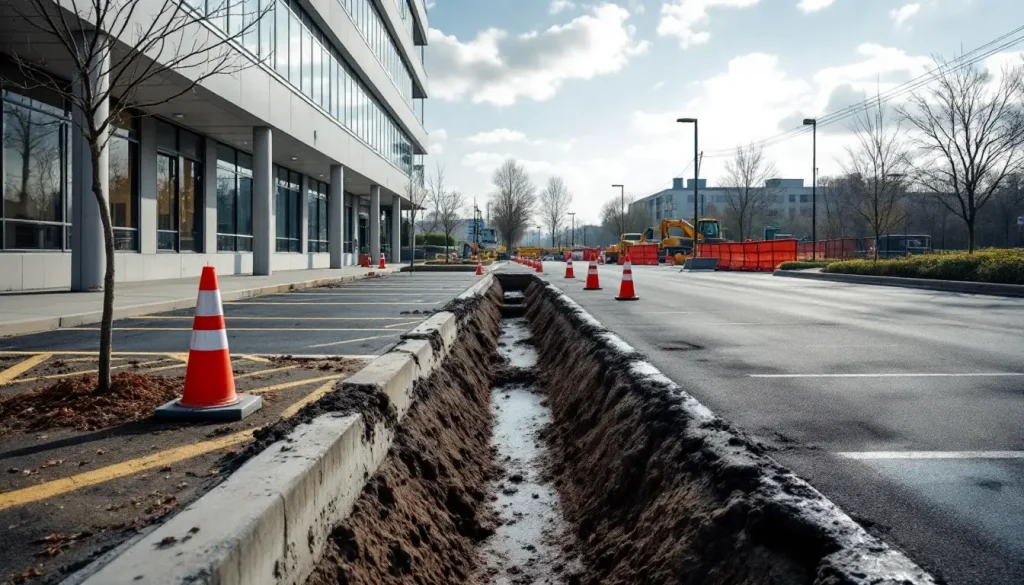
Trenching is the line owners can move most. The DOE report puts 100 feet of trench through concrete at $10,000 at $100 per foot, and found Level 2 sites that needed trenching or boring cost about 25% more than sites that did not. Placing chargers on the parking row nearest the electrical room cuts that line before any equipment is chosen. Our site plan guide covers where utility routes get fixed on drawings.
How much do extra ports per site save?
Installing more chargers at one site spreads the fixed costs of permits, mobilization and switchgear. ICCT’s 2019 tables show a 150 kW DC charger costs $47,781 to install alone and $18,577 each when 6 to 20 share a site; Level 2 outside California drops from $2,836 to $2,305 per charger at 6 or more.
| Chargers per site | Level 2, outside California | Level 2, California | 150 kW DC | Source |
|---|---|---|---|---|
| 1 | $2,836 | $4,148 | $47,781 | ICCT 2019, Tables 3 and 4 |
| 2 | $3,020 | $3,039 | $38,047 | ICCT 2019 |
| 3 to 5 | $3,090 | $2,745 | $28,312 | ICCT 2019 |
| 6 or more (DC: 6 to 20) | $2,305 | $2,837 | $18,577 | ICCT 2019 |
ICCT also notes a site limit of about 2.5 megawatts before costs step up, which caps a site at about 20 chargers of 150 kW. Based on EPRI data, ICCT assumes workplace Level 2 installs cost 10% below the table average and public installs 11% above it, so a private employee lot sits at the low end of each column.
What does a 10-port workplace lot cost?
A 10-port Level 2 workplace lot with 100 feet of trench through asphalt totals about $61,000 to $66,000 on 2019 ICCT prices, or $90,000 to $95,000 when the hardware line uses Oakland’s 2025 price. That is $6,098 to $9,506 per port, before any utility service upgrade, accessible space striping or contingency.
| Line | Input | 2019 hardware basis | 2025 hardware basis |
|---|---|---|---|
| Hardware, 10 ports | $2,793 (ICCT) or $5,701 (CEC) per port | $27,930 | $57,010 |
| Installation, 10 ports | $2,305 per charger, 6+ per site (ICCT, 2019) | $23,050 | $23,050 |
| Trench, 100 ft through asphalt | $100 to $150 per foot (DOE 2015) | $10,000 to $15,000 | $10,000 to $15,000 |
| Total | $60,980 to $65,980 | $90,060 to $95,060 | |
| Per port | Total divided by 10 | $6,098 to $6,598 | $9,006 to $9,506 |
The installation line stays at its 2019 value in both columns, so bids in 2026 should run higher on labor. Carry a separate construction contingency for the utility side, and ask each bidder to price trench footage as a unit rate so a relocated charger row can be repriced without a dispute. Our guide on how to estimate construction costs shows how to structure that unit-price bid form.
How much power does a 10-port lot need?
Ten Level 2 ports count as 72 kVA under NEC 220.57, which is about 200 A on a 208Y/120 V three-phase service if the load is balanced. Because ten 208 V circuits cannot split evenly across three phases, the worst phase carries 210.5 A, so the feeder breaker sized at 125% needs 300 A unless energy management caps the load.
| Step | Rule or formula | Result |
|---|---|---|
| Load counted per port | NEC 220.57: larger of 7,200 W or nameplate; a 32 A port at 208 V is 6,656 W | 7,200 W |
| Ten ports | 10 x 7,200 W | 72,000 W (72 kVA) |
| Balanced current at 208 V | 72,000 / (208 x 1.732) | 199.9 A |
| Worst phase, ports split 4, 3, 3 | 34.6 A per circuit, vector sum on the shared line | 210.5 A |
| Feeder breaker | 210.5 A x 1.25 continuous (NEC 625.41) | 263 A, next standard size 300 A |
| Branch breaker per port | 32 A x 1.25 (NEC 625.41), one circuit per outlet (NEC 625.40) | 40 A, 2-pole |
| With energy management capped at 120 A | NEC 625.42; 120 x 208 x 1.732 | 43.2 kW, 4.3 kW per port, 34.6 kWh each over 8 hours; 150 A feeder breaker |
| Existing building check | NEC 220.87: 12-month peak 160 kVA x 1.25 = 200 kVA | 555 A of an 800 A (288 kVA) service |
| Building plus unmanaged EV load | 200 kVA + 72 kVA | 755 A, fits under 800 A |
The 160 kVA building peak is an example input; use the utility’s 12 months of demand data for the real site. If the existing peak were 230 kVA, the same 72 kVA would push the service past its 288 kVA rating, and a 120 A energy management cap would cost far less than a new service. The voltage and amps formulas behind these rows are in our three-phase power guide.
DC fast sites run on 480Y/277 V. Four 150 kW ports draw 721.7 A at 480 V before charger losses, and 125% of that exceeds 900 A, which puts the site at a 1,000 A service where NEC 230.95 requires ground-fault protection of equipment. A MEP engineer should stamp the load calculation before the utility application goes in.
What do NEVI and grant-funded fast-charging sites cost?
Public records put corridor fast-charging sites at roughly $537,000 to $790,000 each. Ohio’s 27 Round 1 National Electric Vehicle Infrastructure (NEVI) awards had a median of $677,618 in July 2023, and DC’s four sites list total project costs of $536,857 to $769,356, with the NEVI award covering 50% of each.
| Project | Scope | Amount | Per port | Source |
|---|---|---|---|---|
| Ohio NEVI Round 1 | 27 interstate DC sites | $18,427,263 in awards; median $677,618; range $177,924 to $790,866 | $169,405 award at the 4-port minimum (median) | Ohio NEVI Round 1 Summaries, July 12, 2023 |
| Washington, DC NEVI Round 1 | 4 corridor DC sites | Total project $536,857 to $769,356; award 50% | $134,214 to $192,339 at 4 ports | DDOT, October 11, 2024 |
| Downey, California | 5 dual-port DC units (10 ports) | $1.44 million contract; $1.52 million with 5% contingency | $144,000 | The Downey Patriot, February 5, 2026 |
| Oakland, California fleet sites | About 88 Level 2 and 12 DC ports, about 5 sites | $4,459,440 hard costs; $2,300,000 CEC grant | $44,594 blended | CEC, June 11, 2025 |
NEVI sites carry federal rules that private sites do not. Under 23 CFR 680.106, a corridor station needs at least 4 ports able to deliver 150 kW each at the same time, contactless card payment and CCS connectors, and 23 CFR 680.116 requires each port to exceed 97% annual uptime. NEVI work also pays Davis-Bacon wages under 23 CFR 680.118. Downey’s schedule shows the utility timeline: council approval in early 2026, construction from May, and completion expected by March 2028 after underground utility upgrades.
Which codes apply: NEC Article 625 and accessible charging?
NEC Article 625 governs charger wiring, and the ADA’s general access rules govern the parking and the charger controls. The U.S. Access Board recommends charging spaces at least 11 feet wide and 20 feet long with a 5-foot access aisle, controls no higher than 48 inches, and at least two mobility-accessible spaces per station.
| Item | Requirement or recommendation | Section |
|---|---|---|
| Load calculation | Each EVSE at 7,200 W or nameplate, whichever is larger | NEC 220.57 |
| Branch circuit | Each charging outlet on an individual branch circuit with no other outlets | NEC 625.40 |
| Overcurrent protection | At least 125% of the EVSE maximum load | NEC 625.41 |
| Energy management | Load may be set by an energy management system | NEC 625.42 |
| Disconnect | Lockable disconnect for EVSE rated over 60 A or over 150 V to ground | NEC 625.43 |
| Charging space | 11 ft wide by 20 ft long minimum | U.S. Access Board guidance, updated July 17, 2023 |
| Access aisle | 5 ft wide, full length of the space | Access Board guidance |
| Clear floor space at charger | 30 by 48 in, on an accessible route | Access Board guidance; ADA 305 |
| Operable parts | 48 in high maximum, 10 in reach depth maximum, 5 lb force maximum | Access Board guidance; ADA 308, 309 |
| Slope of the space | 1:48 maximum | Access Board guidance |
| Number accessible | No federal count; “reasonable number”; Board recommends at least 2; 2021 IBC option is 5% | Access Board guidance |
The Access Board document is guidance, not an enforceable standard, and a state or local code that sets a count governs. Converting an existing accessible parking space into an EV space is not recommended: the ADA Table 208.2 count must then be recalculated and spaces may need to be added elsewhere. Our ADA parking requirements guide lists the Table 208.2 counts, and the parking space dimensions guide shows how an 11-foot space changes a row layout. The NEC section numbers in this table refer to the 2023 edition of NFPA 70; confirm which edition your jurisdiction adopted.
Is the 30C charger tax credit still available?
No, not for new work: Section 30C does not apply to property placed in service after June 30, 2026. Public Law 119-21, signed July 4, 2025, moved the end date from December 31, 2032. Chargers placed in service by June 30, 2026 in an eligible census tract can still be claimed on IRS Form 8911.
| Program | Status, November 2026 | Key terms | Source |
|---|---|---|---|
| Section 30C credit | Ended for property placed in service after June 30, 2026 | 6% of cost for business property, 5 times that (30%) when prevailing wage and apprenticeship rules are met; $100,000 cap per item; low-income or non-urban census tract only | 26 U.S.C. 30C(a), (b), (c)(3), (g), (i) |
| Form 8911 | Still used for property placed in service on or before June 30, 2026 | Business share flows to the general business credit | IRS Form 8911 instructions |
| NEVI formula funds | Awarded by state DOTs in rounds | 4 ports, 150 kW each on corridors, over 97% uptime, 5 years of maintenance, Davis-Bacon wages | 23 CFR 680 |
| State grants | Competitive solicitations | Example: CEC solicitation GFO-23-606 granted Oakland $2,300,000 | CEC, June 11, 2025 |
This section summarizes public statute and program text and is not tax or legal advice. Before relying on a 30C claim for a charger energized in the first half of 2026, ask your CPA to confirm the placed-in-service date on the record, whether the site’s census tract qualifies under 30C(c)(3), and whether wage and apprenticeship records support the 30% rate.
Level 2 or DC fast: which fits your site?
Pick by how long vehicles stay parked. A 32 A Level 2 port delivers 26.6 kWh in a 4-hour stay, which suits workplaces, multifamily garages and overnight fleet depots; DC fast suits stops under 1 hour, at $123,000 to $192,000 per port versus $6,098 to $9,506 for Level 2.
| If | Then | Basis |
|---|---|---|
| Vehicles park 4 hours or more (workplace, multifamily, overnight fleet) | Level 2 at 6 to 7.2 kW per port with energy management | 6.656 kW x 4 h = 26.6 kWh |
| Dwell under 1 hour (retail stop, highway corridor, fleet turnaround) | DC fast, 50 to 150 kW, on 480Y/277 V | 4 x 150 kW = 721.7 A at 480 V |
| Dwell of 1 to 4 hours (medical office, shopping center) | Mostly Level 2 plus 1 or 2 DC ports | Level 2 hardware $2,793 vs DC $75,000 per charger (ICCT 2019) |
| Applying for NEVI or other Title 23 funds | At least 4 ports at 150 kW each, over 97% uptime | 23 CFR 680.106, 680.116 |
| 12-month peak x 1.25 plus EV load stays under the service rating | No service upgrade | NEC 220.87 |
| New load exceeds the service rating | Cap with energy management first, then ask the utility | NEC 625.42 |
| Trench run over 100 ft through asphalt | Move chargers closer to the panel | $10,000 to $15,000 per 100 ft (DOE 2015) |
Electrician availability also moves the schedule. Our electrician shortage by state report shows where licensed electrician supply is tightest, which affects how many bids a charger project draws.
How does commercial cost compare with a home charger?
As a residential contrast only, ICCT’s 2019 study priced a Level 2 charger upgrade at $1,400 for a detached house and $4,100 for an apartment, hardware and installation included. Apartment costs run higher because of longer circuit runs and shared electrical rooms, which is why multifamily parking prices closer to commercial per-port figures.
| Home charging category | Detached house | Attached house | Apartment | Source |
|---|---|---|---|---|
| Level 2 outlet upgrade | $680 | $2,000 | $3,300 | ICCT 2019, Table 5 |
| Level 2 charger upgrade | $1,400 | $2,800 | $4,100 | ICCT 2019, Table 5 |
Most commercial chargers need three-phase power, and many owners pair them with commercial solar to offset demand charges.
How we compiled this
We compiled 12 primary documents in November 2026: the 2019 ICCT cost study, the November 2015 DOE non-residential EVSE cost report, a June 2025 CEC grant packet, Ohio and Washington, DC NEVI award records, a February 2026 report on a Downey council contract, 23 CFR 680, 26 U.S.C. 30C, the U.S. Access Board guidance and a 2026 utility fee schedule. We excluded vendor price lists, cost-estimator pages and figures seen only in search snippets, and did not escalate older prices with an index.
Frequently asked questions
How much does it cost to install a commercial Level 2 EV charger?
Installation alone ran $2,305 per charger at sites with 6 or more chargers outside California and $4,148 at a single-charger California site, in 2019 dollars per ICCT. Hardware adds $2,793 for a networked charger (2019) or about $5,701 per port in Oakland’s 2025 grant budget. Trenching through asphalt adds $100 to $150 per foot.
How much does a DC fast charging station cost to install?
One 150 kW DC charger cost about $122,781 with installation in 2019 dollars per ICCT. Recent public records run higher: Washington, DC NEVI sites total $536,857 to $769,356 for at least 4 ports, and Downey, California approved a $1.44 million contract in February 2026 for 10 DC ports, or $144,000 per port.
Is the federal EV charger tax credit still available in 2026?
Not for new installations. Section 30C does not apply to property placed in service after June 30, 2026, after Public Law 119-21 changed the end date from December 31, 2032. Business chargers placed in service by that date in an eligible census tract can still be claimed on IRS Form 8911, at 6% or 30% with wage and apprenticeship compliance.
Do I need to upgrade my electrical service to add EV chargers?
Not always. Under NEC 220.87, take the highest demand from 12 months of utility data, multiply by 1.25 and add the EV load at 7,200 W per Level 2 port. A building peaking at 160 kVA on an 800 A, 208 V service can add 10 ports and reach about 755 A, under the 800 A rating.
How many accessible EV charging spaces does a commercial lot need?
Federal ADA standards set no specific count and require a reasonable number. The U.S. Access Board recommends at least 2 mobility-accessible charging spaces per station, each at least 11 feet wide and 20 feet long with a 5-foot access aisle. Some state codes set counts, and the 2021 IBC option is 5% of chargers.
How long does a commercial EV charger installation take?
Utility work usually sets the timeline. Downey, California approved its 10-port DC contract in early 2026, planned construction from May and expects completion by March 2028 after underground utility upgrades. Washington, DC gave its NEVI awardees one year from the grant agreement to build. A Level 2 lot on an existing service avoids most utility lead time.
Sources
- ICCT, Estimating electric vehicle charging infrastructure costs across major U.S. metropolitan areas, Working Paper 2019-14, August 2019. Accessed 2026-11-15.
- U.S. DOE Vehicle Technologies Office, Costs Associated With Non-Residential Electric Vehicle Supply Equipment, November 2015. Accessed 2026-11-15.
- California Energy Commission, June 11, 2025 business meeting backup materials, City of Oakland, Resolution 25-0611-03l. Accessed 2026-11-15.
- State of Ohio, NEVI Round 1 Summaries, July 12, 2023. Accessed 2026-11-15.
- District Department of Transportation, NEVI Round 1 conditional awards, October 11, 2024. Accessed 2026-11-15.
- The Downey Patriot, Downey approves $1.52 million fast-charging EV hub at Civic Center, February 5, 2026. Accessed 2026-11-15.
- 23 CFR Part 680, National Electric Vehicle Infrastructure Standards and Requirements (eCFR). Accessed 2026-11-15.
- 26 U.S.C. 30C, Alternative fuel vehicle refueling property credit (Cornell LII). Accessed 2026-11-15.
- IRS, Instructions for Form 8911. Accessed 2026-11-15.
- U.S. Access Board, Design Recommendations for Accessible Electric Vehicle Charging Stations, updated July 17, 2023. Accessed 2026-11-15.
- Pend Oreille PUD, Utility Extension Fees, effective April 1, 2026. Accessed 2026-11-08.
- NFPA 70, National Electrical Code, 2023 edition. Accessed 2026-11-15.