Value engineering in construction is a structured review that delivers a building’s required functions at the lowest life-cycle cost. A change that saves first cost but loses function or raises 25-year cost is a cost cut, not value engineering.
Key takeaways
- In our worked example, a $150,000 first-cost cut raises 25-year life-cycle cost by $111,195 at the 3.0 percent real discount rate in NIST IR 85-3273-40, while a $60,000 VE change lowers it by $188,310.
- On a private job, value engineering exists only if a contract creates it: the standard architect agreement, AIA B101-2017, lists “value analysis” as a supplemental service in §4.1.1 that the owner must assign to someone or leave out.
- If the lowest bid exceeds the owner’s budget at the end of construction documents, B101-2017 §6.7 has the architect redesign to the budget without added fee, unless the overrun came from market conditions it could not reasonably anticipate.
- Federal work only: agencies must run value engineering on new projects of $5 million or more (OMB Circular A-131, 2013), and the U.S. Army Corps of Engineers sets its trigger at $2 million (U.S. Army, 2017).
- Federal contracts only: on construction above the $350,000 simplified acquisition threshold, FAR 52.248-3 (Oct 2025) gives the government 45 percent of net savings from a contractor’s VE proposal on fixed-price work, so the contractor keeps 55 percent (FAR 48.202; FAR 2.101).
| Key number | What it governs | Source |
|---|---|---|
| $5 million | Federal only: VE study required on new projects unless waived | OMB A-131, section 7a(2)(i) |
| $2 million | Federal only: USACE projects that go through VE | U.S. Army, 2017 |
| $350,000 | Federal only: simplified acquisition threshold; above it, FAR 52.248-3 goes into construction contracts | FAR 2.101; FAR 48.202 |
| 45% / 75% | Federal only: government share of net VECP savings, fixed-price / cost-reimbursement | FAR 52.248-3(f) |
| 20% | Federal only: contractor share of one typical year of collateral savings | FAR 52.248-3(g) |
| 45 calendar days | Federal only: Contracting Officer’s status notice on a VECP | FAR 52.248-3(e) |
| 3.0% | FEMP real discount rate for 2025 life-cycle cost analysis | NIST IR 85-3273-40 |
| 90 days | If bidding has not started this long after construction documents, the owner’s budget is adjusted for market prices | AIA B101-2017 §6.4 |
What does value engineering mean in construction?
Value engineering is a team review of what each part of a project must do and what it costs to do it. SAVE International writes the idea as Value = Function Performance / Resources. OMB Circular A-131 defines it as achieving the essential functions at the lowest life-cycle cost consistent with required performance, reliability, quality or safety. Both definitions measure cost over the building’s life, not only at bid day.
The word “function” carries the method. A study states each element’s basic function, such as “support load” for a transfer beam or “exclude water” for a roof, then prices other ways to deliver it. GSA’s P-120 cost and schedule policy (PBS 1000.6B, November 7, 2022) points practitioners to ASTM E1699 for the VE practice and ASTM E2013 for FAST function diagrams.
A-131 also says the best value can need more money up front: “best value requires an initial expenditure of funds in order to meet basic functions at a lower cost over the life of the project.” GSA P-120 section 7.1 applies that rule and allows first-cost budget increases when life-cycle cost reductions justify them.
What are the phases of a value engineering study?
SAVE International’s job plan has 8 phases, from Preparation to Implementation, and a Certified Value Specialist (CVS) usually leads the team. OMB Circular A-131 lists 6 phases for federal studies because it folds development and presentation into one step and starts at information gathering. The steps run in the same order in both, so a SAVE-run study meets the federal sequence.
- Preparation: set the study subject, team, date and cost model before the workshop.
- Information: gather drawings, the estimate, the program and constraints.
- Function Analysis: name each element’s function and price it; a FAST diagram per ASTM E2013 is the standard tool.
- Creativity: list every way to deliver the high-cost functions, with no judging yet.
- Evaluation: rank ideas against cost, schedule, risk and performance.
- Development: write up the best ideas with first cost and life-cycle cost.
- Presentation: show the alternatives to the owner and design team.
- Implementation: the owner accepts or rejects each idea, and the accepted ones go into the drawings.
| SAVE job plan phase | OMB A-131 phase | Difference |
|---|---|---|
| 1. Preparation | Not listed | A-131 starts at information gathering |
| 2. Information | (1) Information | Same |
| 3. Function Analysis | (2) Functional analysis | Same |
| 4. Creativity | (3) Creative | Same |
| 5. Evaluation | (4) Evaluation | Same |
| 6. Development | (5) Development and presentation | A-131 combines 6 and 7 |
| 7. Presentation | (5) Development and presentation | A-131 combines 6 and 7 |
| 8. Implementation | (6) Implementation | Same |
Guides that list 5, 6 or 7 phases are usually trimming or merging these steps. A-131 section 5n lets federal agencies scale a study, cutting or dropping phases based on project cost, complexity, stage and schedule, so a $6 million fit-out may get a shorter study than a $60 million courthouse.
When should value engineering happen on a project?
Value engineering pays most before the drawings harden: at schematic design or design development, when a change costs a drawing revision rather than rework. On a private job those checkpoints are the builder’s preconstruction estimates. Federal programs set their own points, such as about 35 percent design for the U.S. Army Corps of Engineers (Army.mil, December 2017), listed below.
- Program stage (GSA, federal): GSA P-120 section 7.2 says any project using design-build should have a value management study during the Program Development Study. Our guide to design-build contractors explains why the owner’s criteria are set at that point.
- About 35 percent design (USACE, federal): USACE workshop timing; a typical workshop runs up to 5 days with 6 to 10 people (Army.mil, 2017).
- 75 percent and 90 percent construction documents (GSA, federal): GSA lists these as points for added value management studies, plus 100 percent if technical or budget limits require it (P-120, 7.2).
- Before final design (FHWA, federal-aid highways): FHWA requires a VE analysis on federal-aid highway projects under 23 CFR 627.5.
- After award (federal contracts): a contractor’s value engineering change proposal (VECP) gets a status notice within 45 calendar days under FAR 52.248-3(e).
On private work the same logic applies through the delivery method. Under construction management at risk, the builder’s 3 preconstruction estimates, at schematic design, design development and construction documents, are the natural VE checkpoints before the guaranteed maximum price is signed. Under design-bid-build, VE ideas often arrive only as bid alternates or post-bid deducts, a timing gap covered in our design-build vs design-bid-build comparison.
How does value engineering work on a private project?
No statute requires value engineering on a private building, so it happens only where your contracts create it. Three standard clauses do most of the work: the architect’s supplemental services list in AIA B101-2017 §4.1.1, the architect’s budget duties in B101 §6.5 to §6.7, and the shared-savings fill-point in a cost-plus or guaranteed maximum price (GMP) agreement such as AIA A102-2017 §5.1.7.
| Contract clause | What it does for value engineering | What to do before signing | Source |
|---|---|---|---|
| AIA B101-2017 §4.1.1, “Value analysis” | Lists value analysis as a supplemental service, assigned to the architect, the owner or no one | Assign it, and say at which design stage the study happens | AIA B101-2017 preview |
| B101-2017 §6.5 | When the architect’s estimate exceeds the budget, the architect must recommend changes to size, quality or budget | Ask for an estimate at each design phase so this triggers early | AIA B101-2017 |
| B101-2017 §6.6 and §6.7 | If the lowest bid exceeds the budget after construction documents, the owner may revise scope with the architect, who redesigns without added fee unless unforeseeable market conditions caused the overrun | Keep the budget figure in the agreement current, since §6.7 is measured against it | AIA B101-2017 |
| Construction manager at risk or GMP agreement (AIA A133-2019, A102-2017) | The builder prices design options during preconstruction; savings below the GMP stay with the owner unless a split is written in | Require a VE log with each preconstruction estimate and decide any savings split in §5.1.7 of A102 | Preconstruction services; cost-plus contracts |
The federal rules near the end of this page do not bind a private owner, but they are a tested template: a $5 million study trigger, a certified facilitator and a written results report are all terms you can copy into a private agreement.
How is value engineering different from cost cutting?
Value engineering keeps every required function and judges a change on life-cycle cost. Cost cutting removes scope or quality to hit a first-cost number, often after bids come in over budget. GSA P-120 section 7.1 counts life-cycle reductions as savings only when a life-cycle cost analysis supports them, which is the cleanest line between the two.
| Test | Value engineering | Cost cutting | Source |
|---|---|---|---|
| Required functions | All kept | Some dropped or reduced | OMB A-131, section 5k |
| Cost measure | Life-cycle cost over the study period | First cost at bid or GMP | OMB A-131, section 5b |
| Can first cost rise? | Yes, when life-cycle savings justify it | No | GSA P-120, section 7.1 |
| Who runs it | Multidisciplinary team led by a CVS on GSA studies | Owner, estimator or contractor alone | GSA P-120, section 2.4; SAVE |
| Best timing | About 35% design (USACE); GSA adds studies up to 90% CDs | After bids exceed budget | U.S. Army, 2017; P-120, 7.2 |
| Record | VE log; results report and final report | Deduct change order | GSA P-120, sections 7.2 and 7.3 |
Price pressure is when owners most often confuse the two. When steel, aluminum or copper prices jump, as tracked in our construction material tariffs report, a substitution can be real VE if it keeps the function and life-cycle cost, or a cost cut if it trades a 30-year roof for a 15-year one.
How do you test a VE proposal on life-cycle cost?
Put every option on one present-value basis: first cost, plus yearly energy and maintenance times a uniform present value factor, plus each replacement times a single present value factor. At the 3.0 percent FEMP real discount rate for 2025 (NIST IR 85-3273-40), the 25-year uniform factor is 17.413 and the year-15 single factor is 0.6419.
The example below is a CB&C illustration, not project data: the HVAC package for a two-story office building over a 25-year study period. Option A is the design as drawn. Option B is a cheaper, lower-efficiency equipment substitution. Option C right-sizes the equipment after a load-calculation review and adds energy recovery. Residual value is set at zero for all three, and the costs are round numbers chosen to show the method.
| Line (illustration) | A: as designed | B: cost cut | C: value engineered |
|---|---|---|---|
| First cost | $1,200,000 | $1,050,000 | $1,140,000 |
| Annual energy + maintenance | $96,000 + $18,000 = $114,000 | $108,000 + $21,000 = $129,000 | $90,000 + $17,000 = $107,000 |
| Present value of annual costs (x 17.413) | $1,985,082 | $2,246,277 | $1,863,191 |
| Year-15 major component replacement | $120,000 | $120,000 | $110,000 |
| Present value of replacement (x 0.6419) | $77,028 | $77,028 | $70,609 |
| 25-year life-cycle cost | $3,262,110 | $3,373,305 | $3,073,800 |
| Change vs A, first cost | Base | $150,000 lower | $60,000 lower |
| Change vs A, life-cycle cost | Base | $111,195 higher | $188,310 lower |
Option B has the lowest bid price and the highest 25-year cost, so it fails the VE test. Option C saves less at bid but $188,310 over the study period, which is the result A-131 calls best value. The 3.0 percent rate is the federal energy-project rate; a private owner should use its own cost of capital. At an illustrative 7 percent the factors fall to 11.654 and 0.3624, and the ranking holds: B costs $24,810 more than A over 25 years and C costs $145,202 less. For the first-cost baseline itself, start from our guide to commercial construction cost per square foot, and check any efficiency change against the commercial energy code in your state before counting energy savings.
Is this change value engineering or a cost cut?
Run each item on the VE log through 3 tests in order: function and code performance, 25-year life-cycle cost at a stated discount rate, then warranty, listing and schedule. Fail the first test and the item is a scope reduction. Fail the second and it is a cost cut. Pass all 3 and it is value engineering. The thresholds below come from AIA B101-2017 and, for federal work only, the federal rules near the end of this page.
| If | Then | Basis |
|---|---|---|
| The change drops a basic function or code-required performance (fire rating, egress width, energy code envelope value) | Not VE: scope reduction. Needs owner sign-off and design-of-record review | OMB A-131, section 5k |
| First cost falls but 25-year life-cycle cost at 3.0% real rises | Cost cut: first-cost saving only. Price it as a deduct and record the life-cycle penalty | GSA P-120, 7.1; NIST IR 85-3273-40 |
| Warranty term, UL or FM listing, or schedule is not confirmed in writing | Revise or reject. Get written listing and warranty proof first | CB&C editorial test |
| All 3 tests pass | Value engineering: accept, log it, and adjust the contract by change order | Your contract’s change order clause; FAR 52.248-3(f)(2) on federal work |
| Federal only: project estimate is $5 million or more ($2 million for USACE) | A formal VE study is required unless waived | OMB A-131; U.S. Army, 2017 |
| Federal only: construction contract above $350,000, not incentive-type | FAR 52.248-3 applies; expect a status notice within 45 calendar days of a VECP | FAR 48.202; 52.248-3(e) |
| Federal only: subcontract of $90,000 or more | Flow down a VE clause | FAR 52.248-3(h) |
| Bids exceed your budget after construction documents (AIA B101-2017) | Revise scope with the architect under §6.6.4; redesign is without added fee unless unforeseeable market conditions caused the overrun | AIA B101-2017 §6.6, §6.7 |
| Design is past 90% construction documents | Expect redesign fees and resubmittal time; ask for both in writing before approving | GSA P-120, 7.2 timing |
What should owners ask before accepting a VE proposal?
Ask for the paperwork a federal VE proposal must carry, even on a private job. FAR 52.248-3(c) lists 7 items, from a side-by-side cost estimate to the effect on schedule, and GSA P-120 section 7.3 adds an implementation report from the architect. The questions below turn those into a checklist for a 1-page VE log entry.
- What function does this element perform, and does the alternative perform it at the same level? Ask for the code section or test standard behind any rated assembly.
- What are the first cost, annual energy and maintenance, and replacement cost for both options, and what discount rate and study period were used? 3.0 percent real over 25 years matches the FEMP rate for 2025.
- Who prepared the estimate, and does it net out the contractor’s redesign and resubmittal costs, as FAR 52.248-3(b) requires for instant contract savings?
- Does the architect or engineer of record accept the change in writing, and will they revise the drawings within the current fee or as an added service? After bids, AIA B101-2017 §6.7 makes budget redesign part of the fee unless market conditions were unforeseeable.
- Does the manufacturer’s warranty, UL or FM listing, or insurer requirement change? Ask for the listing number.
- How does the saving split? Under a GMP contract, check the shared-savings clause; on federal work, 52.248-3 sets the share.
- What is the latest approval date that still captures the saving, and what happens to the schedule if approval slips past it?
When VE alternates come in with bids, run each through the 7 questions above and compare it line by line with the base scope, as set out in our guide on how to compare construction bids. CB&C is a matching service, not a law firm or engineer, so read this as a checklist, not legal or engineering advice, and confirm contract terms with your attorney.
Which federal rules require value engineering?
This section applies to federal agencies and their contractors only. Value engineering is a legal duty on federal work. 41 U.S.C. 1711 requires every executive agency to keep cost-effective VE procedures, OMB Circular A-131 sets a $5 million study trigger, and FAR 48.102 requires agencies to give contractors “a substantial financial incentive” to submit proposals. Agencies may set lower triggers, as USACE does at $2 million.
| Rule or program | Who it covers | Trigger | What it requires | Source |
|---|---|---|---|---|
| 41 U.S.C. 1711 | Executive agencies | All | Cost-effective VE procedures and processes | U.S. Code |
| OMB Circular A-131 (2013) | Federal departments; CFO Act agencies report yearly | New projects of $5 million or more, or a lower agency threshold | VE study unless the senior accountable official grants a waiver; annual report to OMB by December 31 | A-131, sections 7 and 8 |
| GSA P-120 (PBS 1000.6B) | GSA Public Buildings Service | Projects of $5 million or more; project rating can add smaller ones | Independent VE consultant hired by GSA; CVS or equivalent leads; A-E incorporates approved ideas | P-120, sections 7.2 and 7.3 |
| USACE program | Army Corps of Engineers projects | $2 million or more | VE workshop; CVS facilitator above $10 million, VMA allowed below | U.S. Army, 2017 |
| 23 CFR 627.5 | Federal-aid highway projects | NHS projects of $50 million or more; NHS bridges of $40 million or more | VE analysis before final design | eCFR |
| FAR 48.202 and 52.248-3 | Federal construction contracts | Above the $350,000 simplified acquisition threshold, not incentive-type | Contractor may submit VECPs and share savings | FAR |
The FAR rules also flow down. FAR 52.248-3(h) requires the prime contractor to put a VE clause in any subcontract of $90,000 or more, and GSAM 548.101 points GSA staff to Order PBS 8050.1 for program procedures. For where federal construction dollars land, see our data on federal construction contracts by state.
On federal contracts, how are VECP savings shared under FAR 52.248-3?
A value engineering change proposal is a contractor’s offer to change the contract in a way that lowers cost without impairing essential functions. FAR 52.248-3(f) takes instant contract savings, subtracts government costs, and gives the government 45 percent on fixed-price contracts or 75 percent on cost-reimbursement contracts. The contractor keeps the rest: 55 percent or 25 percent of the net.
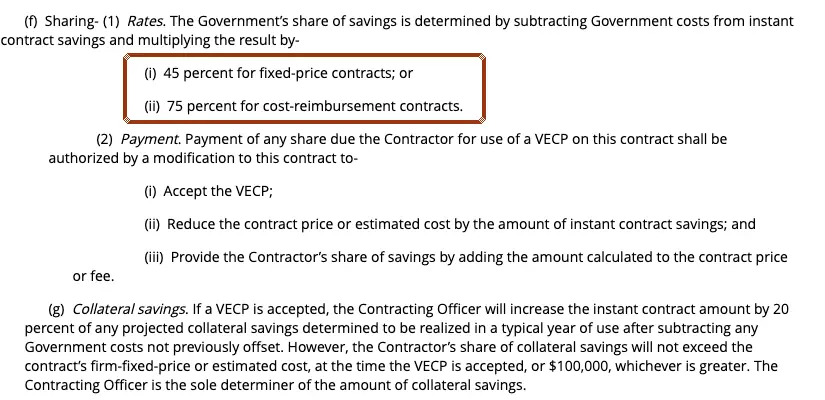
Read the direction of the percentage carefully. The construction clause states the government’s share, while the supply and service table in FAR 48.104-2 shows a 50/50 split for fixed-price incentive VECPs. Mixing up the two tables misstates a construction contractor’s share by 5 points.
| Step (illustration, fixed-price contract) | Arithmetic | Amount |
|---|---|---|
| Contractor’s cost reduction from the VECP | Estimated | $250,000 |
| Less contractor development and implementation cost | $250,000 minus $30,000 | $220,000 instant contract savings |
| Less government costs (testing, review) | $220,000 minus $10,000 | $210,000 net |
| Government share, 45% | $210,000 x 0.45 | $94,500 |
| Contractor share, remaining 55% | $210,000 minus $94,500 | $115,500 |
| Net contract price reduction | $220,000 minus $115,500 | $104,500 |
| Same VECP on a cost-reimbursement contract | $210,000 x 0.25 | $52,500 contractor share |
| Collateral savings, $8,000 a year in agency O&M | $8,000 x 0.20 | $1,600 added to the contract |
The collateral share in paragraph (g) is capped at the greater of the contract’s price or estimated cost, or $100,000, and Alternate I drops collateral sharing when tracking would cost more than it returns. Each VECP must carry the 7 items in paragraph (c), including a separate cost estimate for the existing and proposed requirement and the latest date a modification can issue and still capture the savings.
Thinning a kitchen floor from 3/8 to 1/4 inch saves material but drops its heat rating below dish machine rinse water, a trade-off covered in our guide to commercial kitchen flooring.
How we compiled this
We read 16 primary documents in October 2026: the AIA B101-2017 owner-architect agreement, OMB Circular A-131, 7 FAR and FAR Overhaul sections, GSA P-120 and GSAM 548.101, 23 CFR 627.5, 41 U.S.C. 1711, NIST IR 85-3273-40, 2 SAVE International pages and the U.S. Army’s USACE article. Both worked examples are our own arithmetic on stated, illustrative inputs. We excluded savings percentages that blogs attribute to SAVE but that we could not find on a SAVE page. On October 26, 2026 we re-checked FAR 52.248-3 (via eCFR), OMB A-131 and the NIST 2025 rates at source, added the private-contract section and moved federal-only rules lower on the page.
Frequently asked questions
Who leads a value engineering study?
A trained facilitator, usually a Certified Value Specialist (CVS) certified by SAVE International. GSA P-120 section 2.4 requires a CVS or an equivalent certification to lead a GSA value study. USACE lets a Value Methodology Associate (VMA) facilitate workshops on projects under $10 million and requires a CVS above that (U.S. Army, 2017). The team adds the architect, engineers, estimator and owner.
How long does a value engineering workshop take?
On USACE projects, a typical workshop runs up to 5 dedicated days with about 6 to 10 people, and the facilitator’s written report can take up to a month after the workshop ends (U.S. Army, December 2017). GSA studies produce two deliverables: a Results Report listing every alternative and a Final Report naming the ones selected (P-120, section 7.3).
Is value engineering required on private projects?
No law requires it; your contracts decide. AIA B101-2017 lists value analysis as a supplemental service in §4.1.1 that the owner assigns or leaves out, and §6.7 has the architect redesign to budget without added fee when bids come in high, unless market conditions were unforeseeable. A GMP agreement can add a savings split. Federal rules such as OMB Circular A-131 and FAR Part 48 bind only federal agencies and their contractors.
Does value engineering always lower the construction price?
No. OMB Circular A-131 says best value may require an initial expenditure of funds to meet basic functions at lower cost over the project’s life, and GSA P-120 section 7.1 allows first-cost budget increases when life-cycle reductions justify them. A change that adds $50,000 at bid but saves $8,000 a year in energy passes over 25 years: $8,000 x 17.413 is $139,304 at 3.0 percent.
What is a value engineering change proposal (VECP)?
A VECP is a contractor’s proposal to change the contract in a way that lowers cost without impairing essential functions. On federal construction it is governed by FAR 52.248-3: the contractor submits it to the Resident Engineer, the Contracting Officer gives a status notice within 45 calendar days, and an accepted VECP is paid through a contract modification that splits the net savings.
Who is responsible for the design after a value engineering change?
The designer of record stays responsible, so get its written acceptance of each change before approving it. On a private job under AIA B101-2017, revising documents after a high bid is part of the architect’s fee under §6.7, while other VE redesign may be an added service. On GSA projects, the architect-engineer must incorporate approved VE proposals and file an implementation report with the 90 percent documents (P-120, section 7.3). This is not legal advice.
Sources
- OMB Circular A-131 (Revised), Value Engineering, December 26, 2013, Office of Management and Budget. Accessed October 19, 2026.
- FAR 52.248-3, Value Engineering-Construction (Oct 2025), Acquisition.gov. Accessed October 19, 2026.
- FAR 48.202, Clause for construction contracts, Acquisition.gov. Accessed October 19, 2026.
- FAR 48.102, Policies, Acquisition.gov. Accessed October 19, 2026.
- FAR 48.104-2, Sharing acquisition savings, Acquisition.gov. Accessed October 19, 2026.
- FAR 2.101, Definitions (simplified acquisition threshold), Acquisition.gov. Accessed October 19, 2026.
- FAR Overhaul, Part 48 deviation text, Acquisition.gov. Accessed October 19, 2026.
- GSAM 548.101, General, General Services Administration. Accessed October 19, 2026.
- P-120, PBS Cost and Schedule Management Policy Requirements (PBS 1000.6B, November 7, 2022), General Services Administration. Accessed October 19, 2026.
- The value of Value Engineering in USACE projects, December 30, 2017, U.S. Army. Accessed October 19, 2026.
- 23 CFR 627.5, Applicable projects, eCFR. Accessed October 19, 2026.
- 41 U.S.C. 1711, Value engineering, Office of the Law Revision Counsel. Accessed October 19, 2026.
- NIST IR 85-3273-40, Energy Price Indices and Discount Factors for Life-Cycle Cost Analysis, 2025, National Institute of Standards and Technology. Accessed October 19, 2026.
- B101-2017, Standard Form of Agreement Between Owner and Architect (preview), AIA Contract Documents. Accessed October 26, 2026.
- About the Value Methodology and Certification, SAVE International. Accessed October 19, 2026.