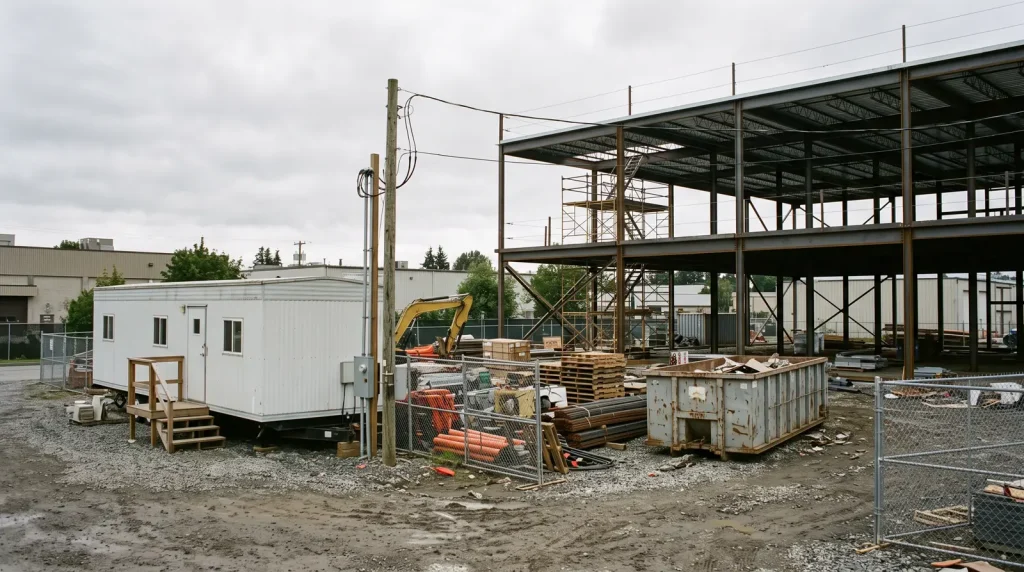
General conditions in construction means two things: the contract’s standard rulebook, such as AIA A201-2017, and the builder’s site overhead cost, which ran 5.18% to 7.16% of three North Carolina county GMPs from 2017 to 2026.
Key takeaways
- The general conditions document is a standard form: AIA A201-2017 for AIA contracts, EJCDC C-700 (2018 edition) for engineer-led projects, and the 52.236 clauses in FAR Subpart 36.5 for federal work.
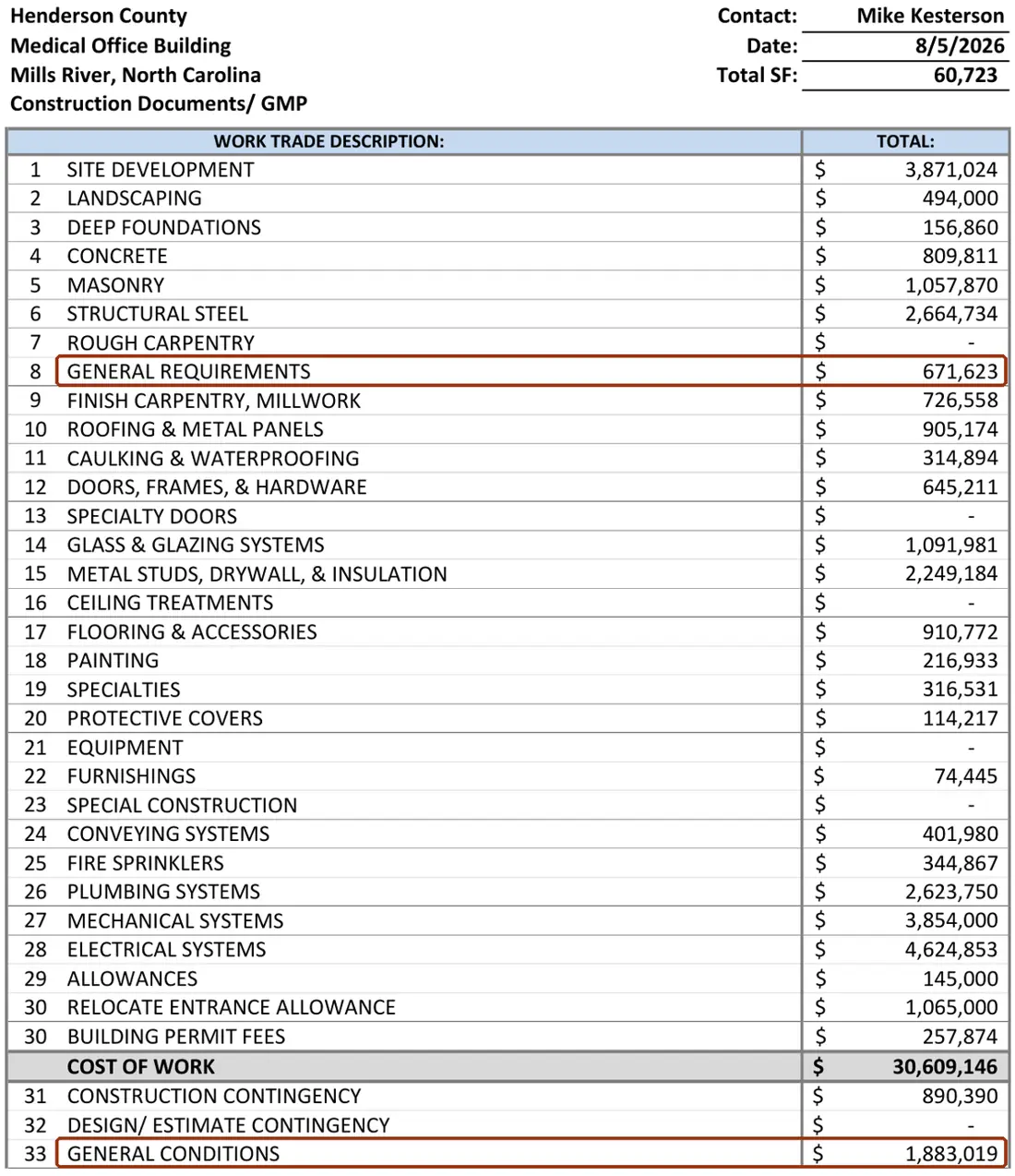
- Henderson County, North Carolina’s 2026 medical office GMP carried $1,883,019 of general conditions, 5.25% of construction cost, and 97% of it was site staff (board packet, September 8, 2026).
- General requirements are a different line: the same GMP priced them at $671,623 inside the cost of work, so the two together were 7.12% of construction cost.
- Washington law defines a GC/CM’s total contract cost as a fixed amount for specified general conditions, plus the maximum allowable construction cost, plus a percent fee (RCW 39.10.210(20)).
- A 2023 Seattle Public Schools audit questioned $246,680 of construction manager billings, including a trailer and cell phones the contract already paid for as general conditions (Ingraham audit, March 7, 2023).
What are general conditions in construction?
General conditions are either the standard terms that govern how a construction contract runs, or the builder’s job-site overhead: the staff, field office and services that keep a project going but never become part of the building. One contract can use both. Northern Arizona University’s October 22, 2025 CM at risk form calls its terms “CM@Risk General Conditions” and, in §6.3, pays “extended Construction General Conditions for a daily sum”.
| Meaning | What it is | Where you find it | Example | Source |
|---|---|---|---|---|
| 1. The document | Standard terms for changes, payment, time, claims, insurance and termination | Bound into the contract, ahead of the specifications | AIA A201-2017, ConsensusDocs 200, EJCDC C-700 | A201-2017 §1.1.1 |
| 2. The cost | Time-based site overhead: superintendent, project manager, field office, vehicles, phones | A separate line in a bid, GMP or schedule of values | $1,883,019 over 20 months, Mills River MOB, 2026 | Henderson County GMP |
Which standard forms are the general conditions document?
Four families cover most US commercial work. AIA A201-2017 is the general conditions document behind A101, A102 and A133 agreements; ConsensusDocs 200 folds them into the agreement; EJCDC C-700 serves engineer-led projects; and federal contracts use FAR 52.236 clauses. Public owners such as universities and the District of Columbia often write their own. Article-by-article detail is in our guide to AIA A201-2017 and its 15 articles.
| Form | Edition | How the general conditions are packaged | Typical use | Source |
|---|---|---|---|---|
| AIA A201 | 2017 | Separate document; §1.1.1 lists “Conditions of the Contract (General, Supplementary and other Conditions)” as a contract document | Private commercial work on AIA agreements | AIA sample, University of Maine System |
| ConsensusDocs 200 | Current edition sold by ConsensusDocs | “Integrates the general terms and conditions and the construction agreement terms into one document” | Lump-sum design-bid-build | ConsensusDocs |
| EJCDC C-700 | 2018 | Separate document, “the keystone of C-Series”; covers lump sum and cost-plus payment | Projects led by an engineer rather than an architect; EJCDC is the Engineers Joint Contract Documents Committee | NSPE |
| FAR 52.236 clauses (federal only) | FAC 2026-01, effective March 13, 2026 | Clauses prescribed in FAR 36.501 to 36.523, such as 52.236-2 differing site conditions and 52.236-12 cleaning up | Federal construction; many apply above the $350,000 simplified acquisition threshold | FAR Subpart 36.5; FAR 2.101 |
| Owner-written forms | Varies | An exhibit or attachment to the owner’s agreement | NAU “Exhibit A, CM@Risk General Conditions” (October 22, 2025 edition) | NAU form |
Owner changes to a standard form go in supplementary conditions, which A201 §1.1.1 lists beside the general conditions as a contract document. Which AIA agreements pair with A201 is mapped in our guide to AIA contract documents.
How do general conditions clauses turn into general conditions costs?
The two meanings are linked: duties written into the general conditions document are what the general conditions budget pays for. AIA A201-2017 requires a superintendent on site (§3.9.1), a construction schedule (§3.10.1), temporary utilities (§3.4.1) and continuous cleanup (§3.15.1). Each duty runs for the length of the job, which is why the cost is priced by the month.
| Duty in the document | Clause | Cost line it creates | Mills River MOB GMP, 2026 |
|---|---|---|---|
| Competent superintendent in attendance at the site | A201-2017 §3.9.1; FAR 52.236-6 | Superintendent salaries | $819,900 for general, project and assistant superintendents |
| Construction schedule submitted after award | A201-2017 §3.10.1; FAR 52.236-15 | Project manager and project engineer time | $894,210 for senior PM, PM, assistant PM and project engineer |
| Water, heat, utilities and temporary facilities | A201-2017 §3.4.1; FAR 52.236-14 | Field office, temporary power and water | Not in the general conditions line; priced elsewhere in the cost of work, which includes a $671,623 general requirements line |
| Premises kept free of waste; site cleaned at completion | A201-2017 §3.15.1; FAR 52.236-12 | Dumpsters, cleanup labor, final cleaning | Not in the general conditions line |
| Accident prevention | FAR 52.236-13 | Safety officer, first aid | $20,800 safety officer |
What is included in general conditions costs?
General conditions costs are mostly people. On Henderson County’s Mills River medical office building, staffing was $1,832,500 of the $1,883,019 general conditions line, or 97.3%, with the rest for staff vehicles, computers and cell phones. The District of Columbia’s CM at risk agreement lists the same core: field staff, fringes, payroll taxes, field office trailer, utilities, office equipment, delivery, first aid and BIM.
| General conditions item | Mills River MOB, 20 months (2026) | DC DGS agreement section |
|---|---|---|
| General, project and assistant superintendents | $112,200 + $469,800 + $237,900 = $819,900 | §9.1.12 construction staff |
| Senior PM, PM, assistant PM, project engineer | $93,120 + $275,400 + $313,560 + $212,130 = $894,210 | §9.1.12 construction staff |
| Safety officer | $20,800 | Not listed; §9.1.20 covers a first aid facility |
| Project executive | $7,590 | §9.1.12, allowed as an exception |
| Office support: clerical, accounting, safety | $90,000 | §9.1.12 accounting services |
| Staff vehicles, computers, cell phones | $50,466 | §9.1.18 office equipment |
| Principal in charge | $0, marked “Part of Fee” | §9.2.9 home office costs go in the fee |
| Total | $1,883,019 | Capped under §8.2 |
The DC list comes from the DC Department of General Services CM at risk agreement for West Elementary School, contract DCAM-19-CS-RFP-0060, §9.1.11 to §9.1.21. It puts the field office trailer, its installation and removal, and its utility charges inside general conditions, while Mills River’s general conditions sheet lists only staff and staff support. Neither placement is wrong; the contract has to say which.
General conditions vs general requirements vs fee: where does each cost go?
Three buckets hold a builder’s non-trade money. General requirements are Division 01 work items such as temporary facilities and cleanup, priced inside the cost of work. General conditions are time-based site staff and support. The fee covers home office overhead and profit. On the 2026 Mills River GMP they were $671,623, $1,883,019 and $1,295,978, with the 3.75% fee charged on top of general conditions.
| Bucket | What goes in it | How it is priced | Mills River MOB, 2026 | Source |
|---|---|---|---|---|
| General requirements | Temporary facilities, fencing, temporary wiring, dumpsters, cleanup | Lump sum or unit price, like a trade | $671,623 (line 8, inside the $30,609,146 cost of work) | UFGS 01 50 00, August 2026 |
| General conditions | Superintendents, project managers, engineers, field staff support | Monthly rates times duration; lump sum or capped | $1,883,019 (line 33) | Henderson County GMP |
| Fee | Home office overhead, principal in charge, profit | Percentage of cost or fixed amount | $1,295,978 (3.75% of $34,559,409) | Henderson County GMP |
Washington’s GC/CM statute draws the same lines for public work. RCW 39.10.210(13) puts “negotiated support services” such as hoisting, safety enforcement, toilets, temporary heat, cleanup and trash removal inside the maximum allowable construction cost, while specified general conditions are a separate fixed amount. How fees are structured and audited under AIA A102 is covered in our guide to cost-plus contracts and GMP fees.
What percentage of contract value are general conditions?
In the four public GMPs we read, the line labelled general conditions ran from 2.79% to 7.16% of the GMP total. The low figure is misleading on its own: Seattle’s Ingraham GMP carried a separate $1,611,908 of negotiated support services, and the two together were 9.00%. Compare the bucket contents before you compare percentages, and check whether the base is the GMP or the cost of work.
| Project (owner, state) | GMP date | General conditions | Share of GMP | Per month | What else sits outside the line | Source |
|---|---|---|---|---|---|---|
| Emergency Services HQ, 52,250 sq ft (Henderson County, NC) | June 30, 2017 | $840,000 | 7.16% of $11,726,445 | $60,000 (14 months) | Final cleaning, $18,600, priced separately | Board packet, July 19, 2017 |
| Edneyville Elementary, 89,635 sq ft (Henderson County, NC) | April 4, 2018 | $1,169,965 | 5.35% of $21,852,605 | About $52,400 (22.3 months, CB&C arithmetic) | Insurance 1.30%, bond 0.80% | Board packet, April 18, 2018 |
| Ingraham HS classroom addition (Seattle Public Schools, WA) | Contract dated March 2, 2017 | $724,986 specified general conditions | 2.79% of $25,969,950 | Not stated | Negotiated support services, $1,611,908 (6.21%); the fixed general conditions also included liability insurance and the bond | SPS audit, March 7, 2023 |
| Mills River medical office building, 60,723 sq ft (Henderson County, NC) | August 5, 2026 | $1,883,019 | 5.18% of $36,355,386 (5.25% of construction cost) | $94,151 (20 months) | General requirements, $671,623 (1.87%) | Board packet, September 8, 2026 |
The base changes the answer for the same dollars. Edneyville’s $1,169,965 of general conditions was 6.00% of its $19,492,757 cost of work but 5.35% of the $21,852,605 GMP, the same ratio our guide to construction management companies and their fees reports. Trade subcontractors carry their own: the mechanical contractor on Seattle’s Northgate Elementary had $357,525 of specified general conditions, 4.7% of its $7,553,372 total (SPS audit, May 17, 2024).
General conditions are priced by time and staff, not floor area: Mills River’s line was “based on a 20 month duration” (GMP note 12) and built from 11 staffing rows. That is why it came to $31.01 per square foot against $16.08 for the 14-month emergency services headquarters in 2017. Ask each bidder for months on site and a staffing chart, then divide.
How are general conditions priced in a GMP or a bid?
The public contracts we read price general conditions in five ways. A fixed lump sum or fixed monthly amount puts overrun risk on the builder; actual cost up to a not-to-exceed cap shares it; a percentage of construction cost rises with change orders. Washington’s 2023 GC/CM best practice draft allows a “monthly fixed not-to-exceed amount or a fixed percentage of the construction cost amount” for specified general conditions.
| Method | How it pays | Who carries an overrun | Public example |
|---|---|---|---|
| Fixed lump sum | Set amount, billed by percent complete | Builder | Seattle Public Schools Ingraham GMP: $724,986 “fixed-price” specified general conditions |
| Fixed monthly amount | Rate times months on site | Builder, unless time is extended | Washington CPARB draft, March 29, 2023 |
| Actual cost up to a cap | Reimbursed at cost, never above the cap | Builder above the cap; owner keeps savings below it | DC DGS §8.2 “Maximum Cost of General Conditions”; Oregon State University GMP amendment line 2(b) |
| Billable rates inside a GMP | Unit rates per role from the GMP breakdown sheet | Builder above the GMP | Mills River MOB note 11: “billed on a billable rate basis” |
| Percentage of construction cost | Fixed percent of the cost amount | Owner, as cost grows | Washington CPARB draft, as an allowed bid format |
The same CPARB draft says bidding general conditions up front stops a builder from bidding a low fee and raising general conditions at the GMP stage, and that billing an item in general conditions and again through a trade package is “double-dipping”, a “serious violation”. On lump-sum bids, line both buckets up against each bidder’s schedule, as our guide to comparing construction bids sets out.
What are extended general conditions when a job runs late?
Extended general conditions are the extra site overhead a builder claims when the contract time grows, usually priced as a daily or monthly rate times the added days. Contracts limit them: Northern Arizona University’s 2025 form pays a daily sum only for owner-caused delay, set before the change order, and the DC agreement adjusts its cap only when changes push completion 30 or more days past Substantial Completion.
| Step | Input | Result |
|---|---|---|
| 1. Monthly general conditions | $1,883,019 / 20 months (Mills River GMP note 12) | $94,151 per month |
| 2. Daily rate | $94,151 / 30.4375 days per month | $3,093 per calendar day |
| 3. Owner-caused delay | 45 calendar days (illustration) | $139,196 |
| 4. Fee, if the contract allows it on changes | 3.75% of $139,196 | $5,220 |
| 5. Change order request | Steps 3 + 4 | $144,416 |
The worked example is CB&C arithmetic on the public Mills River rates, not a figure from the county. A real claim should price only the roles still on site; a project engineer who has left for another job is not a delay cost. For weather-exposed work, our weather workday index for 56 US metros shows how many working days a city loses in a typical year.
How do owners audit general conditions?
Owners audit general conditions by checking three things: that each billed role and month matches the agreed staffing plan, that nothing paid as general conditions is billed again elsewhere, and that home office costs stay in the fee. Seattle Public Schools’ March 7, 2023 Ingraham audit questioned $246,680 of support services billings, including $35,991 for items the contract placed in fixed-price general conditions.
- Get the general conditions breakdown sheet with the GMP or bid: each role, monthly rate and months, like Mills River’s 11 staffing rows.
- Agree a cost allocation matrix before work starts that puts every item in one bucket, as the Washington CPARB draft recommends publishing with the solicitation.
- Each month, match general conditions billed on the pay application to payroll and the staffing plan; our AIA G702 pay application guide shows where those lines sit.
- Search labor rates and trade billings for markups that duplicate general conditions items: safety, small tools, consumables, phones, trailers.
- Confirm the retainage rule: DC holds 10% on general conditions costs until 50% is invoiced; state public-work caps are compared in our prompt payment and retainage table.
- At closeout, reconcile actual cost against the cap or lump sum and take any savings by deductive change order.
| Questioned item (Ingraham, 2023) | Amount | Why the auditor questioned it |
|---|---|---|
| Safety add-on in labor rates (2%) | $18,687 | Duplicates general conditions, which include “all aspects of safety implementation” (contract article 1.0.37) |
| Small tools add-on (7%) | $65,237 | Not a reimbursable labor element; tools already billed at actual cost |
| Consumables add-on (3%) | $27,926 | Same as small tools |
| Construction photos | $6,392 | The contract’s cost matrix lists photographic documentation as specified general conditions |
| Construction office trailer | $10,099 | Article 6.5.7 lists office trailers as specified general conditions, but the cost matrix put field offices in support services; the auditor flagged the conflict for the owner to decide |
| Field office telephone and internet | $496 | Article 6.5.4 puts site telephone service in specified general conditions; the contractor agreed it was billed in error |
| Cell phones in labor rates | $317 | Cell phones are specified general conditions under article 6.5.7 |
The auditor estimated the questioned costs could produce a deductive change order of up to $200,908 against the $28,574,711 contract value, and noted the contractor might dispute the findings (Seattle Public Schools audit). This page is general information, not legal or accounting advice; ask your auditor to test the contract’s own cost definitions.
Which general conditions setup fits your project?
Match the pricing method to how much you know when you sign. If drawings are finished and you are taking lump-sum bids, general conditions sit inside the price and your job is to see them broken out. If you sign a GMP during design, decide between a fixed amount and a capped reimbursement, and write the delay rate in before anyone needs it, as NAU’s 2025 form does in §6.3.
| If | Then | Threshold or rule | Source |
|---|---|---|---|
| Lump-sum bid on complete drawings | Require general conditions and general requirements as separate schedule of values lines | Owner reviews each monthly billing against progress | Schedule of values guide |
| GMP signed during design, staffing plan and duration firm | Fixed lump sum or fixed monthly amount | Specified general conditions as a fixed amount | RCW 39.10.210(20) |
| GMP signed early, duration uncertain | Actual cost up to a not-to-exceed cap | Cap adjusts only if changes add 30 or more days | DC DGS §8.2 |
| Phased, weather-exposed or occupied-building work | Add a daily extended general conditions rate | Paid only for owner-caused delay, set before the change order | NAU CM@Risk form §6.3 |
| Builder bids a low fee with high general conditions | Evaluate fee plus general conditions together | Treat fee and general conditions as one number at selection | Washington CPARB draft, 2023 |
| Federal contract | Expect FAR 52.236 clauses as the general conditions | Many clauses required above $350,000 | FAR Subpart 36.5 |
CM at risk selection itself, including how owners weigh fee and general conditions at interview, is covered in our guide to construction management at risk.
Site offices are often the largest single general conditions line; our construction office trailers guide prices rent against purchase, and contingency is kept separate as shown in our construction contingency guide.
How we compiled this
In November 2026 we read 16 primary documents: 3 Henderson County, North Carolina GMP board packets (2017, 2018, 2026), 2 Seattle Public Schools billing audits (2023, 2024), 3 public owner contract forms (DC DGS, Northern Arizona University, Oregon State University), the Washington statute and CPARB draft, the AIA A201-2017 sample, ConsensusDocs and EJCDC publisher pages, FAR Subpart 36.5 and FAR 2.101, and UFGS 01 50 00. Percentages, monthly rates and the delay example are CB&C arithmetic on those figures; we did not survey contractors or audit any project.
Frequently asked questions
What is the difference between general conditions and general requirements?
General conditions are the builder’s time-based site staff and support, priced by the month. General requirements are Division 01 work items such as temporary facilities, fencing, dumpsters and cleanup, priced like a trade. Henderson County’s 2026 Mills River GMP carried them as separate lines: $1,883,019 of general conditions and $671,623 of general requirements. In contract language, general conditions can also mean the rulebook itself, such as AIA A201-2017.
Are general conditions overhead?
General conditions are job-site overhead: costs that exist because one project is running, such as its superintendent, field office and staff vehicles. Home office overhead, such as headquarters executives and accounting, belongs in the fee. The DC Department of General Services CM at risk agreement says so in §9.2.9, and Henderson County’s 2026 Mills River GMP marks its principal in charge as “Part of Fee”.
Is the superintendent part of general conditions?
Yes, in the cost sense. AIA A201-2017 §3.9.1 requires a competent superintendent in attendance at the site, and that salary is usually the largest general conditions item. On Henderson County’s 2026 Mills River GMP, the general, project and assistant superintendents totalled $819,900 of the $1,883,019 general conditions budget, about 44%, for a 20-month build.
Does the contractor's fee apply to general conditions?
Usually, when the contract says so. Oregon State University’s CM/GC GMP amendment applies the fee percentage to the cost of work plus general conditions, and Henderson County’s 2026 Mills River GMP charged its 3.75% fee on a $34,559,409 base that included $1,883,019 of general conditions. Ask whether the fee also applies to extended general conditions on change orders before you sign.
What are extended general conditions?
Extended general conditions are the added site overhead when contract time grows, priced as a daily or monthly rate times the added days. Northern Arizona University’s October 22, 2025 CM at risk form pays them as a daily sum only for owner-caused delay. At the Mills River GMP rate of $94,151 a month, a 45-day owner-caused delay works out to about $139,196 before fee, by CB&C arithmetic.
What are supplementary conditions in construction?
Supplementary conditions are the owner’s written changes and additions to a standard general conditions form, bound into the contract beside it. AIA A201-2017 §1.1.1 lists “Conditions of the Contract (General, Supplementary and other Conditions)” among the contract documents. Owners use them to set insurance limits, retainage, state law requirements and similar project terms without retyping the printed form.
Sources
- Henderson County, NC Board of Commissioners, Mills River Medical Office Building GMP, meeting of September 8, 2026, accessed 2026-11-01.
- Henderson County, NC Board of Commissioners, Edneyville Elementary GMP, meeting of April 18, 2018, accessed 2026-11-01.
- Henderson County, NC Board of Commissioners, Emergency Services Headquarters GMP, meeting of July 19, 2017, accessed 2026-11-01.
- Seattle Public Schools, Ingraham High School Classroom Addition close-out audit, March 7, 2023, accessed 2026-11-01.
- Seattle Public Schools, Northgate Elementary mechanical contractor audit, May 17, 2024, accessed 2026-11-01.
- Washington State Legislature, RCW 39.10.210 Definitions, accessed 2026-11-01.
- Washington CPARB GC/CM Committee, GCCM Best Practice, Total Contract Cost Chapter (draft), March 29, 2023, accessed 2026-11-01.
- DC Department of General Services, Construction Management At-Risk Agreement, DCAM-19-CS-RFP-0060, accessed 2026-11-01.
- Northern Arizona University, Standard Form Agreement Between Owner and CM@Risk, October 22, 2025 edition, accessed 2026-11-01.
- Oregon State University, CM/GC Sample GMP Amendment, accessed 2026-11-01.
- American Institute of Architects, A201-2017 General Conditions of the Contract for Construction (sample), posted by University of Maine System, accessed 2026-11-01.
- ConsensusDocs, ConsensusDocs 200 Owner and Constructor Agreement (Lump Sum), accessed 2026-11-01.
- NSPE, EJCDC Contract Documents (C-700, 2018 edition), accessed 2026-11-01.
- Acquisition.gov, FAR Subpart 36.5, Contract Clauses, FAC 2026-01, accessed 2026-11-01.
- Acquisition.gov, FAR 2.101 Definitions (simplified acquisition threshold), accessed 2026-11-01.
- USACE, NAVFAC and AFCEC, UFGS 01 50 00 Temporary Construction Facilities and Controls, August 2026, accessed 2026-11-01.