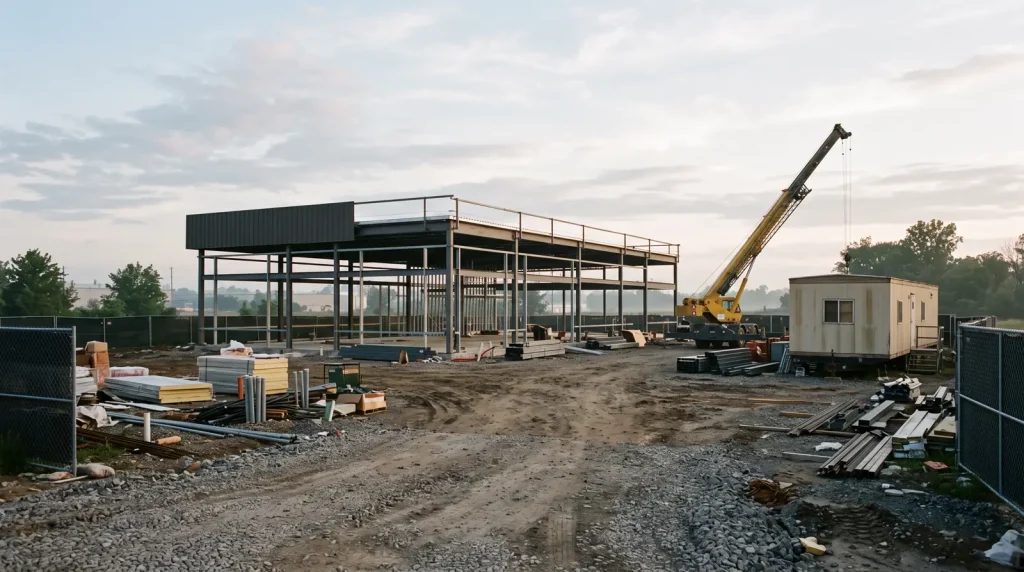
A construction schedule is the contractor’s time plan for a project: every activity, its duration and its logic links, calculated so the longest chain, the critical path, sets the finish date, and updated as work proceeds.
Key takeaways
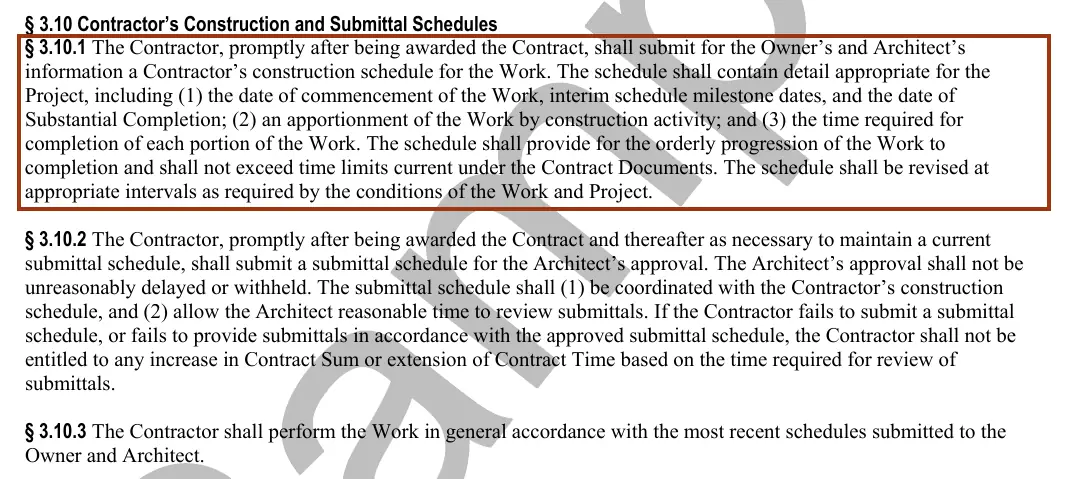
- AIA A201-2017 §3.10.1 requires a schedule “promptly after being awarded the Contract” showing commencement, interim milestones, Substantial Completion and the time for each activity, revised “at appropriate intervals”; it sets no day count, no update frequency and no CPM requirement.
- Public owners write the numbers in: UFGS 01 32 01.00 10 (August 2026) wants a preliminary schedule in 15 calendar days, a full one in 42, monthly updates and activities of 20 workdays or less, and lets the government withhold 10 percent of each pay request until directed revisions are made.
- Texas owners registered 17,587 new-construction projects costing $50,000 or more from January 2025 to October 2026; their planned construction time had a median of 8.0 months, from 5.0 months under $500,000 to 21.2 months at $50 million or more (TDLR TABS, CB&C analysis, November 2026).
- Apartment buildings with 20 or more units took 19.1 months from start to completion in 2025, up from 14.3 months in 2015 (Census Survey of Construction).
- In the 13-activity example below, steel fabrication, erection, MEP rough-in, drywall, finishes and closeout form a 130-working-day critical path; a 15-day late steel delivery moves the finish 15 days, while a 30-day late switchgear delivery moves it 0.
- Time claims run on short clocks: 21 days for notice under A201 §15.1.3.1 and 10 days under FAR 52.249-10; weather counts only when it was abnormal for the period (A201 §15.1.6.2).
What is a construction schedule?
A construction schedule turns the contract’s completion date into dated work. AIA A201-2017 §3.10.1 lists its minimum content: the date of commencement, interim milestone dates, the date of Substantial Completion, the Work split by construction activity and the time for each portion. On commercial and public jobs the schedule is usually a critical path method (CPM) network: activities joined by logic, so a late activity shows its effect on the finish date.
The schedule is separate from the schedule of values. The schedule of values splits the contract sum for billing; the construction schedule splits the contract time. Many owners tie the two, and Washington State’s template (§3.01 I) asks the contractor to coordinate them. Our guide to the schedule of values covers the money side.
| Schedule type | What it shows | Typical use | Where a contract asks for it |
|---|---|---|---|
| Milestone or summary schedule | A handful of dates: start, dry-in, substantial completion | Owner reports, lender draws, bids | AIA A201-2017 §3.10.1 (commencement, interim milestones, Substantial Completion) |
| Bar chart (Gantt) | One bar per activity on a time scale | Small or limited-scope jobs; quick review | Washington DES 01 3216 §3.02 (bar chart allowed for limited scope) |
| Critical path method (CPM) network | Activities, logic links, early and late dates, float | Commercial and public work; delay analysis | UFGS 01 32 01.00 10 §3.5.4.3; Washington DES §3.03 |
| Look-ahead schedule | The next 2 to 3 weeks of work in detail | Weekly trade coordination | UFGS 01 32 17.00 20 §1.3 (weekly, activities of 5 working days or less) |
| Recovery schedule | How lost time will be made up: shifts, crews, resequencing | When an update shows the job is late | Yale 01 32 00 §1.6 E; FAR 52.236-15(b) |
| As-built schedule | Actual start and finish of every activity | Closeout, claims | UFGS 01 32 17.00 20 §1.4.3 |
What activities go in a commercial construction schedule?
A commercial schedule needs every activity that can delay the finish, which includes paperwork and deliveries as well as field work. Public specs spell this out: UFGS 01 32 17.00 20 (May 2025) names nine activity groups it expects to see: design, preconstruction, procurement, government, quality control, construction, turnover, HVAC testing and commissioning (§1.10.1.5). The table groups them by phase in the order they usually happen.
| Phase | Activities to list | Common driver of the dates | Rule or data point |
|---|---|---|---|
| Preconstruction and procurement | Notice to proceed, permits, submittals, long-lead orders (switchgear, steel, elevators, rooftop units) | Submittal review and fabrication time | UFGS 01 32 01.00 10 §3.3.4: long lead = over 90 calendar days; A201 §3.10.2 submittal schedule |
| Sitework | Mobilize, clearing, grading, underground utilities, paving base | Rain days and soil conditions | NOAA normals: 52.2 days a year with 0.10 inch of rain or more at Dallas-Fort Worth |
| Foundations and structure | Footings, slab on grade, steel or tilt-up panels, deck | Steel delivery, concrete cure, inspections | Example network below: steel fabrication is on the critical path |
| Envelope (dry-in) | Roofing, exterior walls, storefront, doors | Weather and material lead times | Dry-in lets interior trades start in the example network |
| MEP rough-in and interiors | Plumbing, HVAC, electrical rough-in, framing, drywall, ceilings | Inspections between trades | UFGS 01 32 17.00 20 §1.10.1.5.6: on-site activities no longer than 20 working days |
| Finishes and equipment | Flooring, paint, fixtures, owner equipment | Owner selections and deliveries | Washington DES 01 3216 §3.01 G to H: finish decision dates, owner-furnished delivery dates |
| Commissioning and closeout | Permanent power, testing, inspections, certificate of occupancy, punch list | Utility energization and final inspection | A201 §9.8 substantial completion; UFGS 01 32 17.00 20 §1.10.1.5.9 commissioning activities |
The phases follow the owner-side sequence in our commercial construction process guide; the schedule adds durations and logic to each step.
Construction schedule template you can copy
The template below is the 13-activity network used for the critical path example: a one-story steel-frame commercial building with a switchgear order. Durations are example inputs in working days, not benchmarks. Copy the six columns into a spreadsheet, replace the rows with your activities and fill the last two columns from your contract and specification.
| ID | Activity | Duration (working days) | Predecessors (link type) | Responsible party | Spec section |
|---|---|---|---|---|---|
| A | Mobilize and site prep | 10 | Notice to proceed | ||
| B | Foundations and slab | 20 | A (FS) | ||
| C | Steel fabrication and delivery | 40 | Notice to proceed | ||
| D | Underground utilities | 10 | A (FS) | ||
| E | Erect steel and deck | 15 | B (FS), C (FS) | ||
| F | Roofing | 15 | E (FS) | ||
| G | Exterior walls and storefront | 20 | E (FS) | ||
| H | MEP rough-in | 25 | D (FS), E (FS) | ||
| I | Switchgear procurement | 70 | Notice to proceed | ||
| J | Framing, drywall and ceilings | 20 | F (FS), H (FS) | ||
| K | Set switchgear and energize | 5 | H (FS), I (FS) | ||
| L | Finishes and equipment | 20 | G (FS), J (FS) | ||
| M | Inspections, commissioning, punch | 10 | K (FS), L (FS) |
FS means finish-to-start: the successor starts when the predecessor finishes. Washington DES 01 3216 (§1.06 B) also asks for the specification section on each activity, which makes the schedule easier to check against the submittal log described in our guide to submittals in construction.
How long does commercial construction take?
Planned construction time grows with project cost. Across 17,587 Texas new-construction registrations with an estimated cost of $50,000 or more, the median planned duration was 8.0 months, and half the projects fell between 5.0 and 12.0 months. The data are the start and completion dates owners enter when they register a project with the Texas Department of Licensing and Regulation (TDLR), which is required at $50,000 or more (TDLR accessibility FAQ).
| Estimated cost (registration) | Projects | 25th percentile (months) | Median (months) | 75th percentile (months) | Median estimated cost |
|---|---|---|---|---|---|
| $50,000 to $499,999 | 4,788 | 3.0 | 5.0 | 8.0 | $220,000 |
| $500,000 to $1.99 million | 6,299 | 5.0 | 7.0 | 11.0 | $1,000,000 |
| $2 million to $9.99 million | 4,316 | 7.0 | 10.1 | 12.0 | $3,600,000 |
| $10 million to $49.9 million | 1,574 | 11.9 | 14.0 | 18.0 | $18,000,000 |
| $50 million or more | 610 | 15.0 | 21.2 | 26.6 | $99,132,500 |
Building type changes the picture as much as size. Restaurants planned a median of 4.6 months, warehouses 8.0 and schools 12.1. Hotels are slower still: our hotel construction guide found a median of 17.2 months across 62 new Texas hotel registrations of 15,000 square feet or more.
| Building type (from project name) | Projects | 25th percentile (months) | Median (months) | 75th percentile (months) | Median estimated cost |
|---|---|---|---|---|---|
| Warehouse or distribution | 697 | 4.9 | 8.0 | 12.0 | $850,000 |
| Restaurant | 592 | 3.5 | 4.6 | 6.7 | $950,000 |
| School (elementary to high) | 501 | 6.0 | 12.1 | 16.5 | $5,400,000 |
| Office building | 198 | 4.2 | 7.8 | 12.0 | $800,000 |
| Retail or shopping center | 974 | 5.5 | 8.0 | 12.0 | $1,200,000 |
| Fire station | 63 | 12.0 | 12.0 | 14.0 | $8,145,000 |
| Car wash | 130 | 6.1 | 8.0 | 9.3 | $1,250,000 |
Large jobs overlap phases instead of running them end to end. Two TDLR records for one data center building in Taylor County, Texas show it: the 738,382 square foot core and shell (TABS2026008318) is planned from March 11, 2026 to May 3, 2027, and the tenant improvement inside it (TABS2026008329) from May 2, 2026 to November 11, 2027. In schedule terms that is a start-to-start link with about a 7-week lag. Our data center construction projects tracker covers more builds of this kind.
For comparison, Texas alteration projects (renovations and build-outs) planned a median of 3.7 months across 26,448 registrations, and additions 6.4 months across 1,966. These are planned dates, not actual ones; the national record of actual time comes from the Census Bureau.
The Census Bureau’s Survey of Construction tracks actual start-to-completion time for new residential buildings. Its 20-plus-unit category, mostly apartment buildings and the largest building class in the survey, averaged 19.1 months for buildings completed in 2025, 4.8 months longer than in 2015. Single-unit houses rose from 6.3 to 7.4 months over the same years.
| Year completed | Buildings with 20 units or more (months) | Single-unit buildings (months) |
|---|---|---|
| 2015 | 14.3 | 6.3 |
| 2016 | 15.0 | 6.6 |
| 2017 | 15.7 | 6.5 |
| 2018 | 17.4 | 6.7 |
| 2019 | 17.2 | 7.0 |
| 2020 | 17.7 | 6.8 |
| 2021 | 17.2 | 7.2 |
| 2022 | 18.1 | 8.3 |
| 2023 | 18.9 | 8.6 |
| 2024 | 19.4 | 7.7 |
| 2025 | 19.1 | 7.4 |
How do you build a construction schedule, step by step?
Building a schedule takes 8 steps, from the activity list to the accepted baseline. Each step below carries the rule from a public specification that sets the standard, so a reviewer on an owner’s team can check the contractor’s file against the same list.
- Break the work into activities. Use the drawings and specification sections, one activity per crew, area and system. Federal specs cap on-site activities at 20 workdays (UFGS 01 32 01.00 10 §3.3.2); a 25-day MEP rough-in would be split by floor or area.
- Add procurement and approvals. List submittal, review, fabrication and delivery for every item with a lead time over 90 calendar days (UFGS 01 32 01.00 10 §3.3.4), and tie them to the submittal schedule that A201 §3.10.2 requires.
- Link the logic. Give every activity at least one predecessor and one successor; UFGS 01 32 17.00 20 §1.10.1.2 bans open-ended (dangling) logic and needs Contracting Officer approval for leads and lags. Most links are finish-to-start; use start-to-start or finish-to-finish only where crews overlap.
- Estimate durations. Duration = quantity divided by crew output per day, checked against the trade contractor’s own number. Record the basis next to the activity.
- Assign calendars. A five-day week with federal holidays is the UFGS default; weather-sensitive activities get a weather calendar, explained in the weather section below.
- Run the forward and backward pass. The software, or the table method shown below, gives early and late dates, float and the critical path.
- Check the result against the contract. The calculated finish must not exceed the Contract Time (A201 §3.10.1); A201 §8.1.4 counts calendar days unless the contract says otherwise.
- Submit, accept and freeze the baseline, then update. Record actual dates and remaining durations each period, monthly at a minimum on USACE work (UFGS 01 32 01.00 10 §3.4.3).
How do you find the critical path?
The critical path is the longest chain of linked activities from start to finish; UFGS 01 32 01.00 10 §3.5.4.3 defines it as “the longest path”. Two passes find it. The forward pass gives each activity its early start (the latest early finish of its predecessors) and early finish (early start plus duration). The backward pass, run from the finish, gives its late finish (the earliest late start of its successors) and late start.
Total float is late start minus early start. Every activity with 0 total float is critical. In the example, the forward pass ends at day 130, and the critical path is C, E, H, J, L, M: 40 + 15 + 25 + 20 + 20 + 10 = 130 working days.
| ID | Activity | Duration | Predecessors | Early start | Early finish | Late start | Late finish | Total float | Free float | Critical |
|---|---|---|---|---|---|---|---|---|---|---|
| A | Mobilize and site prep | 10 | None | 0 | 10 | 10 | 20 | 10 | 0 | No |
| B | Foundations and slab | 20 | A | 10 | 30 | 20 | 40 | 10 | 10 | No |
| C | Steel fabrication and delivery | 40 | None | 0 | 40 | 0 | 40 | 0 | 0 | Yes |
| D | Underground utilities | 10 | A | 10 | 20 | 45 | 55 | 35 | 35 | No |
| E | Erect steel and deck | 15 | B, C | 40 | 55 | 40 | 55 | 0 | 0 | Yes |
| F | Roofing | 15 | E | 55 | 70 | 65 | 80 | 10 | 10 | No |
| G | Exterior walls and storefront | 20 | E | 55 | 75 | 80 | 100 | 25 | 25 | No |
| H | MEP rough-in | 25 | D, E | 55 | 80 | 55 | 80 | 0 | 0 | Yes |
| I | Switchgear procurement | 70 | None | 0 | 70 | 45 | 115 | 45 | 10 | No |
| J | Framing, drywall and ceilings | 20 | F, H | 80 | 100 | 80 | 100 | 0 | 0 | Yes |
| K | Set switchgear and energize | 5 | H, I | 80 | 85 | 115 | 120 | 35 | 35 | No |
| L | Finishes and equipment | 20 | G, J | 100 | 120 | 100 | 120 | 0 | 0 | Yes |
| M | Inspections, commissioning, punch | 10 | K, L | 120 | 130 | 120 | 130 | 0 | 0 | Yes |
Two results surprise owners. First, the critical path starts with a procurement activity, not field work: steel fabrication (40 days) is longer than site prep plus the slab (30 days), so the site crews have 10 days of float. Second, the 70-day switchgear order looks like the longest bar but carries 45 days of float, because permanent power is not needed until MEP rough-in is done at day 80 and closeout starts at day 120.
On a calendar, 130 working days from a notice to proceed on Monday, March 1, 2027 end on Friday, August 27, 2027; with the three federal holidays in that window (Memorial Day on May 31, Juneteenth observed on June 18 and Independence Day observed on July 5, per OPM) the finish is Wednesday, September 1, 2027. That is 185 calendar days, the unit A201 §8.1.4 uses unless the contract defines another.
What is float, and who owns it?
Float is the time an activity can slip before it delays something else. Total float is measured against the project finish; free float is measured against the next activity’s early start. In the example, site prep (A) has 10 days of total float but 0 free float: any slip delays the slab’s early start, but only a slip over 10 days delays completion.
| Event in the example | Activity total float | Effect on the day-130 finish | Arithmetic |
|---|---|---|---|
| Site prep (A) runs 8 days long | 10 | None; float on A and B drops to 2 | 8 is less than 10 |
| 5 rain days lost on the slab (B) | 10 | None | 5 is less than 10 |
| Roofing (F) finishes 12 days late | 10 | Finish moves to day 132 | 12 minus 10 = 2 |
| Switchgear (I) arrives 30 days late | 45 | None; its float drops to 15 | 30 is less than 45 |
| Switchgear (I) arrives 50 days late | 45 | Finish moves to day 135 | 50 minus 45 = 5 |
| Steel (C) arrives 15 days late | 0 | Finish moves to day 145 | 15 minus 0 = 15 |
Ownership of float decides who benefits when a delay eats it. All four specifications reviewed treat it as shared: UFGS 01 32 01.00 10 §3.10 (“available for Contractor and Government use”), UFGS 01 32 17.00 20 §1.12, Washington DES 01 3216 §3.03 C.10 (“Neither the Contractor nor the Owner have exclusive right”) and Yale 01 32 00. AIA A201-2017 says nothing about float, so on a private job the answer depends on what the parties add to the contract.
What do contracts require of the schedule?
The standard private form asks for very little, and public owners add the numbers. AIA A201-2017 §3.10 requires a schedule “promptly” after award, revised “at appropriate intervals”, and §3.10.3 makes the contractor perform “in general accordance with the most recent schedules submitted”. The table compares that with one federal clause, two federal guide specifications, a state template and a private university standard.
| Document (owner type) | First schedule due | Updates | Activity length limit | Float | Teeth | Source |
|---|---|---|---|---|---|---|
| AIA A201-2017 (private, standard form) | “Promptly after being awarded the Contract” (§3.10.1) | “At appropriate intervals” (§3.10.1) | None | Not addressed | Work must follow the most recent schedule (§3.10.3) | A201-2017 §3.10 |
| FAR 52.236-15 (federal clause) | 5 days after work starts, or as the Contracting Officer sets | Actual progress entered on the chart as directed | None | Not addressed | Progress payments withheld; extra shifts at no cost; default termination (c) | FAR 52.236-15 |
| UFGS 01 32 01.00 10, Aug 2026 (USACE guide spec) | Preliminary in 15 calendar days (first 90 days); initial in 42 | Monthly at a minimum (§3.4.3) | 20 workdays or 30 calendar days (§3.3.2) | Belongs to the project (§3.10) | 10 percent of each pay request may be withheld until directed revisions are made (§3.2.3) | UFGS 01 32 01.00 10 |
| UFGS 01 32 17.00 20, May 2025 (NAVFAC guide spec) | Baseline in 30 calendar days after award (§1.2.2) | Monthly, due 5 calendar days after the data date (§1.4.2) | 20 working days on site; 60 calendar days procurement | Not exclusive to either party (§1.12) | No construction start or invoices beyond bonds until baseline accepted | UFGS 01 32 17.00 20 |
| Washington DES 01 3216, Feb 2025 (state template) | Preliminary in 14 days after NTP (first 21 days) | With each Application for Payment (§1.04 F) | 14-day maximum intervals (§3.03 C.3) | Belongs to the project (§3.03 C.10) | Scheduler with 3 to 5 years of CPM experience | Washington DES 01 3216 |
| Yale 01 32 00, Jul 2025 (private university) | Preliminary in 20 days of contract and NTP | Monthly review meetings | 15 days (§1.6 B.1) | Benefits the project as a whole | Owner may hire a third-party scheduler at the contractor’s cost | Yale 01 32 00 |
Two A201 clauses connect the schedule to money and time. Under §3.10.2 a contractor that skips the submittal schedule, or does not follow it, loses any claim for added time or cost caused by submittal review. Section 8.2.1 states that time limits are “of the essence of the Contract”, while the completion date itself goes in the agreement (A101 §3.3); our AIA A201 guide walks through Article 8 in full.
Baseline schedule vs updated schedule
The baseline is the accepted plan and never changes; updates record what really happened against it. Under UFGS 01 32 17.00 20 §1.2.2 the baseline’s data date is the award date with no progress recorded, and the government will not process invoices beyond bonds until it accepts that baseline. Each monthly update is due within 5 calendar days of its data date (§1.4.2).
| Version | What changes | When | Rule |
|---|---|---|---|
| Baseline | Nothing: it is the accepted plan, with no progress recorded | Once, after acceptance | UFGS 01 32 17.00 20 §1.2.2: data date set to award, no progress |
| Update | Actual starts and finishes, remaining durations, percent complete; logic only where approved | Monthly on federal and most public jobs | UFGS 01 32 01.00 10 §3.4.3; Washington DES §3.05 |
| Revision | Logic or durations change to show a change order or new sequence | When a change or delay is approved | Yale 01 32 00: each month’s update absorbs that month’s time impact analyses |
| Recovery schedule | Added shifts, crews or resequencing to regain lost time | When an update shows a late finish | FAR 52.236-15(b); Yale 01 32 00 §1.6 E |
| As-built | Every activity at 100 percent with actual dates | Closeout | UFGS 01 32 17.00 20 §1.4.3 |
How should the schedule handle weather days?
Plan the normal weather into the schedule and claim only the abnormal part. UFGS 01 32 17.00 20 §1.10.1.8 builds a “Weather Calendar” from NOAA’s monthly climate normals: the average number of days each month with 0.10 inch of precipitation or more at the nearest station, treated as non-work days on top of weekends and federal holidays. The table shows that count for three airports from NOAA U.S. Climate Normals (1991 to 2020).
| Airport station (days with 0.10 in or more) | Jan | Feb | Mar | Apr | May | Jun | Jul | Aug | Sep | Oct | Nov | Dec | Year |
|---|---|---|---|---|---|---|---|---|---|---|---|---|---|
| Dallas-Fort Worth | 4.0 | 4.3 | 4.8 | 4.5 | 6.4 | 5.3 | 2.9 | 3.2 | 3.7 | 4.8 | 4.1 | 4.2 | 52.2 |
| Chicago O’Hare | 5.2 | 4.7 | 5.5 | 7.1 | 8.1 | 6.7 | 5.8 | 6.5 | 5.6 | 6.3 | 5.3 | 4.8 | 71.6 |
| Atlanta Hartsfield | 7.3 | 6.9 | 6.7 | 6.1 | 6.1 | 7.5 | 7.5 | 6.5 | 4.8 | 4.3 | 5.8 | 7.0 | 76.5 |
The government extends time only for the difference between actual and anticipated weather days, and only when the delayed activities are on the longest path; a lost workday is one where the contractor cannot work at least 50 percent of the day (§1.10.1.8). Worked example: a Dallas-Fort Worth job with a May weather allowance of 6.4 days, carried as 6, loses 9 workdays on critical activities. The extension is 9 minus 6 = 3 days.
Rain is one cause among several. Our construction weather days by city report adds freezing and 95F heat days for 56 metros: the median large metro loses 57.4 days a year, and Minneapolis-St. Paul averages 22.8 weather-limited days in January alone. The construction seasonality report shows how those months affect spending.
What happens when the job is delayed?
A delay earns more contract time only when it moves the critical path, comes from a cause the contract excuses, and is noticed on time. AIA A201-2017 §8.3.1 excuses acts of the owner or architect, changes, labor disputes, fire, unusual delivery delays, unavoidable casualties, documented adverse weather and other causes beyond the contractor’s control. UFGS 01 32 01.00 10 §3.8.6 adds a float test: no extension unless the delay “consumes all available Project Float”.
| Contract | Notice deadline | What the notice must carry | Source |
|---|---|---|---|
| AIA A201-2017 | 21 days after the event, or after the claimant first recognizes the condition, whichever is later (§15.1.3.1) | For time: an estimate of cost and the probable effect of delay on progress; one Claim covers a continuing delay (§15.1.6.1) | A201-2017 §15.1 |
| AIA A201-2017, weather | Same 21 days | Data showing the weather was abnormal for the period, could not have been reasonably anticipated and had an adverse effect on the scheduled work (§15.1.6.2) | A201-2017 §15.1.6.2 |
| Federal fixed-price construction | 10 days from the beginning of the delay, unless extended (52.249-10(b)(2)) | The causes of delay, in writing | FAR 52.249-10 |
| UFGS 01 32 01.00 10 projects | With the delay request | A time impact analysis; extension only if all project float is consumed and the End Project milestone moves (§3.8.6) | UFGS 01 32 01.00 10 |
This section summarizes contract text and is not legal advice. Before signing, ask your construction lawyer two questions: does the notice period in your agreement replace the 21 days in A201 §15.1.3.1, and who owns float if the contract is silent?
The proof is a time impact analysis: insert the delay as new activities into the latest accepted update and measure how far the finish moves. Yale 01 32 00 requires each analysis to use “the most recently accepted schedule update”. When the contractor owns the delay, the owner’s remedy is usually liquidated damages, a fixed charge per day: FAR 52.211-12 charges them for each calendar day of delay until the work is completed or accepted, and our AIA A101 guide shows how a private owner sets the daily rate.
A201 §3.10.1 requires the Substantial Completion date in every schedule because so much keys off it, from the end of liquidated damages in many agreements to the start of the one-year correction period, as our substantial completion guide explains.
What should you do in each scheduling situation?
Most schedule disputes trace back to a handful of decisions made at contract signing and at each monthly update. The table pairs 8 common situations with the action and the clause or specification behind it, using the thresholds published in the documents reviewed for this guide.
| If | Then | Rule behind it |
|---|---|---|
| Your contract is an unmodified AIA A201-2017 | Add a supplementary condition with a day count for the first schedule (public specs use 14 to 42 days) and a monthly update tied to the pay application | A201 §3.10.1 gives only “promptly” and “appropriate intervals” |
| The job is federal and uses FAR 52.236-15 | Submit the schedule within 5 days after work starts unless the Contracting Officer set another period | FAR 52.236-15(a) |
| An on-site activity runs longer than 20 workdays | Split it by area, floor or system | UFGS 01 32 01.00 10 §3.3.2 (20 workdays); Yale uses 15 days, Washington DES 14 |
| A material or equipment order takes more than 90 calendar days | Give it its own procurement activities (submittal, approval, fabrication, delivery) | UFGS 01 32 01.00 10 §3.3.4 |
| An activity can be stopped by rain, cold or heat | Put it on a weather calendar built from NOAA normals for the nearest station | UFGS 01 32 17.00 20 §1.10.1.8; UFGS 01 32 01.00 10 §3.3.9 |
| A delay hits an activity with float larger than the delay | Expect no time extension; record the event in the monthly narrative | UFGS 01 32 01.00 10 §3.8.6 |
| A delay moves the critical path | Give written notice within 21 days (A201) or 10 days (FAR) and run a time impact analysis on the latest accepted update | A201 §15.1.3.1; FAR 52.249-10(b)(2) |
| More than about 30 percent of activities show as critical | Check for missing logic or forced dates before accepting the baseline | UFGS 01 32 17.00 20 §1.10.1.3 (bracketed limit of 30 percent) |
Durations are easier to defend when they come from the same takeoff as the estimate in our guide to how to estimate construction costs.
Shoring removal and slab curing gates on concrete work are explained, with the spec section for each, in our guide to concrete curing time.
How we compiled this
We read 15 primary sources in full or in the relevant sections: AIA A201-2017 (public sample copy), FAR 52.236-15, 52.249-10 and 52.211-12, UFGS 01 32 01.00 10 and 01 32 17.00 20, the Washington DES 01 3216 template, Yale 01 32 00, the Census start-to-completion tables and NOAA monthly normals for three stations. Duration data come from 46,206 TDLR TABS search records registered 2025-01-01 to 2026-10-30, pulled in November 2026; we kept new construction of $50,000 or more with both dates entered and a planned duration of 0.25 to 60 months, and grouped building types by keywords in the project name. The critical path example is our own worked illustration, not a real project.
Frequently asked questions
What are the two main types of construction schedules?
The two main types are the bar chart (Gantt chart) and the critical path method (CPM) network. A bar chart shows each activity on a time scale; a CPM network adds logic links, early and late dates and float. Washington State’s 01 3216 template allows a bar chart for limited-scope projects and requires CPM network analysis otherwise.
What is the sequence of a commercial construction schedule?
A typical sequence is preconstruction and procurement, sitework, foundations, structure, envelope (dry-in), MEP rough-in, interior framing and drywall, finishes, then commissioning and closeout. Procurement runs alongside the field work: in our 13-activity example, a 40-day steel fabrication sets the critical path before any steel reaches the site.
What is a three-week look-ahead schedule?
A look-ahead is a short extract of the main schedule showing the next two to three weeks of work in detail, used at weekly trade meetings. UFGS 01 32 17.00 20 requires a weekly look-ahead with activities of 5 working days or less, and Yale 01 32 00 requires the look-ahead to be filtered directly from the contract schedule.
How often should a construction schedule be updated?
AIA A201-2017 says only “at appropriate intervals”. Public specifications set a number: UFGS 01 32 01.00 10 requires updates monthly at a minimum, UFGS 01 32 17.00 20 wants each monthly update within 5 calendar days of its data date, and Washington DES 01 3216 ties an update to every Application for Payment.
Who owns the float in a construction schedule?
It depends on the contract. UFGS 01 32 01.00 10 §3.10 says float belongs to the project and is available to both contractor and government, and the Washington DES and Yale specifications say the same. AIA A201-2017 is silent, so on a private job float ownership is whatever the parties write into the contract.
What makes a good construction schedule?
Complete logic with no open ends, short activities (20 workdays or less under UFGS 01 32 01.00 10), separate procurement activities for items over 90 calendar days, calendars with holidays and weather days, and a critical path that is a minority of the work: UFGS 01 32 17.00 20 caps critical activities at a bracketed 30 percent.
Sources
- AIA Document A201-2017, General Conditions of the Contract for Construction (sample, City of Rochester, NH bid attachment 3), American Institute of Architects via City of Rochester, NH, accessed 2026-11-02.
- FAR 52.236-15, Schedules for Construction Contracts (Apr 1984), Acquisition.gov (GSA), accessed 2026-11-02.
- FAR 52.249-10, Default (Fixed-Price Construction) (Apr 1984), Acquisition.gov (GSA), accessed 2026-11-02.
- FAR 52.211-12, Liquidated Damages, Construction (Sept 2000), Acquisition.gov (GSA), accessed 2026-11-02.
- UFGS 01 32 01.00 10, Project Schedule (August 2026), USACE via Whole Building Design Guide, accessed 2026-11-02.
- UFGS 01 32 17.00 20, Cost-Loaded Network Analysis Schedules (May 2025), NAVFAC via Whole Building Design Guide, accessed 2026-11-02.
- Division 01 template 01 3216, Construction Progress Schedule (design-bid-build, February 2025), Washington State Department of Enterprise Services, accessed 2026-11-02.
- Section 01 32 00, Construction Progress Documentation (July 2025), Yale University Office of Facilities, accessed 2026-11-02.
- Average Length of Time from Start to Completion, annual (Survey of Construction), U.S. Census Bureau and HUD, accessed 2026-11-02.
- New Residential Construction: length of time tables, U.S. Census Bureau, accessed 2026-11-02.
- TABS project search (registrations 2025 to 2026), Texas Department of Licensing and Regulation, accessed 2026-11-02.
- Architectural Barriers FAQ ($50,000 registration threshold), Texas Department of Licensing and Regulation, accessed 2026-11-02.
- U.S. Climate Normals 1991 to 2020, NOAA National Centers for Environmental Information, accessed 2026-11-02.
- Monthly normals station files USW00003927, USW00094846, USW00013874, NOAA National Centers for Environmental Information, accessed 2026-11-02.
- Federal holidays, 2027 schedule, U.S. Office of Personnel Management, accessed 2026-11-02.